IOC: $300,000 "emergency fund" for Ukraine

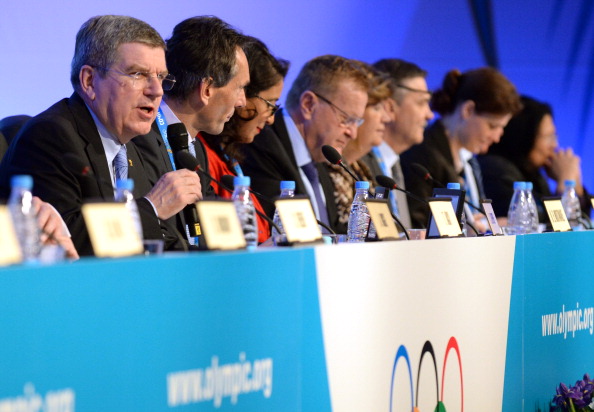
The International Olympic Committee on Wednesday announced it had established an “emergency fund” of $300,000 to benefit Ukrainian athletes, one of the most intriguing moves in recent memory. It underscores the will and decisiveness of the IOC president, Thomas Bach of Germany, and his bid — which he has made a point of repeated emphasis in these first months of his term — to stake out separately delineated spheres for what is sport and what is politics. Recall that the very first call Bach received upon his election last September was from Russian president Vladimir Putin.

It also comes as the days move steadily toward the IOC’s early July executive board meeting. There the list of 2022 bid cities will be finalized. Will Lviv, Ukraine, be among them?
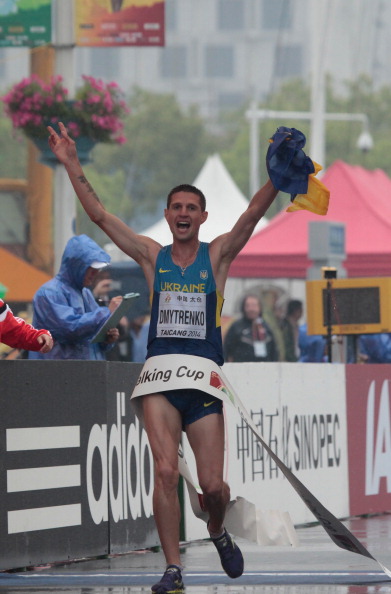
Ukraine's Ruslan Dmytrenko winning the 20km event at the IAAF World Race Walking Cup in Taicang, China // photo Getty Images

Skeptics would say that of course 300,000 reasons to keep going would be helpful — particularly when it seems apparent Almaty, Kazakhstan, and Beijing will go through, leaving the European possibilities of Lviv, Oslo and Krakow, Poland, and both Krakow and Oslo facing distinct financial or political challenges. Indeed, Krakow is up against a May 25 referendum.

In a bizarre turn early Wednesday, someone — no one knows who — sent out a “news release” declaring that Sergej Gontcharov, the head of the Lviv 2022 bid, had been fired. There was no letterhead; the sentences were awkwardly constructed and, moreover, filled with spelling and other errors; the release was quickly dismissed as a fake. A motive also remains unclear.

As difficult as it might be for the skeptics, Sergey Bubka, the IOC executive board member who is also president of the national Olympic committee of Ukraine, said the explanation for the $300,000 fund — one wholly unconnected to the bid — is simple enough.

Bach, he said, has a genuine humanity.

Recall, too, that Bubka, the 1980s and 1990s pole vault champion, was one of the other five candidates for the IOC presidency. Now read these words:

“I think, generally, the president he was himself an Olympic champion,” in fencing at the Montreal Games in 1976. “He was a great athlete.

“Through all this period,” meaning the turbulence affecting Ukraine, “in Sochi, after Sochi, we are in contact all the time. When we are in Turkey,” in April for the SportAccord convention and the IOC executive board meeting, “we had a meeting — you can see him as a human and as a president who cares. He has feelings with a heart.

“The bidding process, all these things, of course it’s important for him to have good bids, different representation from different parts of the world. But I can see he is human.”

Bubka also said, “He is a person with a heart. It is really touching.”

And: “This help is not connected in any way to the bid. I am confident. No way.”

The IOC statement announcing the fund -- from Bach himself -- started by saying he was following the “political, economic and social developments in Ukraine with the greatest attention and growing concern. Also the situation of the Ukrainian athletes, including those who have so successfully represented their country in the recent Olympic Winter Games in Sochi, which has dramatically deteriorated.”

Ukraine won two medals in Sochi, both in biathlon, gold in the women’s 4x6-kilometer relay and bronze for Vita Semerenko in the women’s 7.5km sprint. The gold was the nation’s first in two decades.

The day after they won, the four women were invited to USA House for a private reception, the Americans operating on the belief the Ukrainians perhaps had nowhere else to celebrate; the Ukrainians got a standing ovation. The Americans played that one right down the middle, of course; earlier in the Games, Putin visited USA House as well, where he mingled and took photos.

“For all these reasons,” Bach went on in the IOC statement, “I repeat my appeal of Sochi to all political leaders involved to enter into a summit dialogue in the Olympic spirit of mutual respect and peace.”

At the United Nations on April 28, Bach reiterated the main points he laid out in a speech there in November and, as he said in in Wednesday’s statement, underscored at both the opening and closing ceremonies at the Sochi Games.

This, in part, is what he said April 28 in New York:

“One of the basic principles of sport is non-discrimination for whatever reason, including political ones. Sport is the only area of human existence with a truly universal law. This universal law is based on global ethics, fair play, respect and friendship. This means for sport and sport organizations that we have to be politically neutral without being apolitical. This means for our partners that they have to respect this responsible autonomy of the sport organizations and the universal law of sport. Otherwise, international sport with its unifying, peace-building, dialogue-enforcing and respectful efforts cannot exist.”

Back to Wednesday’s statement:

“To help the Ukrainian athletes — wherever they come from in Ukraine and whatever their background — and to help mitigate their difficult situation, the IOC has established an emergency fund of $300,000.”

The money, it said, is to go through the Ukrainian Olympic committee for both training and competition.

What it means, Bubka said, is that now, as the summer season gets underway, athletes should once again be able to go to various training camps and meets. The NOC had naturally enough been funding those activities. Now the ministry’s funds for the NOC — not enough.

Ten days ago, in Taicang, China, the Ukrainian men’s race-walking team delivered a surprise 20km team victory at the IAAF World Race Walking Cup, highlighted by 28-year-old Ruslan Dmytrenko’s first-place finish, Ukraine’s first-ever individual medal at the Cup, in a national-record 1:18.37.

Igor Glavan finished seventh, in a personal-best 1:19.59; Navar Kovalenko, 10th, in 1:20.11.

Bubka, who is also an IAAF vice president, was there for the moment, and said, “What happened in China was really amazing.”

“I joined them and I saw the happiness of our athletes, our coaches, our team. This was really for our people — the history of our team, the individual success, this is really nice, to feel the team spirit and to feel society together in this particular place.”

He also said, “These last couple of months, we have emphasized that we represent all the nation. From east to west. From north to south. We are different athletes. We are different coaches. We are one team, we are united — to represent the dream.”

And: “I believe we will overcome. The most important thing is peace.”

There will be skeptics. This is an inevitable part of life. Bubka also said, referring to the IOC president, “He cares about the Olympic family of Ukraine. He cares about the movement. This is the real solidarity. We see it and we appreciate it very much. This is important help in the difficult moment of our history from President Bach.”

 

16 months for a supplement, and now?

Russian swim star and world-record holder Yulia Efimova got a 16-month ban for taking a supplement that included a banned substance. She tested positive for DHEA. That’s for sure a no-no.

Odds are, most of you have never heard of her.

Fair enough.

Yulia Efimova after winning the 50 breaststroke at last year's world championships in Barcelona // photo Getty Images

Moreover, doping cases tend to be repetitive, indeed mundane.

This one is actually interesting, and on a number of different levels.

Here’s why:

Efimova will sit out 2014 and the first two months of 2015, meaning she will likely be back in time for the 2015 world championships in Kazan, Russia, before a home crowd, and to make a run for Rio 2016. Thus she had ample incentive to get this over with.

It's another example of leniency for supplement use. Which on the one hand is entirely appropriate. Supplement use is not, for instance, the same as injecting EPO. On the other, it makes you wonder — when is the message going to get through to elite athletes that supplement use can be reckless and irresponsible?

It’s also another victory for noted lawyer Howard Jacobs of Westlake Village, California. Look, if you have a doping problem, it’s like Ghostbusters — who you gonna call? Howard Jacobs, obviously.

Efimova didn’t even bother to have the B sample tested. She didn’t contest the lab finding. She knew what she had done. Again, this was an issue of negligence and then, for the authorities, seeking to measure liability with common sense.

The three-person FINA Doping Panel ruling was dated Monday.

Efimona competes for Russia but trains at the University of Southern California.

She is now 22. She has been a first-rate swimmer since her teens. She moved to USC when she was 18. At the 2012 London Games, she won bronze in the 200-meter breaststroke. Last year, at the world championships in Barcelona, she would win the finals of both the 50 and 200 breast and set the world-record in the 50, 29.78, in the heats - a mark that Ruta Meilutyte of Lithuania then lowered in the semifinals to 29.48.

She tested positive after last year’s worlds — on Oct. 31, in an out-of-competition test.

She loses four gold medals at the European short-course championships in Denmark. She also loses two short-course world records set late last year, including one pending mark. Two of those four were individual races; two, relays.

The source of the positive was a supplement, Cellucor CLK, that she bought Sept. 16 at a GNC near where she lives in California. She said she relied on the advice she got at the GNC store, alleging that she believed “salespersons at vitamin stores in the United States were well-educated and knowledgable concerning the products they sold.”

She said she was “more inclined to question the qualifications of individuals selling supplements in Russia than in the United States.”

The level of her naiveté, frankly, borders on the breathtaking.

We are now 15 or so years after the creation of the World and U.S. Anti-Doping Agencies, and both have spent much time and energy reaching out to athletes in a bid to make clear they have to know what goes into their bodies.

And here is a world-class swim racer, indeed an Olympic medalist and world champion, relying on the advice of a clerk at a GNC?

From the decision: “Ms. Efimova testified that although she is an elite swimmer who had been through numerous doping controls and although she is aware that she is responsible for what she puts in her body, Ms. Efimova has never been given specific anti-doping education and has never been taught how to be a wise consumer of supplements, a problem her lawyer contended was compounded by the fact that her English is self-taught and by her relative unfamiliarity with the supplement market in the United States.”

How can it be she had never been given specific anti-doping education? Seriously?

Just so everyone understands the responsibilities here — though she has been training for the past four years primarily at USC, the party bearing the burden for educating her is the Russian Swimming Federation.

The panel, apparently being diplomatic, said “the fact that no anti-doping education was provided to Ms. Efimova by the RSF is disappointing and put her at a disadvantage in fulfilling her responsibility to be a savvy consumer.”

Is she alone in that regard? If not, how does that get fixed? If she is not alone, that is a significant problem, particularly since, again, next year’s worlds will be in Kazan.

A quick look at the label, as the decision noted, would have clearly shown DHEA listed as an ingredient.

As for her English-language abilities:

Efimova has been in the United States for roughly four years. Nobody is asking her to write like Faulkner. But four years? For sure she should be conversant.

Again, the level of the naiveté at issue surely must give the reasonable person pause.

At any rate, all of this is in its way prelude to what may well be the most intriguing part of the matter.

Some context:

Before moving to LA, Efimova had been coached by her father, Andrey. For the five years before that, she had been coached by Irina Vyatchanina. Efimova moved to SoCal to swim with the Trojan Swim Club, headed by coach Dave Salo.

Salo is, simply put, one of the great coaches in the world.

Here is the thing, though:

Two others, Jessica Hardy and Ous Mellouli, had positives while at USC, Hardy for a supplement, Mellouli for Adderall.

Side note: Howard Jacobs represented them both.

Now Hardy and Mellouli are both Olympic medalists and, yes, absolutely, positive role models. For sure. If you were a seventh-grade teacher, you totally would want Jessica Hardy or Ous Mellouli to come to your class and tell your kids their story of achievement.

Two other notes:

Salo had nothing to do with either positive test.

And he had nothing to do with Efimova’s positive.

In swim circles, however, there have been whispers — like, what is going on there under all that California sunshine?

That’s why perhaps this is maybe the most compelling excerpt in the entire decision, the panel devoting an entire paragraph to it, because what is more essential than someone’s reputation?

“According to Ms. Efimova, her coach at the Trojan Swim Club, David Salo, is adamantly opposed to the use of supplements of any kind. She said her coach frequently tells his swimmers that they can get all the nutrition they need through a well-balanced diet and that supplements are unnecessary.”

If you move halfway around the world … to place your trust in your coach … and your coach is one of the best … and he says don’t use supplements … and you do, anyway … it’s appropriate for the right people to stand up for the coach, in black and white, for everyone to see, when that coach is showing appropriate leadership.

So let’s everyone recognize, as the FINA Doping Panel did, too, that Dave Salo did the right thing here.

And Yulia Efimova made a mistake.

And — despite the fact that USADA, WADA and other responsible agencies — are screaming from the rooftops not to take supplements, that message is somehow not getting across fully and completely.

So, where are we, and — to quote that most famous of Russian aphorisms — what is to be done?


IOC, NBC bet big together through 2032

The subject first came up last November. This was in New York. It was over dinner at DeGrezia, a small Italian restaurant on East 50th Street that features many private rooms. The International Olympic Committee president, Thomas Bach, was in town to deliver a major political statement at the United Nations. While in New York, there was time for him — and a couple senior aides — to meet with a few top executives from the IOC’s longtime broadcast partner, NBC Universal. Thus this dinner.

NBC already held the rights to broadcast the rights to the Games in the United States through 2020. The IOC president knew this well.

What would you think, he said that evening, about the idea of a long-term partnership?

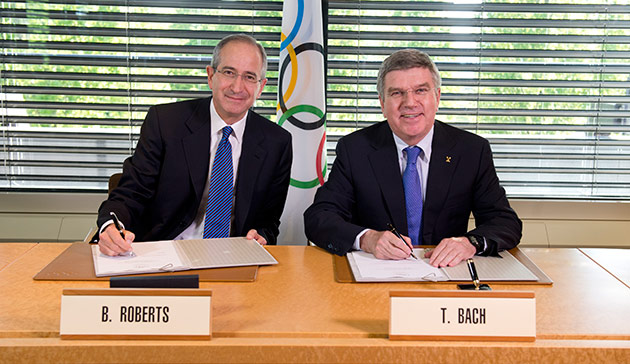
Brian L. Roberts, chairman and CEO of Comcast, and IOC president Thomas Bach, signing the $7.75 billion deal // photo courtesy IOC/Arnaud Meylan

This simple bet would launch a series of clandestine meetings — at The Olympic Club at the Sochi Games in February, and elsewhere — that culminated in Wednesday’s announcement of the $7.75 billion deal to extend NBC’s rights to the Games from 2021 through 2032.

That means six editions of the Olympics.

It is of course a financial play.

But it is so much more.

It is a fantastic triumph, professional and personal, for Bach.

It is a huge win for the entire Olympic movement, securing its financial future, in particular for the IOC and, too, for the U.S. Olympic Committee, which gets a share of the deal.

And it is a major coup for NBC, which secured the rights to the sports property that has for years, through ups and downs, given the network a consistent identity. The Olympics. no matter what, deliver ratings.

London 2012 was the most-watched television event in history, with 217 million viewers. Sochi 2014 was the “most-consumed” Winter Games ever. Even as technologies change, the Olympics drive numbers — whether in the broadcast or on emerging digital platforms — and, simply put, that’s why NBC was willing now to bet so much money into the future, the company’s executives said Wednesday.

Slightly more than half the viewers who watched Sochi 2014 on NBC also used a computer, a tablet device or a smartphone to get information about those Olympics while the TV was on, NBC has said.

It’s not just the IOC that is willing to make bets so far out into time. USA Track & Field three weeks ago announced a deal with Nike — believed to be worth about $500 million — through 2040.

And it’s not just NBC that is willing to pay big for live events.

ESPN has laid out $5.6 billion for Major League Baseball, $7.3 billion for a 12-year deal for the new college football playoff system, $15.2 billion for “Monday Night Football.”

CBS Sports and Turner Sports are paying $10.8 billion for 14 years — 2011 through 2024 — to show the NCAA men’s college basketball tournament.

Others, of course, have broadcast the Olympics — CBS, for instance, in the 1990s.

But over the years, only NBC — relying on its parent companies, first General Electric, now Comcast — has backed up its passionate commitment to the Olympics with really big money.

In two negotiations in 1995, it paid $3.5 billion for the rights to the Games from 2000 to 2008.

In 2000, for $2 billion, it bought the rights to the 2010 and 2012 Games. A GE sponsorship meant another $200 million.

In 2011, it paid $4.38 billion for 2014 through 2020.

The new deal, technically $7.65 billion for 2020-2032, includes a $100 million signing bonus to promote the Olympic movement from 2015 to 2020. Some significant chunk of that $100 million presumably will be used to help boost an Olympic channel that is now the subject of a feasibility study.

This new deal came together in a spirit evocative of the two 1995 deals — when Dick Ebersol headed NBC and Juan Antonio Samaranch the IOC, and it was all done quietly, without bids from other networks.

Here, too.

The 2011 process involved competitive bids, and for those tempted to ask why not this time, too, or to suggest that something might be amiss, there are realities that explain it elegantly.

Another thing Bach knew well is that in 2011 NBC outbid everyone else by a country mile. As a matter of fact, Fox was the only U.S. entity that even bid for four Games, the way NBC did. When NBC went big at $4.38 billion, Fox came in at $3.4 billion. ESPN opted only to bid for 2014 and 2016, and at $1.4 billion.

Accordingly, Bach knew to a certainty that in dealing with NBC he — that is, the IOC — was going to make money.

The new deal breaks down this way: $2.5 billion for 2022 and 2024. $2.55 billion for 2026 and 2028. $2.6 billion for 2030 and 2032.

On average, it represents a 15 percent increase per Games over the previous arrangement.

Really, though, that is not the deal point.

“This kind of deal is not only about money,” Bach said in a conference call with reporters.

“You know, you can maybe  — in one deal you can make one or the other dollar more and maybe have your product destroyed. We are thinking long-term in the IOC. We are here for 120 years, and we want to be there much longer. We want to leave a good legacy there to our successors.

“All these kind of strategic issues play a role. We have a responsibility. We are the trustees. We are the owners of the Olympic Games, yes, but we are the trustees of the Olympic movement. Therefore the balance has to be there between the protection of the Games, the promotion of our values and the financial consideration. There this deal reflects this consideration from our point of view in an excellent way.”

Going forward, it’s obvious — more than obvious — that this deal could in an excellent way boost the chances of a U.S. bid for the 2024 Summer Games. Indeed, Bach said Wednesday a “strong bid” from the U.S. would not only be “very much welcomed” but would be a “very strong competitor.”

To be super-obvious: if the principal broadcast partner of the IOC has put in more than $17 billion since those first deals were announced in 1995, has bankrolled the IOC with that kind of money, it will likely be made clear to everyone — particularly now that things are good again between the IOC and USOC — that the IOC would look favorably upon going to the United States, and for a Summer Games. In 2024.

Larry Probst, the USOC board chair and new IOC member, would only say Wednesday what he and Scott Blackmun, the USOC’s chief executive, have said for months — that the USOC is going through its process, and expects to have whittled down a list of potential applicant cities “sometime in the next few months.”

Los Angeles, Boston, Dallas and San Francisco are believed to be among cities under USOC scrutiny.

Other 2024 candidates from around the world are likely to include Paris but, frankly, it’s understood even in France that Paris could afford to run and lose. An American candidate would be in it to win, and win only, and there is a school of thought that announcing sooner in 2014 than later, particularly given this NBC deal, might well build up momentum that might be difficult indeed to beat.

The IOC will pick the 2024 winner in 2017.  It will pick a 2022 Winter Games site in 2015.

Bach, meanwhile, was elected president just last September, succeeding Jacques Rogge.

Since then, Bach has — at that United Nations appearance last November — outlined a clear vision for how sport and politics inhabit both separate but sometimes intertwined spheres of influence.

In February, he oversaw a Games in Sochi that — despite dire predictions from many beforehand and a $51 billion price tag — were generally an operational success.

He inherited roughly $900 million in reserves, a U.S. TV deal worth $4.38 billion and now has produced a new contract worth $7.75 billion. That means the IOC is and likely will be financially secure not only through his term, which presumably will run through 2025 but, incredibly, through 2032.

All this in but seven months since taking office.

Politically and financially, the IOC would now seem to be set for the next steps — all part of Bach’s big plan, aiming toward December and the IOC’s so-called “extraordinary session” in Monaco, when it will tackle the major issues that are part of what he has dubbed “Olympic Agenda 2020.”

In Sochi, the members floated 211 so-called “interventions” from the floor during their assembly. In Monaco, expect these major topics:

The Summer Games program; the bid process; autonomy and governance; and the structure of the IOC itself.

With this much cash now in hand, for instance, it’s plausible for the members to consider visits once again to cities bidding for the Games. If the IOC itself is paying for such visits, why not?

With this much cash in hand, for example, if the IOC is able to increase its outlay to an organizing committees for the Games to a level approaching or, better yet, over $1 million, isn’t it feasible to start considering a far more extensive use of temporary facilities? Bach has mentioned this notion many times over.

London got just over $750 million from the IOC in the 18 months ending Sept. 30, 2012, according to its March 2013 financial report. If an organizing committee got $250 or $500 million more, wouldn't that directly translate into less money spent on capital costs? Wouldn't that sensibly -- logically and easily -- be able to be explained to taxpayers, no matter where, that hundreds of thousands of dollars for a Games would be coming from the IOC, not from them?

“This is a happy day for the whole Olympic movement,” Bach said at the outset of that conference call, adding a moment later, without explanation, “We are happy for different reasons.”

You bet.

Tyson Gay, entourage and patience

We live now in such a sound-bite society. Too, we swim in a culture in which everyone wants answers, a definitive result, the end of the story — right now.

Particularly when it comes to matters involving doping and entourage.

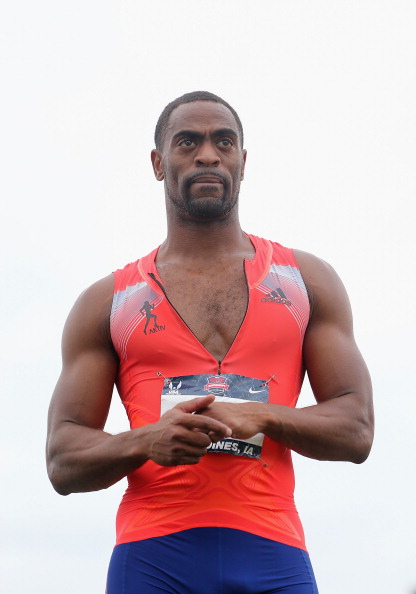
Tyson Gay after winning the 200 in 19.74 seconds at the US nationals on June 23, 2013, the day his sample was collected // photo Getty Images

Sorry, everyone. That’s not the way the real world works.

The first burst of news coverage has now come and gone involving Tyson Gay, the American record-holder in the 100-meter dash and, to be honest, almost all of it was enough to make you wonder why anyone would voluntarily come clean.

Gay’s case rightfully ought to be seen through a different lens.

It ought to be viewed as part of a larger, more comprehensive move by authorities, in particular the U.S. Anti-Doping Agency, to learn and then use what an athlete knows to try to break the circle of doping — by going after, if applicable, coaches, trainers, managers, agents, doctors, other athletes, whoever.

In this case the athlete happened to be one of the biggest names in the biggest sport in the Olympic movement.

As Gay said when he was first busted, “I basically put my trust in someone and I was let down.”

David Epstein, in a story co-published with ProPublica and Sports Illustrated, has reported that Gay tested positive — he failed three tests — for a steroid or steroid precursor believed to have come from a cream given to him by Atlanta chiropractor and “anti-aging specialist” Clayton Gibson III.

But — assuming all that is true, and Epstein has consistently proven a first-rate reporter — Gay didn’t just pick up the phone and call Gibson. There’s way more to the story. That’s what Gay has now told USADA: everything else.

The USADA news release notes, in the specific language of the World Anti-Doping Code, that Gay provided “substantial assistance.”

The way USADA works, you can be sure there were multiple meetings. There were documents. There were products.

We will learn about all the rest of those connections. Be sure there are those who have traveled in track and field circles — and perhaps not just in the United States — who ought to be plenty anxious.

Draw your own conclusions but, typically, in these sorts of things government authorities know now what’s what. Obviously, these agencies never announce who they might be inquiring about, or what timetables might be at issue.

To get through all of this takes time. It  takes process.

What we got, instead, were headlines like these:

Bleacher Report, atop a Bleacher-written story: “Tyson Gay Suspended for 1 Year Following Failed Drug Test”

Huffington Post, atop an Associated Press account: “U.S. Sprinter Tyson Gay Returns 2012 Olympic Medal After Positive Drug Test”

Both these headlines: factually correct.

The headlines, and the accompanying stories, totally glossed over the larger, and more relevant — the more important — point.

Why was Tyson Gay only getting one year?

A standard doping ban is two years, at least through the end of 2014, until the new World Anti-Doping Agency rules take effect and a standard ban goes up to four.

Gay got half that two. He got one.

Frankly, the news coverage — and the response it provoked on social media — did Gay, USADA and, now, WADA, the IAAF and the International Olympic Committee a disservice.

Because now the entire case is politically charged, and for what?

We get swimmers like Britain’s Michael Jamieson, who won a silver medal in the men’s 200-meter breaststroke in London in 2012, tweeting,

Mr. Jamieson — to deconstruct, sir, picking up with the word "National":

The entire point of the USADA and WADA system, just as it is your country, is to take governing bodies such as USA Track & Field out of the process. USATF had nothing — repeat, nothing — to do with any part of this investigation or the one-year ban.

As for that next sentence, you are absolutely entitled to your opinion. And that opinion is ridiculous. To ask the obvious: what first-hand knowledge of Mr. Gay’s case did you have before rendering that judgment?

The reason to ask is that the Daily Mail, the English newspaper, cited you in the story as part of what it called a "furious backlash from athletes" in the headline. The story also went on to quote Sebastian Coe, the London 2012 chair who is a leading candidate to become the next president of the IAAF, track and field’s governing body: “There has to be confidence that the athletes on the track know they will be treated in exactly the same way, and spectators must have complete confidence in knowing what they are watching is legitimate.”

Actually, for sure spectators must have complete confidence in knowing what they are watching is legitimate. That, to be frank, is track and field’s ongoing credibility problem, as absolutely Lord Coe knows well.

But there is no justification for treating everyone the same way. None whatsoever. The rules now allow that if you provide “substantial assistance,” you get a break, plain and simple, as Lord Coe surely knows as well.

What we may now see is Gay’s case appealed. In such cases, the Swiss-based Court of Arbitration for Sport gets the final word. Which means time and money. If that happens, what justice is being served?

Is Gay well-served? USADA? Who, exactly?

It’s ironic, really. In the Lance Armstrong case, USADA is accused of being the ultimate witch-hunter. Here Gay gets a year, and USADA is accused of being too lenient. What, it’s damned if it does and damned if it doesn’t?

This is precisely the crux of the problem with the sound-bite, rush-to-judgment nature of where we are.

Now we get comparisons between Gay’s 12 months and the 18 months Jamaican sprinter Asafa Powell — another big name — got for a supplement with a banned stimulant. (Query: did Powell provide "substantial assistance"? The answer is obvious.)

Yes, for sure, as a corollary matter, it’s interesting and intriguing to try to figure out whether the others on that 2012 U.S silver medal-winning relay team will get to keep their medals — but this is an issue on which the IOC and CAS have gone different ways, given individual fact patterns, in recent years.

It’s a further irony that Justin Gatlin ran on that relay, and he, too, has served a doping ban.

But, again, that’s not the central point.

The key element in the USADA news release, as well as the increased big-picture focus in the anti-doping campaign, is the focus now on the entourage.

Indeed, a new feature of the Code, taking effect at the start of 2015 — just to show how determined WADA is about trying to shake things up — makes it an anti-doping violation for an athlete to associate with an “athlete support person” if the athlete has been formally warned specifically not to do so.

WADA and other anti-doping authorities have learned that athletes typically don’t just go online and order up a mess of steroids; or sketch out a calendar with cycles for usage of substance A, B or C; or intuitively know how to stack steroids X, Y or Z with EPO. These things take money and expertise.

To borrow from the saying: it takes a village. Many successful athletes have a kind of “village” around them. What 15 or so years of the WADA-focused anti-doping campaign has taught is that it is not enough to just go after the athlete, him or herself. You have to disrupt the enablers in that “village” as well, or the status is likely to remain quo.

Back to last Friday’s release: “For providing substantial assistance to USADA; Gay was eligible for up to a three-quarter reduction of the otherwise applicable two-year sanction under the Code (or a six-month suspension).”

Again, Gay’s time could have been cut down to just six months from two years. He got a full year. Does that sound like total leniency?

Just so everyone understands: had this case come up next year, given the WADA Code that goes into effect this coming Jan. 1, given the “substantial assistance” Gay provided, he might well have walked away with no time.

So — here is the deal, literally and figuratively:

Tyson Gay decided to cooperate. Because of that, all athletes, and for that matter, everyone with an interest in clean sport, got a two-for-one. He gave back his unclean medal from London. And now USADA — and, presumably, others — get to go after the entourage.

Gay's one-year period of ineligibility runs for a year from June 23, 2013, the day his sample was collected at the USA outdoor nationals. Obviously he passed whatever tests there were in London, or we would have known about it; USADA had no evidence of his misconduct from July 15, 2012, the date the release says he first used a product that contained a prohibited substance, until he came forward.

For those who prefer:

One way of looking at his ban -- now that he has voluntarily given back his London 2012 medals -- is that it is in effect like two years, from July, 2012, through June, 2014. He didn't just give back that relay medal; he also forfeited all medals, points and prizes from July 15, 2012, forward. Don't forget that at those same USA 2013 nationals Gay ran a 9.75 100.

Gay said in an interview Saturday with his hometown paper, the Lexington, Ky., Herald-Leader, “There’s a lot for me to tell, my side …”

In time we will all hear it.

Everyone just be patient. Sometimes — a lot of times, actually — that’s the way the real world works.


The IOC's big bid problem

One of two Norwegian government parties voted Sunday against supporting Oslo’s bid for the 2022 Winter Games, Associated Press reported, in a three-paragraph story likely to be buried in the back pages of newspapers and de-emphasized by analytics monkeys at websites around the world. It’s 2014. It’s eight years until 2022. The International Olympic Committee isn’t even going to vote for the 2022 city until next year. Who could possibly care?

Everyone should care.

IOC president Thomas Bach leading the session in Sochi two days before the start of the 2014 Games // photo Getty Images

To put it another way — if you have even the most remote interest in the ongoing vitality of the Olympic movement, you should care.

To put it yet another way — the IOC has an enormous problem on its hands.

One notion here is to use the connotatively more neutral word “challenge” — as in,  the IOC has had a huge challenge for the last few bid cycles, and in particular Winter Games bid cycles, attracting enough interested and qualified cities.

Let’s be real, and the language has to reflect that reality.

The IOC has an enormous problem.

This big problem is of its doing, and is many, many years in the making.

The problem is complex.

It is various parts finance, governance, perception and (lack of, by the IOC) communication — with cities, states and nations saying the Games have become way, way, way too expensive; or they don’t like or don’t trust the IOC; or both.

Indeed, a 2008 survey by the British think tank One World Trust found that when looking at 30 corporations, inter-governmental agencies and non-governmental organizations, the IOC ranked 30th in what it called “accountability indicators,” suggesting it was the least accountable and transparent.

Ahead of the IOC on this ranking were such institutions as the International Atomic Energy Agency (29), NATO (28), Halliburton (26), Goldman Sachs (20) and Royal Dutch Shell (12).

In South Korea last Monday, at a good governance forum sponsored by the International Sport Cooperation Center, a Seoul National University professor, Min-Gyo Koo, reminded the audience of that survey, which in Olympic circles strangely has gotten little attention.

One of the panelists at the conference, Anita DeFrantz of the United States, now on the IOC executive board, a member since 1986, told the audience, “I cannot accept that we were behind Halliburton and Shell. That is not acceptable.”

Another panelist, Ivan Dibos of Peru, an IOC member since 1982, said, “”That No. 30 ranking could be looked at positively or negatively,” adding a moment later, “I take it as something positive and I rather prefer it that way.”

In the IOC’s defense, Koo said, at least the IOC made the top 30. Soccer governing body FIFA, he observed, didn’t.

This, then, is what it has come to — at least the IOC is on the list.

What it should be is this, as Koo also pointed out, the new IOC president, Thomas Bach, reminding one and all last December, albeit in the context of a dispute involving India’s national Olympic committee, “It’s about the principles … good governance for the IOC is a key issue. We need to be strict and to make sure the rules of good governance are applied.”

Governance is not sexy. But it is essential. And this should be a key focus of the IOC’s “Olympic Agenda 2020” process now working its way toward Monaco and the extraordinary session in December.

So should PR. The members of the IOC know it is a pass-through that keeps some percent of the money it takes in. Can they all say immediately what percent, to refute the perception the IOC is not some avaricious money-sucking beast? (It keeps roughly 10 percent, perhaps a touch less.) How many know the quadrennial Solidarity budget, which sends dollars back to developing countries for athlete development? (It’s $438 million for 2013-16.)

The same goes for finance — and the issue of how much the Games should cost.

The Sochi Games were, in hindsight, a success — but.

The $51 billion price tag for those Games is, in significant measure, its primary legacy, at least when it comes to the next couple bid cycles.

It does not matter — again and for emphasis, it does not matter one bit — whether that figure is true or not.

That is the number that is out there, and so that is the number everyone around the world believes.

It also does not matter — again, it simply does not matter — that the Games’ organizing budget was roughly a couple billion dollars and the rest went toward infrastructure.

The general public does not understand the difference between operating and infrastructure budgets. They don’t want to hear it. It’s all just money.

After the collapse of the Soviet Union, Russia had no winter sports facilities. Russia bid for the Games, and won. To get the job done, the Russians had to start from nothing. The short story of Sochi 2014 is that the Russians built two new cities, Adler and Krasnaya Polyana, from scratch.

That cost $51 billion.

The $51 billion question: who besides Russia has that kind of money?

China does. The 2008 Summer Games in Beijing purportedly cost roughly $40 billion.

This, then, is the problem.

Who in the world besides Russia or China has $40 or $51 billion just lying around? For a sports event that lasts 17 days -- even if, as the IOC consistently says, and virtually no one hears, most of that money is going toward roads, airports, metro lines, that kind of thing?

Big money. Big issues. Big problem.

It for sure does not help that Rio for 2016 is a hot mess.

Rio, too, is way, way, way over the initial infrastructure projections.

And despite the backtracking that IOC vice president John Coates engaged in after his initial comments last week — he’s now saying that, sure, Rio can “indeed deliver excellent Games” — it’s worth noting that in law school, they teach you in evidence class to pay attention to what people say when their message isn’t at risk for being shaped.

Coates, being an excellent lawyer, would surely know this.

What he said initially, of course, was that preparations for Rio — which he has visited six times as part of the IOC’s inspection team — were the “worst I have ever experienced.”

Sochi and Rio are the triggers.

The big problem facing the IOC, however, has been simmering for a long, long time. It is now finding increasing expression not just in Oslo but across western Europe, the IOC’s once and forever soul, which makes it all the more problematic.

In February, 2012, Rome withdrew from the 2020 campaign, the then-premier, Mario Monti, saying that a projected $12.5 billion was too much. Rome put on the 1960 Games.

In the afterglow of a European Summer Games in 2012, in London, arguably the best-ever Summer Olympics, voters in four -- and, now, maybe five -- separate countries have shot down Games bids:

In March, 2013, voters in Switzerland ended a 2022 bid for St. Moritz and Davos. St. Moritz staged the Winter Games in 1928 and 1948.

A few days later, voters in Austria rejected a Vienna 2028 plan. Innsbruck put on the 2012 Winter Youth Games; it staged the 1976 and 1964 Winter Games. And Salzburg bid for the 2014 and 2010 Winter Games.

Last November, balloting in Germany killed a Munich 2022 bid.

Munich would have been the presumptive 2022 favorite. The city played host to the 1972 Summer Games; it had bid for and lost (to Pyeongchang) for 2018; Garmisch-Partenkirchen, about an hour south, had staged the 1936 Winter Games.

Ludwig Hartmann, a Greens Party lawmaker and a leader of the movement, called “NOlympia,” that led the opposition to the plan, said, “The vote is not a signal against the sport but against the non-transparency and the greed for profit of the IOC.”

Meanwhile, a leading German newspaper, Süddeutschen Zeitung, had run a column comparing the IOC to the mafia and the “North Korean regime.”

This past January, Stockholm pulled the plug on a 2022 bid, the City Council saying the project was too expensive. Stockholm staged the 1912 Summer Games.

Now, Oslo.

Nearby Lillehammer staged the 1994 Winter Games, lauded by many as the best-ever. And Oslo itself put on the 1952 Winter Games.

The global economic situation has already affected the 2024 Summer Games race, too: Mexico City, Toronto and two Russian cities, Kazan and St. Petersburg, have already pulled back for a variety of finance-related reasons.

This is not just an Olympic Games problem. This is an Olympic movement problem. Last month, Hanoi dropped out of staging the 2019 Asian Games, the once-every-four-years event attracting thousands of athletes, citing financial concerns.

In theory, there are five applicants still in the 2022 Winter Games contest: Oslo; Beijing; Almaty, Kazakhstan; Lviv, Ukraine; and Krakow, Poland.

Polish voters are due to vote later this month about the Krakow bid. Polls suggest a difficult situation.

Lviv is in western Ukraine; the eastern sector of that country is being ripped by armed conflict and the fate of the bid is highly uncertain.

That might leaves only three for 2022. Or would it be two?

AP reported the Progress Party vote Sunday against supporting Oslo’s bid is “likely” to put the city out of the race. In Norway, the Conservative and Progress parties rule in a coalition government; Progress Party members said the Games would affect the government’s ability to fund infrastructure projects, education, health care and tax cuts.

For 2018, the IOC managed only three Winter Games candidates: Pyeongchang, Munich and Annecy, France. And in the end, Annecy managed only seven votes.

For 2014, the IOC deemed only three bids worthwhile enough to pass along for a vote: Sochi, Pyeongchang and Salzburg, Austria.

The Oslo bid’s immediate future depends perhaps on whether it can still get the government to underwrite the needed financial guarantees, and whether those guarantees can be offered before the IOC’s July 8-9 executive board meeting. That’s when the 2022 list will be cut to the finalists — the cities that will actually go to a vote in July, 2015.

The IOC — and let’s also be clear about this — has a huge interest in seeing Oslo stay in the race. If the Polish referendum goes badly and if the situation in Ukraine continues to deteriorate, Oslo would be it for Europe for 2022.

For now, though, there’s this, from Atle Simonsen, the head of the youth wing of the Progress Party, speaking to Norwegian public broadcaster NRK: “Believing that the Oslo Olympics would cost under 50 billion kroner,” about $8.4 billion, ”is like believing in Santa Claus, when the Sochi Olympics cost 500 billion.”


Phelps having fun, and it's all good

Thirty years ago, amid the delivery of the Los Angeles 1984 Olympic Games, which proved a huge success, Peter Ueberroth reminded the world of a classic strategy. It works in business. It works in sports. Really, it’s the best strategy for pretty much everything. You under-promise and then you over-deliver.

This is what Michael Phelps and his longtime coach and mentor, Bob Bowman, are doing now in these very first days of the comeback story likely to dominate every swimming story between now and the Rio Summer 2016 Olympic Games.

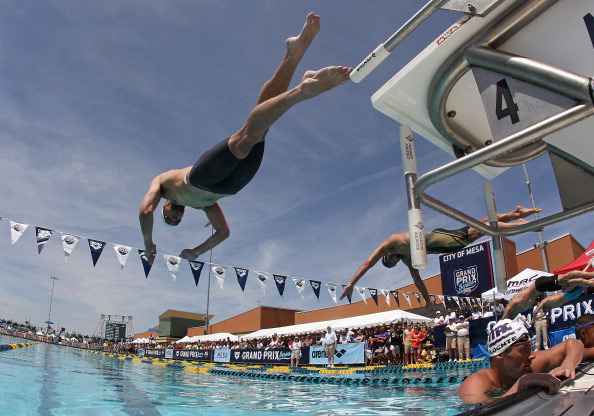
Michael Phelps diving in for his first race back -- over Ryan Lochte, who would go on to win the 100 fly final later Thursday night // photo Getty Images

Michael’s goals? Fun, man. Just here to have fun. 2016? Whatever. Not thinking that far ahead. Just taking it one step at a time. We’ll get there when we get there.

It’s completely shrewd, sophisticated and dazzling in its brilliance.

After years of chasing hard goals — eight-for-eight golds in Beijing, the gymnast Larisa Latynina’s record of 18 overall medals in London — there’s nothing left for Phelps to prove to anyone. He is The Man, and has absolutely, unequivocally earned the right to do this on his own terms.

The thing is, it’s also true.

Enough.

Because, for sure, Phelps has goals. He always has goals.

As he said Wednesday at a news conference, “I always have goals and things that I want to achieve and I have things that I want to achieve now. Bob and I can do anything that we put our minds to.”

Because, for real, Phelps and Bowman assuredly have not through every detail of what the master plan is to get to and through Rio. No way, no how.

Why?

Because it’s April 2014 and they don’t have to.

All Phelps — and Bowman— have to do, right now, is enough to keep the train moving.

Which, as Phelps proved Thursday in sun-blinded Mesa, Arizona, is plenty good enough.

In his first race back after 628 days away, since his butterfly leg in the gold medal-winning leg in the 4x100 medley relay at London 2012 Games, Phelps was put in the last of the 14 heats in the 100 fly.

Phelps watched as rival Ryan Lochte, in Heat 13, went 52.94.

Lochte swam in Lane 4. Phelps drew Lane 4, too. The two of them yukked it up about something as Phelps stepped on the blocks — maybe the absurdity of a jillion cameras recording every move Phelps was making while Lochte, still in the water below, got to watch while Phelps dove over him as Heat 14 got underway.

All Phelps did in Heat 14 was throw down a 52.84, the morning’s fastest time.

Yeah. He was back.

“I felt like a kid, you know, being able to race again and be back at a meet,” Phelps told longtime friend Rowdy Gaines, the 1984 Olympic champion in Mesa working television for Universal Sports.

“I literally felt like a 10-year-old kid, just enjoying it,” Phelps said, which is great, except that the next time a 10-year-old kid throws a 52.8 in the 100 fly please call USA Swimming because that kid needs to be in the Olympics immediately.

The only thing that didn’t go according to script: Phelps usually lags behind the field in the first 50 meters, often making the turn in seventh place. On Thursday morning, he was second. He split the first 50 in 25.15 seconds, the second in 27.69.

All you doubters? Haters? Come on. This is Phelps. He is one of the most competitive human beings ever to inhabit Planet Earth. Did you think he was somehow going to forget how to race?

Especially in the 100 fly, the event in which he is the three-time Olympic champion as well as the world and American record-holder.

This is what Phelps does, and better than anyone, and especially in the butterfly — which is what he is likely to concentrate on going forward.

Do you think — just riffing here — that he would want to try going forward to make amends for the 200 fly in London, a race he seemingly had won but then glided at the end when he shouldn’t have, and South Africa’s Chad le Clos stole by five-hundredths of a second?

Wouldn’t that — just being logical — be a “goal and thing … to achieve now”?

The 200 fly is the Phelps family race; older sister, Whitney, came into the 1996 U.S. Trials in Indianapolis with the best time in the country in the event, and younger brother Michael is a two-time Olympic champion, one of those wins, in Beijing, a then-world record 1:52.03, set with his goggles filled with water.

As amazing as the eight-for-eight is, and it is, the 100 fly three-peat —which by comparison bizarrely gets almost no love — is a profound accomplishment, because that race is so short and in it anything — as the 2008 final, won by one-hundredth of a second, proves — can happen.

Now that 200 fly three-peat is still out there.

Of course, no decisions have been made, or at least announced publicly. It’s possible the 200 individual medley might yet appear on the agenda, too. Or the 100 free. Who knows? Again, and for emphasis: it’s very early.

The prelim set Phelps and Lochte up for Thursday night’s 100 fly final.

Lochte had himself a way busier evening than Phelps. He first swam the 100 free, finishing fourth, in 49.68, behind 2012 Olympic gold medalist Nathan Adrian’s 48.23.

Adrian’s 48.23 will get lost in the swirl but it shouldn’t. It’s the start of the American season and it’s already the third-best time in the world in 2014 — two Australians, James Magnussen, 47.59, and Cameron McEvoy, 47.65, have gone faster, and the Aussies have already had their national championships.

Adrian won by more than a second; South Africa’s Roland Schoeman finished second, in 49.39.

Another race destined to get missed by all but the most hardy swim geeks — about a half-hour after that 100 free, Katie Ledecky swam the women’s 400 free in 4:03.84, which equaled the world’s best time in 2014. Afterward, she wasn’t even breathing hard.

Lochte got done with the 100 free at 5:11 p.m. local time.

The men’s 100 fly started an hour later.

Once again, at the turn, Phelps — in Lane 4 — was second, in 24.76.

This time, Lochte — in Lane 5 — was first, in 24.64.

The Phelps M.O. over the years has been to pour it on in the back half. Lochte knows this.

In Phelps' first competitive final of 2014, it wasn’t there. Lochte held Phelps off, winning in 51.93. Phelps touched second, in 52.13.

Give Lochte credit. That 51.93 was the second-best time in the world in 2014. Only Takuro Fujii, with a 51.84 at the Japanese nationals, has gone faster.

Phelps, meanwhile, with 52.13, is tied for fourth-best in 2014. Already.

“Down there at the turn, I kind of peeked over, I saw him, and I almost started smiling,” Lochte said in a poolside interview with Gaines that was broadcast live over the PA system in Mesa as well.

“Why? Because you were winning? Because you were ahead?” Phelps said, and everyone laughed.

Gaines, turning to Phelps, asked, what now?

“I’m my hardest critic,” Phelps said, “so I know what I can do there. But, like I have been saying this whole time, I am having fun. I really do mean that. There’s nothing like coming here, swimming before a packed stands — they’re cheering us on, helping us get through the race.

“Obviously, being back in the water with Ryan, it’s always fun when we race. Neither one of us wants to lose to each other. But that’s what makes us faster and faster each time.”

The interview actually began with Gaines asking Lochte if he had noticed anything different about swimming Thursday in Mesa — what with, you know, Phelps back.

Lochte laughed. He said, “I mean, especially this morning, seeing all these cameras, right before I’m about to race — I’m like, ‘Thanks, Michael.’ “

Phelps is back. Lochte, too, from that freaky knee injury.

Jeah, dudes.

For U.S. swimming, it’s all good.


Phelps is back, and why not

A great many people are desperately afraid in this life of failure. Being afraid does only one thing. It holds you back.

Michael Phelps is not, has never been, afraid of failure. He has the courage to dream big dreams -- dreams without limits, without worries about what might happen if they don't come true. 

Michael Phelps in the pool Wednesday in Mesa, Arizona // photo Getty Images

Phelps is indisputably the greatest swimmer of all time. There can be no argument. As he steps on the blocks Thursday at the Mesa Grand Prix, having said at the London 2012 Olympics that he was done swimming competitively but now having changed his mind, the natural question is, why, and the one that goes with it for so many is, but isn’t he afraid of damaging his reputation?

The second one first: no.

For Michael Phelps, this is absolutely opportunity, and nothing but.

This is, in plain speech, what sets greatness apart.

Maybe Phelps won’t win every race between now and the close of the 2016 Rio Games.

Strike that. It’s guaranteed that he won’t, starting with the series this weekend in Arizona.

So what?

It does not matter.

For Phelps, what matters is the opportunity to test himself, to see how good he can be.

As he said Wednesday at a news conference, “I’m doing this for me," adding a moment later, "I am looking forward to wherever this road takes me."

Phelps has never — again, never ever never — said, “I want to win x medals.”

He has always said his goals are to grow the sport of swimming and to be the very best he can be.

His impact is broad and deep:

-- The caliber of athletes in the sport is so much better. Guys coming into college are now swimming the 200 freestyle roughly two seconds faster than they did even just a few years ago. Why? Because they watched Phelps swim, whether in 2004 in Athens or 2008 in Beijing, and said to their parents, that guy is awesome and I want to be like that.

-- The U.S. team has its leader back. As great as Missy Franklin or Katie Ledecky are, and they are, and as fantastic an athlete as Ryan Lochte is, and he is, Phelps is incomparable. He makes everyone better.

Why?

This is a guy who loves to race. He loves to win. He hates to lose.

So why, after proving without a shadow of a doubt — 22 Olympic medals, 18 of them gold — is he back once more to see how good he can be?

Wrong question.

It’s not why,

It’s why not?

Phelps is 28. He turns 29 in July.

When he was in his early teens, just getting started with his coach and mentor Bob Bowman, Phelps would do what Bowman told him to do because, well, Bowman told him to do it. In Athens in 2004, when he won eight medals, six gold, same. In 2008 in Beijing, when they hatched the plan that led to the eight-for-eight gold, same.

By the 2011 world championships in Shanghai, that didn’t work so much anymore. Phelps had already achieved the unthinkable in Beijing; in Shanghai, he acknowledged he needed to find motivation.

In short, that’s what Phelps said by the end of the Games in London; he didn’t have the same motivation.

Though elemental, this is essential to understand: swimming is hard work, arguably the hardest Olympic sport there is, because it is often decided by hundredths of a second and it reveals, truly reveals, whether you have put in the work. That’s what Phelps learned in Shanghai. He hadn’t done the work and at that meet Lochte owned him.

By London, Phelps had done the work in every race but -- as the results emphatically showed -- the 400 individual medley. Indeed, that race proves the point. Phelps swam it because he wanted the test, caring not at all about the prospect of "failure," if fourth place at the Olympics is "failure." The instant know-it-all critics who started braying that Phelps might be done? It was his first final of the Games and, as he said immediately afterward, "It was just a crappy race." He would go on to win six medals.

Michael Phelps at the 2012 London Olympics // photo Getty Images

After London? Time to take time off.

Now?

The intense competitive drive that makes Phelps who he is has not gone away. It never did. As if. Phelps has a lot of guys who want to hang out with him. That doesn’t fill him up. That might be good for a weekend, or a week.

Golf? For fun — sure. As an everyday thing? Come on.

Let’s get one thing perfectly straight, and for all time: Phelps is super-smart and, for that matter, multitasks as well as any CEO. He is not, nearing 29, going to go to college; when he was training in Michigan before the 2008 Games, he was not working toward a four-year degree (though he is a big Maize and Blue fan).

Swimming, from the time he was little, not only provided Phelps with structure. Fundamentally, it gave him purpose.

Again —for Phelps, swimming was the ultimate provider of structure in his world. Then and now, it provides him a base of friends. Too, it offers a coach and staff with guidance.

The realization Phelps doubtlessly has arrived at now, in 2014, is that he isn’t coming to Bowman and the North Baltimore Aquatic Club because he has to.

He wants to.

That makes all the difference.

Phelps said Wednesday he weighed 187 pounds in 2012 in London. Afterward, he allowed himself to get to 225. Now he's at 194.

Bowman has assembled at the club a world-class roster that includes the likes of French sprinter Yannick Agnel; American sprinter Conor Dwyer; Tunisian long-distance ace Ous Mellouli; and more.

If you know Phelps, however, you know that for him now training has to be more fun than less. And for him the person who most often makes training fun is Allison Schmitt, who is, among other things, the London 2012 women’s 200-meter gold medalist.

Schmitt, who moved to Baltimore last year after finishing up at the University of Georgia, is making something of a comeback herself. She had a crummy nationals and — to everyone’s shock — missed making the U.S. team that swam at the 2013 world championships in Barcelona.

Phelps and Schmitt have always had something of a brother-sister relationship. They make each other laugh. He’s good for her. She’s good for him.

"I can't say it enough," he said Wednesday. "I am having fun."

As for those 2013 worlds — it was there, in Barcelona, that it became evident to everyone who knows swimming that Phelps would be back.

The only question was when.

The U.S. men’s 4x100 freestyle relay team lost to the French — with Agnel. Having Phelps sure would have helped. He was in the stands that day, texting Bowman, the U.S. men’s 2013 coach, critiques of the race. Phelps takes enormous pride in team and country, and he wants the American men to own that relay.

Phelps also surely would have noticed that Chad le Clos of South Africa won the 100-meter butterfly in 51.08 seconds, the 200 fly in 1:54.32. When he has put in the work, Phelps swims faster than those times.

Le Clos isn’t swimming in Arizona — though there are, in total, 27 Olympic medalists from seven countries who between them have 97 medals, 51 gold, registered to swim in Mesa.

Lochte — and it must be acknowledged he is an extraordinary talent, with 11 Olympic medals, five gold — is on the start lists.

Giving credit where it is due, Lochte did his thing in the 400 IM in London. Phelps might well be done— as the Mesa Grand Prix proves, never say never — with that event. That said, both guys have traditionally duked it out in the 200 IM and if this weekend and for the foreseeable future Phelps swims even shorter events, so be it. He said Wednesday he would be scratching the 100 free in Mesa but would be swimming the 100 fly -- hardly a surprise.

But Phelps knows one other thing, too, and Lochte knows it as well, looking ahead — way ahead — to Rio:

At the Olympic Games, the 200 IM traditionally comes just minutes, literally minutes, after the 200 backstroke. Lochte swims the 200 back. Phelps does not. The 200 back is a killer. It leaves the legs feeling like wood. It is a testament to Lochte’s will that he even tries the double.

Always, always, always remember this about Michael Phelps:

He loves to race. He loves to win. He hates to lose.


"Thank you, Meb"

Meb Keflezghi’s victory Monday at the Boston Marathon, so poignant, so soulful, proved an epic reminder of why sports matter. He is the first American man to win the race since 1983.

Keflezighi, who turns 39 in a couple weeks, is the oldest Boston Marathon winner since at least 1930.

Meb Keflezighi celebrates after winning the Boston Marathon // photo Getty Images

His win, in 2:08.37, marked a soaring triumph of the human spirit — a year after the bombings that killed three people and wounded hundreds. Keflezighi ran with the names of the dead — a fourth, a police officer killed in the manhunt that ensued after the bombings — written on his bib, which read, simply, “Meb.”

Officials estimated that perhaps a million people turned out for the 2014 Boston Marathon, to cheer on the 36,000 runners, 9,000 more than usual.

To say that Keflezighi was not expected to win would be an understatement. After all, he had finished only 23rd at last year’s New York Marathon. Fifteen guys had faster personal-best times than Keflezighi going into Boston 2014.

Keflezighi is, of course, the 2004 Olympic silver medalist and the 2009 New York marathon champ. But he is no longer running in Nikes, having lost that sponsorship  — thought to be too old and too slow. Instead, he was kicking Monday in red-and-silver flyers from Skechers, the Manhattan Beach, California-based company better known for skateboard shoes.

Too old and too slow proved tactically brilliant Monday.

He went out in a two-man pack — everybody else let them go — with Josphat Boit. At Mile 16, Keflezighi made his move, running that split in 4:39, opening up a big gap. He said afterward he had to fight off a stomach bug about Mile 22. He then found the strength to keep ahead of Kenyans Wilson Chebet, the two-time Amsterdam Marathon champion, and Franklin Chepkwony, the 2012 Zurich Marathon winner.

Chebet finished in 2:08.48, Chepkwony two seconds behind that.

“Going through the last two miles, it was a challenge, it was difficult,” Keflezighi said at a news conference, adding a moment later, “Sometimes you just have to run and dig deep.”

The debate can begin now about where Keflezighi stands now in the ranks of American marathoners. Frank Shorter? Bill Rodgers? Alberto Salazar?

Keflezighi's 2004 silver made him the first U.S. man to win an Olympic marathon medal since Shorter, who won gold in 1972 and silver in 1976.  When Keflezighi won in New York in 2009? That made him the first U.S. man to win there since 1982.

For sure, this much  has to be acknowledged: Keflezighi has had to compete in an era when the East Africans have been in their ascendancy. What he has done — Olympic silver, New York and, now, Boston, and Boston in 2014 with all the symbolism — deserves appropriate recognition, and especially from anyone with any connection to the hardest thing that will forever define the distinct culture that is the marathon:

Putting on your shoes — red-and-silver, whatever — and stepping out the door.

Too old, too slow, can't do it -- all of that got beat back Monday. That is the essence of the marathon. And, in a very real way, it is the essence, too, of sports.

It's why he ran, and so many of thousands of others did, too.

“What he has accomplished should be a source of pride for all Americans,” Max Siegel, the chief executive officer of USA Track & Field, said in a statement that captured the moment.

“Since 2004, Meb has set the standard for what American marathoners can achieve. With everything that was at stake at the 2014 Boston Marathon, this must rank as one of the greatest American marathon performances in history.

“Thank you, Meb.”


USATF, Nike in apparent $500 million deal

USA Track & Field on Tuesday announced a groundbreaking 23-year deal with Nike apparently worth $500 million, an arrangement that holds the potential to transform the leading sport of the Olympic movement in untold ways in the United States for a generation. The Nike deal comes 13 days after USATF announced a seven-year partnership with Hershey, the chocolate maker. In February, 2013, USATF announced Neustar, the administrator of the .US top-level domain, as the three-year sponsor of its national road-racing championships.

Two more significant deals are expected to be announced next week.

Olympics Day 14 - Athletics

“We are a more robust organization and, frankly, it is creating a lot of positive momentum for people who want to engage with us,” USATF chief executive Max Siegel said, adding of the Nike arrangement that while the Oregon company is “a significant part of our funding, it is one sponsor.”

Neither USATF nor Beaverton, Ore.-based Nike would disclose the financial details of the arrangement, which runs from 2017 through 2040. It is believed, however, to be at least double USATF’s current annual financial and in-kind support from Nike. Based on USATF financial documents and past media reports, that would put it in the $17-20 million dollar range annually.

“Nike was founded as a running company, and our passion for track and field is at the core of our DNA,” Mark Parker, the company’s chief executive and president, said in a statement, adding, “We have been a longstanding partner of USATF since 1991 and are extremely proud to extend our partnership and commitment to the sport.”

Half a billion dollars is the kind of money that might regularly fly around the NFL, NBA or Major League Baseball.

In Olympic sport in the United States, not so much — and particularly in track and field, bedeviled in recent years by virtually every manner of issue, challenge, problem, crisis, whatever imaginable, everything from rules imbroglios to political turf wars to governance matters to repeated doping scandals.

Despite it all, Team USA keeps racking up medals: 29 at the London 2012 Games, testament to the world’s best grass-roots, high school and college programs.

Because it's USATF, and it has such history, there is the easy temptation to wonder what's the catch in a deal of this magnitude.

For sure, the deal will likely result in more pressure for more track and field events in Oregon. On Tuesday, for instance, the IAAF, track and field’s international governing body announced that Eugene, along with Barcelona and Doha, Qatar, were candidates for the 2019 world championships; the IAAF will decide in November. The world championships, which date to 1983, have never been staged in the United States.

Will Nike be just “one sponsor”? It has provided USATF uniforms for the last six editions of the Summer Games. It is the driver behind the Oregon Project, the group founded more than a dozen years ago to promote distance running — where Alberto Salazar directs the likes of Mo Farah, Galen Rupp, Jordan Hasay, Shannon Rowbury and, now, Mary Cain.

Nike assuredly doesn’t do deals unless it has run the financial analysis and figures it makes sense, or more. Nike surely considered the present value of some $20 million annually, and the 2040 value of those dollars.

Then again, there’s this:  in a deal, it’s always good — for everyone — to find certainty.

What if this deal is indeed a game-changer for USATF and beyond, for the entire U.S. Olympic scene, prompting everyone to think big?

When he took over nearly two years ago as USATF’s chief executive, Siegel took a look at the federation’s financials. USATF had roughly $2.7 million in operating reserves. Now: $6 million. By year’s end: $20 million.

Siegel has simultaneously undertaken a campaign to use increasing amounts of interest income to pay for USATF operating expenses in Indianapolis.

With more money freed up, the theory is to use dollars for programming and athlete support.

“One of the things I wanted to make sure I was able to do was install a really solid financial foundation to give us plenty of runway to [develop] programming,” Siegel said.

c5d976dc-cf5c-49f7-9497-78c544ead812

USATF has long operated in a space where there is consistent, if not chronic, push-and-pull from an incredible array of interests — athletes, agents, organizers from the track as well as road racing, and more.

Half a billion dollars would seem to spell “leverage.”

Siegel would say only, “It definitely gives us the ability to set a very high standard, both in terms of accountability and expectation with our constituents. Every single program in the federation is going to benefit significantly in terms of the infusion of capital.

“We can engage with our leadership and set a new standard of leadership: ‘You are going to have to perform at a very high level.’ “

At the same time, as the pushback from the controversial disqualification of Gabriele Grunewald — and then reversal of that DQ — at the women’s 3,000-meters at the U.S. indoor nationals in February in Albuquerque underscored, USATF needs, now more than ever, to make sure its governance is up to a $500-million standard.

“What I have heard since I got involved with the sport is people talking about professionalizing, or raising the level of professionalism, in the sport,” Siegel said.

“I have read through all the levels of coverage, even the criticism of our sport, from Albuquerque. As CEO, I don’t disagree. For the last 20 years, I have been a talent and athlete advocate. We want to be a big brand and to make money. To do that, what these issues have done, have highlighted, is the need to sit down and make sure our governance lines up with the desired commercial outcome.”

The time is now, he emphasized for a wide-ranging governance review — “across-the-board.”

“We are looking at a pretty comprehensive governance review,” Siegel said, noting that while USATF has already announced a review of “field-of-play” decisions, “To be effective, you have to take a comprehensive look at all of it.” He observed that “special interests” tend “to be passionate,” and USATF “has done patchwork over the years.”

He said, “We need to take a look at governance change for the whole organization."

ANOC gets big-time professionalized

2014-03-31-18.43.40.jpg

KUWAIT CITY, Kuwait — When you are living it in the moment, it is of course a challenge indeed to know whether a three-day meeting spread across a hotel complex and an office tower makes for a turning point, the sort of thing that accounts for the sort of thing Olympic historians can one day point to with distinct accuracy and say, this was when it all came together. As it drew Monday night to a close, however, it seemed abundantly evident that the time is now for the 204-member Association of National Olympic Committees.

Headed by the charismatic Kuwaiti Sheikh Ahmad Al-Fahad Al-Sabah, ANOC seems poised to assert itself on the Olympic scene as never before.

ANOC dignitaries, with Sheikh Ahmad at the center, before Monday's news conference

Against the backdrop of the International Olympic Committee’s own 2014 review process, dubbed “Olympic Agenda 2020,” with the international sports federations due next week to meet in Turkey at the SportAccord conference under the leadership of the influential Marius Vizer, ANOC — first on the post-Sochi calendar — made the most of the timing.

IOC president Thomas Bach, and Vizer, among others, were in attendance here in Kuwait.

In all, 41 of the 106 IOC members were drawn to this desert meeting.

Actually, three separate sessions took place:

— ANOC, overseen by Sheikh Ahmad since a revolution of sorts in Moscow in 2012. The organization had been headed — since its June 1979 founding — by Mexico’s Mario Vazquez Raña.

— Olympic Council of Asia, the regional confederation, overseen by Sheikh Ahmad since 1991.

— Olympic Solidarity, the IOC initiative, overseen now as well by Sheikh Ahmad, that aims to identify and train promising athletes from around the world. It carries a 2013-2016 budget of $438 million.

The trip to Kuwait marked Bach’s first to the region since becoming IOC president last September. In a news conference Saturday, noting the participation of ANOC, OCA and others in Olympic Agenda 2020, he called these meetings an “important step in the procedure.”

ANOC, meanwhile, kicked things off Saturday with a series of commission meetings.

So what?

So often the volunteers who make up the Olympic movement are derided for what is depicted as the desire to belly up to some trough and pig out on all the free food and booze imaginable.

One, this is Kuwait. There wasn’t booze.

Two, these meetings were held in the second floor of the Missoni hotel, or alternatively at the Olympic Council of Asia complex, starting at 9 a.m. sharp. It was like being in a hotel room in Buffalo, or Cleveland, or anywhere. The doors were locked and no one got out, except for a coffee break, for three hours. The afternoon sessions? Same deal. Three hours, if not longer.

Three, the nine commissions were a first — specialized task-forces created, 30-some years after ANOC itself got launched, to, as a press statement would put it, “add fresh impetus to ANOC’s ongoing process of reform and modernization at a time when the IOC is calling on all stakeholders within the Olympic movement to undergo a process of self-analysis and self-evaluation.”

Here, for instance, was a “marketing and new sources of finance” commission, headed by Larry Probst, the U.S. Olympic Committee board chair and new IOC member.

“He’s a professional,” Sheikh Ahmad was saying Sunday night of Probst. “For that I was very happy when I was hearing all those reports. The road map is very clear. It’s never too late, as I was mentioning in the beginning.”

There was a “modernization follow-up commission.”

There were, among others, finance, juridical and medical panels.

Too, here was an athletes’ commission, headed by Barbara Kendall, winner of gold, silver and bronze medals in windsurfing, also an IOC member and, moreover, runner-up in 2009 in the New Zealand version of “Dancing with the Stars.”

And so on — all part of the professionalization of ANOC.

ANOC also approved a new logo, the design soon to be made public.

It authorized plans, at a one-time cost of $20 million, for new headquarters in Lausanne, Switzerland. Sheikh Ahmad said at a news conference Monday night he was confident the bid would be brought in under budget.

Plans are in the works for a world Beach Games, perhaps as soon as 2015; interest has been solicited from a number of cities; a final report on the project is due at a meeting, set for Lausanne of the ANOC executive council in July, the sheikh said.

Another project — a gala awards ceremony. This is now set for Nov. 7, at the ANOC general assembly, in Bangkok. The concept — they’re thinking big — is for this gala is in very short order to become the sports Oscars, and with all due respect to every other show out there, ANOC has ambition and resource.

“I think this the reality of the NOCs,” Sheikh Ahmad said Monday night at that same news conference. “I think the NOCs have a good role to play in the movement …

“The head is the IOC. At the right hand should the NOCs. The left hand should be the IFs," meaning the international sports federations. "This, I believe, is the summary of the situation.

“For that we have to work because we lost 30 years of our movement.

“We have to work in a very speedy way to reach exactly all our demands. This is the demand of our NOCs.

“What we promised in the Moscow general assembly [in 2012], I think we will achieve it all in Bangkok.

“In two years we will have achieved everything. Then we will have a stable situation to develop and achieve our success.”