Why by the Persian Gulf

2014-03-30-11.32.28-1.jpg

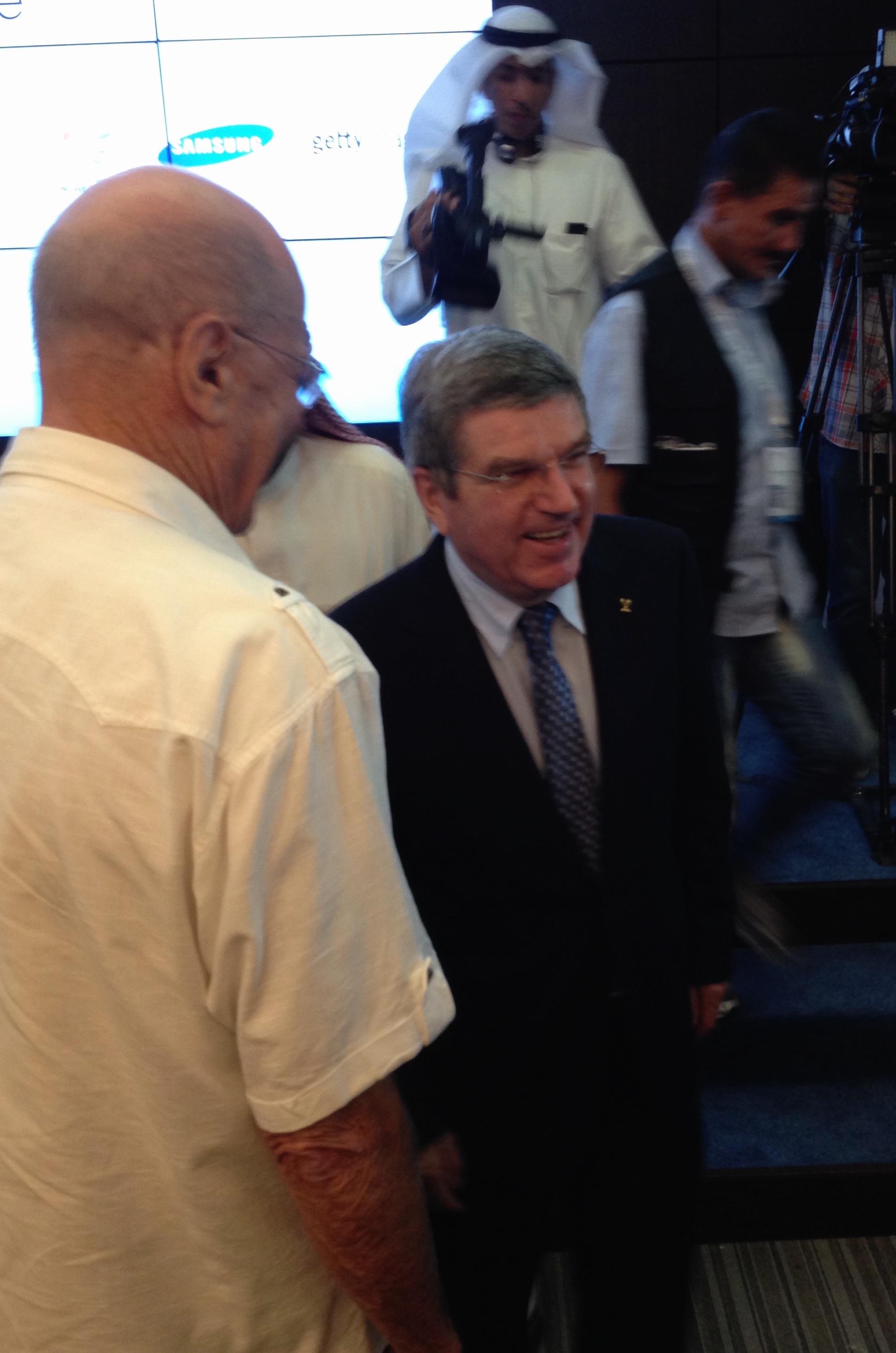
KUWAIT CITY, Kuwait — Accounting for the sudden resignation a couple days ago of French ski legend Jean-Claude Killy, there are now 106 active members of the International Olympic Committee. As the IOC president, Thomas Bach, pointed out in a news conference Sunday morning, Arabic hospitality is known worldwide.

Maybe that is why a reported 41 IOC members gave up their weekend to come to Kuwait to attend the meeting of the 204-member Association of National Olympic Committees.

Or perhaps it is a signal of the considerable influence of Sheikh Ahmad Al-Fahad Al-Sabah — who, among other roles, is the ANOC president — that some four of 10 IOC members came to Kuwait from around the world.

IOC president Thomas Bach and honorary member R. Kevan Gosper of Australia at Sunday's news conference

Here, among others: IOC vice president and Rio 2016 coordination chair Nawal El Moutawakel of Morocco. Executive board members Pat Hickey of Ireland and Gunilla Lindberg of Sweden.

IOC athletes’ commission chair Claudia Bokel of Germany, another executive board member.

Larry Probst, the U.S. Olympic Committee board chairman and new IOC member.

And many more influential personalities within the Olympic sphere — among them, SportAccord and International Judo Federation president Marius Vizer.

The Sochi Games closed just roughly five weeks ago.

The IOC executive board meeting, to be held in conjunction with the SportAccord conference in Turkey, goes down next week.

It’s not as if IOC members are — or were — lacking for opportunities to get together.

Yet here they were.

For ANOC, this was in fact something of a history-making occasion. On Saturday, it held a variety of commission meetings — that is, the first time its commissions were said to have had these kinds of meetings, all designed as a lead-up toward the ANOC general assembly this fall in Bangkok.

And then there was the pull of having Bach on hand as well.

“It’s a big honor to welcome the president of the International Olympic Committee here in Kuwait,” Sheikh Ahmad said at that same news conference.

Bach said, “We are having a broad discussion among all the stakeholders of the Olympic movement,” adding a moment later that the weekend involved “looking into the future and looking into the different roles of the stakeholders and ensuring the harmonious roles under the leadership of the IOC.”

Much of 2014, of course, is being devoted to what Bach has called “Olympic Agenda 2020,” a far-reaching review of what works — and what doesn’t — as the IOC and the broader movement, now past Sochi, regroups and looks toward Rio 2016, the 2022 Winter and 2024 Summer bid cycles and beyond.

Bach took a moment to note the “great success of the Sochi Games,” in contrast to the doom and gloom that preceded virtually all the talk beforehand.

Five bid cities are in the 2022 pipeline: Almaty, Kazakhstan; Beijing; Krakow, Poland; Lviv, Ukraine; and Oslo. Lviv must confront political upheaval; Krakow now looks set to deal with a referendum; Oslo is grappling with local challenges to long-held assumptions about who bears what responsibilities in the bid system.

How many of the five applicants will ultimately see it through to the 2015 IOC election in Kuala Lumpur, Malaysia, remains decidedly unclear.

A “candidature for the Games,” Bach said — reflecting on how the “great positive legacy” of Sochi is now “well understood by the respective cities and countries” — is a “great opportunity to transform a region and a society for the better.

“Therefore, I am not too worried.”

As for Olympic Agenda 2020, he laid out a timeline, apparently for the first time publicly, for getting to the IOC’s all-members extraordinary session in Monaco in December. There the issues will be debated and, presumably, decisions will be taken. Or, more likely, ratified:

— The special special email address set up to solicit suggestions from around the globe — OlympicAgenda2020@olympic.org — closes April 15.

— Working groups will convene, probably in June.

— July will see a summit of sorts, the presidents of the major stakeholders.

— In September, the results from the working groups and the “summit” will go to the IOC commissions. Bach is due to announce in the next few days the make-up of the 2014 commissions.

— In October, the commissions are due to make recommendations to the executive board.

— The board will prepare a document to be submitted to the extraordinary session, set for Dec. 6-7.

“This will give us a good opportunity, as the president has mentioned … to keep the values of the movement and the main ideals of the movement but also to develop the relationships,” Sheikh Ahmad said.

And if you want to know why more than 40 IOC members made their way this weekend to the Persian Gulf, there you have it.

Life is a relationship business. Especially in the IOC.

Who understands this principle?

Thomas Bach.

And the host for the weekend, Sheikh Ahmad Al-Fahad Al-Sabah. You had better believe he understands this is how things get done.

What does Sheikh Ahmad want?

2014-03-28-18.02.43-3.jpg

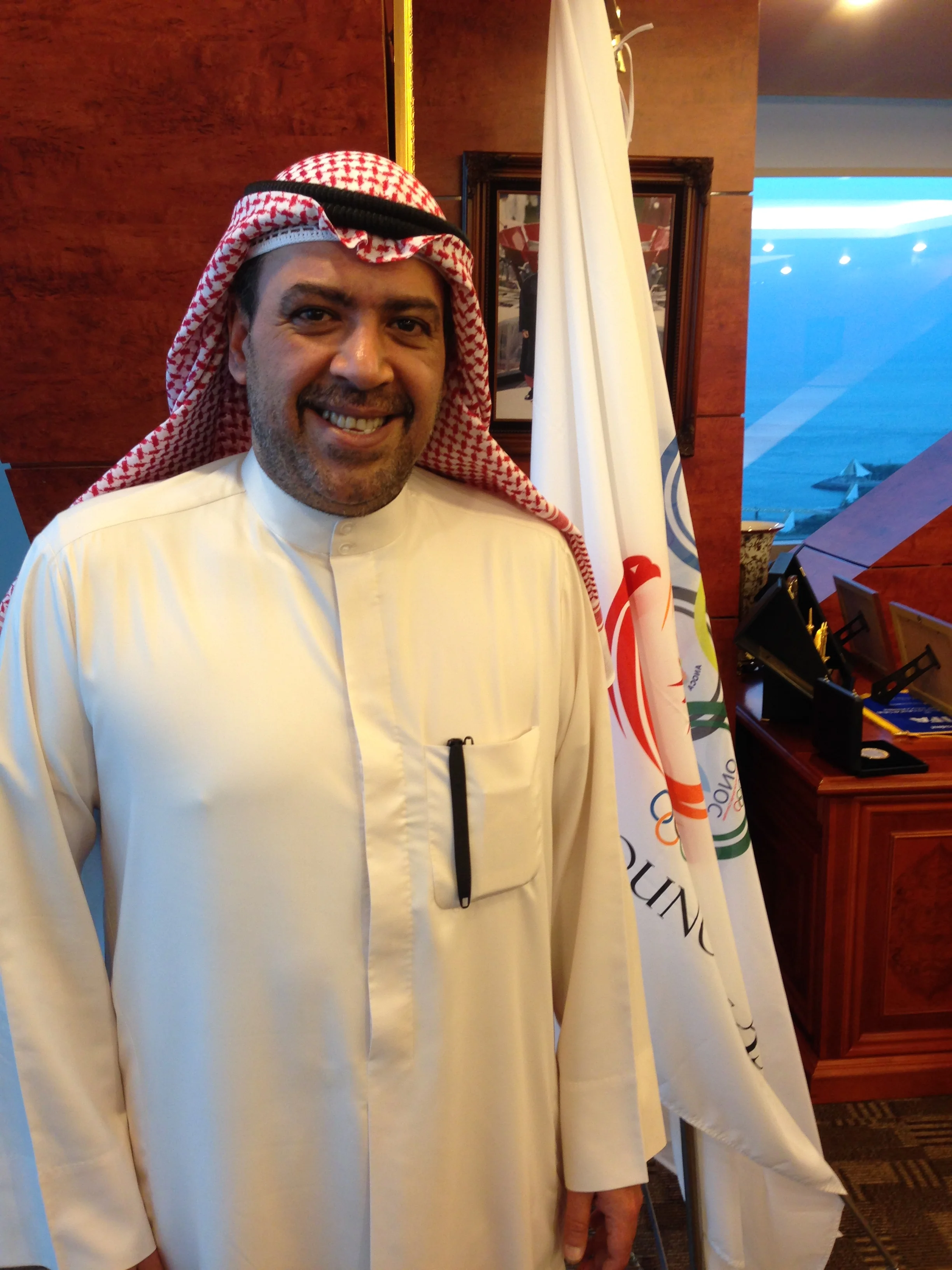
KUWAIT CITY, Kuwait — One rumor has him one day taking over FIFA, soccer’s international governing body. Another has it that he is simply biding his time and wants to be president of the International Olympic Committee. He is, after all, only 50 years old. Still remarkably young for a man at ease in so many intersections.

Sheikh Ahmad Al-Sabad Al-Fahin his Kuwait City offices

Yet another talking point has it that Sheikh Ahmad Al-Fahad Al-Sabah, the former OPEC chairman who since 2006 has been his country’s national security minister, is cleverly aiming to parlay his Olympic, soccer and sports portfolio into a long-range hardball twist, back into the top echelon of Kuwaiti leadership. When, of course, the timing is right.

What does the sheikh want?

A year ago, this was the question on the minds of virtually everyone in the Olympic sphere.

Throughout the spring and summer, and then at the historic 125th IOC session in early September in Buenos Aires, he parlayed his behind-the-scenes political acumen into a magnificent triple-play, helping to effect the election of Thomas Bach as president; Tokyo as host of the 2020 Summer Games; and the reinstatement of wrestling onto the Summer Games program.

For good measure, he even saw to it that Anita DeFrantz of the United States was elected to the IOC executive board — this after she had secured single digits in two prior election runs.

When all was said and done in Buenos Aires, as the sheikh was — and remains — quick to underscore, there was zero question that Bach was  indisputably in charge of all things IOC, indeed Olympic.

At the same time, there was no doubt, too, that the sheikh — head of the Olympic Council of Asia, the 204-member Association of National Olympic Committees and, as well, the IOC’s own Olympic Solidarity initiative, which carries oversight of a 2013-16 budget of $438 million — had positioned himself to be a man of significance, indeed.

The sheikh, for those who don't understand, practices grass-roots politics. Solidarity is a perfect example. It aims to provide financial, technical and administrative aid to national Olympic committees, particularly those in developing nations.

The 2013-2016 budget? Up more than 40 percent from the 2009-12 cycle, $311 million.

Since taking office, Bach, 60, has wasted little time making it plain that change is the order of the day. Bach has an eight-year mandate and, unless something extraordinary happens, will almost surely get four more years after that. He figures to be in office until 2025.

Even so, Sheikh Ahmad would by then only be in his early 60s, still plenty young enough to be -- the first Arabic -- IOC president. If that is what he wants.

Of course, 2025 is a long, long way away. The Bach years are just starting.

Last fall, Bach gave a speech at the United Nations outlining separate but important roles for the worlds of sport and politics, roles he again delineated at the Sochi Games. At the IOC session in Sochi, he invited comments from the floor, and got them — in all, 211 over a day and a half, an unheard-of number, the members weighing in on the make-up of the Olympic program, visits to bid cities and much, much more.

The IOC is due to study what — in nature and scope — will be done as part of what Bach has termed “Olympic Agenda 2020.” Another all-members assembly is planned for Monaco in early December.

For political junkies, this is all great stuff.

Thus, again the question: what does the sheikh want?

In his 18th-floor office, the waters of the Persian Gulf shimmering below as the sun set gently Friday in the west, the sheikh smiled. Over the course of this weekend, ANOC’s executive council is due to meet; dozens of IOC members are expected on hand; it is rumored Bach may make an appearance.

“I want to see the movement in a better situation,” the sheikh said.

“I want to see the movement flexible to receive everybody in it.

“I want to see the movement in a position which keeps the logo of the sport around the world and I don’t think this is [just] what Sheik Ahmad wants — I think this is what a lot of IOC members want,” he said, adding a moment later, “I think this is our dream.”

How, he was asked did he assess the state of the movement? Was it healthy? And how did he view prospects for Olympic Agenda 2020?

“I think it’s healthy, a healthy movement,” he said.

“My part should be two main roles. To show the wishes and the [desires] of the NOCs. Not all of them have a part of the IOC house. For that I have to be their ambassador …

“Then, as an IOC member, I have to support the president and be his supporter to achieve his goals.

"I have two different positions and be a supporter of both of them.”

Some, it was suggested, would say, yes, OK, but what about your own personal ambitions?

“I don’t think so,” Sheikh Ahmad said. “Otherwise, I will be in the EB of the IOC. I know everybody knows the story.”

So why so many rumors?

“I think the reality is not giving you witness for these rumors.”

He laughed.

“You know my way. I am an open man.”

Another laugh.

“Maybe it makes people a little scared [that] he,” and here the sheikh was referring to himself, “is an open man.”


Doping echoes of East Germany

Doping in elite international sport is “rampant,” the former executive who last year exposed failings in the Jamaican testing program said this week at a conference in London, just as it emerged that the entire Azerbaijan weightlifting team’s results from the 2013 European championships were wiped out — five lifters, 14 medals — by positive tests. Moreover, those tests were for oral turinabol, the very same steroid at the heart of the 1970s East German doping system.

Four more Azeri weightlifters were also sanctioned in 2013 after testing positive for the exact same steroid. Two were teenagers -- one 17, the other 16 -- when they tested positive. The seeming star of the team is now just 19; he was a bronze medalist at the London 2012 Summer Games.

IWF World Weightlifting Championships

Speaking Wednesday at the Tackling Doping in Sport conference, Renee Anne Shirley, the former director of the Jamaica Anti-Doping Commission, said, “Every time someone says, ‘We don’t have a problem in X sport or Y country, I say, ‘Oh, really?’ “

Meanwhile, the International Weightlifting Federation, based in Budapest, released an opaque statement acknowledging that the Azeri competitors and the national federation had “received punishment.” Separately, the Azeri head weightlifting coach, Zlatan Vanev, said, “I [am], frankly, shocked.”

For all the very real progress the World Anti-Doping Agency, the U.S. Anti-Doping Agency and others have made over the past dozen or so years, the Lance Armstrong affair, Operation Puerto, BALCO and more have made it abundantly clear that doping remains a powerful current with which sports officials, police and prosecutors must contend.

The shock is not that the current exerts its pull.

It always will do so. Human nature is what it is.

The shock is threefold:

One, the Azeri weightlifting program — an asset of a state ministry — apparently sought to enhance performance in 2013 in much the same fashion the East Germans did in the 1970s. Has nothing changed in some 40 years?

Two, the Azeris are hardly alone. Other weightlifters were also sanctioned in 2013 for using oral turinabol, including more than half a dozen from Kazakhstan.

Three, instead of making an example of such programs and those athletes, the International Weightlifting Federation opted to low-key the matter. Why?

The 2015 weightlifting world championships are due to come to Houston, in November. The sport will get far more attention in the U.S., and indeed the western, press then than it typically does. The months between now and then offer a window for the International Olympic Committee to take a long, hard look at weightlifting and to assess, meaningfully, whether weightlifting deserves its place in the Summer Games.

Wrestling got such a review in 2013. Now it’s weightlifting’s turn.

Should a sport with such a demonstrably poor record in the anti-doping campaign keep getting a free pass when it comes to staying on the Olympic program? Shouldn’t weightlifting have to meet real metrics, and prove to the IOC that — as a prerequisite for staying on for 2024 and beyond — it is serious about cleaning up?

Some background and context:

For all the widespread public focus on sports such as cycling and track and field, weightlifting is where the most concentrated work in the anti-doping campaign needs to be done.

Numbers do not lie.

According to the WADA's 2012 report, the most recent year for which figures are available, weightlifting showed 159 “adverse analytical findings” — that is, positive tests — from 3,893 in-competition urine tests worldwide, for a return rate of 4.1 percent.

For comparison:

Across all sports, there were 1,546 positive in-competition tests, out of 102,102, a return rate of 1.5 percent.

Weightlifting also had —by far —the most out-of-competition positives, 91, out of 4,299 tests, a rate of 2.1 percent.

The sport with the next-most, track and field, had only 38, out of 10,952 samples, a rate of 0.3 percent. Cycling? 24 positives from 6,797 tests, 0.35 percent. Swimming, just as another example? 11 positives from 6,444 tests, 0.1 percent.

Across the board, there were 280 positives in 71,349 out-of-competition samples, 0.4 percent.

That report also details what happens when you inject real money into the equation.

As part of the lab process, officials can use a far more refined analysis —it’s called the carbon-isotope test —to look for evidence of doping. Each use costs about $400.

Around the world in 2012, officials used the carbon-isotope test 318 times to search for evidence of doping in weightlifting. Figuring $400 per test, that’s just over $127,000.

For $127,000, here’s what you got:

—108 in-competition samples, 17 positive tests, 15.7 percent.

—210 out-of-competition tests, 32 positive tests, 15.2 percent.

Combined, that’s 318 tests, 49 positive tests, a return rate of 15.4 percent.

To be super-obvious, 15.4 percent blows away the “normal” rates of 4.1 or 2.1 percent.

Statistically, no other Olympic sport is nowhere close to weightlifting’s 15.4 percent return rate. Cycling, thought by many amid the revelations of the Armstrong case to be simply filthy? 4.97 percent, on 543 carbon-isotope tests. Track and field, 5.75 percent.

If you know where and how to dig through the IWF’s website, you find even more disturbing figures.

Deep within that site are the IWF’s lists of “sanctioned athletes.”

Up now is the list for 2013. It shows the IWF sanctioned — to be clear, these are cases in which a positive test produced action — 76 athletes around the world, 53 from in-competition tests, 23 out-of-competition, the vast majority, whether in- or out-of-competition, for steroids.

A full 43 of those 76, or 56.5 percent, were for stanozolol. That is like taking a ride on the way-back machine to 1988. Because that is the same steroid that got Canadian sprinter Ben Johnson busted at the Seoul Games.

Twelve of the 76? From Kazakhstan. Seven of those 12 — busted for oral turinabol as well.

Uzbekistan? Seven, all but one stanozolol.

These sorts of numbers underscore two big-picture trends.

The first can be traced to the eruption roughly 10 years ago of the BALCO affair in the United States. That, in turn, prompted a rules change that had the practical effect of swinging would-be cheats away from designer steroids — such as THG, the substance at the heart of the BALCO matter — and back to the basics.

Like stanozolol, oral turinabol or straight testosterone.

The second is an advance in testing technology.

As a German television station reported last year, scientists at the Moscow and Cologne, Germany, labs have developed a new testing procedure — known as the “long-term metabolites method” — to extend the detection window. Officials from those labs told the TV station that a sample that would have produced a negative result as recently as 2012 would in 2013 glow positive more than six months after it was taken.

Two track and field athletes, for instance, tested positive for oral turinabol at last summer’s world championships in Moscow: Ukrainian javelin thrower Roman Avramenko, who finished fifth, and Turkmenistan’s Yelena Ryabova, who failed to make it out of the heats in the women’s 200 meters.

The IAAF, track and field’s governing body, made sure everyone knew about these positive tests.

The IWF?

That statement about “punishment”? Indeed, it was put out front Wednesday on the IWF website. But not under “doping” or “Azerbaijan” or another similarly suggestive keyword. The trick was to look for “official communication.”

The statement named no names of anyone sanctioned. Nor to be found was the name of the IWF president, its general secretary or anyone from its executive office.

Too, the statement leaned heavily toward passive voice: “In this process, in 2013 several anti-doping violations were disclosed …”

Even allowing that it took nearly an entire year -- the 2013 European championships were staged last April, in Albania -- why no allocation now of responsibility for the disqualification of an entire team and its marks?

More of the same: “The relevant procedures of anti-doping violations by multiple weightlifters from Azerbaijan have now been closed.” By whom? When? How? Were there appeals? Were any appeals contested?

The statement said immediately thereafter that those lifters who tested positive at the 2013 European championships and subsequently in out-of-competition testing had been sanctioned and results lists updated. Incredibly, the statement did not identify the lifters or provide links to the “before” or “after” results.

The notice also said the athletes and the Azerbaijan Weightlifting Federation itself had received punishment “following the sanctions stipulated in the IWF Anti-Doping Policy.” Did that mean the federation was fined? How much? The policy suggests that nine or more violations equals a $500,000 fine.

If so, when is the fine due? How will anyone know the federation paid such a fine? If it’s not paid, will the Azeri federation — as the policy suggests — be suspended for four years? Again, how will anyone know? What would trigger the start of such a suspension?

The statement went on to say, “The Weightlifting Federation of Azerbaijan is one of the most active also as the home of a Weightlifting Academy and host of various significant events. Drawing the conclusions of last year they now have the obligation to turn a new page and build a new, clean national team.”

What about any of this offers the sort of transparency and forthright reporting an international federation dedicated to genuinely and meaningfully reporting and addressing, much less cleaning up, its significant doping issues would present?

As a start, the rules mandate that the names of athletes who are sanctioned be made public.

So here, via cross-referencing in the IWF website, are the nine Azeri lifters sanctioned in 2013. All, according to the site, tested positive for the steroid dehydromethyltestosterone. That steroid’s brand name, according to three knowledgeable figures in the anti-doping community: oral turinabol. 

The list from the European championships:

— Valentin Hristov. Just 19, born in Bulgaria, he won bronze in the bantamweight class at the London 2012 Games.

— Intiqam Zairov. A 28-year-old London 2012 Olympian.

— Sardar Hasanov. Also 28, another London 2012 Olympian.

— Zulfugar Suleymanov, 31, who missed the London Games because of a prior ban.

— Silviya Angelova, 31.

Intiqam Zairov, Day 8, London Olympics // photo Getty Images


Also sanctioned in 2013:

— Kamran Ismayilov, 20. The DQ erases results from the European Junior Championships.

— Alona Kiriienko, 26. Gone are her results from the Summer University Games in Kazan, Russia.

— Marziyya Maharramova. When she tested positive last September, she was just 17. She turns 18 on April 14. Her two-year suspension runs until September 2015.

— Kseniia Vyshnytska. Even younger. Her birthday: Jan. 16, 1997. She was 16 last year, just turned 17 a few weeks ago. Her suspension runs until April 2015.

Eight of the nine received two-year suspensions. Suleymanov was banned for life, having been suspended once before.

Ismayilov and Kiriienko were caught in out-of-competition tests. The other seven positives were in-competition tests.

Baku, it should be noted, is due to play host to the 2015 European Games. Those Games are intended to serve as a coming-out party, a symbol of prestige for Azerbaijan.

With Baku aiming yet for bigger things — it has bid for the Summer Games before and presumably has a bid for the 2024 or 2028 Games in its sights — the question is obvious: how can the weightlifting program have been operating so recklessly?

Unlike the United States, where sports and government are separate, in Azerbaijan, the Ministry of Youth and Sports oversees Olympic sport. So the question perhaps ought to be framed differently: who in the Azeri ministry is responsible for the weightlifting program and what did that official know, and when? Further, is it credible to believe the weightlifting program was operating independently of political or governmental control?

If Baku wants to be a serious player on the world stage, it has to take these questions -- and provide answers -- seriously.

The same applies in equal measure to Kazakhstan. Almaty is firmly in the race for the 2022 Winter Games.

“I know nothing,” Vanev, the Azeri weightlifting coach, was quoted as saying. “That’s all I can say for today. Someone went to the site and there is something written,” apparently a reference to the IWF website.

His quote then concludes with these words, which surely carry unintended meaning: “It boggles the mind.”

 

The vexing Iran conundrum

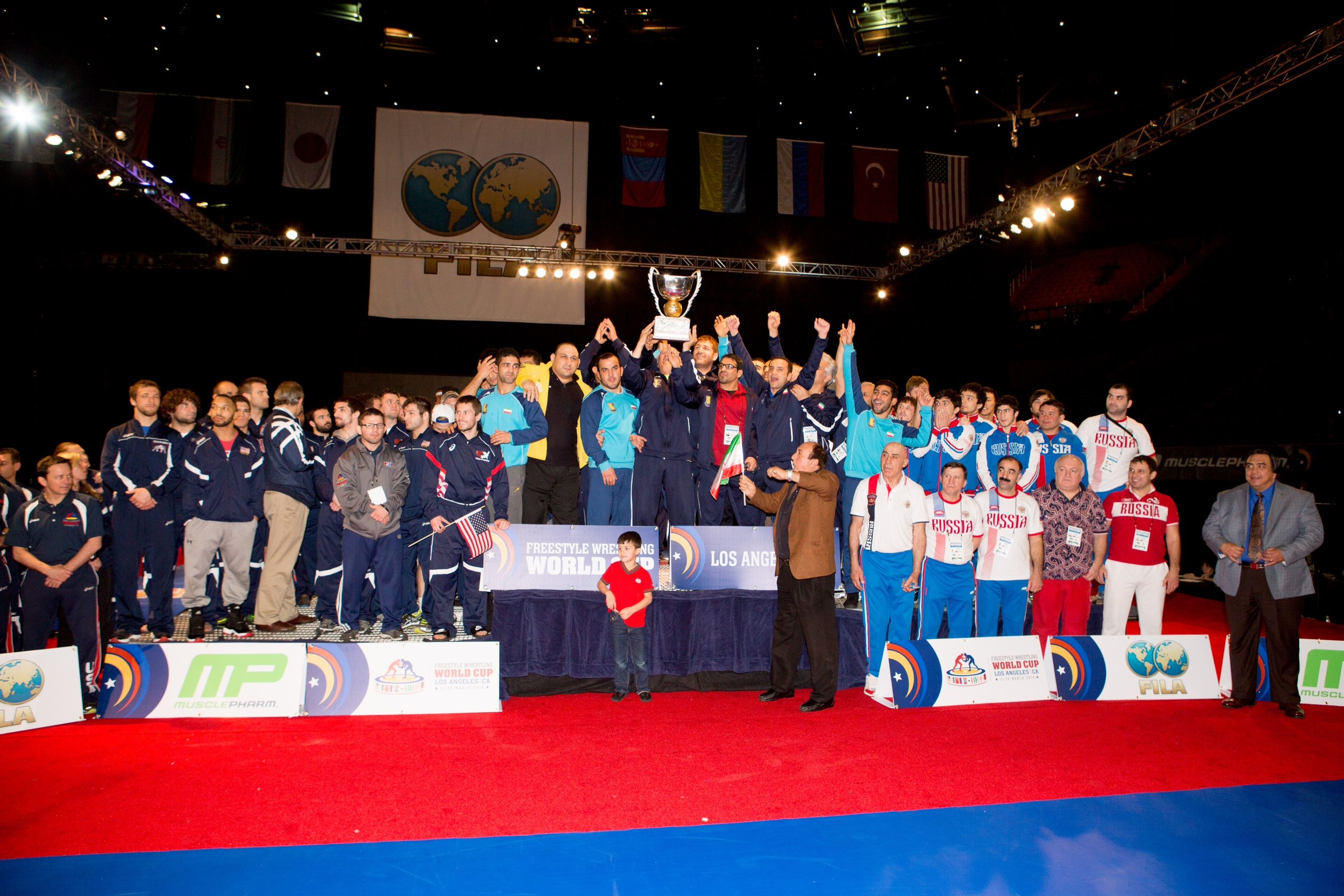
With leadership comes responsibility. At wrestling’s freestyle World Cup Sunday in Los Angeles, the Iranian men’s wrestling team asserted it is, once again, best in the world. Now the challenge facing it — as well as everyone connected to the sport, indeed the broader Olympic movement — is as simple and elegant as it is vexing.

Are the Iranians — that is, its government, through its wrestling program — prepared to step up and show they will fully engage with the world?

285A4639

If not, what is to be done?

Jordan Burroughs, the American champion, said these words after wrestling Sunday night, and while they were uttered in a slightly different context, they apply here as well: “I just want our sport to be great. I want people to give us the respect we deserve.”

There was great solidarity and sportsmanship on display over the weekend as wrestlers from Iran and the United States, from Ukraine and Russia, from Turkey and Armenia competed on the mat. There were handshakes. There was talk, meaningful talk, of “family.”

For that talk to be fulfilled, the Iranians have to wrestle all comers. Everyone. That means, should they appear, the Israelis.

In addition, for the sake of credibility and for the growth of wrestling, the Iranians must field a women’s wrestling team. Right now, they don’t.

These issues are vital. Wrestling last year escaped the death knell in a vote by the International Olympic Committee. It has a window — and that window is short — to keep proving to the IOC it is relevant in our 21st-century world.

In significant ways, wrestling advanced its case in this weekend’s action at the World Cup in Los Angeles, so much so that word is the 10-team World Cup is due back in LA in 2015.

At the same time, when your best team in your most important discipline is the projection of a state policy that is exclusionary and discriminatory — there’s no other way around it — that is a matter that calls not just for serious reflection but action.

“The challenge for us — not just for the Iranians — is that we are coming together not just for sport but for the betterment of mankind,” said Rich Bender, the executive director of USA Wrestling, evoking the aspirational ideal of the French baron Pierre de Coubertin, widely acknowledged as the founder of the modern Olympic movement.

“How do we do that?”

As a starting place:

If next year the World Cup is indeed back in Los Angeles, how about organizers pair up all 10 teams with area middle-schools and, as part of the program, organize a mandatory excursion for everyone — repeat, everyone — to the Museum of Tolerance on LA's Westside?

At every big-time soccer game, you see the players lining up at the start with kids. Pairing up with local schools would be a great way for the wrestling community to create outreach all kinds of different ways: it would help build needed community buzz around the World Cup, maybe jump-start a fund-raising opportunity for the schools and, along the way, raise awareness among everyone — again, everyone — of tolerance.

Who is opposed to tolerance?

If it’s the Iranian government, how does that position jibe not only with the ideals of the Olympic movement but with the Olympic charter? With the rules of FILA, the international wrestling federation?

Iran's Reza Afzalipaemami, in blue, on his way to a 6-0 victory over Parveen Rana of India // photo Tony Rotundo, FILA-Official.com

No one outside Iran knows, for instance, why the Iranian wrestling team — due to come to LA last year immediately after an appearance in New York amid the Olympic reinstatement campaign — suddenly flew home. Or why it was OK this year to come to LA.

The Iranian athletes and coaches have, typically, been circumspect.

Further: no one on the outside knows whether the Iranian wrestlers were frustrated or upset — or otherwise — when denied the opportunity to come to LA last year.

Just like outsiders have no clue what is really going on when, as has been the case over the years at various events, Iranian athletes don’t show up to swim or suddenly fall ill at a taekwondo match when an Israeli is involved. Are the Iranian athletes themselves just as frustrated as anyone would seemingly be in that sort of situation?

Referring to last year’s planned trip to LA, Iranian wrestler Masoud Esmailpour Jouybari, who competes at 61 kilograms/134 pounds, speaking Saturday through a translator, said, “We were supposed to come last year but under some circumstances it didn’t happen.

“This is a place where many Iranians live, so the World Cup came here,” he said, meaning Southern California. “Hopefully, if it’s a great event, it can ease problems between the two countries.”

The axiom is that sports and politics are supposed to stay separate.

Reza Yazdani, the Iranian 2013 world champion at 97 kilos/213 pounds, had said Saturday, “It’s best if sports and politics don’t mix. In wrestling, it’s best if the politics stay out of the sport itself and people are able to appreciate the sport for what it is.”

This, though, is where they intersect.

FILA has done a commendable job of promoting the work of female referees, even — especially — at a male-only event such as the World Cup. The Iranians? They’re OK if a woman works as what’s called the “mat chairman” — that is, the official who sits table-side in the shadows and confirms the on-mat referee’s scores. But they “request” that a woman not work as the referee, as one did Sunday night in Burroughs’ 15-4 victory in the 74 kilogram/163-pound class over Ukraine’s Giya Chykhladze.

FILA officials are acutely aware of all of this. Rest assured Iran would otherwise have had the world championships by now.

It is reportedly the case, for instance, that official policy in Iran bars women from being spectators at events such as wrestling and soccer matches.

This is why Iran has been relegated to events on the calendar such as the 2013 World Cup, held in Teheran.

It’s also why there is no one from Iran on FILA’s ruling council, its bureau. Including the honorary president, a Rio 2016 coordinator, continental presidents, even a member suspended until next year, it features 24 personalities — and yet no one from Iran. It’s obvious why.

It's entirely uncertain whether isolation is the answer.

And the corollary — whether the regime believes it has sufficient leverage, confident the Olympic world would not want to do with Iran what was done years ago with South Africa over apartheid.

What to do about a country that has such passionate fans? If your metric is Facebook and Twitter, the United States is wrestling’s No. 1 fan base. No. 2? Iran. Measured by comments and shares, Iran is far and away your leader. The No. 1 city in the world for fan involvement? Teheran.

USA Wrestling sponsored the first American sports team to compete in Iran after the 1979 revolution. A U.S. freestyle team competed in the 1998 Takhti Cup in Teheran. Afterward President Clinton hosted the five wrestlers — Zeke Jones, Kevin Jackson, Melvin Douglas, Shawn Charles and John Giura — at the White House, with presidential spokesman Mike McCurry saying, “People-to-people contact is something useful for both nations.”

Jones is now the U.S. freestyle coach. He led the team to a third-place finish at the LA World Cup.

An American Greco-Roman team is due to go to Iran in May. The Americans have been to Iran 11 times since the revolution.

Iran’s LA World Cup delegation marked its 13th time a wrestling delegation has come to the United States since 1979.

Of course the stands Saturday and Sunday included plenty of women. No issues. The Iranian wrestlers waved to all in attendance. Some of the wrestlers even blew kisses.

As for people-to-people understanding, Iranian wrestler Hassan Rahimi, the 2013 world champion at 57 kilograms/125 pounds, said Sunday, “I have great memories from being here and being amongst Iranians. This is the first time our team has come to Los Angeles. We were supposed to come last year but some things came up and we couldn't make it.

“We're going to leave with a lot of really good memories and we hope to return. There's a lot to see in Los Angeles, Hollywood – for the worlds, it's one of the leading tourist destinations.”

On the mat, there can be no question of Iran’s dominance.

Iranian coach Rasoul Khadem Azgadhi, right, during World Cup action. He is a 1996 Atlanta gold and 1992 Barcelona bronze medalist // photo courtesy Tony Rotundo FILA-Official.com

Iran won the 2013 freestyle world championships. Coming to Los Angeles, the Iranians had finished first or second in the last five World Cups, seven of the last eight.

In Saturday’s pool action, the Iranians were so much better than everyone — except for the Americans — that it was like watching a Mack truck square off in a demolition derby against a VW bug.

With rowdy — and knowledgeable — fans blowing horns and yelling “Iran!” the Iranians took it to Armenia, 8-0, and Turkey, 7-1. Then they defeated the Americans, 5-3.

On Sunday, the Iranians made short work of India, 8-0.

The domination of India was so thorough the Iranians did not give up a single point.

Against Turkey, three of the matches were 11-0; another was 11-1; a fourth was 10-0.

Two of the eight matches against Armenia ended in pins.

After rolling through Pool B, the Iranians met Russa — which had cruised undefeated through Pool A — in Sunday night’s finals.

Christakis Alexandridis, the Russian coach, had said Saturday that while he had a strong team, he also had a young team.

The Iranians, buoyed by the crowd, prevailed, 6-2. Four of the matches were shutouts.

Iran technical manager Ali Reza Rezaie said afterward, "We're really happy with the result. We're so glad we were able to make our fans here and in Iran proud. We plan to keep the success going."

For sure. Right?


Wrestling's handshake moment

Russia put troops on the Ukrainian mainland for the first time Saturday, deploying 80 soldiers along with four helicopter gunships and three armored vehicles to seize a natural gas terminal distribution station near Crimea. Crimea is set to vote Sunday whether to secede from Ukraine and join Russia. Ukraine’s government and Western governments have denounced the vote as illegal.

What role, if any, can sports play amid such turmoil?

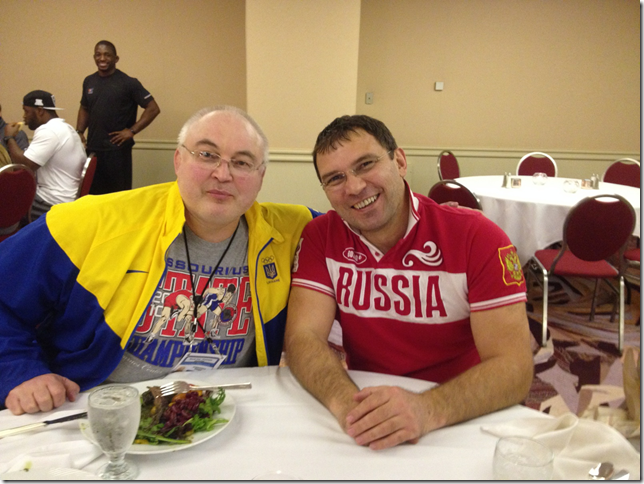
Ukrainian and Russian wrestlers and team officials meet before action gets underway at the LA World Cup // photo courtesy Tony Rotundo, FILA-Official.com

The Olympic movement aims to move the world toward peace. Can it?

What of the symbolism in the protest Saturday in Sochi by the Ukrainian cross-country ski team at the Paralympics? On the podium, as the rival Russians collected their golds, the Ukrainians — winners of silver — covered their medals in silent protest.

“It is a silent protest, fighting for peace for everyone … because the situation in Ukraine didn’t change,” Ukraine team official Nataliya Harach would later tell Associated Press.

Here in Los Angeles, at wrestling’s annual World Cup, the Ukraine and Russian men’s freestyle wrestling teams squared off in pool play, beforehand the two squads meeting in the middle of the mat for the traditional handshakes. In some cases, there were genuine hugs.

“Sport is not political,” a Ukrainian national team coach, Yurii Nazarenko, would say later. “Just go wrestle,” adding a moment later, “We can’t really fight about anything.”

Before each of the eight individual matches, the two wrestlers, one Ukrainian, one Russian, one in red, the other in blue, would once more shake hands. Afterward, no matter the result — Russia defeated Ukraine, 7-1 — again they shook hands.

At the end of every match, each Ukrainian wrestler shook hands with the Russian delegation. And vice-versa.

“They come on the mat, they fight like warriors and then they shake hands and then they shake hands again," Nazarenko said speaking through a translator. "That is the beauty of the sport.”

Christakis Alexandridis, the Russian coach, said, “They are our brothers. We support our brothers. We don’t go for political ideas. We go for sport ideas. A political situation can happen to any family. We will be brothers forever.”

This, bottom line, is why wrestling has been part of the Olympic Games since the beginning, why its adherents fought so fiercely to keep it in the program last year when the International Olympic Committee’s executive board had moved last February to give it the boot, why its ethos deserves renewed attention and respect.

Intriguingly, of course, Russian president Vladimir Putin was one of the biggest backers of the push to keep wrestling in the Games.

Putin was in Sochi on Saturday, where he watched part of the cross-country event, meeting with Ukraine Paralympic Committee president Valery Sushkevich.

“During the meeting, they discussed how the celebration of sport, especially one like the Paralympics, cannot and should not come under the influence of some or other processes on the international political agenda of the day,” Kremlin spokesman Dmitry Peskov was quoted as saying by the Interfax news agency.

In Los Angeles, Andy Barth, head of the World Cup LA organizing committee, said at Saturday evening's formal opening ceremony, amid flags from Russia, Ukraine, Iran, the United States and elsewhere, “We come here as competitors, as wrestlers — we leave as friends.”

The president of the international wrestling federation, FILA, Nenad Lalovic of Serbia, was supposed to be at the World Cup event. Complications from a broken arm kept him in Europe. In a taped video message, he noted the obvious — teams from Russia and Ukraine, Iran and the United States — and said, “We send the world a message that friendship is always possible.”

This is because Olympic wrestling is fundamental, elemental and close.

The two guys — for this discussion, Saturday’s wrestling involved only men — have to confront each other, physically, mentally and emotionally. Of course, they have to compete. But it’s not like track and field, or swimming. They have to engage. They have to touch each other. There is no hiding.

As physical as wrestling is, and for sure it is physical, it is even more a test of wills.

That’s why there is so much respect and goodwill out there on the mat and within and among anyone who knows wrestling.

Alexandridis said, “In this place, all is friends. USA, Iran, Russia, Ukraine, no problem, all is friends. We are one family. The family name is wrestling family. We are here, one family. All is friends, everybody. Come on, everybody.”

A couple hours after Russia and Ukraine got after it, the Iranians and Americans met on the mat. Again, there were handshakes.

"It's best if sports and politics don't mix," Iranian wrestler Reza Yazdani, who competes at 97 kilos, or 213 pounds, said, speaking through a translator.  "In wrestling, it's best if the politics stay out of the sport itself and people are able to appreciate the sport for what it is."

U.S. coach Zeke Jones said, “Wrestling is the common bond in the world.

“If you look around the world, this is the sport that bonds the world together. I don’t know any other sport that has this many countries that have wrestling. And there is a certain amount of respect for a wrestler who bleeds out on the mat. We fight each other. But when we leave, we shake hands.

“We knew because we’re in the fight together that when we leave — we’re friends.”

In the second match, 61 kilograms, or 134 pounds, as Reece Humphrey of the United States and Masoud Esmailpoor Jouybari of Iran were going at it, the two wrestlers skittered off the mat, the Iranian finding himself on the edge of the other, where wrestlers from Turkey and Armenia were competing.

Before Humphrey and Jouybari started up again, they shook hands — no hard feelings.

“You gotta respect these guys,” Humphrey would say later.

“When you’re on the mat, you gotta fight. I knew I was getting ready to go into a war, a fistfight, basically. When he was pushing me out of bounds, he drove a couple extra steps, so I kind of threw him down. and it’s weird - because I could start to feel him break a little bit. But that guy doesn’t break. He just keeps coming. And then you slap hands. It’s like, ‘Hey, man, let’s go. It’s going to be a good fight.’ So, there’s always sportsmanship with a guy that can beat you or almost beat you.

“You’ve got to respect them. Because you know the work they put in. It’s got to be just as good as yours."

Humphrey built a 6-1 lead, pushed it to 8-1. Then, though, Jouybari cut it to 8-3, tied it up at 8 and, finally, won, 10-8. At the end, the two guys hugged.

Over the course of the evening, the Iranians defeated the Americans, 5-3.

At the 2013 World Cup in Teheran, with seven classes instead of eight, the Iranians defeated the U.S., 6-1. A couple of swings here and there Saturday night — besides Humphrey’s match, the Americans lost two by the same 1-0 score — and things might well have gone the other way.

That’s what was on Jones’ mind at the end of the night. Not world politics.

“I know the rest of the world is paying attention to it but when we go out there, we are shooting double-legs and trying to get gut-wrenches,” he said, using wrestling lingo for take-downs.

“We’re not thinking about what the political leaders are doing. We want to focus on what our wrestling matches are doing. Obviously they are a great, great competitor — Iran. We want to beat them. And they want to beat us. They showed up to win. And they did tonight.”

Wrestling: now, the spotlight

Russia massed troops and armored vehicles Thursday in at least three regions along Ukraine’s eastern border, the New York Times reported. In Washington, the Obama Administration deferred a request from Ukraine’s interim government for arms and ammunition, the Wall Street Journal reported.

Here in Los Angeles, the Ukrainian and Russian men’s freestyle teams are poised to wrestle this weekend as part of the year’s biggest tournament, the 10-team World Cup. Sports diplomacy, such as it was, was left to dinner late Thursday. At a pre-meet news conference at a hotel near Los Angeles international airport, the Ukrainians weren't on hand, leaving it to the Russian coach, Christakis Alexandridris, to hit the right notes. He said, speaking through a translator, “We live in a world where we can not do about politics, nothing. From our side, all the country, our politics is wrestling. That is the main goal — to be here.”

eam leaders Christakis Alexandridis of Russia (right) and Eduard Nosadchyy of Ukraine shares smiles over dinner in the Team Dining Room, prior to the 2014 FILA Men’s Freestyle World Cup of Wrestling. // photo courtesy USA Wrestling

For a sport that a year ago was literally struggling just to stay relevant, Olympic wrestling — yes, wrestling — is all of a sudden one of the most captivating, dynamic, provocative things going.

This weekend’s World Cup — at the newly renovated Fabulous Forum in Inglewood, where the Lakers used to play, you know, when they would win — is action-packed with storylines.

The annual dual-meet competition has returned to the United States for the first time in 11 years.

Last year, the meet was held in Teheran. The Iranians won. Just to set the scene — the Iranians have been first or second in the last five World Cups, seven of the last eight.

In Teheran, the Russians came in second, the Americans third.

The Ukrainians were not there. They qualified for the LA World Cup by finishing in the top 10 — fourth — at the 2013 world championships, held in Budapest. Ukraine is back at the World Cup for the first time since 2011.

Russians tend to be very big on wrestling, and if the promoters were smart, they would have made sure that in particular the Russian-speciality stores around Fairfax and Melrose avenues in LA were big boosters of this event. No less an authority than actor Billy Baldwin,  the honorary chair of the weekend event who will be working the TV booth for Universal Sports, declared at the news conference that “half a million” people with some connection to Russia call Southern California home.

Another current: relations between Russia and the United States. Note that while President Obama and the Canadian prime minister, Stephen Harper, bet some beers on the outcome of the men’s and women’s hockey games at the Sochi Olympics, Mr. Obama and Vladimir Putin — not so much.

Alexandridris, again: “Our federation, our team have the best friends on the American team. They are our partners. Every political change in Russia, they have always been our friends. And we are their friends. This will carry on in the future.”

Putin, of course, played a vital role in ensuring wrestling stayed on the Olympic program, the International Olympic Committee reinstating it last September through an all-members vote.

“We are here to make sure wrestling stays in the Olympic family,” Alexandridris said, adding a moment later, “That is what we have to strive [for] — all the teams here.”

The Turkish coach, Adem Bereket? A Sydney 2000 Games bronze medalist, he spoke not Turkish but Russian at the news conference, saying he brought a young team, acknowledging that in Pool A, “Our group is very strong. We have America, Iran. We try our best.”

Were it not for the escalation of tensions between Ukraine and Russia, certainly much more attention would be paid to the matchup — Saturday evening — between Iran and the United States, again in pool play.

More background:

The 2013 World Cup in Teheran took place just after the initial IOC executive board decision to yank wrestling off the Olympic program.

Jordan Burroughs, the U.S. middleweight gold medalist at the 2012 London Games, said Thursday he had originally been scared to go to Iran. He also allowed as he had watched the movie “Argo,” about the covert operation to rescue six U.S. diplomats from Teheran amid the 1979 hostage crisis, which exacerbated his concern.

Just to make things all the more interesting — in London, Burroughs had to defeat Iran’s Sadegh Saeed Goudarzi for the gold.

As it turned out, Burroughs said, the scene in Teheran was “awesome,” the Iranian fans “great,” treating him “better than I had ever been treated in my entire life.”

Last May, as part of the Olympic reinstatement campaign, the Iranians wrestled in New York. Then they were supposed to fly directly to LA for more wrestling. Didn’t happen. They flew right back to Iran, never really explaining why.

Asked what happened, the Iranian coach, Ali Reza Rezaie, an Athens 2004 Games silver medalist, didn’t really explain why — again.

Through a translator, he said initially, “The conditions were not prepared to bring the Iranian team at that time to Los Angeles. The goal was to come to New York. After competing in New York, [we] decided to go back to Iran for some conditions.”

The follow-up question — what about now? He didn’t answer directly, saying, “There is not any specific reason. But since we came to New York, we decided not to come to LA.”

A third try: “There is not any particular problem to come to LA. Right now, here, we are here for World Cup. LA is hosting. So we are here to compete for World Cup.”

Did anybody expect anything different?

Making the Iranian pull-out last year all the more mysterious is that there absolutely, positively are hundreds of thousands who claim Iranian descent in Southern California. Indeed, Iranian fans were waiting to welcome the team — the wrestling team! — upon arrival at LAX.

Understand — in Iran, wrestlers are the soccer team in Spain, or NBA or NFL stars here in the United States.

“We really enjoy coming to the United States,” Rezaie said, adding a moment later, “We really feel at home. We don’t have any problem coming here.”

Which is why, for the United States — again, third last year in Teheran — winning the 2014 World Cup is a priority.

“This is a bullseye for us,” the U.S. coach, 1991 world champ and Barcelona 1992 silver medalist Zeke Jones said. “We want to win this competition. Make no mistake.”

And for lots of reasons:

— To grow wrestling in the West, and especially in California. Contrary to the widespread American imagination, which might fix wrestling as something done in places such as Iowa, Michigan or Pennsylvania, California is USA Wrestling’s biggest membership state, Jones said.

“If we can have just one kid be inspired,” by the likes of Burroughs or Tervel Dlagnev, the U.S. super-heavyweight, or "even by an Iranian or a Russian wrestler, it inspires them to say, ‘I want to be an Olympic champion,’ and in California, that’s a place we can do that. We have had a tremendous legacy and tradition. Stephen Abas. Dave Schultz. Mark Schultz. I mean, the list goes on and on of our great wrestlers in California.”

— To promote wrestling itself. Even though the sport saved itself last year — that was so last year. Everyone involved understands wrestling has to keep proving that wrestling is, indeed, vital.

That’s why, for instance, Burroughs appeared Wednesday night on Arsenio Hall’s talk show. It’s why, too, he had this to say Thursday:

“We definitely need to kind of portray our sport as the great sport that it is. You watch ESPN and you see poker on ESPN more often than you see wrestling. I think — I don’t think people aren’t interested in wrestling. Wrestling’s a very interesting sport. It’s a great sport. It’s extremely exciting to watch. You just have to give it to the people where they have viewership, they can see it, they can be interested in it, follow it, do a lot of different aspects of social media, be on the internet, television and all those different kind of outlets.”

Wrestling could not ask for a better spokesman than Jordan Burroughs. The man is exceptionally thoughtful and well-spoken. He also had this observation when asked what the sport needs:

“It’s going to cost a lot of money, probably, but I would put us on on TV. I would take our best athletes and just put them on a large media [platform] — 'Mike & Mike' in the morning, ESPN, 'Pardon the Interruption,' all these different shows, the Ellen DeGeneres Show, Oprah Winfrey, whatever it is. A lot of different stuff. Because wrestlers are interesting personalties and are very appealing to general audiences.

“You know when you see a football player outside of his helmet, it’s like, those sports are getting recognition. Ask a guy what he did in high school and he probably played football or he wrestled. We’ve got a number of professionals who are successful people. We’ve got a number of connections through people who understand that, who recognize it, who give us the respect that we deserve. We have been asking for it. But it’s like — we don’t have to go out and beg for attention. You know, it’s like a dog. You go to your owner and you beg for food. We don’t want to be like that. We just want to do what we do  — that’s wrestle at a high level. Hopefully the recognition will come our way.”

And when, at an event like this weekend, there’s an overlay of perhaps potentially profound geopolitics?

“This is wrestling,” Jordan Burroughs said.

“Outside of all the politics, this is my occupation. I think the media kind of portrays a number of ideas on the actual event. Outside of everything that’s going on around the actual event, it’s a wrestling match. I’ve been wrestling since I was 5 years old.

“Regardless if I don’t like the guy across from me, regardless if our governments are arguing, we’re going to go out there and do what we’re best at, and that’s wrestle. We try to keep it within the circle. That circle is all that matters. Everything that’s going on outside, the turmoil, problems at home, problems with politics and governments and all that good stuff — it’s out of our reach, out of our grasp. So we just go out there and compete.”

Championships, gala -- or what?

SOPOT, Poland — Let’s say you dropped into Sunday’s final day of the 2014 world indoor track and field championships. Further, you were a stranger to the sport, maybe kinda-sorta checking it out, a local from here in Sopot or Gdansk.

The program started at 2:50 in the afternoon. It wrapped up a little past 7 in the evening. That’s just over four hours. In those four-plus hours you saw — deep breath now — 14 events, two semifinals and 12 finals, as well as 17 medal ceremonies.

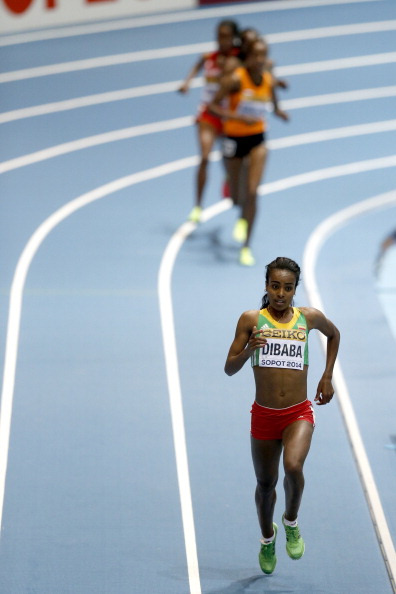
Ethiopia's Genzebe Dibaba winning the women's 3k // photo Getty Images

Essentially, you went to the circus. All that was missing was lions, tigers and bears.

This has to change.

At one instant Sunday, long jumper Erica Jarder of Sweden, the 2013 European indoor bronze medalist, launched herself into the pit exactly as, at the other end of the infield, Polish pole vaulter Anna Rogowska, the 2009 world champion and 2004 Athens bronze medalist, was going up and over the bar. Bad timing for Erica Jarder. She might as well have been invisible.

Later, the gaggle of guys running the 3000 meters circled the track as, again, Rogowska jumped at 4.7 meters, or 15 feet, 5 inches, the crowd clapping for her, paying the guys little if any attention. The 39-year-old defending champ, Bernard Lagat of the United States, had been shown pre-race on the big-screen. But what about the 21-year-old sensation Caleb Ndiku of Kenya, who would go on to out-kick Lagat and, you know, win?

A few moments later still, as American Chanelle Price, Poland’s Angelika Cichocka and Marina Arzamasova of Belarus were taking their victory laps -- Price the first American woman to win an 800, indoors or out, at a senior IAAF championship -- the guy high jumpers were, one after another, doing warm-up leaps over the bar. Halfway through that 800 victory lap,  the medal ceremony for Saturday’s men’s 60-meter dash broke in, the strains of “God Save the Queen” ringing out for Britain’s Richard Kilty, the photographers framing him just so with American Marvin Bracy and Qatar’s Femi Ogunode.

Everyone connected to track and field recognizes this problem. It is the deep, dark secret. A day like Sunday merely underscores the challenge, if you prefer a more connotatively neutral word.

Are the indoor worlds in particular a championships, or a gala? Like, what?

To frame it differently: why is pole vault a straight final but not high jump, which involved a qualification round?

Track and field is the the leading sport in the Olympic movement. But other sports — swimming, in particular — are gaining ground, and fast, which is why the International Olympic Committee last year elevated swimming and gymnastics into the top tier of Olympic revenue-sharers; the IAAF used to be alone in that top tier.

One of the main reasons: those other sports have made major changes in their presentations to the viewing public.

By contrast, track and field has pretty much stayed the same. A track meet in 2014 is essentially like going to a track meet in 1994 or 1974.

This has to change.

Of course, the essence, the beauty, of track and field is that it has an amazing tradition, including records from way back that you can compare to today’s athletes. (Let’s put aside, for just a moment, doping controversies and certain 1980s seemingly never-to-be-matched records.)

Track still has the capacity to produce amazing athletes from the world’s four corners. Genzebe Dibaba of Ethiopia is a marvel. The world record-holder in the event, she won the women’s 3000 Sunday, dropping everyone else like they were irrelevant, winning in 8:55.04. The Kenyan champion, Hellen Onsando Obiri, was more than two seconds back, in 8:57.72.

How best to spotlight a race like the 3k with a talent like Dibaba in it? While the women’s pole vault and men’s high jump are going on simultaneously?

The very last event on the program, the men’s 4x400 relay, produced a new world indoor record, 3:02.13, set by Americans Kyle Clemons, David Verburg, Kind Butler III, Calvin Smith Jr.; there was so much going on that any announcement was lost in the general din.

The IAAF on Sunday thoughtfully provided a stapled results package from both Friday and Saturday to the members of the press. Friday’s ran to 41 pages. Saturday’s, 42.

On the one hand, this was glorious for stat freaks.

On the other, this highlighted the magnitude of what’s at stake.

Why so many events? So much stuff?

Every sport has to evolve, and track is way, way too slow to get with the program.

Now — right now — is the time to do so.

These figure to be the last years of Usain Bolt’s reign. Since 2008, he has been — pretty much by himself — the face of track and field everywhere in the world.

Bolt doesn’t do the indoors. That right there — despite the fact that Sopot 2014 was, legitimately, the most important international meet of the year, because there are no world outdoor championships — tells you things need to be looked at closely.

Bolt isn’t even here for ceremonial purposes. Why not?

These are also the final years, presumably, of Lamine Diack’s years as IAAF president.

Now is the time to lay the groundwork for the big changes that have to happen, beginning with the next Olympic cycle in 2016 — and, better yet, before, with the 2015 worlds in Beijing and the 2016 indoors in Portland.

The IAAF, to its credit, recognizes it has issues. That’s why it is launching the world relays, the first edition in Nassau, Bahamas, in May.

Giving some more credit — the IAAF mobile-phone app is the best on the Olympic scene. Flat-out.

But more, much more, needs to be done.

If you go now to a major swim meet, you see the way it can be done.

In theory, a swim meet should be the most boring thing imaginable. What could be more dull than watching eight or nine people swim laps with their heads at or under the water?

Instead, USA Swimming in particular, and FINA, the international federation, have made swim meets electric. At the U.S. Trials, there are fireworks. Indoors. As a matter of course, the athletes now come out from behind curtains to be introduced individually, with spotlights and to the beat of rock music. It generates a sense of competition and drama.

There’s nothing like that at a major track meet. The internal TV camera feed goes down the line as racers stand in front of the blocks. But only Bolt has understood over the years how to really play to the camera — that is, to play to the crowd. And because there are way too many competitors there’s no time for individualized music.

It’s not just the indoors meets at which there’s too much happening. At last summer’s world championships in Moscow, or on an average night at an Olympic Games, there typically are seven or eight events going on over two-and-a-half or three hours, sometimes longer.

On Day 6 of the Moscow 2013 worlds, for instance, one of the great men’s high jump competitions in history had to compete for attention with the heats of the men’s 4x400 relay; the women’s triple jump final; the women’s 200-meter semifinal; and, then, in succession, finals in the women’s steeplechase, women’s and men’s 400-meter hurdles and, finally, the women’s 1500 meters.

Absolutely, some leading voices within track and field recognize the issues — among them Sergey Bubka of Ukraine and Seb Coe of Great Britain — and are mindful of the need for change.

Bubka’s mid-winter pole vault-only meet in Donetsk, Ukraine, for instance, with its rock-and-roll back beat, offers an intriguing model. What if, for instance, a particular world championships session was one discipline only?

Or: what if the qualifications were set beforehand and, say, a particular discipline at a world championships was limited to eight or 12 competitors? Couldn’t the current Diamond League system, if it were tweaked, offer a way to make that happen?

Most critically: how do you get geeked-up teenagers and 20-somethings to want to come to track meets all stoked out like at slopestyle and snowboard events? No -- seriously.

The International Olympic Committee is taking 2014 to undertake studies leading to potentially wide-ranging reform; an all-members assembly has been called for Monaco in December.

What if the IAAF undertook a similar process?

All reasonable ideas ought to be on the table.

Now.


Is winning gold ever 'failure'?

SOPOT, Poland — Over two days, the drama and excitement built, Ashton Eaton chasing his own world record through seven events of the heptathlon. It came down to, ultimately, the final event, the 1000-meter run. To set a new mark, the math tables said he needed to run a time that was, actually, one second slower than his personal best.

He started off great. The announcer said he seemed on his way. The crowd roared. His wife, Brianne Theisen Eaton, who herself had won silver in the pentathlon the night before, was in the stands, cheering. On the bell lap, he seemed to be digging deep.

He crossed the line. Everyone turned to the clock.

No.

He was one second slow.

Ashton Eaton crossing the finish line in the heptathlon 1000, one second too slow for a world record // photo Getty Images

“I wish I could have gotten the record,” he told the crowd moments later, adding, “I’m not a robot. But I try.”

This all makes for a fascinating case study in success and “failure,” all neatly encapsulated in the person of Ashton Eaton, who — let us all acknowledge — is the gold standard, the most consistent thing going right now in American track and field.

If USA Track & Field were smart — this is a huge if — it would wake up, smell the Courier Coffee (Portland reference, get with it, people) and make Eaton the focus of, like, everything between now and the 2016 world indoors (oh, in Portland) and then the Summer Games later that year in Rio.

The guy is the real deal. He is solid. In every way.

In “failure,” Ashton Eaton should have inspired kids everywhere to ask their high school coach about the heptathlon or the decathlon or, at the least, to want to be a lot like him. For emphasis: everyone should "fail" like this. This was what it is like to test yourself and find that that even when you are best in the world, like Ashton Eaton, you can still discover things about yourself to become better still for the next test.

Because life always holds a next test.

Eaton is the London 2012 Olympic and Moscow 2013 world decathlon champion; he is also the Daegu 2011 silver medalist. He holds the decathlon world record.

He is now indoor world champion at both Sopot 2014 and Istanbul 2012.

The gold Saturday means he has now won the Olympic, world and two indoor titles within just two years.

He and Brianne — she competes for Canada — train in Eugene with coach Harry Marra. They comport themselves in seemingly every way with modesty, humility and decency.

Eaton’s prior three heptathlons had produced world records. The IAAF was offering $50,000 for any new world record here. Before the competition got underway, however, he insisted Thursday he truly was not thinking about a new mark.

“It’s all about pushing the limits and seeing where it takes you. The IAAF invites us,” meaning the combined-event athletes, “because they saw our performances and wanted us to compete here. I’m not going for a world record, I’m competing to win and whatever else happens is a cherry on top.”

Friday’s events — the first four of the seven — had left Eaton just one point behind world-record pace.

In Saturday’s morning session, precisely at the stroke of 10, Eaton ran the 60-meter hurdles in 7.64 seconds. That was just four hundredths off his lifetime best. It was also four-hundredths better than he did in Istanbul. That put him nine points ahead of world-record pace.

An hour later, in the pole vault, he cleared 4.90 meters, or 16 feet, 3/4 inch, and made it look easy. The same at 5.0, 16-4 3/4. He skipped 5.1, electing to go straight to 5.2, 17-3/4. There he missed his first two attempts. He cleared the third, seemingly more on will than anything else, veering to the right as he cleared.

As he hit the pad, both arms went up, touchdown-style. He was, still, nine points ahead of world-record pace.

“It was ugly,” he said later. “That’s the beauty of the decathlon. It doesn’t have to be pretty. At that point, it was — screw technique, just get the body over the bar.”

He missed his first two attempts at 5.3, 17-4 1/2. The music started pumping for the third try and he pumped his right fist in time. But he came up well short, indeed under the bar.

That meant he needed 2:33.54 in the 1000 to break the world record. His personal best: 2:32.67, at the 2010 NCAAs.

That, per the schedule, had to wait until Saturday night.

Other American athletes came through with some shining results as the evening wound around: in a major upset, Nia Ali, coached by Moscow 2013 110-meter men’s hurdles silver medalist Ryan Wilson, won the women’s 60 hurdles in a personal-best 7.80, defeating Australian Sally Pearson, the London 2012 100 hurdles champ, who finished second in 7.85; Francena McCorory won the women’s 400, in 51.12 seconds; Marvin Bracy took silver in the men’s 60 in 6.51; Kyle Clemons, who got on a car accident en route to the airport on his way to Poland, took bronze in the men’s 400, in 45.74.

Brianne, escorted by Marra, made it out to the seats about five minutes before Ashton’s race.

He went immediately to the lead and held it at every split but one, at 400 meters. At 800, the timing clock said 2:06.20, and he kicked it into high gear, gritting his teeth, pumping his arms.

He crossed the finish line in 2:34.72.

For sure, it was good enough for gold. Everyone knew that. Andrei Krauchanka of Belarus would end up taking silver, Thomas Van Der Plaetsen of Belgium bronze.

After Eaton saw the time, he slapped his fist in his hand. He shook his head. He took a few steps and then slapped the railing in disgust.

There will naturally be critics who say — that’s sportsmanship?

Attention, critics: Ashton Eaton is competing for two days with the other guys. They enjoy a fraternity and camaraderie. The only guy he was miffed at was himself, for a second, over a second.

We ask our Olympic champions to be real. Here’s real:

“I think,” he said, “I was just mentally weak.”

He also said, “I don’t know. I should be satisfied with the gold medal. But at this point — indoors, if I don’t get a world record, it feels like silver, like a loss.”

And: “I know, it’s kind of awkward. It’s the position I put myself in. I think I expected a lot from myself. I wanted the world record, too,” after the pole vault, when it became apparent it was again attainable. “I’m disappointed.”

This is what he was telling himself in the 1000: “Ashton, you need to be tough.” But: “I just didn’t push myself hard enough. Clearly, I mean, the last lap, I went, and I was like, let’s see what I have, and I had a lot — I was like, you idiot.”

What, then, he was asked, is the lesson from all this?

Good question, he said.

“If I hadn’t gotten silver in Daegu, I don’t think I would have learned from ‘quote’ failure. Not getting a record indoors, that’s a failure for myself. I’m not sure what I have learned yet. But I will reflect and I know I will learn something. Maybe a little bit about myself.”

A good place to start will be with Marra. Ashton and Brianne hugged each other under the stadium as their coach had this to say:

“Bottom line is this: you come to a competition, whoever you are, whatever event, you try to show to the world you’re the best. Ashton Eaton competed well. Bottom line is to win. He put himself in to position to try to go get a world record. You can’t put a damper on that; you can’t put a damper on that. Otherwise, the sport would go down the tubes.

“It’s about head-to-head competition. If you can, you get the world record. Would it have been nice? Of course. But it didn’t happen. OK.

“Solid,” Harry Marra said, “all the way through.”


This Eaton couple is really good

SOPOT, Poland — From the bang of the first gun Friday, it was crystal-clear Ashton Eaton is truly one of the most remarkable and versatile athletes of our time. On the track, he seemingly does everything so well. Why doesn’t he get more due? Running in Lane 8 in the 60-meter dash, Eaton got off to a quick start and, outlined in Team USA red against the blue track, an even-faster finish. He crossed in 6.66 seconds, equaling a personal best.

Eaton is of course the 2012 Olympic decathlon champ. He is, too, the decathlon world-record holder. The heptathlon, the indoor version, offers seven events instead of 10. Eaton’s last three heptathlons have produced world records as well — at the last world indoors, in Istanbul in 2012, he racked up 6,645 points.

Ashton Eaton in the long jump portion of the heptathlon // photo Getty Images

To watch Eaton Friday — and, for that matter, the Ethiopian middle distance runner Genzebe Dibaba — is to bear witness to athletic greatness.

Track and field is lucky to have them both.

It is lucky to have anyone, frankly, not named Bolt because the sport cannot be all Usain all the time. Since 2008, when the record-breaking rampage in the sprints began, if most casual fans were asked to name just one track and field athlete the answer would, of course, be Bolt.

Generally speaking, an overarching question for track and field this weekend is easy to frame. These Sopot indoor world championships, as IAAF president Lamine Diack noted at a news conference Thursday, make for the biggest meet of the year, with some 600 athletes from roughly 140 nations. There will be a first edition of the world relays — in the Bahamas in May — but there are no outdoor world championships in 2014.

Bolt is not here in Sopot. He does not do the indoors.

For track fans, as Diack noted, these indoors are indeed a big deal. For everyone else?

The situation is further complicated when the likes of American Nick Symmonds, a silver medalist in the 800 at the 2013 Moscow worlds — he of the new Brooks shoe contract, he of the book due out in June — announces after failing Friday to qualify for the 800 finals that he is done, forever, running indoors.

“It’s a season to have fun and try different things,” Symmonds, always candid, said, adding, “There’s one championship, I want to be out there, I want to give my sponsor the best exposure I can,” and here he waved his shoes at the camera, “so here I am, having a good time even though I’m not in the finals.”

With Dibaba, the major challenge for the sport is she does not speak English — at a time when English is increasingly the global language. Eaton, if he were seemingly anywhere but Oregon, could go to the mall unpestered. Good for him. Bad for track.

First, Dibaba.

Her running style is elegant. Moreover, she comes from running royalty. Her older sister, Tirunesh, has five Olympic distance-event running medals, three gold; another sister, Ejegayehu, is the 2004 Athens 10k silver medalist; a cousin, Derartu Tulu, is the 1992 and 2000 10k gold medalist.

Genzebe Dibaba won the 1500 in Istanbul. In London, a hamstring injury took her out. At the 2013 Moscow world championships, she finished — surprisingly — eighth in the 1500.

This winter, she has simply been on a tear.

Within two weeks in early February, she set two world records — 3:55.17 in the 1500 and 8:16.6 in the 3k. For good measure, she also ran a two-mile world best, 9:00.48.

Here, because this is only a three-day meet, she said she had to choose between the 1500 and the 3k. She opted for the 3k, and in Friday’s heat made it look too easy, running away from the field in 8:57.86.

In the heats, they typically don’t run any faster than they need to — yes, that was indeed 40 seconds slower than that new world record.

She said afterward, “The race went very well. I didn’t want to lead in the early laps. I only wanted to move up with five laps remaining, and I executed my plan. I know I have a great time in this event, and it gives me great confidence.

The Kenyan running in the second heat is the one I have to watch out for,” she said, referring to Hellen Onsando Obiri, who finished behind Maryam Yusuf Jamal of Bahrain in a much-faster heat. Jamal, moving up for the first time from the 1500, finished in 8:53.07, Obiri, the reigning Kenyan champion, in 8:53.31.

“My goal is to win,” Dibaba said. “I don’t think I’ll have a hard time taking gold, God willing.”

Eaton’s elemental goal is to win, too.

In seemingly every way, Eaton comes off as the perfect package. He is not only an athletic talent, he is handsome, well-spoken and humble. And he is now one-half of track’s power couple, married to Canadian Brianne Theisen. Last summer, when he won gold in the decathlon at the world championships, she won silver in the heptathlon; they train together in Eugene, Ore., under coach Harry Mara.

At a news conference here, Eaton had said, “My coach will definitely be the most tired tomorrow. This is the first time [Brianne and I] have done a world indoor championships together. This will be the first time we’ve competed [in the combined events] at the same meet in such close proximity.

“So when I’m doing the long jump, she’ll be doing shot put; we’ll be 20 meters away. It’ll be fun to kind of look over and cheer her on and see how she’s doing and also get some encouragement. We do practice together and it’ll increase our performances being able to feed off each other.”

The pentathlon is a one-day event. Theisen Eaton, with 4768 points, a Canadian record, finished a close second Friday behind Nadine Boersen of Holland, with 4830.

Just 237 points separated first and eighth in the pentathlon — it was the closest-ever contest at the world indoors.

If the 2013 Moscow heptathlon silver marked a breakthrough, this 2014 Sopot silver served as confirmation that she, too, is a world-class talent.

It also served as evidence of her mental resolve -- the thing that all champions have, and must show under pressure.

Theisen Eaton started off the long jump with two fouls before jumping 6.13 meters, or 20 feet, 1-1 1/2 inches.

After that second foul, she said, he — preparing for the shot put — smiled, clapped his hands and said, “Keep going.”

She added, “That is the exact moment when I looked for kind of comfort because I felt scared. It’s great competing with him.”

She also said, “It’s almost like unfair, because no one else gets that.”

During the 800, her final event, “I knew that he would be right there, [saying], ‘Come on, Bri, pick it up, pick it up.’ I thought, ‘I can’t, it’s hard.’ I could just hear him cheering.”

He said, “I am proud of her. I wish she could have gotten one of those long jumps. But that is the way it goes.”

In the night’s only other final, the men’s shot put, American Ryan Whiting took gold with a toss — on his fourth throw — of 22.05,  or 72-4 1/4.

For the first time ever at a world indoors, five guys went over 21 meters. Whiting,  however, was the only guy in the pack to go over 22.

In Oregon, as noted, Eaton is something of a rock star.

Elsewhere in the United States? The reality is, Marcus Mariota, the quarterback for the Ducks’ football team, would be better known, and by a lot.

That is the — now seemingly eternal, if not infernal — challenge.

The days when Bob Mathias, Milt Campbell, Bill Toomey, Rafer Johnson, even Bruce Jenner were the man among men — those days are long, long gone.

All Eaton does is relentlessly produce.

The long jump — the heptathlon's second event of seven — seemed to doom any world-record bid. Eaton jumped a season-best 7.78, 25-6 1/4. Again, that was best in the field. But in Istanbul two years ago he jumped 8.16, 26-9 1/4.

Then, though, In the evening session, in the shot put, he crept back toward world-record pace, throwing 14.88, 48-10. In Istanbul, his best had been 14.56, 47-9 1/4.

After three events in Istanbul, Eaton had been at 2823 points. After three in Sopot: 2794. Just 29 off.

In the high jump, he banged out 2.06, or 6-9. In Istanbul, he went 2.03, 6-8.

His overnight score in Istanbul: 3654. In Sopot, after that huge effort in the high jump: 3653.

Andrei Krauchanka of Belarus would clear 2.21, 7-3, the outright best-ever within a heptathlon high jump at a world indoors. That pulled him to 3583 points overnight, 70 back of Eaton.

The hurdles, pole vault and 1000 are set for Saturday.

“That is another thing,” Brianne Theisen Eaton said. “I just want to go to sleep and feel at home, you know. Get ready for him for his next day, bring him dinner so he can just lay in bed and relax.”

“I’ve been running great hurdles this year so try to run great again,” Eaton said. Same in the pole vault. “And if I have to go for a record in the 1000, I’ll do it.”

Winter Games XC -- why not?

SOPOT, Poland — The Sochi 2014 Winter Olympics rang the bell on a year of imagination and fresh thinking for the International Olympic Committee. The IOC’s all-members session immediately before the opening ceremony produced, over a day and a half, 211 comments from the floor.

The signal was clear for the new president, Thomas Bach, under the guise of his “Olympic Agenda 2020” program, as the IOC launched itself toward Monaco in December and another all-in assembly — he has a clear mandate for change, the members urging a fresh look at, well, pretty much everything.

In short: Be visionary. Be imaginative. Be creative.

The snowy scene at the 2013 world cross-country championships at Bydgoszcz, Poland // photo Getty Images

So: here Thursday, the question emerged anew as track and field — still the most important of the international sports federations — prepared for its three-day indoor world championships.

Why not cross-country at the Winter Games?

Of course there’s already cross-country skiing at the Winter Olympics.

What about cross-country running?

“I think we have to contribute to the fight of this direction,” Lamine Diack, the president of the track and field federation, the IAAF, said at a news conference, adding a moment later, “Certainly, ourselves, we are looking at that.”

To begin with the most obvious challenge:

It’s commonly accepted that the Olympic charter says Winter Olympic sports must be played on snow or ice.

Here is what the charter says, word for word: “Only those sports which are practiced on snow or ice are considered as winter sports.”

Parse that as you will.

Here is what Bach has said, albeit in a different context, and parse this, too: “The Olympic charter is not set in stone. We have to evolve, adapt to modern times.”

The next issue: what about the weather?

It was of course warmer in Sochi, with its palm trees and 55-degree weather during the Olympics, than in Sopot. But Sopot, a cute little beach town that boasts the longest wooden pier in Europe, jutting out into the Baltic Sea, was not so bad Thursday at 37 degrees Fahrenheit or, if you prefer, almost 3 Celsius.

Great cross-country weather.

It was warmer most days in Vancouver in 2010 than it was in Sopot. And Torino in 2006 often saw  weather comparable to Thursday in Sopot.

To be clear, these are the indoor championships at Sopot's Ergo Arena; cross-country is not on the competition schedule. The weather reports here, or in Vancouver or Torino, are winter talking points.

The weather report for Friday for Pyeongchang, South Korea, site of the 2018 Winter Games? High of 44. (7 Celsius.)

Cross-country running is not supposed to be like Fourth of July at the Santa Monica beach.

As the respected British track outlet Athletics Weekly has pointed out, cross-country often takes place on “muddy fields, thick turf or dusty trails,” but it has “also regularly been seen on snow.”

The 2012 European championships, just outside Budapest? Snow, icy ground, “vicious sub-zero temperatures,” and a “huge success.” The 2013 worlds, in Bydogoszcz, Poland — on an icy course.

Going all the way back to the 1992 cross-country world championships? On a snowy course in Boston.

Now, another positive for cross-country on the Winter Games program:

There are, in all, 204 national Olympic committee. Of those, 88 were in Sochi; of those 88, only three were African — Morocco, Togo and Zimbabwe. Putting cross-country on the program would do wonders for what the IOC calls “universality,” or the notion that the Games truly belong to the entire globe, especially the Winter Olympics.

There’s room on the running calendar for cross-country. It’s a fall and winter sport (in the northern hemisphere). The IAAF world championships are now held in odd-numbered years — 2013, 2015 and so on, meaning the Winter Games fall perfectly. The Olympics could offer spots for men, women and relays.

For those who simply want to argue that cross-country flatly can’t belong on the Winter program: explain basketball, a sport that stretches across the winter months if there ever was one, on the Summer Games program. You have 10 seconds.

Finally, there’s history — beautiful history and fantastic tradition — to consider:

Cross-country was part of the Summer Games in 1912, 1920 and 1924.

On race day in Paris in 1924, temperatures reached 103 degrees, or 40 celsius. Adding to the racers’ woes, as the story goes, were fumes from a nearby industrial chimney.

Only 15 of the 38 racers finished.

The alarm was such that cross-country was yanked from the program — and, of course, has never returned.

The first-place finisher in that 1924 team race was none other than one of the greatest long-distance Olympic runners of all time, Finland’s Paavo Nurmi.

Between 1920 and 1928 Nurmi won a record nine Olympic gold and three individual silver medals; in his career, he would set 22 official and 13 unofficial world records; there is a copy of a Waino Aaltonen statue of him in, among other places, the garden of the Olympic Museum in Lausanne, Switzerland, just a couple kilometers down the road from where the IOC is based.

Six years ago, the long-distance running aficionado Seppo Luhtala of Finland, too, had an idea — what about cross-country at the Olympics? Luhtala is the author of ‘Top Distance Runners of the Century’ and the producer of many films, including ‘Running is Your Life,” which followed Lasse Viren’s life and training prior to the 1980 Moscow Summer Games.

The line of Finnish distance running goes from Nurmi to Viren — Viren winning double gold in the 5 and 10k in both the 1972 and 1976 Games; he would finish fifth in the 10k in 1980.

Through his book, Luhtala got to know many of the world’s great distance runners. In 2008, three of them wrote a letter to the then-IOC president, Jacques Rogge, urging him to add cross-country to the Games as either a Summer or Winter sport, saying the problems of 1924 were “certainly unique” and it would be “wonderful” to give the world’s best cross-country runners the “chance to compete” at the Games.

The three signers: Haile Gebrselassie, Kenenisa Bekele, Paul Tergat.

It is difficult, given their many achievements, to know quite what to highlight:

Gebrselassie, from Ethiopia, is the 1996 and 2000 10k gold medalist; Bekele, also Ethiopian, the 2004 and 2008 10k gold medalist and 2008 5k gold medalist; Tergat, from Kenya, is the 1996 and 2000 silver medalist, the 2000 Sydney 10k considered one of the best races ever.

Tergat is now an IOC member.

Diack is, above all, a realist. He recognizes fully that the Winter Games sports federations are unlikely to welcome the addition of the IAAF to their show with, shall we say, champagne.

If cross-country can get on the Summer Games program — he allowed as that would work, too.

The Summer Games, though, are already so big.

There’s way more room for growth on the Winter side. And if ever it might be cross-country’s best chance to get into the Winter show, it’s now.

“Now,” Diack said, “we have to push.”