Ryan Braun and real math

That Milwaukee Brewers slugger Ryan Braun, the 2011 National League Most Valuable Player, accepted a suspension for the remainder of the 2013 season, 65 games, marks a step forward for baseball's credibility in waging its anti-doping campaign. The action also makes it plain that baseball is dead serious in its investigation of the now-defunct Biogenesis clinic in South Florida, which is accused of supplying performance-enhancing drugs to a list of other players, foremost among them Alex Rodriguez of the New York Yankees. Rodriguez has denied any involvement. Stay tuned.

It also means baseball manifestly now understands what Olympic authorities have for years -- that you don't need positive tests but can rely on notebooks, receipts and other evidence to make a powerful case. And that the commissioner's office and the players' union jointly comprehend, and can work together to do something about, the real threat doping poses to the integrity of the game.

But it's just a start, and pending what's yet to come with Rodriguez and the others -- it's not enough.

Baseball needs, at the minimum, to adopt an Olympic-style approach to doping-related jurisprudence. Athletes who cheat need to be suspended for two years, at least, without pay. Baseball also needs to strip players of whatever awards and achievements they won while they were juiced, just like Olympic "champions" have to give back their medals.

Otherwise, why bother?

This, like many things in baseball, is an exercise in math -- probabilities, possibilities, tendencies and statistics. And, like many plays in baseball, there are short- and long-term implications.

First, giving baseball credit. The sport has made significant advances since the BALCO scandal erupted 10 years ago, and again since the 2007 Mitchell Report. Baseball at least has in place now testing protocols and a three-tier suspension program: 50 games for a first steroid-related offense, 100 for a second, a purported lifetime ban for a third.

Then again, as evidence of how flawed the system remains, there's this:

Last season, pitcher Bartolo Colon failed a drug test. Baseball hit him with a 50-game suspension. He served it (the final five games came this year) and signed a new deal with the Oakland A's. Now Colon is a candidate for the Cy Young Award for the American League's top pitcher; on Sunday, he shut out the Angels, improving his record to 13-3 and lowering his earned-run average to 2.52.

The game Sunday was Colon's first start since returning from the All-Star Game -- Colon's third career All-Star Game appearance. Again, and for emphasis: last year, a drug cheat, this year an All-Star.

Asked by reporters Sunday to explain how Colon is able in this, his 16th big-league season, to pitch at such a high level, A's manager Bob Melvin said, "I've been trying to explain it all year and I can't."

Colon, like Braun, like Rodriguez, has been linked to Biogenesis.

Most of the U.S. press harshly criticized Braun after word of his suspension came down on Monday.

ESPN's Buster Olney, for instance, called him the "Lance Armstrong of baseball."  Ken Rosenthal of Fox Sports said Braun's name is "ruined," his reputation "shattered," and he will "forever be an object of scorn." Christine Brennan at USA Today: "They threw the bum out."

Why such intense reaction?

Because, perhaps, Braun had escaped liability for a 2011 test on a technicality, then said at a news conference in the Arizona desert before spring training in February 2012, "Today is about anybody who has been wrongly accused," and, "The simple truth is I'm innocent."

In a statement issued Monday by Major League Baseball, Braun said, "I realize now that I have made some mistakes."

He realized that because he was flat-out caught, of course. Moreover, the statement does not acknowledge in plain language what those "mistakes" might be, even if they're obvious.

All of that, yes.

And yet, from here, while Braun may -- and let us emphasize, may -- be embarrassed, what is his real punishment? Again, probabilities, possibilities, tendencies. There's short-term damage control, for sure. But in the long run, who's the winner?

Consider:

The Brewers are terrible, as of Tuesday 16 games under .500, 19 games back of St. Louis in the National League Central. Braun's right thumb, moreover, is hurt. So sitting out 65 games in a lost season? Big deal.

Commissioner Bud Selig gets to crow that he got one of the game's big names for more than 50 games. Sixty-five is 15 more than 50. That's a bonus for the commissioner, who also undeniably sends a signal to Rodriguez. But for Braun -- so what?

The announcement by MLB suspending Braun doesn't spell out why. For Braun -- that's a win.

When Lance Armstrong was found out to be a serial doper, the seven Tour de France titles were no longer his. When Marion Jones was found out to be a cheater, her Olympic medals were stripped. Ryan Braun's MVP award? That's still his.

And here's Braun's biggest win:

Braun's suspension means he has to forfeit nearly half of his $8.5 million 2013 salary. Again, so what? He's getting a guaranteed $127 million from the Brewers through 2020.

Rosenthal, in that same column, estimated that the money Braun would forfeit this year would amount to 2 percent of Braun's career earnings.

This, bluntly, is the problem.

Do the math. Run the analysis. If you can take steroids (or whatever), and those performance-enhancing drugs can help you bang your way to a deal worth more than $100 million, and then you get caught, and getting caught means you have to give up 2 percent of the money -- would you make that trade?

Absolutely you would. Two percent? That's an ATM fee.

Who cares, meanwhile, what all those sports writers say? That's just noise.

Unless and until baseball enacts a policy that means a big name like Braun is giving up two years and something like $40 million -- now we're talking real money -- there's no meaningful deterrent. Frankly, it's debatable whether $40 million from $127 million is significant enough -- after all, that still leaves 87 million reasons to take steroids -- but at least it's enough to start the conversation.

Next spring, Ryan Braun will come back and there will likely be another news conference in the Arizona desert, and he will say something and we will all get back on with the business of baseball. Contrary to what my good friend Christine Brennan wrote -- she and I went to college and graduated together -- baseball did not throw the bum out.

Look around. Mark McGwire is now the hitting coach of the Los Angeles Dodgers.


In a perfect world: Mellouli rocks

Everyone knows Michael Phelps. Pretty much only swim geeks, and Tunisians, know the story of Ous Mellouli, which is the way it is but not the way it should be. In a perfect world, Mellouli would be celebrated like Phelps. He is charming, funny, good-looking, well-spoken, plain-speaking, at ease in different languages and, as a University of Southern California guy, completely and totally comfortable in celebrity culture.

All of that, and Mellouli, now 29, is one of the most accomplished athletes of our or any time, with a knack for coming up big when the lights are brightest. In winning the open-water five-kilometer swim Sunday at the 2013 world championships in Barcelona, Spain, Mellouli added to his considerable resume with a victory that nobody saw coming.

Maybe -- truth be told -- not even him.

Mellouli_medalla.v1363594126

With a final kick evocative of the way that runners in the 5k distance race finish off the race on the track, Mellouli won in 53 minutes, 30.4 seconds, holding off Canada's Eric Hedlin, who finished 1.2 seconds back. Germany's Thomas Lurz, another six-tenths behind, took third.

"You get in that zone and your thoughts get dialed in," Mellouli said Sunday in a phone call. "In that moment, all the other things don't matter. It doesn't matter if you are swimming in mud. You just have to get to the finish first."

The victory closed a circle of sorts.

It was 10 years ago, at the 2003 Barcelona world championships, that Phelps won the 400-meter individual medley. Laszlo Cseh of Hungary took silver in that race. Mellouli took third.

Barcelona 2003 was, in many ways, the meet that announced Phelps to the world. Since then, of course, Phelps has gone on to win 22 Olympic medals, 18 of them gold.

Mellouli?

From Tunisia, he went to school in France, then came to USC. There he would connect with coach Dave Salo, who has a remarkable record of helping swimmers -- among them Mellouli, U.S. breaststroker Rebecca Soni and the likely breakout star of the 2013 meet, Russia's Vlad Morozov -- achieve their best.

At the 2004 Games, Mellouli finished fifth in the 400 IM, then turned to longer distances -- which, it would turn out, would prove his calling.

In 2007, at the world championships in Melbourne, Australia, Mellouli came from behind to win the 800; he also earned a silver in the 400. Then, though, his results would be nullified after a positive test for amphetamines. It turned out -- and he has always totally owned up to this -- that he had taken an Adderall pill to finish writing a term paper at USC.

A dumb mistake that any college kid could have made.

Because Mellouli was forthright, authorities reduced his suspension from the usual term, two years, to 18 months.

In retrospect, Mellouli says now, the episode served as a powerful lesson: "I gained perspective and built momentum from it. It was a mistake and cost me my first world title. I came out of it a stronger and better and more professional athlete. I'm actually grateful for it."

At the 2008 Beijing Games, in the 1500 -- the swimming equivalent of a mile -- much of the focus was whether Australia's Grant Hackett, the two-time defending Olympic champ, would become the first man to win the same individual event at three consecutive Games.

Mellouli won the race, in 14:40.84. Hackett took silver, in 14:41.53.

It was Tunisia's first-ever swimming medal.

At the 2012 Games, Mellouli, showing his versatility and range, swam both in the open-water event and in the pool.

The 10k open-water marathon wound through London's Serpentine, in Hyde Park. Mellouli won, in 1:49.55.1; Lurz took silver, 3.4 seconds behind.

In the pool, meanwhile, in the 1500, China's Sun Yang turned in an other-worldly 14:31.02 to win gold. Canada's Ryan Cochrane, who had won bronze in 2008, finished in 14:39.63 to claim silver; Mellouli finished third, in 14:40.31.

That made him the first to win pool and open-water medals at a single Games.

After London, Mellouli took some well-deserved time off. He traveled -- Rio de Janeiro, the Bahamas, Montreal, Hawaii, back to Tunisia, Europe. By his own admission, he gained -- well, 30 pounds.

Thinking he was going to retire, he didn't swim meaningfully for six months.

What makes Sunday's victory all the more astonishing is that he has been training -- really training -- for only eight weeks.

That's right. Eight weeks.

He did a stint at altitude in Colorado with Phelps' coach, Bob Bowman; some time with his Tunisian coaches; some work with Salo; with Catherine Vogt, who also helps train Sunday's 5k women's winner, Haley Anderson; and with Jon Urbanchek, the former University of Michigan head coach, now based in Southern California.

It was, Mellouli said, "something completely different, no structure at all, going by feel," and "everybody really helped out."

He said he intends to race the 10k on Monday. And now Rio and 2016 beckon.

"The coolest thing about it is I really love open water," Mellouli said, adding, "It's a great challenge. That's why you see my reactions at the end -- it's a scream of a mixture of just rage and just happiness and everything.

"It tests you. You get tested mentally and physically and everything. To be part of it, helping the sport grow and giving the sport credibility and now making a name for myself in the open-water world, I see the sport growing year by year -- I take a lot of pride in that, for sure."

--

Update:

Mellouli finished third in Monday's 10k.

Greece's Spyridon Gianniotis, the Shanghai 2011 world champion in the 10k, repeated in Barcelona, winning in 1 hour, 49 minutes and 11.8 seconds. He had finished fourth at last summer's London Games.

Lurz took second, in 1:49:14.5. Mellouli's third-place time: 1:49.19.2.


Olympic boycotts do not work

The Honorable Lindsey Graham Republican, South Carolina

United States Senate

290 Russell Senate Office Building

Washington, D.C. 20510-4001

--

Dear Sen. Graham:

Please allow me to start with a joke. I guess the 2024 Summer Games won't be in Charleston, South Carolina!

Now, sir, seriously:

Olympic boycotts only harm athletes. Please read your history books. Thank you.

Senator, you are flat-out wrong in suggesting in an interview with The Hill newspaper that the United States boycott the Sochi Olympics, which begin next Feb. 7 in southwestern Russia.

Your remarks show a profound misunderstanding in suggesting there is, or possibly could be, a connection between the Olympics and exerting any sort of political or diplomatic leverage on the Russian government in resolving the matter involving Edward Snowden, the former intelligence contractor on the run from the U.S. authorities.

Moreover, your remarks -- like a stone cast upon a pond -- may yet have a ripple effect in ways you did not intend. That's because, though you told NBC you "love" the Olympics it is a fair question how much you genuinely know, sir, about the actual Olympic movement -- not just the pageantry of the Games, what you see on television every two years, but its import and reach throughout our world, and the unique American role in it.

For if you did the idea of a boycott would never have passed your lips.

In the first place, it is somewhat amazing that you -- a Republican who served as co-chair of Arizona Sen. John McCain's 2008 presidential bid -- would reach back in history to an idea backed by a Democratic president, Jimmy Carter.

Even Sen. McCain knows an Olympic boycott does not make for sound policy. He told The Hill in that same story, “There’s many things we can do, but I think the experience of canceling the Olympics the last time around wasn’t very good."

Why isn't it sound policy? Because punishing hard-working, dedicated athletes -- who have nothing to do with global politics or diplomacy -- is not the means to any end. What did the 1980 Moscow boycott bring about? The retaliation of a 1984 boycott at the Los Angeles Games by the Soviets and some of their allies. And nothing more.

The irony of the 1980 boycott, of course, sparked by the Soviet invasion of Afghanistan, is that it is now the United States military that finds itself in Afghanistan. What -- should the Russians tell the American team not to come to Sochi in February? That wouldn't be very peaceable, would it?

Predictably, senator, your comments sparked outrage and disbelief Wednesday in Russia.

"America is in an extremely uncomfortable situation because of its surveillance of citizens of the whole world and this has undermined its reputation as the 'beacon of democracy,'" Sen. Ruslan Gattarov, chairman of the committee on information society in the Federation Council, told the wire service Ria Novosti.

He added, "In the international arena, when the United States can't use its army and navy to strike at a country directly, it starts issuing political statements that belittle itself."

One of Russia's three International Olympic Committee members, Shamil Tarpischev, told the R-Sport news agency that your remarks were "absolutely devoid of understanding of the sports movement as a whole."

Tarpischev, you should know, is close to Russian president Vladimir Putin. Tarpischev went on to say, "In reality, there is nothing to this apart from tabloid chatter and an effort to attract attention and show off. Sports encompasses the world itself.

"It is obvious that the senator is not a sportsman himself. In reality, he merely wants to aggravate this situation for some interests of his own."

What those interests might be remains entirely unclear. At the same time, the interests of the U.S. Olympic Committee, and American athletes, are entirely transparent -- and, senator, it's worth asking whether you considered any or all of them before you went public.

The USOC is in the midst of trying to line up support for a bid, probably for 2024. Your comments may well be dismissed by some in the international arena -- who better understand American politics -- as just one voice among 100 in the U.S. Senate. But others may not understand and you may have set back the USOC's efforts amid its three year-long effort to repair and rebuild relationships.

Meanwhile, the odds of the United States boycotting the 2014 Sochi Games are, absent something extraordinary between now and Feb. 7, minute.

When the hundreds of young men and women representing Team USA walk out on the evening of Feb. 7 into the opening ceremony, wouldn't you, senator, want them to receive a warm reception? If you "love" the Olympics, how do you believe your remarks helped advance that?

One final thought:

The security situation in the region is already tense -- earlier this month, a Chechen warlord urged militants to disrupt the Games, which he described as "satanic dances on the bones of our ancestors" -- and American athletes typically draw extra attention at any Olympics, all the more so since 9/11. The Boston Marathon bombing may or may not also figure into the Sochi security scenario. Why rile things up further, senator?

The last words here, senator, go to Patrick Sandusky, the USOC's chief communications officer. He issued a statement Wednesday that said, echoing the sentiments in this space, "Olympic boycotts do not work," adding, "Our boycott of the 1980 Olympic Games did not contribute to a successful resolution of the underlying conflict. It did, however, deprive hundreds of American athletes, all [of] whom had completely dedicated themselves to representing our nation at the Olympic Games, of the opportunity of a lifetime.

"It also deprived millions of Americans of the opportunity to take pride in the achievements of our athletes, and in their dedication and commitment, at a time when we needed it most."

Just, sir, as we do now.


Bill Johnson off life support

If indeed the end is near for Bill Johnson, who nearly 30 years ago brashly predicted that he would win the Olympic downhill in Sarajevo, and then went out and did it, it has to be said that he is, to the last, as always, being true to himself, with spirit and soul. Johnson, now 53, had been hospitalized in Oregon with a severe infection. He elected to "shut himself down," his mother, DB Johnson-Cooper, said Tuesday in a telephone interview, removing himself Sunday from all life-support systems.

Johnson went into the hospital June 29, spending 11 days in intensive care. Doctors "gave him multiple antibiotics and quite frankly have run out of ideas of what to do," his mother said. He's due to go back now to Gresham Regency Nursing & Rehabilitation Center, where he has been living since suffering a major stroke three years ago. She said she was making hospice plans.

"He has no quality of life from this point on and never will," she said, adding, "It's a tough one."

In 1984, Bill Johnson was a genuine badass. He said he was going to win the Olympic downhill, and did, by 27-hundredths of a second, over Switzerland's Peter Müller. That made him the first American to win gold in an Alpine event. Sports Illustrated put him on the cover -- "Flat out for glory," it said.

As Bruce Springsteen once wrote about glory days, however, they pass you by, and in Johnson's case -- though the telling of what happened after Sarajevo has been told many times and in many ways, it nonetheless remains so, so sad.

In 1992, Johnson's toddler son, Ryan, just 13 months old, drowned in their home's hot tub. The door to the room housing the tub had been left open by a friend.

By 1999, his wife had left him. She took their two other boys.

The next year, he decided to try a comeback. He thought he might win back his ex-wife. He had the words "Ski to die" tattooed on his arm.

Near Whitefish, Mont., on a stretch of mountain called Corkscrew, he caught an edge and crashed, at 60 mph, into the safety netting. For three weeks, he lay in a coma.

He was never really right afterwards and in 2010 suffered the major stroke.

Now -- this huge infection and the decision to take himself off life support.

In a note sent Sunday to family and friends, DB wrote, "The doctor was very frank with him and Bill knew exactly what he wanted. He shed a few tears, which was a very hard thing to see."

On the telephone Tuesday, she said, "He has no physical use of any part of his body. He has difficulty even raising his head. His mind is still very keen but his body has literally shut down."

She said, "It's very sad, very sad. He is having a hard time."


Bubka, entourage issues up front

When he was a pole vault star, Sergei Bubka said he was so careful about what he ate and drank that, for instance, he would never sip from a bottle with an open seal. Now Bubka, who broke the pole-vaulting world record 35 times in a career that includes the 1988 Seoul Olympic gold medal, is a senior member of the International Olympic Committee and, since 2010, chair of its Entourage Commission. Now he is, as well, a vice president of track and field's governing body, which goes by the acronym IAAF.

Now, too, he is one of six candidates running for the IOC presidency in an election set for September, and if anyone figured to have keen insight into Sunday's news that some of the world's top sprinters, including American Tyson Gay and Jamaican Asafa Powell, had failed doping tests, it figured to be Bubka.

If you were looking for someone to make nice or to be an apologist, you mistook Bubka for the wrong sheriff in town. He was clear, decisive and direct, calling it "imperative" that "all athletes" take "total care and responsibility for what food, drink and other supplements they are given."

He also said, "While no one wants to create an atmosphere of mistrust, there is a lot at stake at the highest levels of sport and anyone who claims to support clean sport must ensure that they set an example by avoiding any possibility of taking something that is banned."

What makes the Gay and Powell cases so compelling is that they figure to prove fascinating studies in entourage -- shining a spotlight on this heretofore under-appreciated corner of the Olympic scene, perhaps with implications even for the IOC presidential race, with Bubka obviously smartly positioned.

Sometimes, that's just the way circumstance plays out.

Bubka's remarks came as Associated Press reported police raided a northeastern Italian hotel where Powell and another top Jamaican sprinter, Sherone Simpson -- who also failed a doping test -- had had been staying, and as Adidas suspended its sponsorship of Gay.

The German company had backed Gay since 2005. It invoked a clause in Gay's contract relating to doping, saying it was "shocked" by the allegations, adding "even if we presume his innocence until proven otherwise, our contract with Tyson is currently suspended," AP reported.

Gay, who had run a 9.75, the fastest 100 meters in the world this year, said he had tested positive for a banned substance in an out-of-competition test on May 16. The substance at issue has not been identified. He is still awaiting confirmation of his backup "B" sample.

Gay said Sunday he had "basically put my trust in someone and was let down," declining to identify that "someone."

Gay immediately sought to accept responsibility, saying Sunday he did "not have a sabotage story" nor "any lies," adding, "I don't have anything to say to make this seem like it was a mistake or it was on [the U.S. Anti-Doping Agency's] hands, someone playing games. I don't have any of those stories."

Powell, a former 100 world-record holder, and Simpson, a three-time Olympic medalist, both tested positive for the stimulant oxilofrine.

AP reported police seized unidentified substances in a raid at the Fra i Pini hotel in Lignano Sabbiadoro, Italy, where Powell's room, Simpson's room and the room of physical trainer Christopher Xuereb of Canada were searched.

The New York Times, in a story published late Monday, reported that Paul Doyle, Powell and Simpson's agent, was blaming Xuereb for the positive tests. An email Doyle got Sunday from Xuereb said the trainer had provided the two sprinters with a combination of about 20 supplements and injections, and had injected Powell with actovegin, made from calves' blood extract. Doyle told the newspaper it was "pretty obvious where we needed to look" in trying to "figure out what went wrong."

The paper asserted that none of the substances is banned by the World Anti-Doping Agency.

In a statement issued before Monday's police action in Italy, Powell said, "My team has launched an internal investigation and we are cooperating with the relevant agencies and law enforcement authorities to discover how the substance got in my system. I assure you that we will find out how this substance passed our rigorous internal checks and balances and design systems to make sure it never happens again."

He also declared he was "not now -- nor have I ever been -- a cheat."

Last month, Jamaica's Veronica Campbell-Brown, the 2004 and 2008 200 meter champion, tested positive for a banned diuretic.

Gay and Campbell-Brown, meanwhile, are longtime friends.

Perhaps as many as 30 doping cases are awaiting resolution in Turkey -- on top of a number of high-profile others that have already come down there earlier this year.

The news Sunday broke about a month before the IAAF world championships in Moscow. The sport, and indeed the wider Olympic movement, found itself Monday confronting -- yet again -- the issue of doping among high-profile athletes.

Spokesman Nick Davies issued a statement saying the IAAF's anti-doping commitment was "unwavering" because it had an "ethical obligation" to clean athletes.

"The credibility of our anti-doping program, and the sport of [track and field], is enhanced, not diminished, each time we are able to uncover a new case and we have the committed support of every athlete, coach or official who believes in clean sport."

IOC president Jacques Rogge said in a statement issued to AP, "I am naturally disappointed, and I would like to reiterate our zero-tolerance policy against doping.

"Clearly, the fight against doping can never be totally won, but these cases do once again show the effectiveness of the strong, sophisticated and continually evolving battle against doping in sport being waged by the International Olympic Committee and its partners in the Olympic movement."

Bubka, meanwhile, observed, "Doping and corruption are two of the biggest challenges facing the Olympic movement and we must do all we can to stay one step ahead of those who seek to threaten the purity of sport.

"The fact that there have been so many positive tests in recent weeks is a good thing. It means that anyone who is caught using banned substances is one less athlete able to compete and gain an unfair advantage."


Track's dirty day

When people ask, and they ask all the time, is track and field clean, there's only one answer. It came on a day like Sunday, when sprinter Tyson Gay, once among the poster boys for a U.S. Anti-Doping run-clean program, tested positive for a banned substance, and five Jamaicans, including gold medal-winning sprinters Asafa Powell and Sherone Simpson, also returned positive samples.

Those developments followed by just days word that the sport's governing body, which goes by the acronym IAAF, had stepped up its drug-testing program in Turkey amid reports of dozens of positive cases there, perhaps as many as 30, ahead of last month's Mediterranean Games in the city of Mersin.

Results in Turkey remain ongoing; under IAAF rules, a doping case can be announced only after a "B" sample confirms the initial positive finding of a failed "A" sample. Turkey has been hit by a rash of recent cases -- eight in June, including 2004 Olympic hammer silver medalist Esref Apak, and in May, allegations against London Olympic 1,500 meter champ Asli Cakir Alptekin and two-time European 100-meter hurdles champion Nevin Yanit.

The rash of positives Sunday comes just weeks after 2004 and 2008 200 meter Jamaican Olympic champion Veronica Campbell-Brown tested positive for a banned diuretic. Gay and Campbell-Brown are longtime friends.

Powell and Gay, to be clear, are among track and field's biggest names. For them to be busted, and on the same day, is -- there's no way around this -- a double dose of ugly news for a sport that just can't escape the perception that doping remains the fast lane to victory.

The world championships will be run next month in Moscow. Now they surely will go off under a shadow. A thread on the letsrun.com message boards proclaimed: "Admit it, we are all now waiting to see if [Usain] Bolt is positive … "

Bolt, the multiple Olympic champion, self-proclaimed "legend" and world-record holder in the 100 and 200 meters, has maintained to all skeptics that he is running clean.

As Adam Nelson put it in a Twitter post Sunday, "Drug testing detects the symptoms. We have a lot of work to do to fight the cause."

Nelson would know. He was made the 2004 Olympic shot put champ earlier this year after the guy who for nine years had won, Ukraine's Yuriy Bilonog, was finally caught. Bilonog had been doping.

Gay, 30, has run a 9.69 100 meters, the second-fasted ever -- tied with Yohan Blake, behind Bolt's 9.58.

A three-time world champion in 2007, Gay had often been plagued since by hamstring and groin problems. He came in fourth in the 100 at the London Games by one-hundredth of a second. This year, he had run the world's fastest 100, 9.75 in Des Moines at the U.S. nationals in June.

A few years ago, he was part of USADA's "My Victory" program, in which athletes pledged to complete clean. In his testimonial on that website, Gay said, "I compete clean because I really believe in fairness, and besides that, my mom would kill me! Just being honest."

He told Associated Press on Sunday that he had been notified late last week that a sample came back positive from a May 16 out-of-competition test, adding that he will have the "B" sample tested soon, possibly as early as this week. He said he had voluntarily withdrawn himself from Moscow.

It remained immediately unclear what Gay had tested positive for.

"I don't have a sabotage story," he said. "I don't have any lies. I don't have anything to say to make this seem like it was a mistake or it was on USADA's hands, someone playing games. I don't have any of those stories. I basically put my trust in someone and was let down."

Asked by AP who that was, Gay said, "I can't really say it. Sometimes a human being naturally, generally trusts somebody. That's what people do."

USA Track & Field chief executive Max Siegel said in a statement, "It is not the news anyone wanted to hear, at any time, about any athlete."

Powell, for his part, held the world record -- running a 9.74 in 2007 -- before Bolt started his assault on the mark. Powell is still the fourth-fastest man all time and holds a gold medal as part of the Jamaican 4x100 2008 relay team.

Powell has run 9.88 this year. Even so, he did not make the Jamaican team for Moscow.

He and Simpson reportedly tested positive for the stimulant oxilofrine, and Powell issued a statement in which he denied being a "cheat."

It said, "I want to be clear in saying to my family, friends and, most of all, my fans worldwide that I have never knowingly or willfully taken any supplements or substances that break any rules."


Here's one way to be more relevant

All six International Olympic Committee presidential candidates have, to varying degrees, called on the organization to play a bigger role in the world. In a word, to be more -- relevant. Each has stressed the key Olympic values: friendship, excellence, respect.

Now comes Friday's episode in the San Francisco Bay Area, where a television station and the National Transportation Safety Board have had to apologize for their roles in the broadcast of fake, racially insensitive names of the pilots flying Asiana Flight 214. A third person died Friday in connection with crash and more than 180 were hurt when the Boeing 777 slammed last Saturday into a seawall and then skidded down the runway at San Francisco International Airport.

In a segment that aired at noon Friday, station KTVU identified the pilots as "Ho Lee Fuk," "Wi Tu Low," "Sum Ting Wong" and "Bang Ding Ow."

In a written explanation, the station later said it "never read the names out loud, phonetically sounding them out," and on air, KTVU anchor Frank Somerville added, "There's just no other way to say it -- we made a mistake … we offer our sincerest apology."  The NTSB, meanwhile, said a summer intern confirmed the "names" to KTVU when a station reporter called with an inquiry; it added its apology as well.

Asiana has identified the pilot and co-pilot as Lee Kang Kook and Lee Jung Min.

What does this have to do with the Olympics?

The smart candidate would immediately see the opportunity for an Olympic-themed dialogue on advancing cultural understanding and tolerance -- and the right person to foster it is already one of the key members of the so-called Olympic family, Korean Air chairman Yang Ho Cho, who as it happens is one of the world's foremost experts in one of the hardest things to both define and put into practice, the notion of enterprise culture.

Among the six presidential candidates, for instance, Singapore's Ser Miang Ng has repeatedly called for inclusive dialogue while stressing the notion of being a "universal, unifying" leader as the IOC faces "new realities and opportunities." Another, C.K. Wu of Chinese Taipei, the president of the international boxing federation, has highlighted the value of education in schools worldwide to showcase the Olympic values. Ukraine's Sergei Bubka, in his wide-ranging 28-page manifesto, says the time is now for the IOC to take the "lead role" in ensuring the movement becomes "even more relevant."

Almost without exception, reports last week about the crash of Asiana 214 -- apparently aiming to build in background -- sought to frame the crash as a wider indictment of South Korean aviation. Time and again, there were references to fatal crashes in the 1980s and to the crash of Korean Air flight 801 in Guam in 1997, which killed 228 passengers and crew.

As readers of Malcolm Gladwell's 2008 best-selling book "Outliers" know well, Cho effected a massive cultural change at Korean Air after the Guam crash. Junior pilots were encouraged to speak up to their seniors, to whom they previously might have shown considerable deference, even if the senior pilot might well be on course for disaster. All pilots had to learn to speak English, the language of the global control tower, better.

Cho tends to run on the quiet side. Even so, he is a first-rate thought leader.

For many years now, Korean Air's record has been spotless. Of course, every day is a new day. An accident can happen at any time.

Even so, again and for emphasis, Korean Air's record has not been accident-free, it has been an industry leader.

In 2006, for instance, as the Wall Street Journal noted recently, the International Air Transport Assn., a trade group for the world's major airlines, certified that Korean Air had achieved the "highest standards and best practices for safety."

At the same time, Korean Air has also become a major player in other areas of interest. The company recently announced plans to construct a 73-story, $1-billion tower in downtown Los Angeles, for example, that would be the tallest building west of the Mississippi River and, as the LA Times noted, a "symbol of South Korea's status as an up-and-coming economic powerhouse."

Just blocks from Staples Center, the home of the Los Angeles Lakers, Clippers and Kings, the building would further enhance the ongoing re-development of downtown LA. At 1,100 feet, the tower would be one of the tallest in the United States -- taller even than the Chrysler Building in New York.

Two years ago, Cho led Pyeongchang's bid for the 2018 Winter Games.

The 2018 bid followed narrow Korean losses for 2014 and 2010.

With Cho directing, the 2018 bid fashioned a hugely winning culture.

Of course, he did not do it alone. The prior bids were ever-so-close, led by the-then provincial governor, J.S. Kim. The Korean Olympic Committee's leadership, with Y.S. Park, proved considerable as well.

Backstage, perhaps, there might have been, well, let's say "discussions" among the various bid factions, which included the various levels of government, corporate supporters including Samsung and the KOC. When it came to showtime, however, Cho understood that there had to be one person indisputably in front, that everyone had to be all smiles, that there had to be way more women involved and that everyone had to speak English, a radical change from the 2014 and 2010 bids.

Behind probably the best Olympic bid tagline ever, "new horizons,"  Pyeongchang rolled to a massive victory over Munich and Annecy, with a whopping 63 votes, the highest total ever recorded for a first-round win.

Last week at the extraordinary session in Lausanne, Switzerland, the IOC reached out for nine new members. Only one was Asian, Mikaela Maria Antonia Cojuangco-Jaworski of the Philippines.

The new president -- whoever he is -- could do the institution a lot of good by looking anew at Cho's credentials.

In the meantime, in the aftermath of Pyeongchang's victory, they launched an initiative in Seoul called the International Sport Cooperation conference. Recent attendees have included Ng; Wu; Rio 2016 coordination commission chairwoman and the IOC member from Morocco, Nawal el-Moutawakel; and Wilfried Lemke, the United Nations' special advisor on sport for development and peace.

The ISC series is designed to be relevant and hugely topical. Here's a suggestion for the next conference: the importance in the real world of friendship, excellence, respect, tolerance, diversity and enterprise culture and the IOC's lead role in moving all of that forward.

--

[Disclaimer: Korean Air advertises on this website. I have had no contact with anyone from the company in writing this column.]


A reflective Jacques Rogge

There are precisely two months to go in Jacques Rogge's term as president of the International Olympic Committee. He is not, at least in public, particularly reflective. History will be as it is. At the end of a teleconference Wednesday with reporters from around the world, the president was asked to assess the highlights and disappointments of his 12 years in office. For once, he seized the moment.

The "biggest satisfaction," he allowed, was that he was "able to positively describe" the six editions of the Games on his watch, three Summer and three Winter, as well as the inaugural Summer and Winter Youth Olympic Games, as "magnificent Games or exceptional Games."

He added, in a nod to his predecessor, Juan Antonio Samaranch, who served for 21 years, "You know I will never say, 'The best-ever.' "

Rogge then went on, "The worst day was definitely the death of Nodar Kumaritashvili," the Georgian luger killed in a training accident before the opening ceremony of the 2010 Vancouver Olympics, adding, "This is definitely something I will not forget."

At an all-members assembly Sept. 10, the IOC will elect Rogge's successor. Six candidates are in the running to replace him: Ukraine's Sergei Bubka; C.K. Wu of Chinese Taipei; Switzerland's Denis Oswald; Germany's Thomas Bach; Singapore's Ser Miang Ng; Puerto Rico's Richard Carrion.

Two of the presidential candidates are Asian; Carrion is from the Western Hemisphere. All but one of the IOC's presidents -- Avery Brundage, an American -- have been European. Asked by a reporter from Singapore if it would "be good for the IOC to have a non-European president," Rogge replied:

"I don't think this factor will play in the election of my successor. My colleagues will go for the man they think is the most able to lead the IOC. They will not not [factor in] nationality or continent."

Asked a few minutes later about the influence of the IOC member and power-broker Sheikh Ahmad Al-Fahad Al-Sabah of Kuwait, the president of the Assn. of the National Olympic Committees, who has played a key role in several recent IOC elections and is widely believed to have close ties with Bach, Rogge said, "I have no reason of concern," adding, "I have a very good relationship with him."

Under IOC rules, Rogge is eligible to stay on as a member until 2022, when he would be 80. He said Wednesday, however, that when his successor is elected he will resign his IOC membership and become an honorary member.

It would "not be wise or advisable," he said, to have the incumbent and past IOC president both "running around … and making comments."

He also said he would "not seek to … intervene in the business of the IOC and my successor."

He added, "I will be probably an elder statesman but probably not more than that."

In other developments, Rogge said:

-- The deal sealed last year between the U.S. Olympic Committee and IOC on certain revenue-sharing matters "definitely paved the way" for the nomination announced last week of USOC board chairman Larry Probst to IOC membership. Probst is expected to be made an IOC member at the Buenos Aires session, along with eight others, among them Russian Olympic Committee boss Alexander Zhukov. "We absolutely want a good relationship with the USOC," Rogge said.

--  The three 2020 bids -- Madrid, Tokyo and Istanbul -- are "very close to each other" and the final weeks "will be important." The IOC will pick the 2020 city on Sept. 7, also at the Buenos Aires assembly.

-- Expressed confidence in the operational readiness and security preparations for the 2014 Sochi Olympics: "I am sure they will deliver."

-- Observed that while the leaders of the international wrestling federation, which goes by the acronym FILA, had done "good things," it "remains to be seen" whether wrestling, squash or the combined baseball and softball bid will make it onto the 2020 program. "You understand I will be neutral," he said. This, too, is a decision to be taken in Buenos Aires.

-- Said that while the IOC has "encouraged our friends" at the 2016 Rio organizing committee to "accelerate" preparations, "there is no concern whatsoever" with the Games there just three years away.

Rogge was also asked an intriguing question -- by a Brazilian reporter -- about the recent demonstrations there linked to the Confederations Cup soccer tournament. Were those protests a sign that "big sporting events will have to change as well?"

"Well," Rogge said, "definitely we have to explain very clearly to all the public that the investment made in the Olympic Games is going to be for sustainable legacy for generations to come.

"That is the message that we are sending. We will declare it very clearly in the future. Yes, the Games are a force for the good. Yes, the Games improve society.

"… Most people," he said, "don't know exactly what the investments are."


Looking presidential

LAUSANNE, Switzerland -- At every edition of the Olympic Games, Summer or Winter, the International Olympic Committee president stands up before a global television audience of billions of people to say a few words. The cameras, like it or not, take the measure of the man.

The president, for lack of a better word, has to look -- presidential. He has to match the moment. He has to appear calm, confident, in control. This is what Jacques Rogge has done for the past 12 years and Juan Antonio Samaranch for the 21 before that.

The six candidates running for the presidency of the International Olympic Committee took Thursday to the lectern here at the Beaulieu conference hall, each seeking to make the case that he has what it takes -- the gravitas, the stage presence, the know-how.

This was uncharted territory for the IOC. It had never before asked the presidential contenders to get up and speak before the assembled members like this. Thus the pressure was on. While it was evident the race was surely not going to be won -- obviously there were no ballots cast Thursday for the presidency -- it could, like any campaign, with a misstep of some sort, be lost.

The early returns:

"You think -- how would this person look standing at the front of the world representing the organization? It's a helpful exercise," Canadian member Dick Pound said. "It's far better than sort of, 'Let's have a coffee.' This is a kind of a platform."

Denis Oswald of Switzerland, one of the six: "I wouldn't say it will change the course of the election. It probably will position each of the candidates better."

The presentations wrapped up a two-day so-called "extraordinary session" at which the IOC heard from the three 2020 bid city candidates -- Istanbul, Madrid, Tokyo -- and selected Buenos Aires to play host to the 2018 Summer Youth Games.

The Argentinian capital defeated Medellin, Colombia, in the final round of voting, 49-39.

The IOC will be in Buenos Aires in just two months for the historic assembly at which it will pick the 2020 site and its next president. The 2020 vote will come Sept. 7; the presidential vote goes down Sept. 10.

The six candidates spoke Thursday in this order: Puerto Rico's Richard Carrion; Singapore's Ser Miang Ng; Germany's Thomas Bach; C.K. Wu of Chinese Taipei; Oswald; and Ukraine's Sergei Bubka.

Bach has long been considered the front-runner. Even so, there's a current that insiders have taken to calling "ABB" -- "anyone but Bach," a term that has gained traction within the last several weeks. Will it come to define the race?

For his part, Bach is completely sanguine about the entire thing. He has said many times and in many ways that he is not running against anyone; rather, he is running on his own record and in favor of his own ideas.

"This is not about being the favorite," he told reporters after emerging from the auditorium. "I'm an athlete," a fencing gold medalist at the 1976 Montreal Games. "This is like a sports competition. It does not mean anything if you feel well in the warm-up rounds or the test competitions. It's about [being] fit on the day of the big final. And the big final is on the 10th of September."

Another element in the campaign: what role will the Kuwaiti power-broker Sheikh Ahmad Al-Fahad Al-Sabah, the IOC member and president of the Assn. of National Olympic Committees, want -- or seek? He and Bach have long enjoyed a cordial relationship. Is that a plus for Bach -- or given the sheikh's hand in several recent winning elections, not so much, with some members perhaps cautious about the perception of too much of a two-for-one deal?

One more dynamic: what role, if any, will Rogge play in the election? He has sworn to be studiously neutral. For sure he will be publicly. Behind the scenes? And especially in the final couple weeks? This remains to be seen -- though it must be said, and for emphasis, that the president's record suggests he would do nothing that would even hint at impropriety.

All six, meanwhile, aim to take over an IOC at a crossroads:

Young people increasingly have alternatives other than sport.

The world's population centers are shifting to Asia, the Middle East and Africa. Though the IOC made it first to post-Soviet Russia and China, FIFA in 2010 staged a World Cup in South Africa and is due to go to Qatar in 2022.

It's uncertain how many more years the IOC's longstanding revenue model -- which depends on roughly a dozen top-tier marketing sponsors and a U.S.-based broadcaster -- can remain reliable.

These, and other, concerns mean one thing:

The next president must have the vision thing.

Ng, for instance, said, "In this rapidly changing world, the IOC will need a new leader with fresh ideas and new energy to carry our flame."

Carrion, too: "The next leader will have to face challenges that are clearly on the horizon and many more challenges that have not revealed themselves yet. That's the leader you want.

"… It is about the trust in the leadership position. That's a decision each and every member gets to make, and I know they will do it carefully and wisely."

Twelve years ago, when Rogge was elected, the IOC was just emerging from the scandal tied to Salt Lake City's winning bid for the 2002 Winter Games. The IOC needed a steady hand. To use the obvious metaphor, the Belgian sailor gave the movement calm waters -- he delivered credibility and consistency.

Now the movement needs that, and more. It needs energy, vitality and innovation.

Just to take one of those examples from above -- how does the pie get divided between the national Olympic committees, international federations and organizing committees? It has not been anyone's experience that any of these entities are lining up to turn money back in.

It's a positive that whoever takes office will not be coming in at a time of crisis. The IOC is, as all six have pointed out in their so-called manifestoes, on solid footing after the Rogge years.

Then again, consider:

The last three editions of the Olympics have taken place in Beijing, Vancouver and London.

The next three: Sochi, Rio and Pyeongchang. Compare the name value of those three against the prior paragraph and ask, how to keep sponsors and broadcasters invigorated against that line-up? That's just one many reasons why this next president has to be innovative.

It would be hugely relevant to know, exactly, what kinds of innovation the candidates highlighted Thursday to their colleagues -- or just how presidential they looked at the lectern.

To see, for instance, the reaction to the proposal in Wu's manifesto that the IOC reinstate visits to bid cities -- that is, in groups, along with involvement from national Olympic committee and international federation representatives. Or his emphasis on the power of education.

Or Bubka's proposals for an "Olympic Future Project" -- a detailed study about the impact of the movement -- as well as the "Council of Elders," an idea drawn from the ancients of Sparta, and an IOC Youth Council and Icon Council, among intriguing notions in his manifesto.

But the IOC opted to run Thursday's presidential presentations behind closed doors.

This is, to be gentle, counter-productive.

Best practices and good governance demands transparency. Why? Because transparency increases public confidence. Simply put, that confidence then enhances relevance.

Not only did the IOC keep out the media, the process it designed also had the effect of keeping out some of the contenders themselves. Once a contender spoke, he was allowed to sit in the room and listen to the others. Until then, he was kept out. So, for instance, Carrion, who went first, heard all the other five presentations. Oswald, who went fifth, heard only Bubka's. Bubka heard nobody's. Does that make sense?

Asked at a very short news conference Thursday evening a general question about the afternoon's events, Rogge said, "I think it was an innovative and a good idea to have the candidates present their programs. The membership liked it very much."

The IOC's next chance to go through this presidential election process will come either eight or 12 years from now. With so much at stake, it seems anachronistic -- at best -- for it to go through key parts of the system in 2013 behind closed doors.

There are so many stakeholders: the NOCs, the IFs, sponsors, broadcasters, athletes, fans. You're not just talking to 100 people. You're talking to billions. What's to hide?


2020: Madrid's day to surge

Madrid-2020-Presentation.jpg

LAUSANNE, Switzerland -- Four years ago, the bid team for Rio de Janeiro's campaign for the 2016 Summer Games came here and unveiled The Map. It was so simple, so breathtakingly elegant, so powerful.  In a single stroke of unassailable logic, it showed it all: the Olympic Games had never been to South America.

Three months later, when the International Olympic Committee convened in Copenhagen to vote for the site of the 2016 Games, Rio rolled to a runaway win.

On Wednesday, the three candidates for the 2020 Summer Games -- Istanbul, Tokyo, Madrid -- took their chances for the first time before the full IOC, each hoping to generate the same sort of lightning that jolted Rio.

There was no vote Wednesday. That will come Sept. 7, at another all-members assembly in Buenos Aires. Instead, the idea Wednesday was, again, elemental -- to spark momentum and roll to Argentina.

Madrid 2020 Presentation

All three candidates were judged to have performed well by the IOC members. But -- the clear surge Wednesday went to Madrid.

As Alejandro Blanco, the head of the Madrid 2020 bid had put it in a briefing Tuesday with a small group of reporters, "I hope people look into our eyes and see the true passion we have," and by all accounts that's exactly what happened -- the Madrid bid jolted by the appearance on stage of Crown Prince Felipe, who drew wide praise for his energy, enthusiasm and, moreover, elegance in simply telling the IOC, "Madrid 2020 makes sense."

Madrid had been thought by some -- who never did understand the dynamic -- to be lagging in this three-way race.  After Wednesday -- no way.

Then again, this is July. September is still two months away. And as Juan Antonio Samaranch Jr., Spain's executive board member, cautioned, what happened Wednesday amounts in the vote column to, as he put it, "nada."

On hand Wednesday were 86 of the 100 members; a handful more are due in Thursday, when the six presidential contenders will make presentations and the IOC will also pick the site of the 2018 Youth Games from among Buenos Aires, Glasgow and Medellin, Colombia.

Some 530 accredited reporters and camera crews were also on the scene at the Beaulieu congress hall, up from 160 at the similar event four years ago. Seventy percent of the 530: Japanese.

There could be no single grand gesture Wednesday like The Map.

There's no geographical singularity at issue in the 2020 race like there was in 2016. Beyond that, the world has changed considerably in four years. Indeed, the dynamics of this race have changed profoundly over the last several weeks, tied to the fluidity of the situation in Turkey.

Once the three finalists were announced, the 2020 race has always been -- even before the unrest in Turkey -- in the first instance a referendum on Istanbul. Do the members want to continue the trend of going to "new horizons" -- say, Korea (Winter 2018) Brazil (Summer 2016), Russia (Winter 2014) China (Summer 2008)?

Implicit in such a move are big construction projects. Istanbul comes with a roughly $19 billion infrastructure bill.

Or does the IOC want to go to a more traditional venue, with lower capital costs? Tokyo, site of the 1964 Games, comes with a $4.9 infrastructure bill. Madrid, bidding for a third straight time -- and of course Barcelona played host to the 1992 Summer Olympics -- is stretching the envelope with a radically low $1.9 billion infrastructure tab. It's that low because, over the course of the prior two bids, pretty much everything there already got built.

For Istanbul, the direction Wednesday was clear. Despite everything, there of course remains  sentiment for the Turkish bid. For those members who might be leaning the Istanbul way -- the trick was to offer sufficient assurance, if not reassurance, that everything not only is would but would be OK, in time reassurance theoretically translating into votes.

This must be understood: in the complex domino-world of IOC bidding, a vote for Istanbul takes Doha and Qatar out of the running for the Olympics, perhaps for a generation, and it's abundantly plain there are those within the IOC who simply do not understand -- or who are outright threatened by -- the potential of the Qatari wealth.

All the presentations Wednesday were offered in closed session so word of what happened is, at best, reliable hearsay -- the IOC opting, despite vows of best-practices and good-governance transparency, not to make the show available on a closed-circuit feed to the nearby media room. During the Istanbul presentation itself, the protests and violence were only slightly mentioned. In the Q&A that immediately followed, the members offered no questions on the topic.

As the members mingled at the IOC coffee break immediately after, the buzz was whether Istanbul had just effected a most sophisticated move -- or not.

At the news conference that ensued thereafter, Ali Babacan, a deputy prime minister for economic and financial affairs, asserted that "non-violent peaceful protest is a very basic human right" and the government "has no problem with that" but does take issue with what he called "some illegal organizations … in the crowd." He also said, "Our police maybe made some mistakes."

On the matter of social media -- Turkish prime minister Recip Tayyip Erdogan has called Twitter a "menace" -- Babacan said, "We have to drive good policies, inclusive policies" but cautioned that government is concerned such new media is "not used for illegal purposes, it is not used for bad purposes."

How this jibes with free speech rights in a liberal democracy, of course, remains uncertain.

In a later interview, Babacan said, referring again to the protests, "It is very natural in any democracy, these things happen. Every incident is a good excuse to learn from, to upgrade our practices, whether it's about freedoms or fundamental rights or so forth. It's a changing country, we shouldn't forget that. It's a changing country, an evolving country, moving for better and better."

He also said that Erdogan -- who, according to most accounts, is the government voice that matters in Turkey -- would be in Buenos Aires: "He is going to be our chief." And he noted that Erdogan, before turning to politics, used to play soccer. The deputy noted of the prime minister, "He is very into sports."

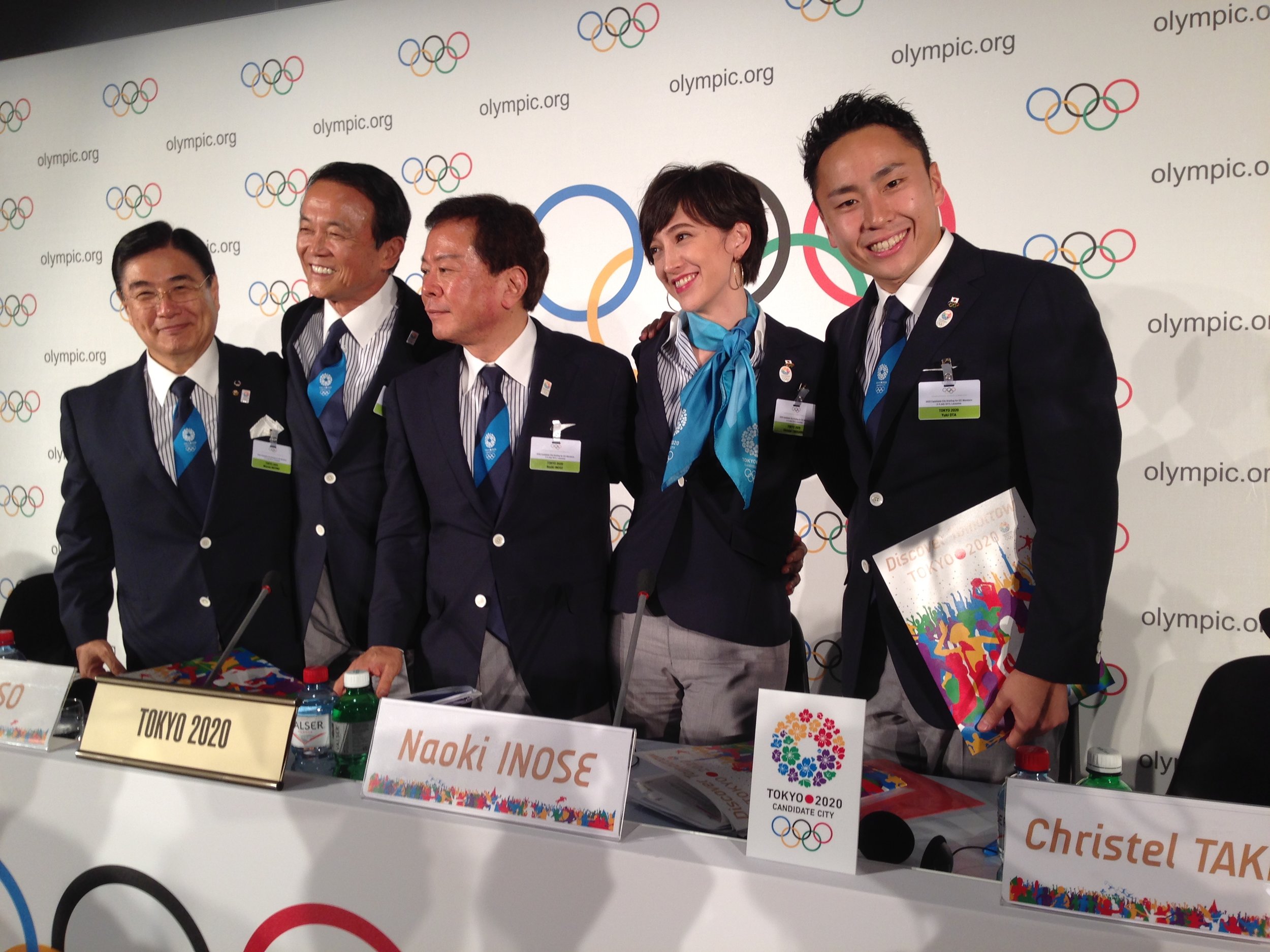
The Japanese came next, unveiling a government-sponsored initiative dubbed "Sport for Tomorrow" comprised of overseas projects aimed at promoting the Olympic movement, the creation of a Japan-based international sports academy and support for the World Anti-Doping Agency.

What the Japanese have -- no problem -- is money. They have a $4.5 billion reserve fund, cash, sitting in the bank.

What they also can tout is security. "The other day my daughter lost her wallet," the Tokyo governor, Naoki Inose, said Tuesday. "It contained $600. The wallet came back. And it contained the cash in the wallet."

What's at issue is whether they can convey to the IOC the passion they assuredly feel, and in particular the way the 2011 earthquake and tsunami in northeastern Japan have served as a catalyst for the bid, and indeed the entire country.

Takeda, proclaiming that Japan's "affected areas are now rising," said that by "maintaining your hopes and dreams, you can rise again," adding, "We can show the world … that is the power of sport … by giving them hopes and dreams through the power of sport, it is possible to rise up."

2013-07-03 14.44.41

The Madrid team closed the day.

The Spanish capital would have to build only four new permanent venues and three temporary sites. In the world of Olympic bids, this is a novel approach, indeed. Because of the bids for 2012 and 2016, "The promises made then are today realities," Samaranch Jr. explained.

The Madrid bid was presented with but five questions from the IOC members. None dealt with the Spanish economy -- a notion perhaps unthinkable perhaps even six months ago.

"A realistic bid for realistic times," Blanco said at the news conference following their presentation. He also offered an extraordinarily fresh take that perhaps ought to be the new 21st-century template for what the Games should be: "Many years ago [the talk was of] the globalization of the Olympic movement," adding, "The true globalization comes today from television. The Games have to be a reality of the country, a reality of the world in which we live. Madrid presented a bid that is compact and a reality of the times in which we live."

On top of all that came the appearance on stage of the crown prince, the honorary Madrid 2020 president, an Olympian and Spain's flag-bearer at the 1992 Barcelona Games. One IOC member called the prince, who told the members he wanted Spain to again feel "promise and hope," the "star performer of the day."

"Whatever the goalposts were, he moved them," the member said.

Added Craig Reedie, the chairman of the IOC 2020 evaluation commission, emphasizing that he was observing, not endorsing, Madrid "lifted their game."

Two months now until the vote in Buenos Aires. Only one thing matters.

As Masato Mizuno, the Tokyo 2020 vice president and chief executive put it in a comment that could apply to all three bids, "We have to get more votes. We have to work hard from now until Sept. 7."