
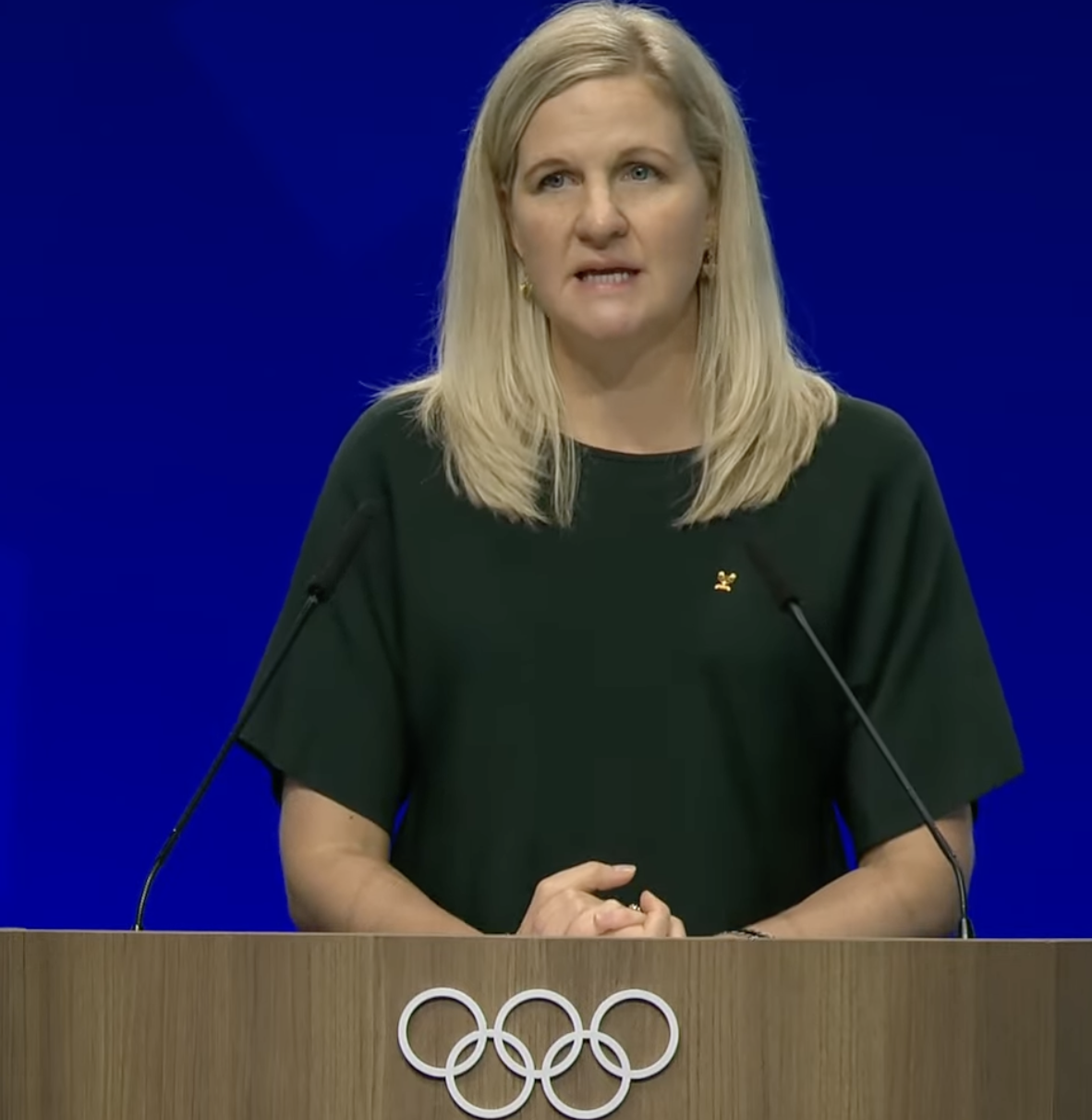
LAUSANNE, Switzerland — Kirsty Coventry clearly has ambition. And some real political talent. She was elected president of the International Olympic Committee in the first round of balloting in March 2025.
Coventry, who is from Zimbabwe, formally took over as president a year ago this week from Thomas Bach, who had led the organization for 12 years, and the symbolism of her presidency is considerable. She is the first female president in IOC history. The first from Africa.
After the first day of an IOC assembly that on Wednesday sprang an athlete pay surprise and ratified far-reaching changes to the sports program that threaten to spark Hunger Games-style infighting — in or out of the program — the comment and the obvious follow-up are both timely and legitimate.
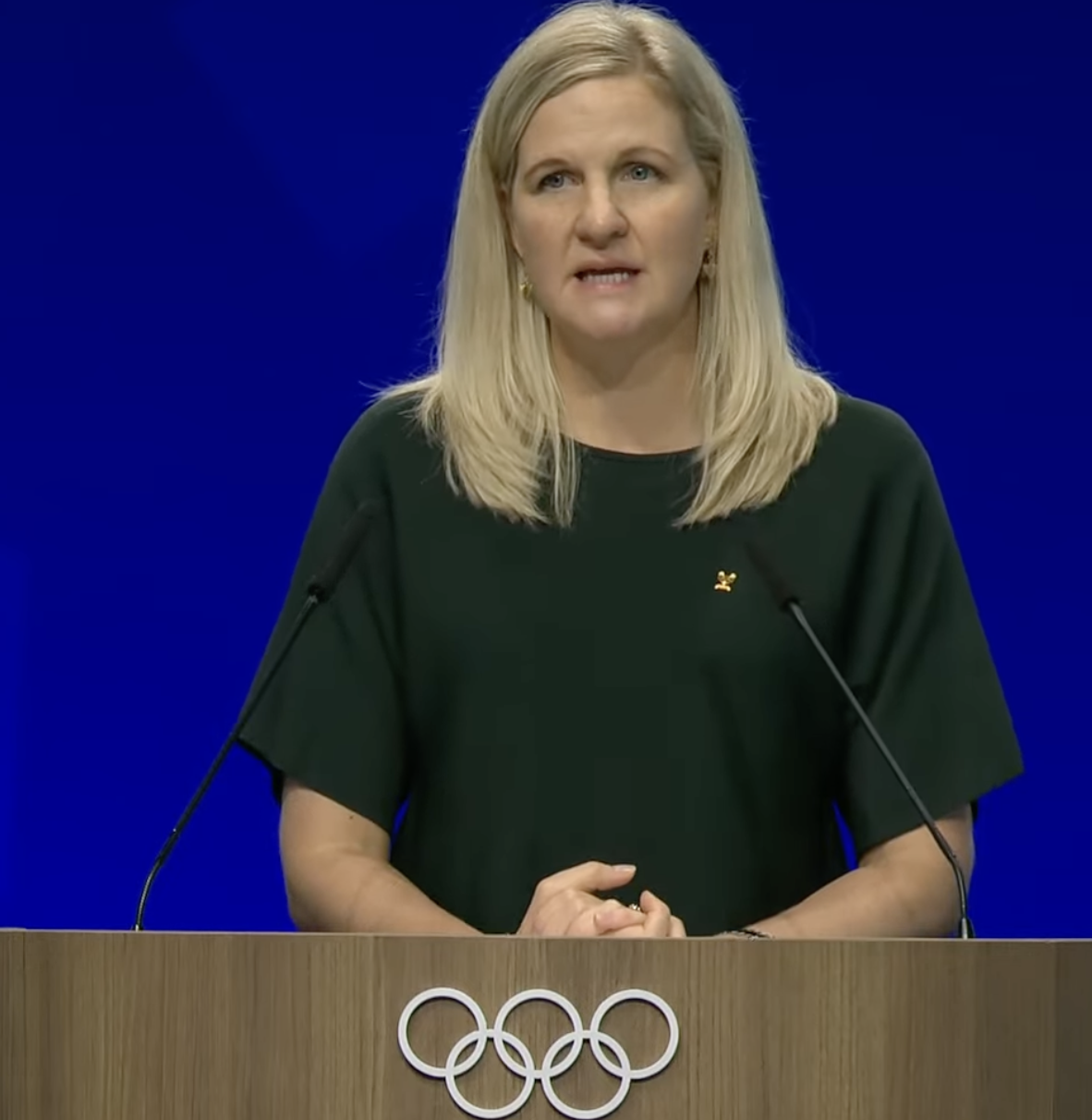
IOC president Kirsty Coventry at the 146th Session // IOC YouTube screenshot
“The kind of movement we want for the future must … be reflected in how we lead,” Coventry said Wednesday amid her opening remarks to the assembly, which in IOC lingo is called a “Session.”
OK, so how is Kirsty Coventry leading?
To her considerable credit, in her first year Coventry has made plain a focus on athletes as the center of the show. In March, she moved — in just one example of a reversal of policy from the Bach years — to protect the female category. And in the big reveal announced late Wednesday, amid weeks of mounting media pressure, the IOC announced that all athletes at the Olympics will be eligible to apply for a $10,000 “grant.”
Coventry asserted that the “grant” project had been in the works for months. Cost: up to $140 million.
“At the end of our day,” she said at a news conference late Wednesday afternoon, “we ask ourselves, is this the right thing to do?” She answered the rhetorical question: “This is the right thing to do.”
Big picture, she said earlier Wednesday, the Games must be “relevant in a changing world.”
Which, she said, meant: “How do we simplify delivery, contain costs and reduce complexity and risks to realize our ambition and our goals?”
Clearly, the gathering Wednesday was not designed to deliver specifics in answer to that — and many other — questions.
“This is not the end. This is the beginning of this next chapter,” Coventry said at a late Wednesday news conference. “We are very clear on the strategic frameworks and the strategies that we want to put in place, and now it’s going to be about implementation.”
If the implementation remains significantly unsettled, a telling shift in tone — one year in — was undeniable.
For starters, there was a fascinating bit of fashion symbolism that speaks to an unmistakable generational shift — Coventry in a black blouse and skirt with comfy red heels, the male speakers almost uniformly in jacket and shirt but no tie. Bach, now honorary president, was, as ever, wearing a (red power) tie. He was not asked to offer the Session his thoughts.
Aside from the “grant” announcement, meanwhile, there was so much word salad one might have thought the IOC had jumped on the ranch dressing-is-great discovery that has marked the ongoing men’s soccer World Cup.
“We want good governance to be applied in practice, followed up seriously and improved over time, and our ambition is just as clear: governance should be visible in the way we work every single day,” said Nicole Hoevertsz of Aruba, who played a key role in marshaling election support for Coventry last year.
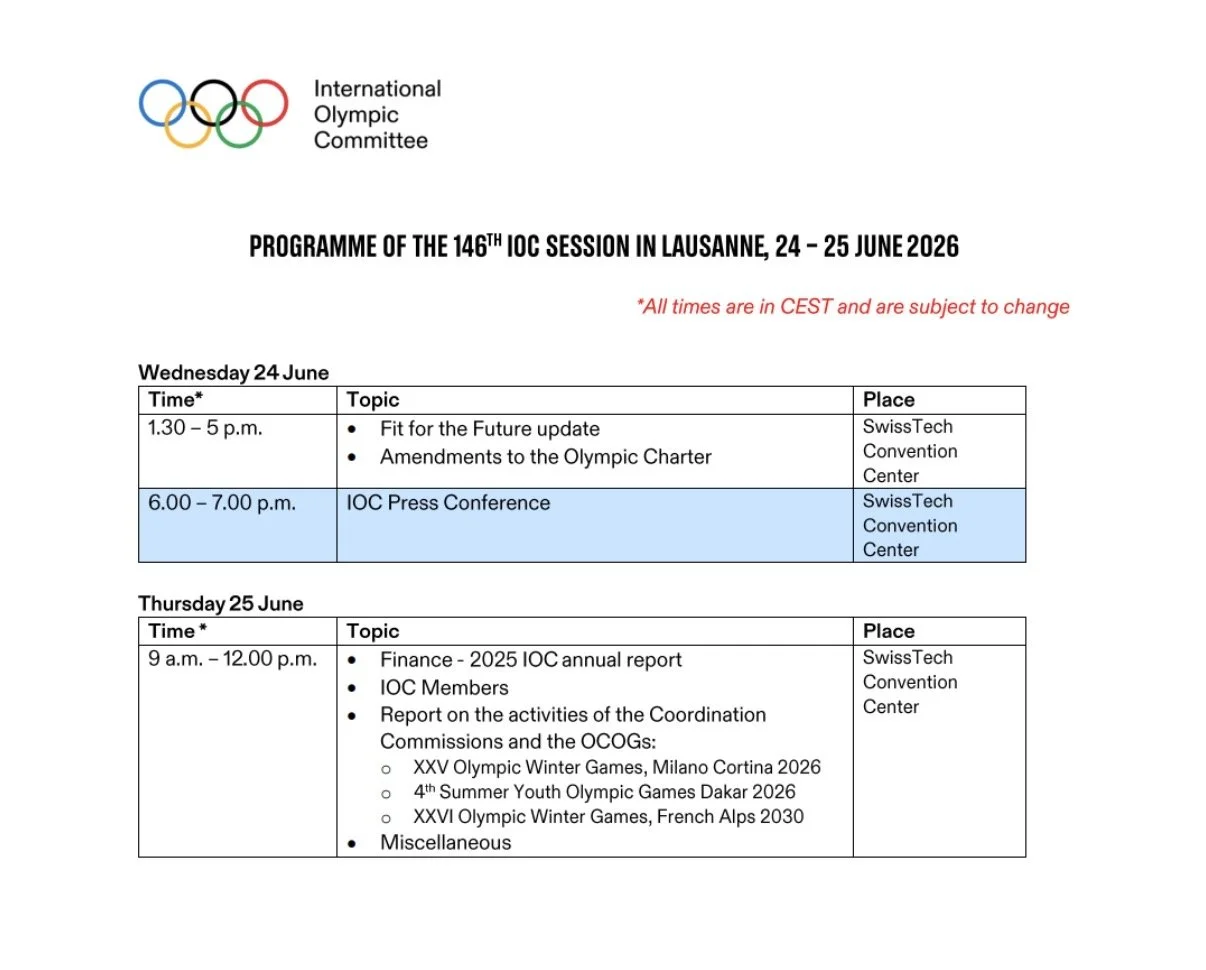
Compare: this is the official ‘program’ for the IOC assembly
There was also a major disconnect. Coventry said listening sessions over the year had proven a “strong demand” for “trust, transparency and accountability.” This, after the members met in the morning behind closed doors to discuss what Coventry has called her “Fit for the Future” plan. Only after, on Wednesday afternoon, was the Session opened to the public.
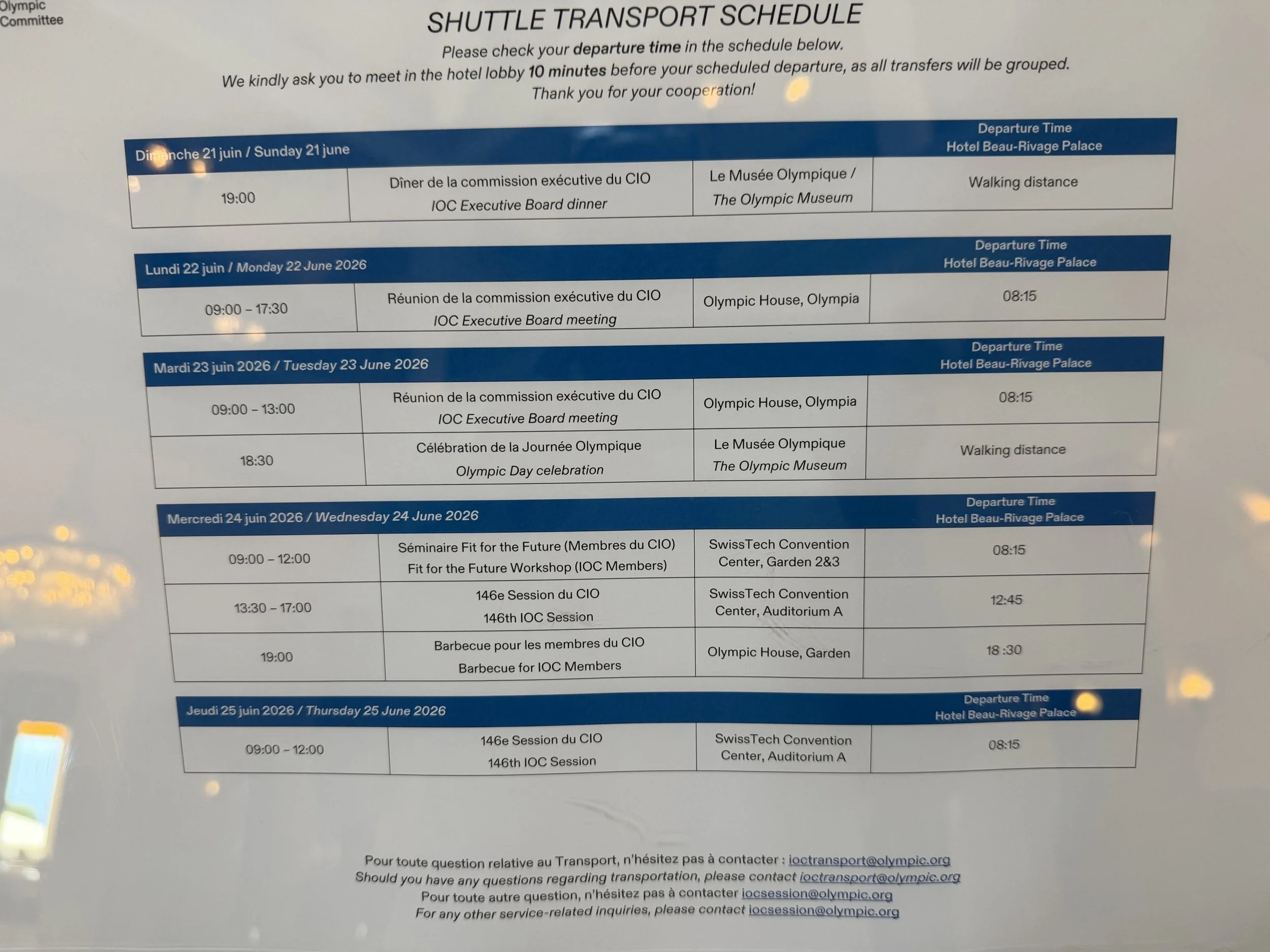
And this, from the shuttle service to the convention hall, tells the real program — including the three-hour ‘workshop’ behind closed doors that, Coventry said, ran to four
This is unacceptable — a marked departure from the assembly-open-to-the-public policy sparked by the Salt Lake City reforms 25-plus years ago. It’s not OK to call it a “workshop” and thus deem it not formally part of the “Session.”
Indeed, Coventry noted at one point amid a North Korea-style no-dissent succession of votes that the “very debatable session that we had this morning has maybe tired you all out,” Which raises the obvious: what were those debates about, and why in secret?
Further, as Coventry said later in the day, the devil is always in the details, and while there were platitudes galore at the Session, there were, regrettably, precious few details in how “Fit for the Future” will or should practically play out.
The one that obviously stands out:
Amid an uptick in media pressure in recent weeks, the IOC announced that, reaching back to the 2026 Milano-Cortina Games and going forward, all athletes at an Olympics will be eligible to apply after a Games for a $10,000 “grant.”
Pau Gasol, the former Los Angeles Lakers and Spanish Olympic basketball star who now heads the IOC athletes’ commission, stressed, “This is not prize money. This is about recognizing the journey and the commitment that it takes to become an Olympian.”
Some 14,000 athletes in each four-year period are expected to be eligible, the IOC said. That’s how the number gets to $140 million. Where is the money coming from? “It’s coming from the IOC,” Coventry said at the news conference. Are NBA and NHL stars eligible, too? Yes.
Credit here needs to go to a leading proponent of athletes being paid fairly: the International Boxing Association president Umar Kremlev. Bach had the IBA thrown out of the Olympic scene.
World Athletics president Seb Coe, who advanced the pay debate by awarding prize money in track and field at Paris 2024 — which Bach resolutely opposed — said from the floor, “This is a historic moment, and I’m absolutely delighted to be in the room when this has been announced.”
Inevitably, there will be complications to the “grant” scheme.
Funds will be delivered to the national Olympic committees, who will then be responsible for delivering each $10k. Will they? Will this authority further empower the NOCs even as the international sports federations were literally written out Wednesday of the Charter?
Another complexity: will the European authorities view a “grant” as something other than a “salary”? Does a “grant” get around the thorny issue in European circles of Olympic athletes potentially becoming “employees”?
What about the Paralympic athletes?
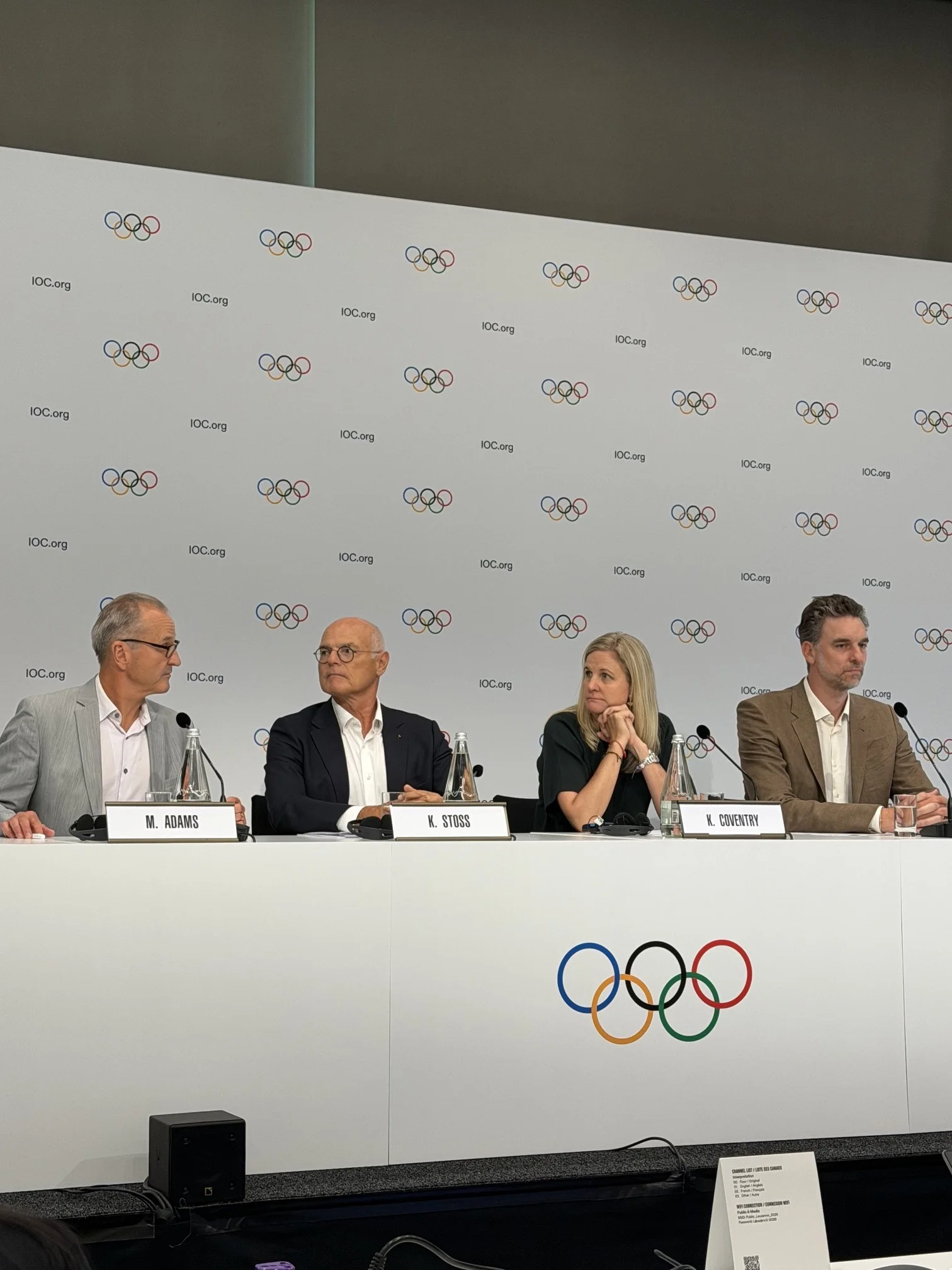
At the post-Session news conference: spokesman Mark Adams, Austrian IOC member Karl Stoss, Coventry, athlete commission chair and basketball star Pau Gasol
Meantime: the 2036 Summer Games site will be picked in 2029.
As for the rest:
“The next step is where all the details will count,” Coventry said in the moments before the members approved, without dissent, the notion of assessing not sports but “venues” and “disciplines.”
“Fit for the Future,” Coventry said, “is a document that will not sit on a shelf. It’s a living document, a compass, a mindset, a commitment that we will continue listening, learning and adapting as the world around us evolves. Because this is not only about us, it’s about our children and their children.”
It has been increasingly clear that Coventry’s tack during this first year has been to repudiate considerable pieces of the Bach presidency — for instance, stepping back from his one-on-one work with an array of world leaders to assert that, now, the IOC focus is on sports. Politics? Not so much.
The members on Wednesday approved a change to the “Fundamental Principles of Olympism” in the Charter that removes the word “political” before “neutrality” and adds the words “at all times” to this sentence, reading now:
“Recognizing that sport occurs within the framework of society, sports organizations within the Olympic movement shall apply political neutrality at all times.”
What does this mean in practice for Russia being back at the Olympics by LA28? Immediately unclear.
Of note:
Last week, the G7 leaders, including U.S. President Donald J. Trump, convened in the French resort town formally called Évian-les-Bains (where fancy Evian water comes from), a mere half-hour ferry ride straight across Lake Geneva from Lausanne. The Los Angeles 2028 Games are in two-ish years. Did Coventry meet with Trump or, for that matter, French president Emmanuel Macron, a Bach regular in the run-up to Paris 2024? The problematic 2030 Winter Games are in the French Alps.
Answer: When the IOC holds official meetings, it communicates them. There were no such communications.
Bach pushed Coventry as his successor, and it must have been awkward, if not worse, to sit on her immediate left at the dais, that red tie speaking of a time gone by. It is fair criticism of Bach to note that it was his way or the highway, but there can be no doubt that he led the IOC through the existential crisis — two Games, Tokyo 2021 and Beijing 2022 — that was the pandemic. No one can ever question his passion for and deep institutional knowledge of the Olympic movement. For all that, if the stories that are circulating widely are to be believed, since she was elected Coventry has sought from Bach exceedingly little input and insight. If that much. The past, it is frequently said, has little if any attraction for Coventry in being fit for the future.
The future, though, demands substantive action now.
It’s not a reach, not in the slightest, to assert that the IOC, given the changes in the way the organization is funded and the advent of social media as a communication driver, and more, much more, finds itself at an inflection point.
Coventry recognizes this: “It is normal in any organization’s evolution over 10 to 12 years’ time to take stock of where we are, to pause and reflect, and then be able to readjust and realign where the movement feels we should be.”
Paris 2024 has been hailed as a success, and Tony Estanguet, who oversaw delivery of those Games, summoned from the lectern the emotion of “the whole city alive.” If it was so great, one would think corporate sponsors would be in line to sign up. Since Paris, the IOC has signed one top-tier sponsor, JP Morgan Chase, and that is more than anything an LA28 buy.
Nor is it a reach to observe that the Olympic movement is, by and large, full of well-meaning people — if sometimes, let’s say, grubby — but the IOC staff is both too much and too little.
That is, during the Bach years, the staff grew enormously. Why has Coventry not already made the needed cutbacks? Moreover, the culture at Olympic House, the gleaming IOC headquarters building by the lake that opened during those Bach years, has turned profoundly risk-averse. An apt analogy: Olympic House might as well be a 21st-century castle surrounded by a figurative moat. Who gets in? The drawbridge stays up and, more importantly, goes down for — who, exactly? And is anyone inside — listening?
The IOC indisputably needs initiative. So — what, really, does Fit for the Future do? Coventry on Wednesday called it a “living framework that adapts as we learn and we move forward.”
In plain English, what?
Everyone knows the Games are too big. LA will see 36 sports. Instead of just making cuts that are beyond common sense — why is men’s soccer in when it’s for players 23 and younger, meaning the best players don’t play? — the IOC has opted to focus on, again, “venues” and “disciplines.”
And what is a “discipline”?
The definition: one or more events within a sport that require either a dedicated field of play or a significant modification of a shared field of play.
Pick: lacrosse, flag football, squash, more. Congrats, you’re in for 2028. Beyond? Are you, in the new IOC lingo, an “incumbent discipline” or a “candidate discipline”? Another example: open water swimming doesn’t share a venue. Should open-water swimmers be worried?
“Criteria and data points will evolve over time,” said Karl Stoss, the Austrian IOC member who promised an “objective, robust, incredible analysis.”
So, in American lingo, are the goalposts ever-shifting? What?
Coventry has stressed the IOC must confront hard choices. How is she going to lead the IOC through those hard choices?
“The world will keep changing, and so will we,” Coventry said as the open part of the Session wrapped up. “Today is not a finish line. It is the start of our next chapter.”
The symbolism of the Coventry presidency is real and meaningful. But symbolism will not prove enough. Not nearly.