
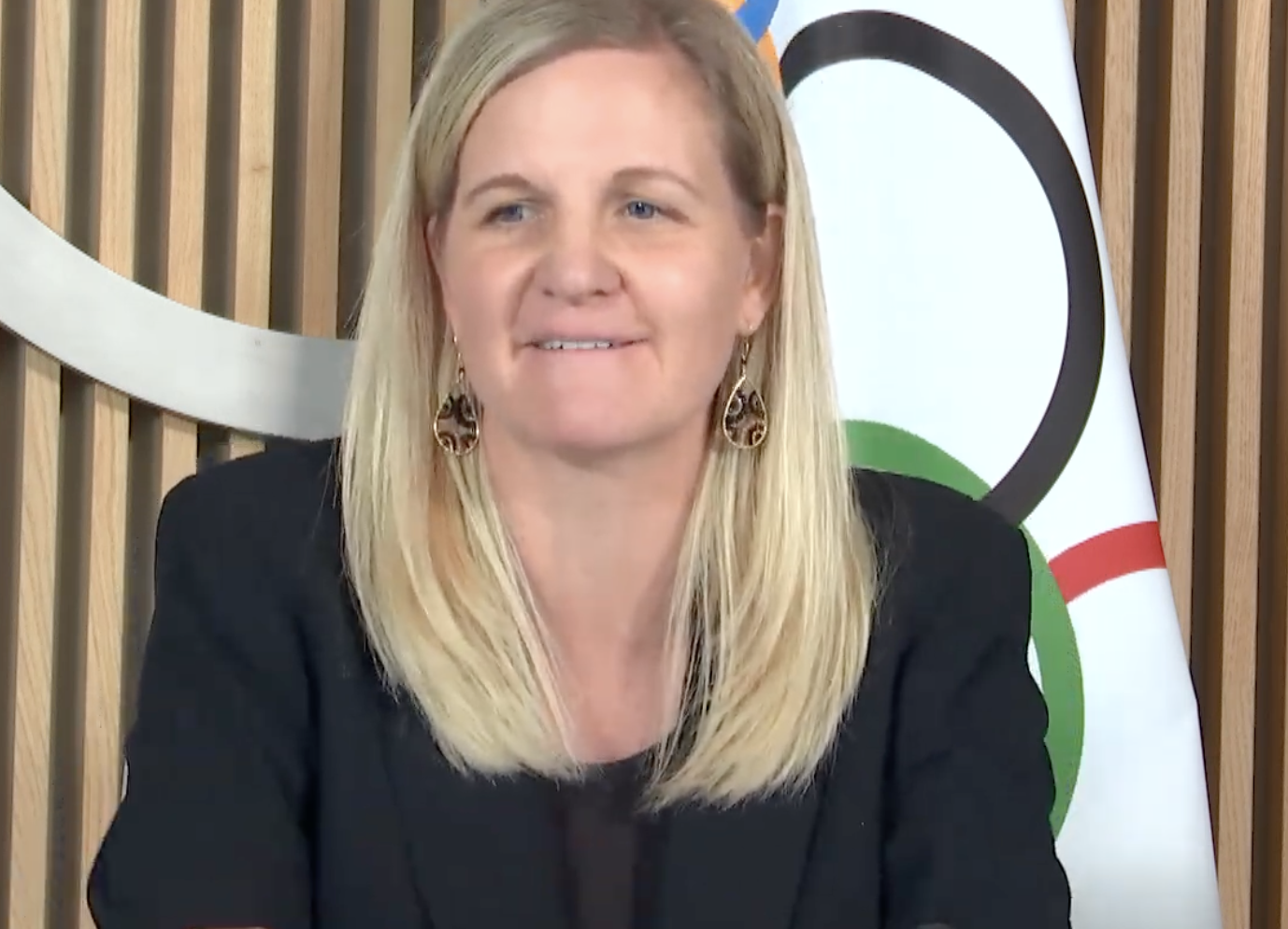
Kirsty Coventry has been president of the International Olympic Committee for, by her count at a news conference Thursday, 318 days.
In almost every meaningful way, Coventry is now executing a pivot away from predecessor Thomas Bach, IOC president from September 2013 until last June. Indeed, it is said behind the scenes in Lausanne, at IOC headquarters, that Coventry has little to maybe no interest in the past — only what lies ahead.
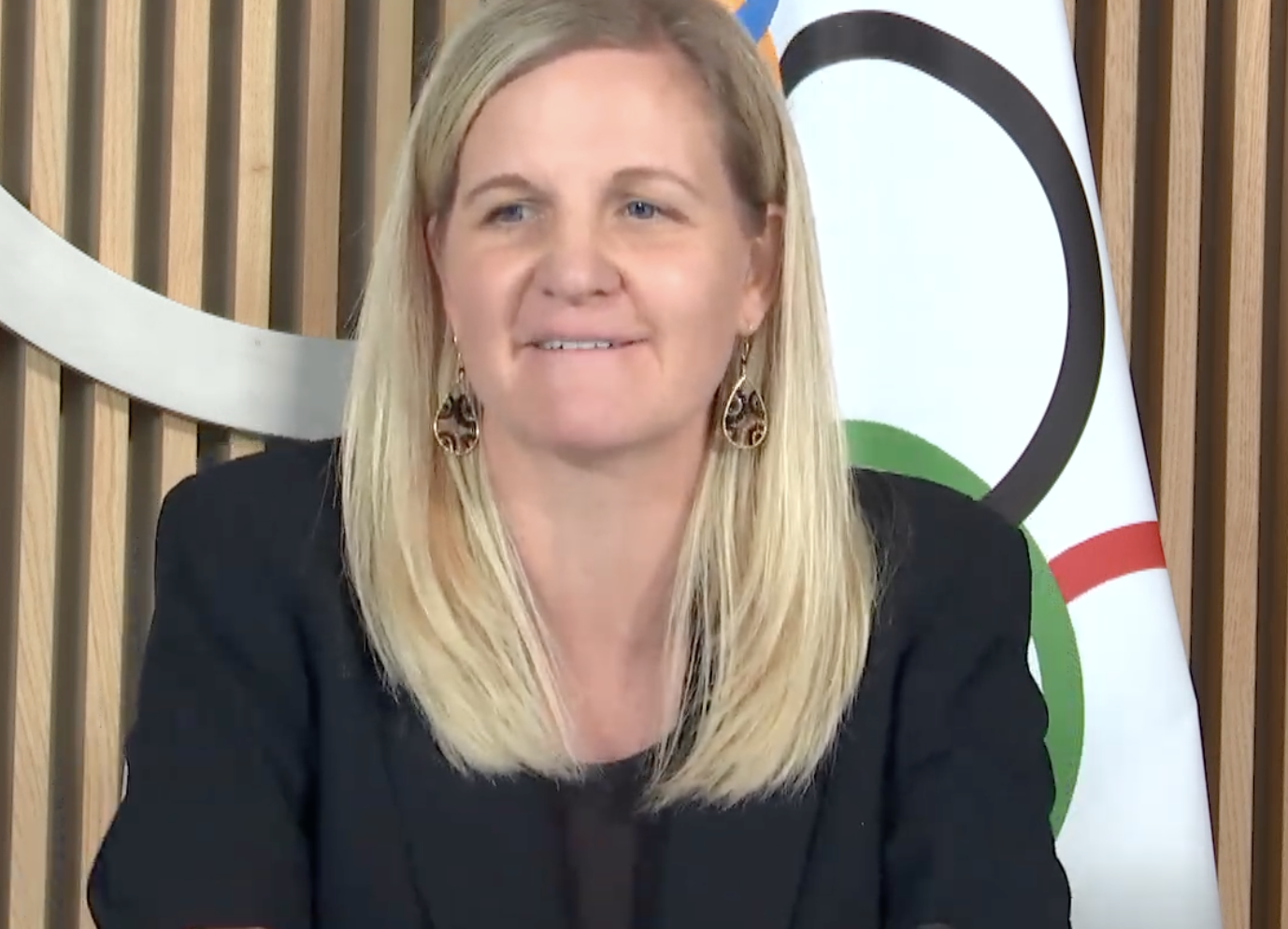
IOC president Kirsty Coventry during Thursday’s news conference // YouTube IOC media screenshot
Sports diplomacy as an IOC driver? Not really. Female category protection? Yes. And, as Thursday’s news conference made clear, after the policy-making Executive Board meeting and ahead of June’s IOC all-members assembly, a focus — in almost every way — on the IOC basics:
The athletes. Plus, which sports and. perhaps more important, which not.
1/ In response to a question about esports in the Olympics, Coventry said the IOC is “focusing on our core business and trying to make strong future strategies for the core business first.” Asked about the Russians on a day when the IOC recommended restrictions on athletes from Belarus be done away with, Coventry said, “Our remit is sport … we made it very clear we want all athletes to be able to participate.”
2/ Big picture, the IOC reminded in a statement Thursday, the mission is “to preserve a values-based and truly global sporting platform that provides hope to the world.”
3/ In that news conference, Coventry noted time and again that she was herself an athlete (for the record: a champion swimmer, seven Olympic medals, two gold). And that she remembers — because it truly was not that long ago, her fifth and final Games in Rio in 2016 — what that means.
What does this mean in practical terms?
— Bach pushed hard for Coventry to succeed him. She is the IOC’s first female president. She is the first from Africa (from Zimbabwe). Now she clearly would seem in the business of moving away from, if not repudiating, sooner if not later, but presumably sooner, some if not most of the key markers of his presidency.
When Bach took over, he convened a number of working groups under the guise of what would become “Agenda 2020,” a purported 40-point reform plan. During his 12 years, he spent considerable capital working with the United Nations and flying around the globe to meet with this president or that prime minister.
Coventry’s working groups are directed toward something called “Fit for the Future.” What is fit, and what are the details that will help shape that future? Perhaps the big reveal is forthcoming at the assembly in June. Nearly a year in, she has yet to go on anything resembling a tour of world capitals.
— Meantime, as my Canadian colleague Rob Livingstone astutely pointed out in a tweet after Thursday’s news conference, the IOC’s expansion era is over amid a drop of revenues triggered by the loss of top-tier sponsors after the Paris 2024 Games.
This means:
Esports — all but dead as an Olympic proposition.
The future of the Youth Olympic Games, an initiative launched nearly 20 years ago under the presidency of Jacques Rogge and carried on through the Bach years — uncertain at best.
The next YOG editions: Summer, later this year in Dakar, Senegal (Coventry, who is from Zimbabwe, can hardly cancel an African YOG), and Winter, in northern Italy in 2028. After that? Could well be like esports. Bye.
— The nature and number of sports in the Olympics is gonna change. Big time.
Winter Games: still ice and snow through the 2030 Games in the French Alps. After that, who knows? Could, for instance, cyclocross and cross-country running make it? Should certain indoor sports on the Summer program be shifted? Can the Winter sports federations (traditionally lower funded, and like everyone, they can read the post-Paris financials) be convinced to let Summer federations into the Winter tent?
Maybe, or not, and in the meantime:
There were 26 sports on the program at the London 2012 Games. In Los Angeles in 2028, there will be 36. In Brisbane in 2032, there will not be 36, Coventry saying the IOC is “under the very big realization we can’t continue to just get bigger, bigger, bigger, bigger, bigger.”
The IOC is trying to assess every sport not in the typical way, but through a different lens — disciplines.
Why? Every sport, through the various disciplines, needs a venue. Venues typically are not inexpensive.
London: 26 sports, 39 disciplines, 302 medal events.
Los Ángeles 2028: 36 sports, 51 disciplines, 351 medal events.
A, if not the, variable not much talked about Thursday for public consumption: flag football, likely to be the breakout sport at LA28, which has — back again to the income question — the enthusiastic backing of the NFL. Who would want to lose the NFL?
“We feel we need to regain the control of the program. We are the leaders,” Coventry said, meaning the IOC. Referring to the Games, she said, “This is our product.”
— If Belarus is back, why not Russia?
The obvious starting place for this very complicated issue: Russia invaded Ukraine in February 2022, days after the close of the Beijing Winter Games.
Athletes from Russia and its ally, Belarus, have largely been banned from international competition since, though some have been permitted in as neutrals.
“The IOC reaffirms,” it said in that statement Thursday, “that athletes’ participation in international competition should not be limited by the actions of their governments, including involvement in a war or conflict.”
To be clear: “back” for Belarus means the IOC “recommends” the dozens of international sports federations follow its lead. World Athletics, as was reported by the BBC and others, said later Thursday it would not — that the ban it imposed in 2022 after the invasion remains in effect for Belarus and Russia, and that it needs to see “tangible movement towards peace negotiations” before “it can begin to review its decisions.”
This, of course, stands in direct conflict with the IOC assertion that athletes should not be held responsible for what their governments do, or not.
It is worth remembering that, though most people see the IOC as something akin to an all-powerful Wizard of Oz in the Emerald Olympic City, it is almost always the case that the sports — that is, the federations — run them, even (especially) at the Olympics. (Notable exception: IOC-overseen boxing, Paris 2024, and look how the women’s competition sparked huge controversy.)
There are those in the Olympic landscape, especially Nordic nations, who don’t want Russia back.
There is also a push elsewhere, and significantly, to bring the Russians back into the fold — for if the Olympics stand for an aspirational ideal, who is to say that Russian boys and girls should be denied hope?
There is, to continue, antipathy in some quarters toward the Russian president. Then again, there is considerable venom directed toward the American president, too, and no one is seriously suggesting American athletes ought to be banned amid the conflict in the Middle East.
There is the history of Russian doping — and renewed concern that the state is still meddling inappropriately, sparked by recent reports about the chief executive of the Russian anti-doping agency, Veronika Loginova. A “known source” made “another serious allegation” last December against Loginova, World Anti-Doping Agency officials said Thursday, adding that its investigations department — which operates independently — is inquiring. The IOC noted Thursday these issues “with concern.”
“I was an athlete in 2016,” Coventry said Thursday, alluding to the Russian doping issues with her next words. “It was messy.”
To be crystal clear, though, the issue at hand with the Russians is not, at least not immediately, doping. It is the war.
Or, more precisely, that amid the war, the Russian Olympic Committee recognized regional organizations from four eastern Ukrainian territories. That led the IOC to suspend the ROC. It is still suspended.
The national Olympic committee of Belarus had not been suspended. “They’ve always been in good standing,” Coventry said, meaning that NOC.
Coventry said there had been “constructive” talks with the Russians. Meanwhile, the IOC’s legal affairs commission “continues to review the matter.” In a story Thursday, TASS quoted the Russian sports minister, Mikhail Degtyarev, as saying the ROC had given the IOC “an ample package of documents long ago that prove there are no legal grounds” to keep the ban in place.
In that statement released Thursday, the IOC — in keeping with the position since Coventry took over — noted that a key piece of “Fit for the Future” is, in its words, “the fundamental right of athletes to access sport and compete free from political interference or governmental pressure.”
It’s in everyone’s interest for resolution to come, once more, sooner if not later but presumably sooner — qualifications for the LA28 Games begin this summer.