
There is stupid and then there is the decision by officials at Sunday’s Los Angeles Marathon to award “finisher” medals to untold numbers of people who ran 18 miles instead of the prescribed 26.2.
Organizers said heat prompted the move. Even at the beach, by late morning it was nearly 80 degrees, or 27-ish degrees Celsius. Inland, along the course, it was for sure hotter.
So what?
The idea that someone should get rewarded for 18 instead of 26.2 reflects the very worst sort of snowflake culture run, if you will, amok — you’re so special because you tried, gosh darn it.
Moreover, when we recognize effort that spotlights shortcut, it’s thoroughly corrosive.
In a world where AI increasingly threatens the value of human effort because what AI delivers is shortcut, we must — all the more so now, and emphatically — recognize not just the essence of but the valor in being human in doing something that holds physical, mental and emotional if not spiritual challenge, that is thus fully and completely demanding, that is, in a word, authentic.
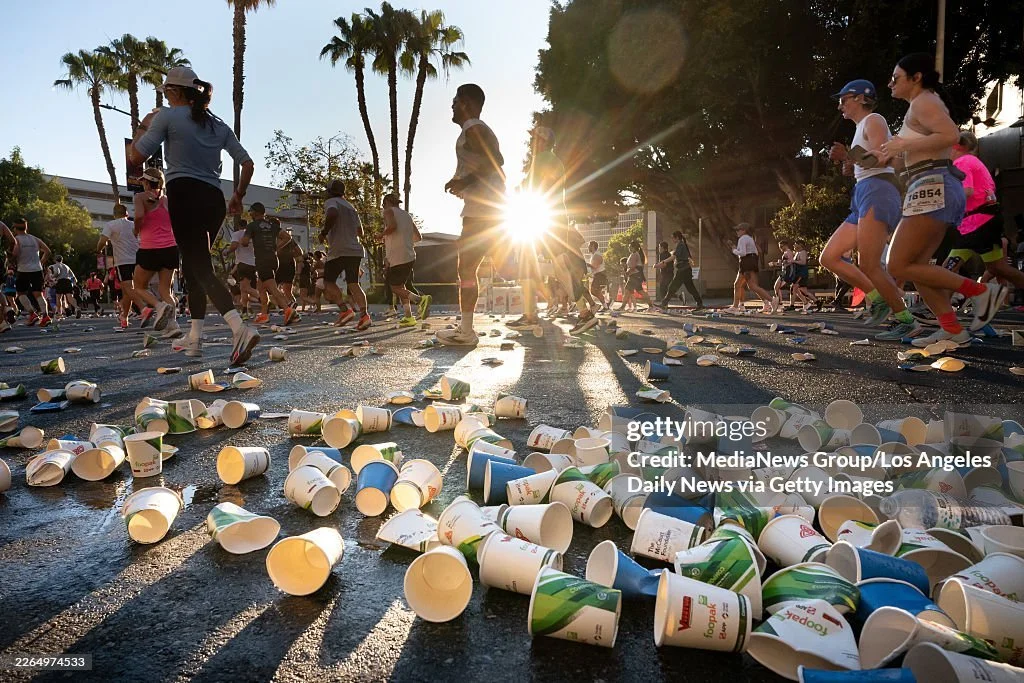
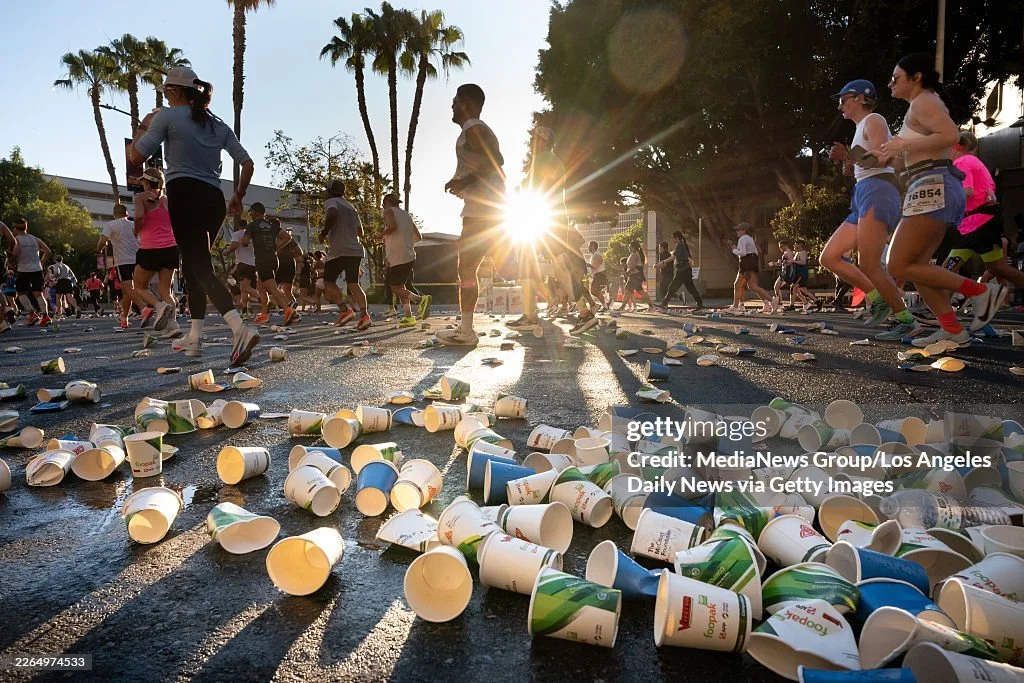
A water stop along Grand Avenue during Sunday’s 41st running of the LA Marathon // David Crane/MediaNews Group/Los Angeles Daily News via Getty Images
That is what 26.2 is all about.
Not 18.
This point is all the more relevant here in Los Angeles, where a big piece of the annual marathon, roughly 10% of all finishers, involves a group known locally as SRLA — Students Run Los Angeles, where the mission is to teach middle and high school kids to set goals and achieve them by finishing.
The numbers for 2024-25, which as a reminder included the January 2025 fires, showed 3,818 students from in and around LA, 81% of whom are Latino.
The program dates to 1986, when teacher Harry Shabazian challenged a first group of kids to, as it now says on the SRLA website, “lace up, train hard and complete the Los Angeles Marathon with him.”
That first group didn’t just finish the race — they finished high school and went to college.
It has been ever thus. Of those 3,818 who took part in the 2025 race, 99% finished — and 94% said they plan to attend college.
The 2026 SRLA success numbers are yet to come. But the LA Daily News, in a lengthy story about the thousands who ran Sunday as part of SRLA, quoted high school senior Nicolas Soltero: “This one was really challenging. The heat definitely played a big factor.”
Still, he said, he ran in part for family and friends waiting at the finish line: “I thought about my family and friends. I didn’t want to disappoint them.”
Marathons are hard and warm weather makes them harder — that’s why, for instance, the 2019 world championship marathons in Qatar were run at midnight and the 2021 Olympic marathon, set for Tokyo, was moved north to cooler Sapporo.
Nathan Martin, 36, a substitute teacher and track coach at Jackson High School in Jackson, Michigan, won Sunday’s men’s race, in 2 hours, 11 minutes and 18 seconds. Kenya’s Priscah Cherono, a 45-year-old mother of three who lives in Colorado Springs, Colorado, won the women’s race in 2:25.20.
These times, of course, are for 26.2 miles.
Not 18. No one wins anything at 18.
Of course, a big-city marathon features a pack of top racers and then thousands of people — 26,000 registered for Sunday — who are out there not to win but, like the SRLA kids, for the run itself.
All the same, a marathon is not kindergarten AYSO soccer, where everyone gets a participation ribbon. That’s for 5-year-olds who are playing games that don’t count.
A marathon counts.
There is a clock. And a finish line. That’s how you know.
When, at the 1968 Olympics, the Tanzanian John Stephen Akhwari staggered across the line, last, 57th, he said, “My country did not send me seven thousand miles to start the race. They sent me seven thousand miles to finish it.”
At the 2013 track and field world championships in Moscow, the American John Nunn, in screaming pain, crossed the 50-kilometer race walk dead last by about an hour. He collapsed and had to be carried off on a stretcher. His uniform had to be cut off him. “I learned,” he said later, “you just don’t quit.”
This is what stepping off at 18 is — quitting.
We need to be direct about this, even for those who stepped off because it was warm and all the more so because these were recreational runners at the LA Marathon, not hardly an Olympic Games. It probably was smart, medically, to call it a day and try, try again another time.
Indeed, this was the rationale the organizers put forward Sunday in opting for 18-mile finisher medals: it was prudent to be mindful of the heat.

Fans on Rodeo Drive in Beverly Hills // David Crane/MediaNews Group/Los Angeles Daily News via Getty Images
“There is no shame in making a smart decision for your body,” the McCourt Foundation, which operates the race, said on its website, also proclaiming, “No matter how many miles you complete on race day, you should be proud of what you’ve done.”
No question.
But that doesn’t make you a legit marathon “finisher,” not in Los Angeles in 2026 or anywhere, anytime.
The gut part of a marathon is from 18 to 26.2. This is also well known. It’s why 26.2 is so demanding.
If LA Marathon organizers want to award a certificate or another token to those who ran 18, all good. But it cheapens the accomplishment of those who ran 26.2 to lump 18 and 26.2 together. And it inevitably will call into question the legitimacy of the event, the LA Marathon, altogether.
Not finishing a prescribed course — and calling it all good — is not how sports work. Or, for that matter, a million jillion things in life itself.
Is that high school kid who turns in a test with 30% of it still to go likely to be told — good enough? What kind of message is that? How does that jibe with the SRLA ethos?
Out in the real world, your boss says I need a 26-page memo by midnight? You do 18 and say, at 11 p.m., tired, even though you still have so much to do, good enough.
Something costs $26? I’ll give you $18 — whaddya mean that’s not good enough?
And on and on.
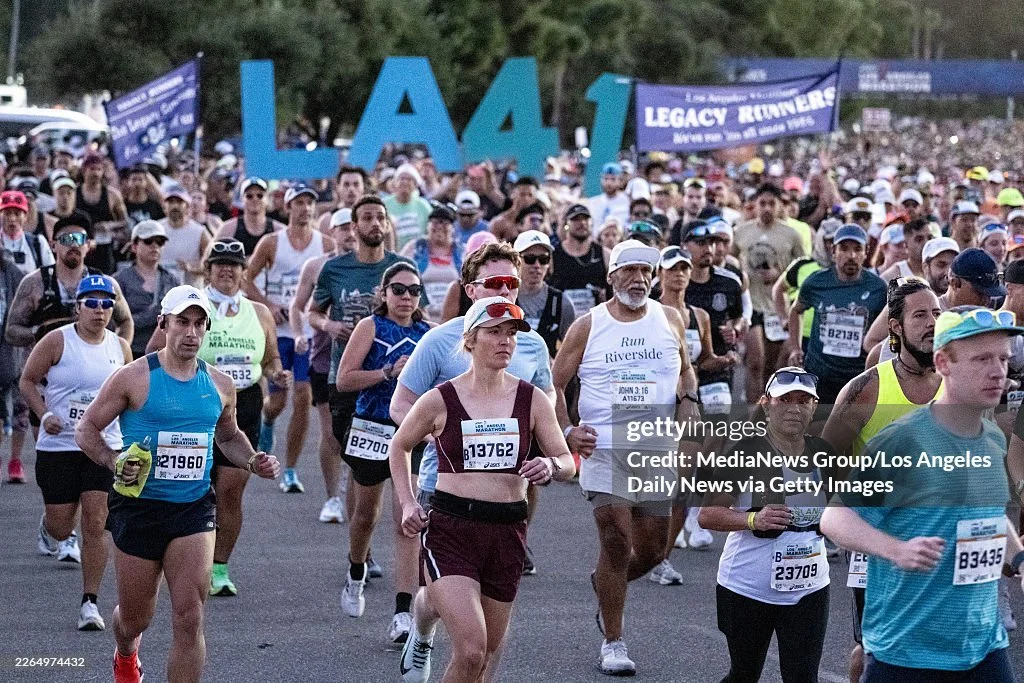
The start of Sunday’s race at Dodger Stadium // David Crane/MediaNews Group/Los Angeles Daily News via Getty Images
The entire point of a marathon is the struggle. And the authenticity that goes with crossing the line at 26.2.
In marathons, especially, organizers are typically on the lookout for cheaters — which is what we would otherwise call people who don’t run the full distance but later claim they did, which is 100% why it’s absolutely absurd for race organizers to lump 18 in with 26.2.
This is such an obvious and, once more, well-known point that any number of major outlets have written about what, as the Guardian put it in a September 2018 piece, “makes a person claim a medal when they haven’t gone the full distance.” The story was headlined: “Meet the marathon cheats.”
The New York Times, all the way back in 2009, ran a front-page story — front-page, because 26.2 is the standard and anything less not — in which the-then director of the New York Marathon, Mary Wittenberg, made it explicit:
“We have a duty,” she said, “to make sure that everyone who crosses our famed finish line earns the medal they achieve.”