
MILAN — The late Bud Greenspan made films about the Olympics. In 1968, as the story famously goes, he waited at the end of the men’s marathon in Mexico City. In the darkness, John Stephen Akhwari of Tanzania, who had fallen midway through the race, finally finished, bloodied — more than an hour after the winner.
Why, Greenspan asked Akhwari, did you keep going?
In remarks that have since come to define the essence of the Olympic spirit, Akhwari said, “My country did not send me seven-thousand miles to start the race. They sent me seven-thousand miles to finish the race.”
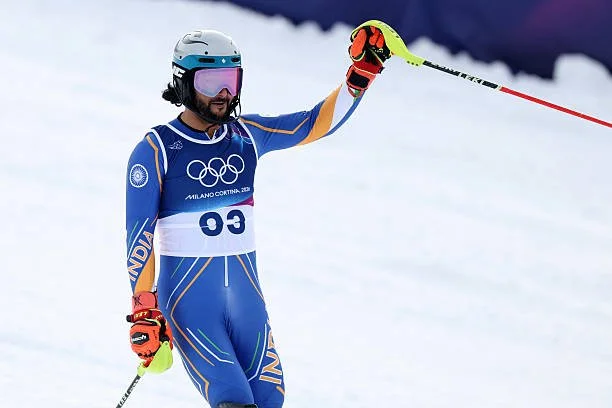
Skiing got its Bud Greenspan moment here at these 2026 Milano-Cortina Winter Games. In men’s slalom, India’s 35-year-old Arif Khan, with back pain and more, finished dead last. In a sport in which races are won by hundredths and sometimes thousandths of a second, Khan finished nearly 48 seconds behind the winner, Switzerland’s Loic Meillard.
But — Khan finished.
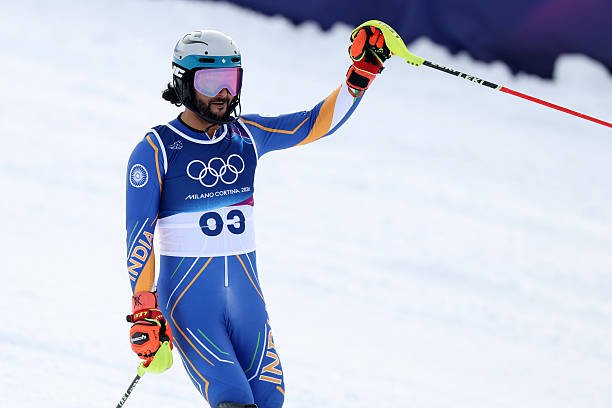
India’s Arif Khan after finishing the 2026 Winter Games men’s slalom // Getty Images / Sean M. Haffey
In conditions that knocked more than half of those who started out of the race, among them Norway’s Atle Lie McGrath, the first-run leader who after missing a gate took off his skis and literally walked into the woods, distraught, Arif Khan finished.
“Sometimes,” Khan said in the moments after the race, “I tried to ski faster but,” because of the weather and the pain, “the reactions were really restricted. So, I just kept in my mind, ‘Just finish the race, no matter what it is.’”
In a lengthy interview a couple of days later here in Milan, Khan said, referring to himself among the official list of finishers, “The name is there,” adding, “That’s a great thing for my country, which,” and here he meant India, “I really love.”
Slalom is the Winter version of the 100-meter dash at the Summer Games. It draws athletes from the four corners of the world. Just to be here. Not a snowball’s chance of winning anything.
In Monday’s race: Uruguay, Thailand, Jamaica, the Philippines, the United Arab Emirates, Saudi Arabia, Hong Kong, Guinea-Bissau and more.
In the Olympic world, this is called “universality,” the idea that everyone can take part.
The plain fact, though, is that at the Winter Games hardly everyone takes part. At the Summer Games, athletes come from all 206 national Olympic committees — more representation than the United Nations, which counts 193 nation-states. At these 2026 Winter Games, there are athletes from 92 delegations.
India has been part of the Winter Games since 1964 — albeit, and this is what Khan wants to change, in a limited way, typically sending a handful of athletes. India, with almost 1.5 billion people, the most populous nation on Planet Earth, has never won a Winter medal.
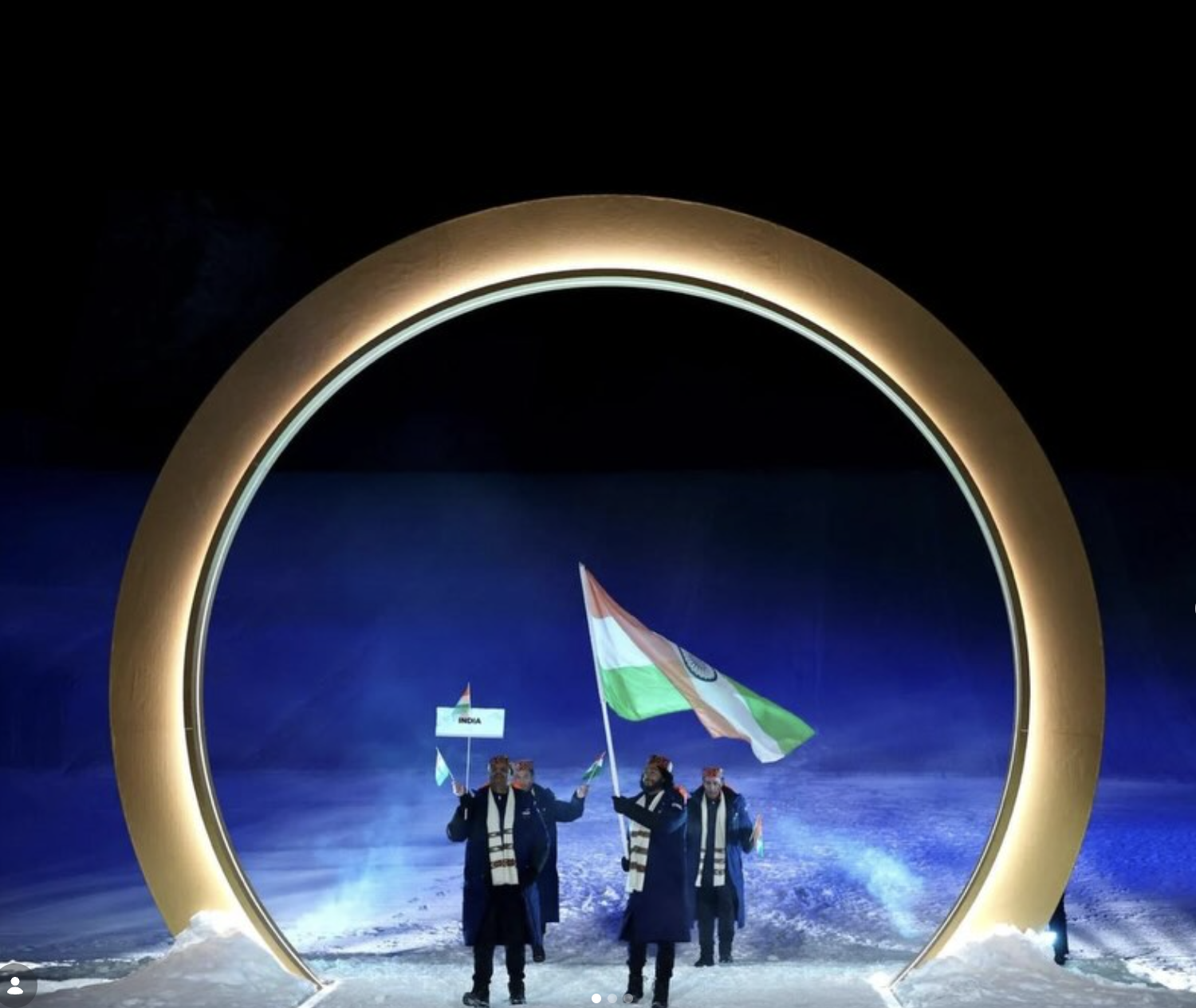
Khan leading the Indian delegation at Milano-Cortina 2026 opening ceremony // Instagram / Arif Khan
China has 1.4 billion people and has used international sport to project soft power — staging the 2008 Summer Games and the 2022 Winter Games. It sent a team of 126 to these 2026 Games. Heading into the final few days of these Olympics, China had nine medals, including two gold, after Xu Mengtao on Wednesday repeated her Beijing 2022 gold in women’s freestyle aerials.
India has never staged the Olympics.
Here, India sent two athletes — Khan and 27-year-old cross-country skier Stanzin Lundup. In last Friday’s 10-kilometer interval start, won by Norway’s Johannes Høsflot Klæbo, 111 guys finished. Lundup was 104th, almost 8 minutes back.
Four years ago, in Beijing, Khan was India’s only athlete. He finished 45th in giant slalom. He did not finish the slalom.
The mystery is why it’s all so different in India from China — particularly because, contrary to a widely held impression that it’s steamy hot everywhere in the subcontinent, India assuredly has mountains on which it could train winners.
They’re called the Himalayas.
“We are not a country that does not have mountains,” Khan said. “It’s not that we don’t have snow. It’s not that we don’t have landscape. We are full of all of that.
“We have to put it all together.”
Khan grew up in those mountains, in the far northern Indian state called Jammu and Kashmir. His father, Yasin, now 70, runs — still — a ski shop in a tourist town called Gulmarg.
Gulmarg, not far from the Pakistan border, is about 30 miles from Srinagar, the state capital (Srinagar is the second-largest metropolitan area in the Himalayas, after Kathmandu).
Denver, where the altitude shapes NFL games and the way baseballs fly out of the Colorado Rockies’ Coors Field, is 5,200 feet above sea level — that’s just under 1,585 meters.
Gulmarg sits at 2,650 meters, or about 8,700 feet. It gets … a lot of snow.
Gulmarg is high on Mount Apharwat, with well over 1,330 vertical meters of skiable terrain. The Gulmarg Gondola is the highest ski lift in the world, up to 3,980 meters — 13,057 feet above sea level.
Arif Khan’s younger brother, Raja, is a snowboarder — who in 2024 won a bronze in a race in Serbia sanctioned by the international ski and snowboard federation, which goes by the acronym FIS. The younger brother broke his leg two weeks ago. “Part of the game,” the older brother said.
It’s in those sorts of races that racers, ski or snowboard, can earn FIS points to qualify for the Olympics.
To earn those points takes way more than talent and dedication. It takes time. And, most, it takes money.
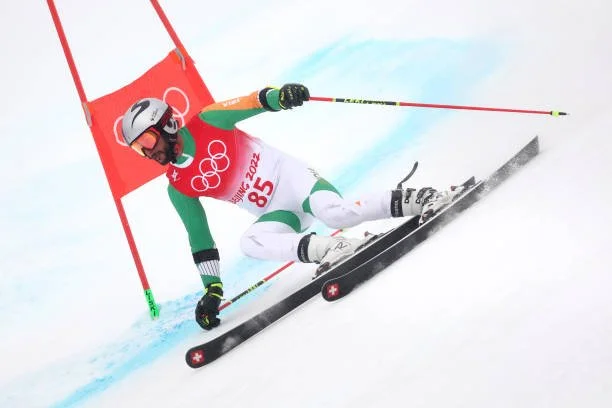
Khan at the 2022 Beijing Games // Getty Images / Sean M. Haffey
For the 2018 Winter Games in South Korea, Khan tried crowdfunding. He didn’t make those Olympics.
He had planned to get married the September before the 2022 Beijing Games. But, he told Reuters in a story published last summer, “I delayed it by one and a half years because I needed that money to fund my travel. My wife, Sabiena, was fine with it. Her only worry,” he added with a smile, “was what if I ran away.”
Now married, he and Sabiena parents of a 1 1/2-year-old son named Luqmaan, Arif Khan made it to the 2026 Olympics on maybe, and he said this is the high end of an estimate of what he had for the season, 40,000 euros, or roughly $47,000.
The IOC, through what’s called its Solidarity program, helped with a scholarship. The Mumbai-based Inspire Institute of Sport pitched in. So did Indian officials as it became increasingly clear he would make it, he said.
“If you want to really improve,” he said, “to get stronger and train, it’s double or three times more.”
All the same, he made it.
The part of India that Khan calls home has been the focus of a dispute between India and Pakistan since partition in 1947, and since 1959 between India and China.
He told Reuters in that same story, “My childhood memories are of gunfights and the sound of grenades and bombs going off.”
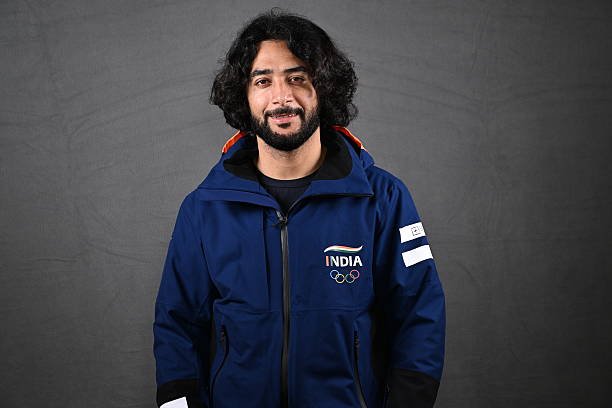
Arif Khan // Getty Images / IOC
He said this week in Milan, “To come out of the conflict zone — it’s not good to be thinking always of the conflict. There are greater things in life. We have to achieve them.
“It just takes effort. The path,” he said, “will guide you to the heights.”
Or, as it might be, through and to the finish line.
An Olympic slalom is two runs. Fastest combined time wins.
Skiers must pass between a series of gates. Missing a gate means DNF — did not finish. You’re out.
A slalom set is much tighter than giant slalom, and the distance in slalom between one gate and the next shorter. A slalom race has a distinctive sound, swoosh-swoosh-swoosh, the razor-sharp edges of the skis cutting through the course and sending up sprays of ice and snow.
On Monday, in rotten weather on one of the toughest mountains in Europe, the Stelvio course at Bormio, 95 guys started Run One. They represented 69 different national Olympic committees.
Of those 95, 53 would not finish — including Lucas Pinheiro Braathen of Brazil, who two days before had won gold in the giant slalom, and Beijing 2022 slalom gold medalist Clément Noël of France.
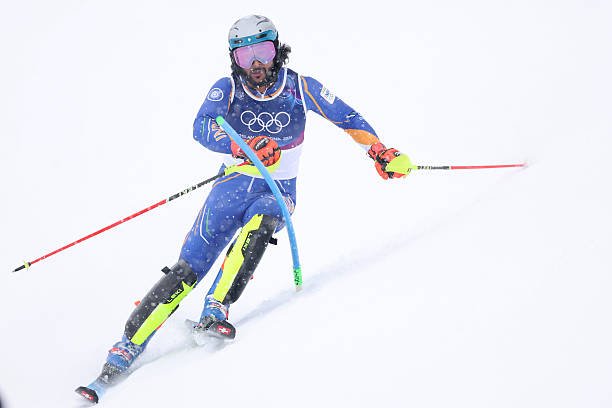
Khan on the Stelvio slalom course in Bormio, Italy // Getty Images / Sean M. Haffey
Another three got disqualified for a rules violation — coming to a full stop in the middle of the race. So, in all, 56 of 95, nearly 60%, out. And this was the Olympics.
A little more math to underscore the KO nature of this race:
Of the 95 who started, 44 made it through Round One.
Round Two took out five more, four DNFs and one of the DQs.
Only 39 … finished the race.
Khan”s Run One: 1 minute, 22.12 seconds, 25.98 seconds behind McGrath of Norway. He was 44th of 44.
Skiing steadily in Run Two, Khan crossed in 1:19.48, 39th of 39. His overall time, 2:41.60, 47.98 seconds behind the gold medalist, the Swiss Meillard.
Ariunbat Altanzul of Mongolia was 38th. Altanzul’s overall time was more than 11 and a half seconds faster than Kahn’s.
So what?
India sent Arif Khan thousands of miles to finish. He finished.
Khan said Monday in the moments after the race that he was “suffering with back problems and a lot of other problems in my body.”
He finished.
The head of the Indian Olympic Committee, P.T. Usha — whose husband had died days before but nonetheless made a huge effort to be here — was at the bottom of the hill.
“I finished,” Khan said, “while all the athletes were going out, and she said — it’s courage. You kept your courage.”