
MILAN — These Milano-Cortina 2026 Winter Games, which opened Friday night to ceremonies across northern Italy, including a traditional and spectacular show at the iconic San Siro stadium in Milan, would seem the last at which the Russians are not coming.
At least under their flag, anthem, colors, all that. Here, 13 Russians (and seven from Belarus) are due to compete under the acronym AIN, French for individual neutral athletes. It’s the fewest number of Russians at an Olympics since 1924, when Russia sent just three, according to the definitive Olympedia site.
The signals suggest that a full Russian team is increasingly likely to take part in Los Angeles in 2028.
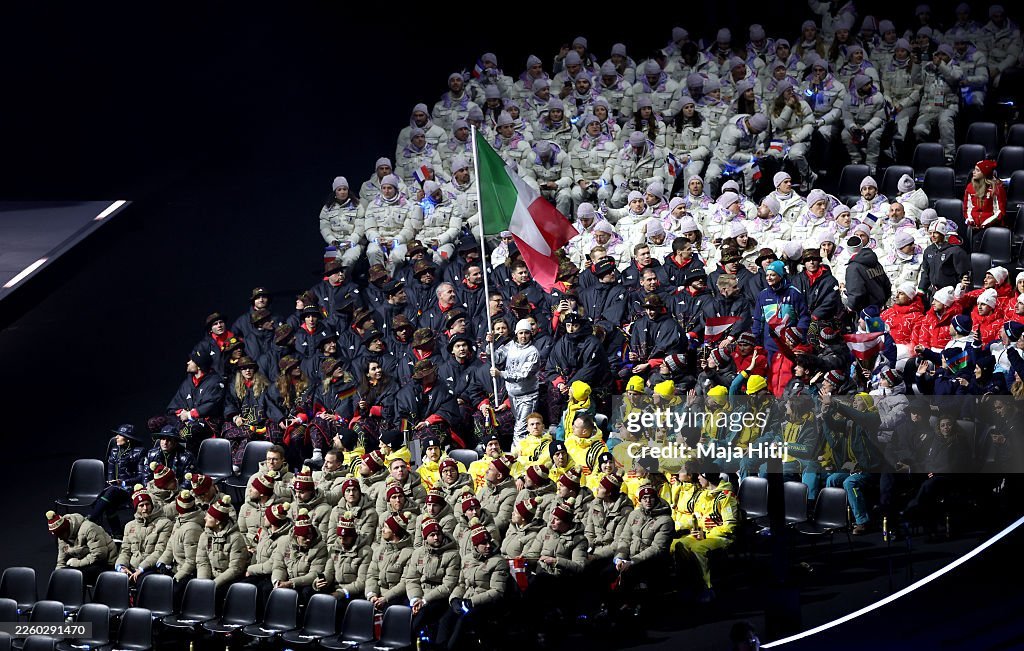
Athletes at the iconic San Siro stadium for Friday night’s opening ceremony // Getty Images/Maja Hitij
To be clear: the war in Ukraine is horrific, the carnage almost unimaginable, the toll — loss, displacement and more — upon thousands upon thousands of lives immeasurable. All of it is awful beyond words.
With a pause to acknowledge emotion of every sort, absolutely genuine, perhaps even overwhelming, the primary issue the war - any war - presents in an Olympic context is nonetheless fundamental: should an athlete be responsible for what his or her government does? If so, why?
A legitimate question is whether history will be unkind to the many efforts undertaken over the past several years to keep the Russians out, except as a clutch of neutrals. Time and perspective have proven decidedly unkind to the U.S.-led boycott in 1980 and the Soviet reprisal in 1984.
The war in Ukraine presents a second key issue. Conflict rages everywhere on our planet. A reasonable reading of world history suggests that violence is part of human nature. The Olympics seek to offer an alternative. Why are the Russian athletes being treated differently from anyone and everyone else?
Those two questions inevitably lead to the third. Why, when it comes to the way the Russians have been ostracized, such double standard if not hypocrisy?
Assuredly, there are those who believe Vladimir Putin is despicable. Let’s be honest: there are those who believe despicable would be a gentle description of the current American president and, for that matter, George W. Bush, a huge sports fan who memorably attended the 2008 Summer Games.
Is Team USA banned?
Why no bans on the Americans amid U.S.-led wars this century in Iraq and Afghanistan?
Should the IOC take action against the United States Olympic team because of aggressive immigration raids in Minnesota?
Vice President JD Vance and Second Lady Usha Vance were in attendance Friday night for the main ceremony, at San Siro. When Vance showed up on the big screen, there were boos. When the U.S. athletes came in — cheers.
At a news conference here this week, American freestyle skier Hunter Hess said, “Just because I’m wearing the flag doesn’t mean I represent everything going on in the U.S.”
Meantime, there are those, particularly in the Baltic and Scandinavian states, who fear their nations would be next to face Russian arms. They say it’s not right for Russia to politicize sport, to use the glory of the Olympics for what the presidents of three Baltic Olympic committees — Estonia, Latvia and Lithuania — in December called “the dissemination of state propaganda.”
IOC rules issued in March 2023 say anyone “contracted to the Russian or Belarusian military or national security agencies” is out, as are athletes or support personnel who “actively support the war.”
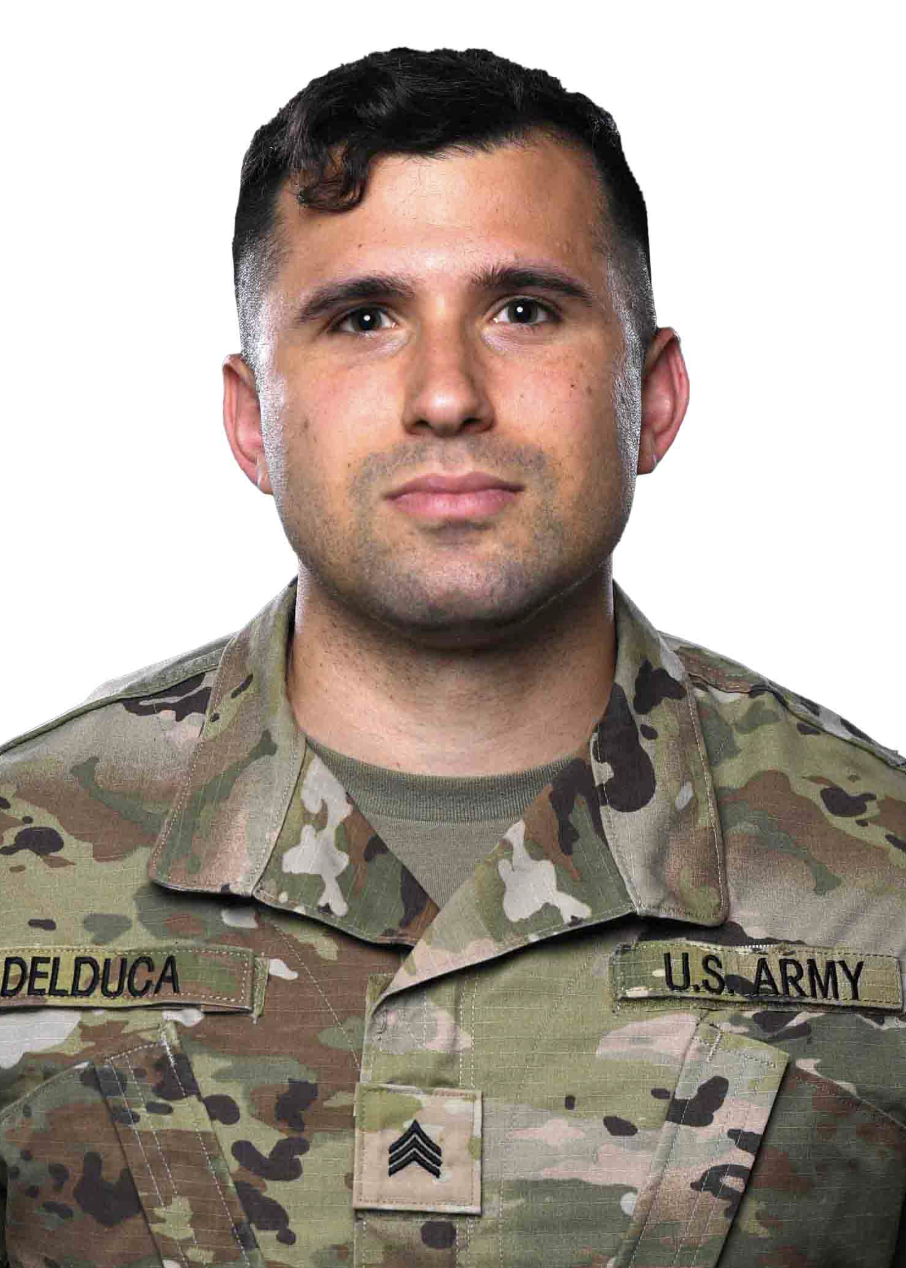
Bobsledder Frank del Duca in his U.S. Army headshot // US Army WCAP
Compare:
One of the two American flagbearers Friday night: bobsledder Frank del Duca, a legitimate medal hope.
That would be U.S. Army Sgt. Frank del Duca, 34, of Bethel, Maine, His Army ‘MOS’ — that’s Army-speak for his job — is “infantryman.”
“It’s been a wonderful experience, and I can’t wait to get it started,” del Duca said Friday night of being a flagbearer, bantering on NBC with Snoop Dogg, who led a clutch of American athletes in chants of “U-S-A!”
The U.S. Army, officials proudly touted in a Jan. 29 news release, is sending nine “Soldier-athletes and coaches” to these 2026 Games.
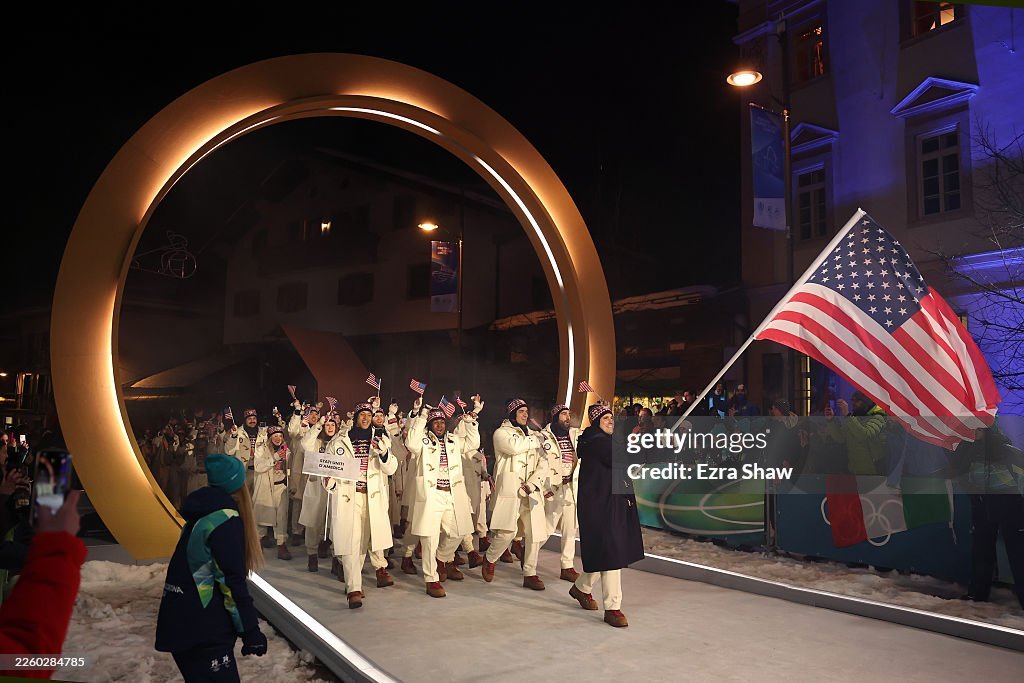
Flagbearer Frank del Duca at the parade Friday night in Cortina d'Ampezzo, Italy // Ezra Shaw/Getty Images
For 75 years, the release said, the Army has been sending “Soldier-athletes,” capital S, to the Olympics, winning more than 120 medals across 37 sports.
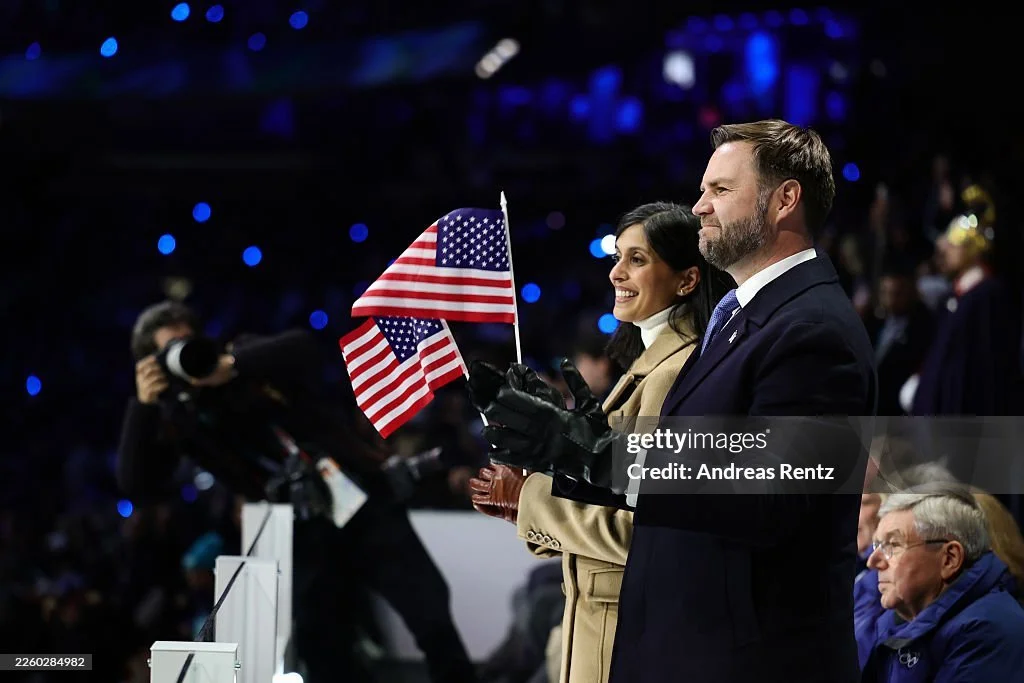
Vice president JD Vance and Second Lady Usha Vance at the ceremony in Milan // Getty Images/Andreas Rentz
The release goes on, “The backdrop of the [2026] competition holds special significance for the Army, dating back to World War II, when the 10th Mountain Division - an elite alpine unit trained for mountain warfare - ascended the critical terrain of Riva Ridge in northern Italy to secure a victory that shifted the momentum of the war.”
The U.S. Army’s “chief marketing officer,” Brig. Gen. Matthew Braman, offered this quote: “This is a unique moment to honor our force’s rich history in high-altitude combat and worldwide athletic success. We are proud of these Soldiers as they continue to carry on the Army’s legacy and will be cheering as they make history in this region once again.”
In case anyone remains unclear on the concept, this piece from a Q&A that was also included in that Jan. 29 release:
“Q: Are World Class Athlete Program (WCAP) athletes still full-time U.S. Army Soldiers?
“Yes, WCAP Soldier-athletes are first and foremost Soldiers … “
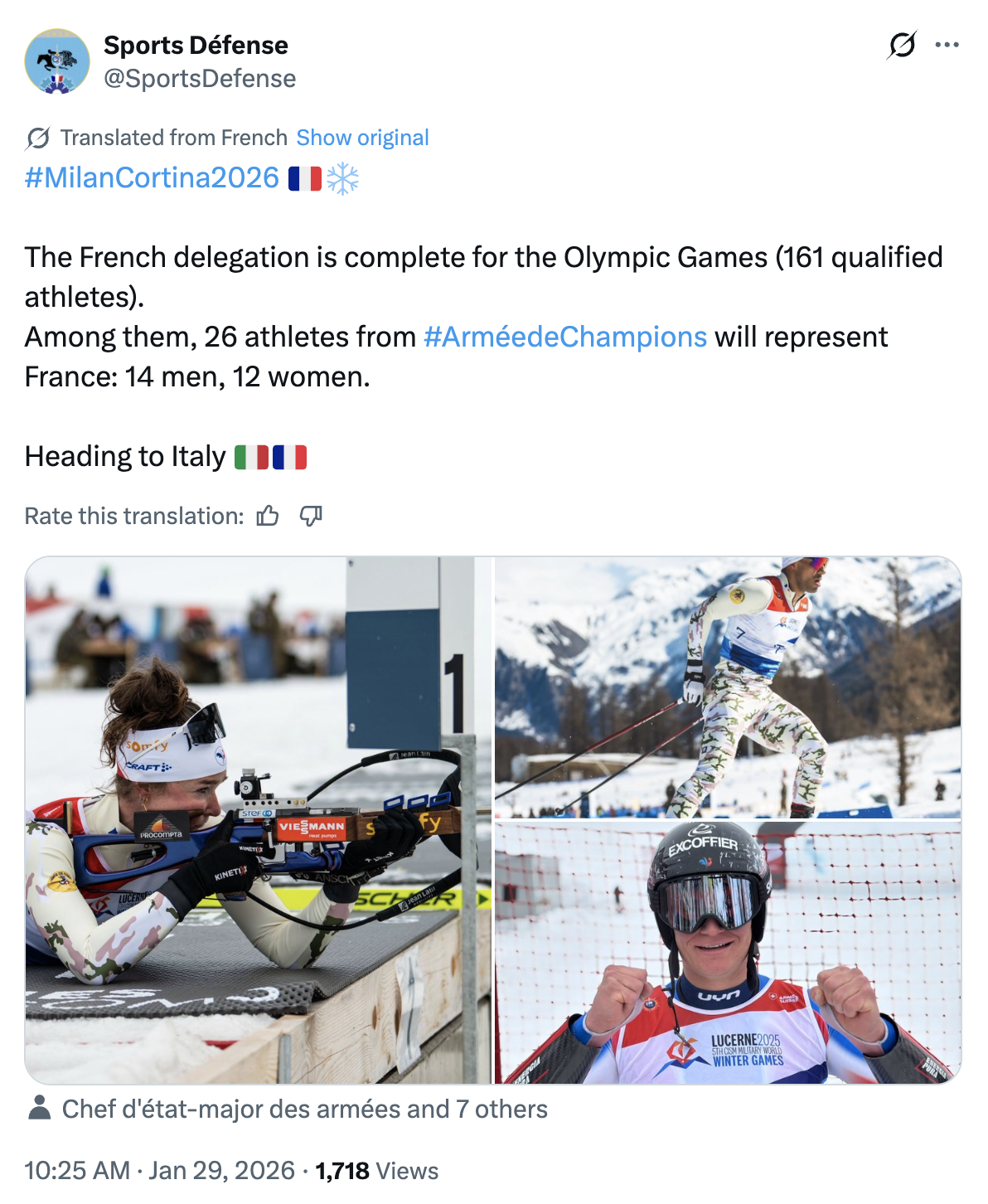
It’s hardly only the United States. This, from France, and the “Army of Champions”:
To be fair, the Russians have not made getting them back easy.
It’s indisputable the Russian government provoked the move that led to the push directed at its athletes — the war launched at the end of those 2022 Games, a ready violation of the UN-adopted Olympic Truce. Before that came years of Russian doping matters. In fall 2023, the IOC suspended the Russian Olympic Committee after it moved to include four regional sports organizations in eastern Ukraine. Moreover, it’s widely believed at IOC headquarters that the Russians have been involved in all kinds of dirty tricks in or around Lausanne.
All that, and probably more, makes it challenging — some might say exceedingly — to argue for including the Russians.
The essential philosophical question, though, is whether this is really about the Russians.
What if, instead, it’s what the Olympics are supposed to be about?
The fundamental purpose of the Games is to offer a place apart, a symbolic space to, in the words of Friday’s ceremony program, “promote and strengthen a culture of peace” — to believe the words of John Lennon, played at so many recent editions of an Olympic opening ceremony, can be made real:
Imagine all the people
Living life in peace, you
In San Siro Friday night, the actress Charlize Therion, speaking center stage, recited the words of Nelson Mandela in 2004, in New Delhi, at the Global Convention on Peace and Non-Violence:
“Peace is not just the absence of conflict. Peace is the creation of an environment where all can flourish regardless of race, color, creed, religion, gender, class, caste or any other social markers of difference."
Then Therion added, “Let these Games … be a reminder of our common humanity, our respect for one another and a resounding call for peace, everywhere.”
Listen, too, to what IOC president Kirsty Coventry said here earlier this week and be mindful that the IOC almost always speaks in code for public consumption, and thus next steps when it comes to Russia would seem ever-closer — despite the raw, very real and very understandable emotion of those who see it differently, a sentiment reflected in the huge applause the delegation from Ukraine drew as it walked Friday in San Siro.
She said, “Throughout the [IOC presidential] campaign and in many of our conversations since, I’ve heard the same message from so many of you [members] — focus on our core.
“We are a sports organization. We understand politics, and we know we don’t operate in a vacuum.
“But our game is sport.
“That means keeping sport a neutral ground — a place where every athlete can compete freely, without being held back by the politics or divisions of their governments. In a world that is increasingly divided, this principle matters more than ever. It is what allows the Olympic Games to remain a place of inspiration, where the athletes of the world can come together and showcase the best of our humanity.”
FIFA president Gianni Infantino just days ago said, echoing the conclusions of those who lived the 1980 and 1984 Olympic boycotts, “We have to [look at reinstating Russia], definitely, because this ban has not achieved anything. It has just created more frustration and hatred.”
The hard-line positions of 2022 and 2023 are clearly eroding. The IOC last month recommended that Russian youth teams and athletes should be eligible for international events, saying: “…Athletes have a fundamental right to participate in sports across the world, and to compete free from political interference or pressure from governmental organizations.”
The International Paralympic Committee moved in September to reinstate the Russians. The International Judo Federation has fully reinstated the Russians, declaring in November in a release headlined, “Sport: the last bridge for reconciliation and peace”:
“Sport is the last bridge that unites people and nations in very difficult conflict situations and environments. Athletes have no responsibility for the decisions of governments or other national institutions, and it is our duty to protect the sport and our athletes.”
Russian swimmers took part — as neutrals — at the world swim championships last summer in Singapore; the Russian neutrals won two relays, the mixed 4x1 and the men’s 4x1 medley, proving possible the notion that Russians, everyone obviously knew they were Russians, could compete not only as individuals but as a team, and without tension. There were no incidents.
In 2008, amid the Beijing Summer Games, Russia launched an incursion into Georgia. The Russian military invaded on Aug. 8, the day those Games began. A ceasefire, brokered by France, was signed on the 16th.
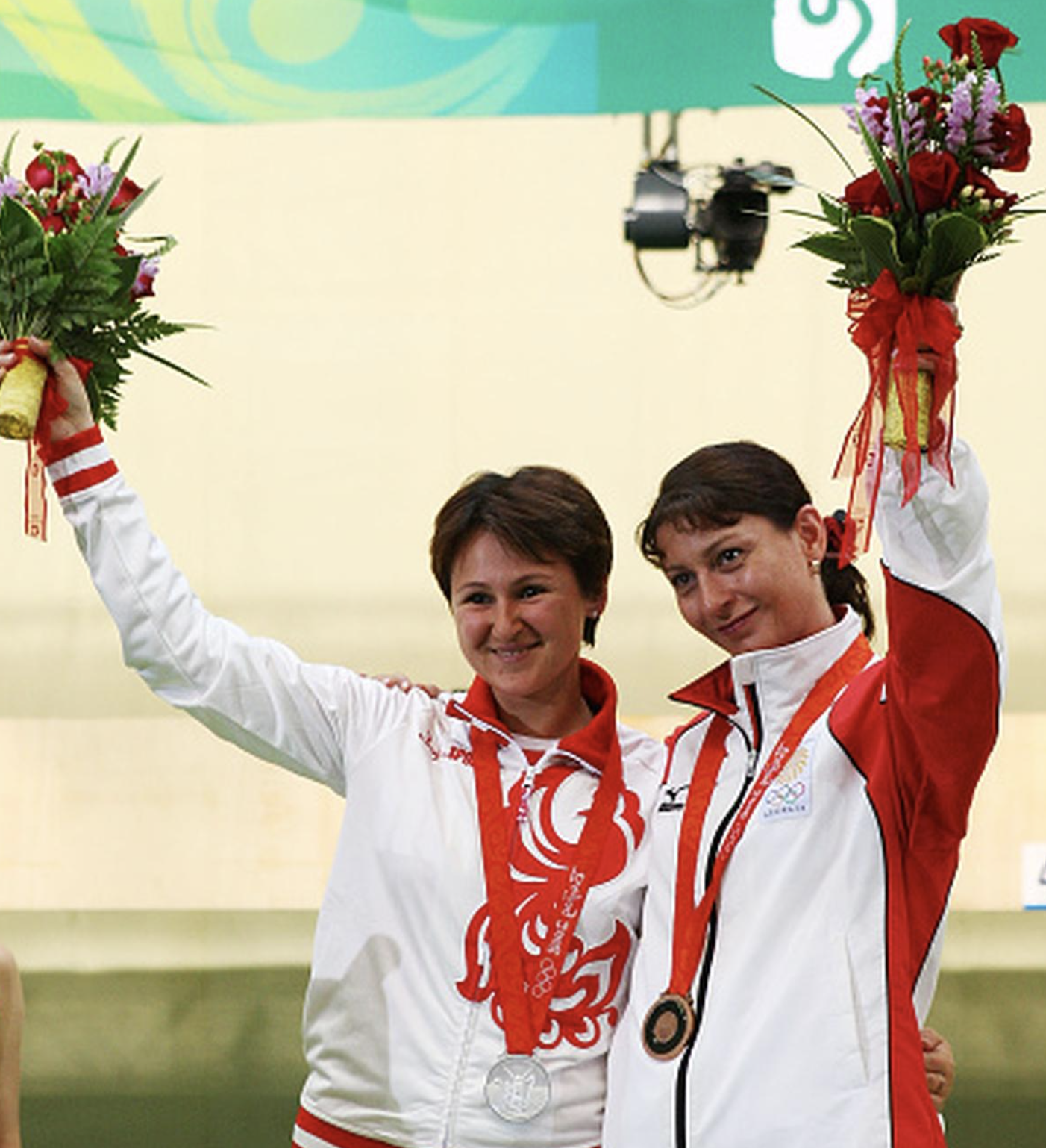
Silver medalist Natalia Paderina of Russia, bronze medalist Nino Salukvadze of Georgia after the Beijing 2008 women’s 10m air pistol final // Getty Images
On Aug. 10, a Georgian and a Russian embraced on the Olympic podium: Georgia’s Nino Salukvadze, the bronze medalist in women’s 10-meter air pistol, and Russia’s Natalia Paderina the silver medalist. This moment could only happen because both — both — were there.
Paderina said, “We are friends indeed. We’ve been shooting together for a long time. We don’t get mixed up in political things. Sport is beyond politics.”
Salukvadze — who has gone on to compete in 10 Games, most for a female athlete, age 55 at Paris in 2024 — said then, in the glow of Georgia’s first medal in 2008, “There should be no hatred between athletes and people in general. We’ll leave this to the politicians to figure out.”
And, too, expressing a profound understanding of the symbolic space — the aspirational ideal — the Olympics are supposed to be all about, she said, “If the world were to draw any lessons from what I did,” sharing the podium, “there would never be any wars.”