Here today, Ghana tomorrow: US not a soccer nation

Attention, soccer crazies: the United States is not, repeat not, a soccer nation. Or, as your all-knowing mother — and, for sure, mine — might have said: here today, Ghana tomorrow.

Head coach Jurgen Klinsmann with the US team during training last week in Brazil // photo courtesy Getty Images

Every four years, with the arrival of soccer’s World Cup, the opportunity presents itself to write a column like this. It’s difficult to know which is more fun. The column. Or the howling in response from the soccer crazies.

Though I have lived in California for 31 years, I was born and raised in Dayton, Ohio. If I went back home to the central bus stop in Dayton, on Main between Third and Fourth, and asked the first 10 people I met who Landon Donovan is, odds are they would say, no idea. Maybe that guy from “Little House on the Prairie”?

At the outset, to be clear: I actually like, really like, soccer.

One of the perks of my job is that I have gotten to see games at some of the great temples of European soccer — San Siro, Allianz, Old Trafford, Emirates, Bernabéu, Camp Nou. Moreover, I was there at the David Beckham news conference in Carson, California, in 2007. And I would venture that Giovani Dos Santos’ goal, the dagger that gave Mexico its fourth goal in its 4-2 victory over the United States in the 2011 CONCACAF Gold Cup at the Rose Bowl, is still one of the great displays of soccer skill, anytime, anywhere.

Of course, that most of the 93,420 people in the stands that day were rooting for Mexico — and that the American team had been up 2-0 and a real team at that level does not, can not blow a two-goal lead — emphatically prove my point.

But I digress.

I do not, will not, dispute that over the next month thousands of Americans will crowd bars and sit in front of their living-room TVs to watch the goings-on from Brazil. That is not, however, because the United States is a soccer nation or even because the U.S. team has an odds-on chance of getting out of the Group of Death. It is because Americans love big events. The day the World Cup is over, soccer in the United States will go back to being what it is — background noise.

I might wish it were different. But it’s not.

The Los Angeles Times, where I spent 17 years as a staff writer, ran a story a few days ago that explained to readers “how to watch the World Cup.”

For purposes of discussion, it is essentially 40 years, or two generations, since Pelé joined the New York Cosmos — it was June, 1975. That’s more than enough time for Americans to have learned how to watch the World Cup, if they were so inclined.

Did the LA Times feel compelled to run a similar story before the Super Bowl — explaining, for instance, who the Denver Broncos or Seattle Seahawks were, and how a first down involves moving a football 10 yards or more on the ground or through the air? Obviously not. There’s no need to do so. Football is ingrained in American culture. Soccer is not.

Throughout this column, by the way, I am going to be resolutely American and call it soccer. Not futbol or football, all pretentious-like, like this story in the New York Times that is a candidate for most over-the-top piece of journalism in recent memory. I have covered Rose Bowls, BCS championship games and Super Bowls. That is football. Later in this column I am going to return to football, and explain why football, Peyton Manning-style, is what Americans really care about. So soccer it is.

Here, soccer nuts, is the crux of the problem: there are heavy economic, social, cultural and peer incentives working against soccer.

Before getting there, let us examine some of the arguments that the United States is, actually, a soccer nation:

Look at how many teams there are now in the MLS! Look at the new MLS TV deal! Look — the English Premier League is now on NBC!

For sure there are more teams now than before in the MLS. It’s even expanding. (Oh, joy. More minor-league soccer.)

Currently, there are 19 MLS teams. (Up to 21 soon.) According to a November, 2013, story in Forbes, 10 are making a profit. Maybe I didn’t learn a lot in journalism school but if 10 are making money it seems pretty elemental that nine are not or are at best breaking even.

If the financial play in the MLS is increased franchise valuation over time, fine. Good for the owners and their long-term investment plans.

But to have the half the teams in the league flat or in the red — as Dean Wormer might have said in Animal House, that is no way to go through life.

Since this is a World Cup year, you’d think that attendance at MLS games would be way up, right? Wrong. Eleven of the 19 teams are down. Overall, through June 2, attendance is down 1.86 percent from 2013.

As for TV:

The new package, an eight-year deal with ESPN, Fox and Univision, is worth a worth a reported $90 million a year or, all in, $720 million.

Compare that to these numbers:

ESPN is paying $5.6 billion for Major League Baseball, $7.3 billion for a 12-year deal for the new college football playoff system, $15.2 billion for “Monday Night Football.”

CBS Sports and Turner Sports are paying $10.8 billion for 14 years, 2011 through 2024, to show the NCAA men’s college basketball tournament.

When you compare the soccer package with sports that matter in the United States, the conclusion is inescapable: soccer is, at best, a value proposition.

And why is that? Because ratings for the MLS stink. Again, from Forbes: ESPN’s regular-season telecasts were down 29 percent, to an average of 220,000 per game, while NBC’s MLS audience fell 8 percent, to 112,000 per game — ranking the MLS behind the WNBA.

So, the natural question: why are ESPN, Fox and Univision shelling out money? And why is NBC showing the Premier League?

Disclaimer: I have had a relationship with NBC, on air and online, since 2003. But I have had no involvement, zero, with its soccer programming.

The logical answer is that in an age of exploding channels, soccer games fill a lot of airtime. And there’s a niche that’s interested, especially in the Premier League.

But that hardly makes the United States a soccer nation. Especially if what’s at issue is televising games from some other country.

It’s so obvious that football is America’s game. The two most popular sports in the United States are the NFL and college football.

When Ohio State and Michigan play football, they jam into the Shoe in Columbus or the Big House in Ann Arbor.

The two schools played at Michigan in 2013, at Ohio State in 2012. Here are the attendance figures: 2013 in Ann Arbor, 113, 511. 2012 in Columbus, 105, 899.

When the two schools play men’s soccer? Michigan played at Ohio State last Oct. 6. Attendance: 962, at 10,000-seat Jesse Owens Memorial Stadium.

As they say, ladies and gentlemen, numbers do not lie. The numbers here say that soccer is roughly 1/100 as popular as football. That seems about right.

Oh, and there’s an MLS team in Columbus. So it’s not as if soccer is unknown in central Ohio. (Incidentally, for 2014, through June 2, Columbus Crew attendance is down 7.95 percent compared to 2013.)

The issues confronting soccer, as it relates to football, are both simple and complex.

When boys who are talented athletes are roughly middle-school age, they self-select out of the AYSO leagues they have all been in since they were 5 or 6. Why? Because it becomes apparent that there is way more opportunity — of all sorts — in football than soccer.

For one, there are more than 120 FBS football schools. Each of those schools offers 85 scholarships. This is simple math -- more than 10,000 scholarships. There's also the allure of playing on television every week.

There simply aren’t that many soccer scholarships --  a fully financed Division I team can offer 9.9 full scholarships for freshman to seniors, and those scholarships can be divvied up among the team. In total there are 1,990 scholarships.

That’s a powerful economic incentive right there in favor of football -- roughly a 10 to 1 scholarship-available ratio at the major-college level alone.

Then there are the many social and cultural imperatives.

At many if not most high schools, it is a tradition that the football players get to wear their jerseys to school on Fridays. It is a big deal on multiple levels to be school royalty — believe it.

It has been a long time since I was in high school but this much has not changed: cheerleaders and the dance team tend to notice the football players.

Do you think “Friday Night Lights” was all about … soccer? Right.

If you are good enough to play college football, that is a calling-card that stays with you for life -- in business, wherever you go. That is America.

This is not likely to change.

Talk, too, all you want about concussions, and how a great fear of football is suddenly going to sweep the country and drive parents to move their boys to soccer. As if. Talk to soccer moms about concussions — you don’t think you can get hit playing high-level soccer?

We haven’t even gotten yet to basketball. Suffice to say that there are basketball scholarships, too, and that basketball, college and the NBA, is way more popular than soccer. That’s why CBS and Turner are shelling out those billions for March Madness. It’s why — if I went to that bus stop in Dayton — you bet they’d know who LeBron is, and I wouldn’t have to volunteer a last name.

There are all kinds of things wrong with baseball. Yet each year most Major League teams consistently draw millions of fans.

The United States is not really a hockey nation, either. But on this subject it’s difficult. The Los Angeles Kings just won the Stanley Cup for the second time in three years. The Cup went back to the bar across the street from the house I lived in for 14 years. So I’m going to move along in this column.

The two factors that can spark the changes that might — I say, might — make the United States a soccer nation are, one, a deep run in the World Cup, or, two, the MLS.

A deep 2014 World Cup run would be, in a word, unexpected. It would seem apparent that US Soccer head coach Jurgen Klinsmann, who dumped Donovan and is going with a younger team, is setting things up for a more sustained run in 2018 in Russia and hoping luck might turn the Americans’ way in Brazil. No argument here with that strategy.

Of course it all starts Monday with Ghana — which has knocked the U.S. out of the past two World Cups, beating the Americans in the final group-stage game in 2006, defeating the Americans again in the round of 16 in 2010.

Meanwhile, the MLS simply is not designed for that kind of far-reaching change. Structurally, everything is all wrong. US Soccer is in charge of soccer in the United States, not the MLS. Which is kind of weird — like USA Basketball telling the NBA how to run things. Which, when you think about it, raises a fundamental question: why is it that way in American soccer?

While that gets sorted out, one of the best thing that could happen to the MLS — besides the obvious, more talented players — would be a sharp dose of the WAGs and drama that attend the Premier League. That would make soccer way more interesting.

In the meantime, everyone, enjoy the World Cup. Don’t sleep on the Belgians.

When it’s all over in Brazil, NFL training camps will commence. Thankfully. Richard Sherman, America awaits your next breath of fresh air.


1932, 1984 -- can you say 2024?

photo.jpg

Set against the backdrop of International Olympic Committee president Thomas Bach's extensive comments the day before, the U.S. Olympic Committee met Tuesday in Boston as part of its ongoing deliberations regarding the 2024 bid race — and what he had to say, for anyone paying close attention, surely and logically would be shaping the USOC’s direction, if and when it opts to jump in to the 2024 campaign. 1932, 1984 — can you say 2024?

At a 2014 LA Marathon announcement, in front of the famed peristyle end of the LA Coliseum

"We need to change philosophy,'' Bach said Monday in Rome. "In the past we needed to build many stadiums with huge capacity and with so many technical procedures to respect.

"At the time maybe it was right but it doesn't respond to today's demands. We have to think about how the Games could enter into the social fabric of the host country. We have to be more flexible, starting with the program, and understand how to best manage costs.''

To be clear:

The USOC did not, after its board of directors meeting Tuesday, disclose any cities it is or is not considering. Board chairman Larry Probst said only that the USOC would be communicating now with a “smaller” group of “fantastic” cities.

In the 24/7 news cycle in which we all swim, it’s only natural that everyone wants to know — now! — what is what. The instant pace of the internet has conditioned more and more of us to expect immediacy.

Reality check:

That is not this process. The USOC is taking its own sweet time because, frankly, it can.

The IOC is, as Probst made clear Tuesday, still working through the work of Bach’s “Agenda 2020” review and potentially wide-ranging reform process. Probst, for instance, speaking at a recent Sports Business Journal conference, had suggested that perhaps the IOC executive board - rather than the full membership — might decide which bid cities ought to get the Games. Probst is a new IOC member as well and that comment had generated some headlines. Upon further reflection, he said Tuesday, maybe the board could winnow a list of x number of cities to two, and the members could then decide between those two.

“These are all things that are just ideas at this point, things for the working groups to consider,” he stressed, adding that all of his remarks on these points ought to be taken “in the spirit of being a little more efficient and cost-effective than we” — meaning the IOC membership — “may have been in the past, and I think that’s something the entire membership is looking to do.”

For its own part, the USOC is -- as ever -- also involved in any number of issues.

— In a bid to investigate and resolve allegations of sexual abuse in Olympic sports, it announced Tuesday the launch of a potentially far-reaching “safe-sport” project, to be launched at the start of 2015. To get the initiative underway, the USOC board committed to spend $5.2 million over the next five years and have the the governing bodies of Olympic sports combine to match that amount. The USOC also said it would seek another $10 to $15 million from elsewhere.

USOC chief executive Scott Blackmun said, "There's a widespread recognition over the Olympic movement that we need to shine more light on this problem," adding a moment later, "We believe this is important for someone to step up and take a leading role. There was a vacuum there. We needed to fill that vacuum. But the issue is important enough that we shouldn't be the sole funders of the initiative. We need to look for like-minded organizations.''

— It is exploring what, if anything, to do about potential changes in American college sports. Roughly four of five medals won by the U.S. team at the London 2012 Games came from athletes who were in college or took part in college sports. As Probst and Blackmun pointed out, college track, swimming, gymnastics and wrestling programs are at the core of the American Olympic program. The NCAA, though, now finds itself under attack from a variety of different directions. What happens if the landscape as it has existed for generations suddenly shifts?

As for 2024, Bach was in Rome Monday to tout the possibility of a bid. He said Rome could be a “very strong candidate,” declaring, “Italy is a country with a great passion for sport and great athletes and is efficient in hospitality and organization.”

These sorts of comments are to be expected. It’s the IOC president’s job to talk up as many cities as expected.

Glossed over Monday, of course, was that Rome, which staged the 1960 Games, pulled out of the running for 2020. Why? Too expensive.

The current Italian government has made no decision on 2024.

The list of potential 2024 bidders is widely thought to include, among others, Paris; Berlin or Hamburg, Germany; and Doha, Qatar.

Another check-in on some more reality points:

The IOC and NBC recently signed a $7.75 billion deal to televise the Olympic Games in the United States through 2032. The revenue-sharing issues that shadowed the relationship between the USOC and IOC are done. Jacques Rogge is no longer the IOC president. Probst, as an IOC member, is in position to carry some influence.

At some juncture, the Games are going back to the United States. The question is — when?

The IOC will not select the 2024 site until 2017.  That means, logically enough, that any number of variables could yet come into play.

The USOC, if it opts in to the 2024 campaign, likely will not do so until after the IOC’s all-members session in December in Monaco, at or after the conclusion of that Agenda 2020 assembly, and if you think about it, that just makes sense: how is the USOC supposed to know until then what the bidding rules are going to be?

For all that, it is abundantly obvious that the list of any potential U.S. bid cities, which might include, say, Boston, would now seem to start, first and foremost, with Los Angeles.

Sochi 2014 cost $51 billion. Beijing 2008 cost $40 billion. Rio 2016 is now on track to cost at least $17 billion, and for sure that figure is going to go up. London 2012 cost $14 billion. Tokyo is now re-doing its extensive 2020 stadium plan amid cost concerns.

The 2022 Winter Games bid dynamic has already been shaped by a number of western European cities issuing sharp no thank-you’s to the IOC — among them, Stockholm, Munich and, most recently, Krakow, Poland. It remains entirely unclear whether Oslo will ultimately stay in the race.

The IOC will pick the 2022 site in July, 2015.

In LA, meanwhile, comparatively little needs to be built because the city staged the 1932 and 1984 Games.

LA, as due diligence over the past several months has made plain, has overwhelming local and regional political support, including the enthusiastic backing of a new mayor, Eric Garcetti, who is both fluent in Spanish and such a huge Olympics fan that he keeps a 1984 torch in his office.

LA is, and this must be understood, seen as electable by key IOC factions.

In the press, there will be a lot of speculation over the next few weeks and months over this and that relating to 2024. Whatever. The USOC learned from Chicago 2016 and New York 2012 that conducting a very public campaign costs more money and, as Blackmun said Tuesday, creates added political risk.

Risk is the very thing the USOC is, as it weighs 2024, seeking to avoid.

Even as, ultimately, it undertakes -- if and when --- to create excitement around an American bid.

The knock on LA is easy. 1932. 1984. Again?

London answered that knock. 1908. 1948. 2012.

Plus, 1984 to 2024 is 40 years. That's plenty long enough.

When you can beat a low-cost effort that boasts potent political support with world-class beaches, the surfer-dude lifestyle copied the world over, awesome weather, Disneyland, an iconic already-there stadium with the Olympic rings on the famed peristyle end, a super-hipster downtown that is home to an under-construction 73-story building (tallest west of the Mississippi River) and, oh, the chance to run into the likes of Kim and Kanye on Rodeo Drive — have your people call my people, OK?

What would Jackie Robinson say?

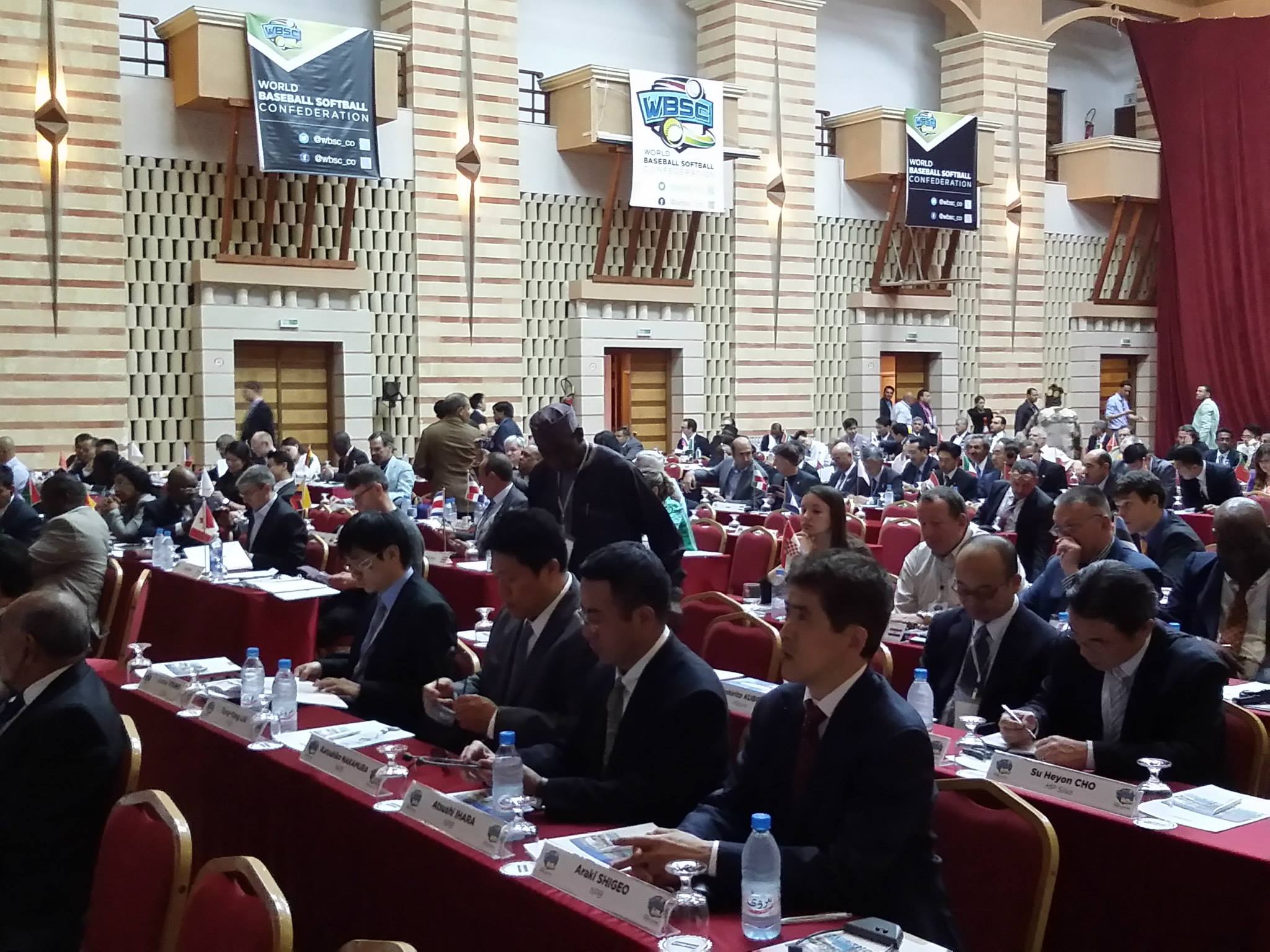
10-May-2014-1st-WBSC-Congress.jpg

International Olympic Committee news releases are written in distinctive code. In an otherwise anodyne six-paragraph release issued a few days ago on autonomy and good governance, the IOC dropped a bombshell. For years, Iran as well as a number of Arabic countries have taken sly steps aimed at denying appropriate recognition to Israeli officials or athletes; further, athletes from these countries have mysteriously feigned ailments or been ordered not to compete with Israelis. The new IOC president, Thomas Bach, is seemingly now keen to send a strong signal that on his watch this sort of thing is not likely to be tolerated.

To be clear, the release itself hardly makes any grandiose pronouncements.

But the signal would seem strong.

An overview of the WBSC congress in Tunisia // photo courtesy WBSC

It’s spelled out in the fourth paragraph, the IOC noting that at the instruction of the president himself, a task force has begun an investigation into an “incident” that “may represent discrimination” against the Israeli baseball/softball federation at the World Baseball Softball Confederation general assembly last month in Hammamet, Tunisia, a resort about an hour south of Tunis.

This marks the first time in recent memory the IOC has pointedly taken such official note of such an “incident” involving potential “discrimination” waged against the Israelis.

The details of the “incident,” moreover, make it abundantly clear the president of the Israeli baseball federation, Peter Kurz, absolutely was singled out and made the target of discrimination.

Not only that: though he was not harmed, he was left throughout the congress feeling unsafe and vulnerable. Given that security -- as the IOC is always given to say, is paramount issue No.1 -- that can never be tenable, particularly given the lessons of the 1972 Munich Olympics.

The question now: what is to be done?

Tunisia is among those nations that have inappropriately mixed politics with sports when it comes to Israel. Last fall, for instance, Tunisia’s tennis federation ordered its top player, Malek Jaziri, ranked 169th in the world, not to play Israel’s Amir Weintraub in the quarterfinals of a lower-tier ATP event in Tashkent, Uzbekistan.

The WBSC congress, its first after the merger of the international baseball and softball federations, took place May 10-11.

In a May 12 letter to newly elected WBSC president Riccardo Fraccari, Kurz wrote that despite the history between the two nations he had been assured he and Israel would be appropriately “recognized and honored” per usual Olympic-style protocol at the assembly. But “unfortunately, the night before the Congress, I was asked to sit without my national flag and country sign, for ‘my own well being’ and for the sake of the host country.”

In a telephone interview Tuesday, Kurz said, “I went there with assurance the Israeli flag would be shown,” adding a moment later, referring to Tunisian authorities, “They told me that for my own benefit it was probably better if I didn’t sit with the flag. I agreed, for my own safety. Afterward, when I left, I sent them,” meaning the WBSC, a “letter of protest.”

Israel was the only nation so singled out at the conference. The merged confederation represents more than 100 nations; softball alone is played in more than 140.

Bach has made autonomy and governance issues — which typically do not receive much, if any, press — one of the mainstays of his “Agenda 2020” IOC review and potential reform process, now working its way toward an all-members session in Monaco in December.

In governance, the president has sought to underscore the obvious: without consistency, everything can get very shaky, and very fast.

"The health and viability of the Olympic movement start and end with issues of ethics and governance," said Atlanta-based Terrence Burns, a noted Olympic strategist. "These principles are embedded in the Olympic charter and have guided the movement since 1896."

Bach has also, since his election as IOC president in Buenos Aires last September, sought to highlight the import of fair play and respect, both on and off the field of play.

He has cited Nelson Mandela: “Sport can change the world.”

In a late April speech at the United Nations, he reiterated the words he used in closing the Sochi Games, when he urged “the political leaders of the world to respect the Olympic message of good will, of tolerance, of excellence and of peace” and appealed to “everybody implicated in confrontation, oppression or violence: act on this Olympic message of dialogue and peace … have the courage to address your disagreements in a peaceful, direct political dialogue.”

If the IOC in prior years might have been perhaps more inclined to be more passive about what happened in Tunisia, it’s clear a different sort of reckoning now awaits.

Uncertain, though, is the full scope and nature.

For its part, the WBSC has also launched its own inquiry. It will “fully cooperate” with the IOC to determine “warranted sanctions” and “any other course of action,” Fraccari said in an email sent early Wednesday from Tokyo.

Tangled up in all this — albeit as a side issue, though one that has sparked some concern within the WBSC — is the federation’s positioning going forward as it seeks to get baseball and softball back onto the Olympic program, perhaps as soon as the Tokyo 2020 Summer Games.

Fraccari said, “Good governance, autonomy and upholding the Olympic values are absolutely paramount to the WBSC, and the IOC’s involvement in this highly important matter is very much valued -- and any guidance that is provided will be strictly followed.”

He also said, “I am deeply, deeply disappointed with this incident; the flag of Israel should have been proudly on display alongside the other flags.”

He  said, “On behalf of the WBSC – and in my own name – I personally apologized to President Kurz and the Israel Association of Baseball following the incident, and I have given IAB every assurance that the newly elected WBSC executive board will handle this case in a swift, just and decisive manner, so that no such occurrence -- or such a scenario – is ever repeated.”

Kurz said the apology came in a telephone call last Friday: “He said it shouldn’t have happened.”

Fraccari also said this: “This regretful, isolated incident in no way reflects what baseball and softball represent — baseball and softball have a long and proud tradition of promoting racial diversity and multiculturalism, and have helped challenge racism, stereotypes and have helped to tear down both social and gender barriers."

In that spirit, Bach has, and with ample reason, pointed to Nelson Mandela. The Olympic movement has long venerated, again with sound reason, the U.S. track star, Jesse Owens.

In this instance, perhaps the time has come to look to another American icon, the baseball player Jackie Robinson. He literally changed the face of professional sports in the United States. Throughout his life, he proved an exemplar of peaceful tolerance. Each year, on April 15, in a celebration of his life and achievements, is Jackie Robinson Day in Major League Baseball; all the players, coaches, managers on both teams, even the umpires, wear Robinson's No. 42.

The irony of the "incident" in Tunisia is that the other candidate to have hosted the WBSC assembly was Los Angeles; of course, that's where the team that Robinson played for, the Dodgers, moved to from Brooklyn, and that's where he grew up, in nearby Pasadena, California, and went to college, at UCLA.

The federation opted to have the congress in Tunisia on the theory that staging it in Africa would be a part of promoting a growth strategy for their games; after all, in January, Uganda opened central Africa's first-ever national baseball and softball stadium.

It was left to Kurz, in his letter, to point out the obvious: "Future Congresses should not be held in countries that do not respect or recognize the rights of other countries, and you had over 145 countries to choose from."


Weightlifting, and the many turns of fate

At the 2000 Sydney Olympics, three Bulgarian weightlifters failed doping tests. The rules said the entire Bulgarian team was thereupon supposed to be expelled. However, Galabin Boevski had already competed and, because he did not test positive, he was allowed to keep his gold medal. In 2004, Boevski was found liable of tampering with the urine sample he provided at the 2003 world championship in Vancouver. He would be banned from competition for eight years.

In October, 2011, Boevski was arrested at the airport at Sao Paolo, Brazil, while trying to board a plane to Spain. The authorities found nine kilos, or nearly 20 pounds, of cocaine, in his bags.

The cover of a new book that delves deeply into the culture of Bulgarian weightlifting

Galabin Boevski is a complicated figure and weightlifting is a complex sport, filled with intrigue and drama. On the stage, the bar does not lie. You either lift it or not. Behind the scenes, however, as a new book, The White Prisoner: Galabin Boevski’s Secret Story, makes plain, it can be an enormous struggle not just to become Olympic champion but to stay on top.

The book, written by Ognian Georgiev, sports editor at the “Bulgaria Today” daily newspaper, available Friday, offers a revealing look into a sports culture that demands further — and intense — examination.

Bulgaria has long had outsized influence in weightlifting.

Bulgaria has close connections with the unraveling doping story in Azerbaijan, where more than a dozen lifters tested positive in 2013 for illicit performance-enhancing drugs.

Indeed, the coach of the 2013 Azeri team, Bulgaria’s Zlatan Vanev, is a three-time world and four-time European champion.

Among the Azeri athletes suspended last year by the International Weightlifting Federation: Bulgarian-born Valentin Hristov, 19, the 2012 London bronze medalist in the bantamweight class.

Remarkably, Bulgaria was a weightlifting force even in the years after the break-up of the former Soviet bloc system.

As the book makes plain, for everyone everywhere in the system — athletes, coaches, sponsors — manipulation is the name of the game.

It is said that the "wily" Bulgarian coach, Ivan Abadzhiev, the famed "Senior Trainer," goes to "slaughterhouses to collect oxen testicles, so his weightlifters could get stronger."

Athletes can be “sold” to other countries.

In 1999, the year before the Sydney Games, the world championships in Athens are of course themselves a major event but will also set the Olympic quotas. In Bulgaria, there are far more athletes than there are spots, according to the book.

What to do?

Opportunity suddenly beckons. Abadzhiev, acting through the track and field mediator, Yanko Bratoev, decides to send lifters to Qatar: “The plan is clever because the motivation of his team stays high.”

The details: “The Bulgarian federation receives $40,000 a year from those transfers. The salaries of the new Qatari athletes are $800. The weightlifters keep $500. The rest go to the federation, according to the contract. Apart from that, Bulgaria receives 50 percent of the bonuses of the athletes, promised to them for success in major competitions.”

In Qatar, the coach will be Abadzhiev’s assistant, Zlatin Ivanov. The Qataris quickly issue new names and passports to the Bulgarians, among them Peter Tanev, the European middleweight champion; heavyweight Angel Popov; and super-heavyweight Yani Marchokov.

In Sydney, it all proves convoluted.

From the book, and now oxen testicles seem, well, quaint:

"The cup with pills is getting fuller. Every weightlifter has a personal one. Drugs, vitamins and amino acids are taken to a schedule. The Senior Trainer and his assistants keep close watch to see that everyone is taking their medication. A war would break out if someone threw away a vitamin C pill. Abadzhiev is strict. He wants every rule he gives to be abided by. The coach is most rigorous about medication. He keeps adding more and more to the pill cups. One of them is Orocetam -- a metabolic booster."

Orocetam is a medication made by a company called Sopharma. Orocetam is designed to help brain rehabilitation during and after illness; it improves blood flow in the brain; that can enhance mental concentration.

It turns out that, as the company acknowledges, Orocetam contains traces of the banned diuretic furosemide.

The company says it regrets the disqualifications -- to show you how important weightlifters are in Bulgaria, Boevski was the country's landslide winner of Athlete of the Year for 1999, when he dominated his category at the world championships. But it also says it should not be blamed for tiny amounts of furosemide in the drug, which it points out -- accurately -- is not designed for use by athletes.

It is also pointed out by the Bulgarian pharmaceutical trade agency that manufacturers are not required to list a component that makes up less than 0.1 percent of a drug. Here, the trace amount of furosemide is 0.003 percent or less.

At the Olympics, a trace is more than enough.

Boevski and Abadzhiev had long gone their separate ways in terms of training methods. Perhaps this is why Boevski's sample is clean.  

Some of the Bulgarians, like Boevski, get to compete. Some don’t.

The team is suspended. Then there is an appeal, led by the then-president of the Bulgarian Olympic Committee, Ivan Slavkov, known to his peers and colleagues as "Bateto," or the "elder brother." Slavkov had been president of the BOC since 1982. In 2005 he would be expelled on corruption charges from his membership in the International Olympic Committee; he would then be replaced as BOC president as well.

An Olympics runs for 17 days. Time is ticking.

In the heavyweight division, Alan Tsagaev, born in Russia but competing for Bulgaria, is finally cleared to compete — on the day of competition itself, and then only after the Court of Arbitration for Sport signs off on it all, saying there is no legal basis to disqualify the entire team.

He wins silver.

Popov, now Said Saif Asaad, takes bronze. He is the only one of the eight Bulgarians turned Qataris to win a medal in Sydney.

Always, as the book — and as the historical record — makes plain, in weightlifting the specter of illicit performance-enhancing drugs is about.

Three Bulgarian lifters will be banned for doping before the Athens 2004 Games.

The entire Bulgarian team will withdraw from the 2008 Beijing Games after 11 of its athletes test positive for a steroid.

Because of the scandal at the 2000 Games, one of the Bulgarian lifters, Georgi Gardev, who surely would have been a top contender for gold in his class, is precluded from taking the stage. He can do nothing while Greece’s Pyrros Dimas becomes Olympic champion for the third time, with a weight that was 10 kilograms, about 22 pounds, less than Gardev had lifted two weeks before in practice.

Gardev is perhaps one of the two unsung heroes of Galabin Boevski’s layered tale.

There is Boevski’s wife, Krasimira. She is by his side when he wins. Too, she is there for him through his many trials.

And there is Gardev — who after being denied the chance to become Olympic champion will go on, among other things, to become Italy’s coach, directing several championships. A few months ago, he opened a bakery back in his home town, Pazadzik, Bulgaria.

On stage, there is a simple truth — a man, a bar, his will, the weights. The rest of the time?

In Sydney, Gardev can only watch. At this, Gardev turns to Boevski with the line that arguably encapsulates the entire story: “Galab,” he says, using Boevski’s nickname, “look how interesting fate is.”


Bahamas rocks, U.S. rolls

NASSAU, Bahamas — The crowd was loud for the local boys’ 4x400 race. That was with Thomas A. Robinson Stadium not even maybe one-quarter full. With 19 people in line downstairs for the Kings of Jerk chicken ($10) and pork ($12), it would be more than an hour until the pros took to the blue Mondo track, two more after after that until the Bahamas Golden Knights, with three of the four guys who won Olympic gold in London two years ago in the 4x4, lining it up. Then the place all but erupted.

It’s a no-brainer why the IAAF is coming back here next year for the follow-up edition of the World Relays.

LaShawn Merritt, left, after winning the men's 4x400 relay, holding off Michael Mathieu // photo Getty Images

Next year’s meet will be held earlier, the first weekend in May, straight after the Penn Relays. The Youth Olympic Games this summer in Nanjing, China, will feature mixed boys and girls relays, and who knows how that will play for the 2015 event in Nassau? Maybe, too, there might be medleys or sprint hurdles. It’s clear, too, that there need to be more women’s teams in the 4x1500.

But these are all nice problems to have.

Because, frankly, every track meet should be like this.

This meet had passion.

Unlike, for instance, the first few days of last year’s world championships in Moscow, where Luzhniki Stadium was way too empty, here Robinson was alive and jamming. It was 79 years to the day that Jesse Owens had done his thing, tying or setting four world records in the space of 45 minutes at the Big Ten championships, and all of a sudden Sunday track and field was vital again.

They went crazy here, cheering loud and long for the consolation final in the men’s 400, won by the Belgians. The consolation final!

Passion is what track and field needs.

Passion is what the Bahamas delivered, along with great weather, spectacular scenery, a Junkanoo band, fantastic hospitality, first-rate facilities and a fast track that produced three world records, 37 national records and, overall, saw the U.S. team — and especially the U.S. women — dominate the meet.

One world record came Sunday night in the men’s 4x1500, courtesy of — who else — the Kenyans. Two came Saturday, in the women’s 4x1500 and in the men’s 4x200.

The Kenyan men destroyed the 4x1500 record by more than 14 seconds. The new time: 14:22.22.

Asbel Kiprop ran a 3:32.3 anchor. He pointed the baton at the finish line. After the victory ceremony, the Kenyans threw their flowers to the crowd. More roars.

The U.S., anchored by Leo Manzano, ran an American-record 14.40.80. Ethiopia — which had to battle visa issues just to get here — finished third, in 14:41.22.

As for the U.S. women:

On Saturday, the 4x100 team won in 41.88.

Then came victories Sunday in the:

— 4x400, keyed by a killer third leg from Natasha Hastings, in 3:21.73.

Sanya Richards-Ross after the U.S. women's winning 4x400 relay // photo Getty Images

— 4x800, with Chanelle Price leading off and Brenda Martinez anchoring, in 8:01.58. Kenya finished second.

"It started to get loud and I just wanted to bleed for my teammates,” Martinez would say afterwards.

— 4x200, in 1:29.45, with Great Britain second, 17-hundredths back. Jamaica took third in 1:30.04, Shelly-Ann Fraser-Pryce anchoring.

Gold in the 100, 200, 400, 800 — and silver, after a fall, in the 1500.

There was one other U.S. victory Sunday.

Just not one the crowd came to see.

The Bahamas’ line-up in the men’s 4x400 featured Demetrius Pinder, Michael Mathieu and Chris Brown, just like two years ago in London. LaToy Williams subbed for Ramon Miller. Williams opened it up; Pinder ran second, as usual; Brown, third (he had run first in London); Mathieu would close it out.

The U.S. countered with David Verburg; Tony McQuay; 2012 Olympic triple jump champion Christian Taylor, who also runs a mean 400; and LaShawn Merritt, who is the 2008 Olympic as well as 2009 and 2013 world champion in the 400.

Merritt is also a gold medalist at the 2007, 2009, 2011 and 2013 4x400 relays.

It takes nothing — repeat, nothing — away from the Bahamas gold in 2012 to note that LaShawn Merritt was hurt and did not run in London.

The Bahamas defeated the U.S. in April at the Penn Relays; the U.S. has never lost to the same team twice in a row in the men’s 4x4.

By the time Brown handed off to Mathieu, the Bahamas had a four-meter lead. The music was at full roar. The place was jumping. It was loud. It was exciting. It was great theater.

The men’s 4x4 was, simply put, an advertisement for track and field.

Merritt is 27, 28 at the end of June. He has been through it and come out the other side. Not just on the track but, as has been well-documented, off. He has matured and is as mentally tough a customer in not just this sport but any sport.

He tried a move at 250 meters. Nothing there. So he settled in and waited, behind Mathieu, for the turn.

And then just turned it on.

Down the stretch, LaShawn Merritt showed why he is one of the great 400 runners in history.

He didn’t just run Mathieu down, he buried him.

The clock read 2:57.25 when Merritt crossed first, the crowd suddenly very, very quiet.

Mathieu crossed next, in 2:57.59. Trinidad & Tobago took third, in 2:58.34.

Merritt’s final split: 43.8.

Mathieu’s: 44.6.

“Of course we felt some pressure,” Merritt said later. “It was a big business for us. The Bahamian guys sometimes do trash-talking so we wanted to come out here and, in front of their fans, prove that we’re the best in the world.”

The U.S. men didn’t get the chance to challenge almighty Jamaica in the men’s 4x1. Anchored by Yohan Blake, the Jamaicans won in 37.77. The Americans didn’t run in the final. They had been disqualified in the heats — the result of yet another bad pass, this time Trell Kimmons to Rakieem Salaam, Man 2 to Man 3 on the backstretch.

By the time the pass got completed, the guys were way out of the zone. Obvious DQ.

The men’s 4x2 team had been DQ’d Saturday for another out-of-zone pass.

It surely will prove little consolation that the Jamaican 4x4 team Sunday dropped the baton.

Some context:

Of the last 11 major championships, world or Olympic, including these Relays, dating back to 2001, the U.S. men’s 4x1 team has been DQ’d or DNF’d five times — again, out five of 11.

It’s six of 11 if you include the retroactive doping DQ for the 2001 team.

There is only one word for that: unacceptable.

What is far more problematic is that USA Track & Field has been down this institutional road before. See, for instance, the Project 30 report from 2009.

Looking ahead now to the world championships in Beijing in 2015 and to the Rio Summer Games in 2016, and even beyond, one of the key action points going forward for USATF has to be addressing its sprint relay issues.

Some of what happened here may be, simply, that runners took off too early. That can happen.

Then again, it may also be the case that USATF would be well-advised to name a relay coach — someone in charge of just the relays — and get this right.

There is ample history for any reasonable person to argue that USATF is dysfunctional and incapable of this or that.

There’s also the counter-argument that, at some level, USATF must be doing something right. The 29 medals U.S. athletes won at the London Games didn’t just happen.

Duffy Mahoney, USATF’s high-performance director, has been involved in track and field for decades.

He was alternately sanguine about the DQ’s and resolute about the need to get results.

“Life,” he said, “is what happens to you while you are making plans.”

He also said that the possibility of a full-on relay coach is “one of the beginnings of the solution.”

Who that might be, of course, is a mystery.

It’s hugely unlikely to be Jon Drummond. He is now enmeshed in all kinds of legal complexities involving the Tyson Gay matter. Beyond which — to think that Drummond is the only person in the United States who can coach up the relays is absurd.

Dennis Mitchell served here. On the one hand, the women won, and for the most part they were not the Olympic A-listers. But, again, the men had issues. And Mitchell has a significant PR issue because of his doping ties.

The relays involve timing, communication and confidence. And more.

As Manteo Mitchell, a courageous silver medalist at the London 2012 for the U.S. team in the 4x400 relay, posted on Twitter Sunday within minutes after the 4x100 debacle, without further comment, “Too many egos in one group.”

The Jamaicans seemingly have proven you don’t need group therapy to run the sprint relays. The Americans shouldn’t, either.

A light rain began to fall late Sunday as they wrapped it all up here, the Americans pondering what’s next, the IAAF exuberant.

“In the ‘sun, sea and sand paradise’ that the Bahamas markets itself, we have experienced a true sporting paradise which has excelled beyond our expectations,” Lamine Diack, the IAAF president, said. “The people have embraced the IAAF World Relays and the noise of their support will be left ringing in our memories for many years to come.”

As the rain fell, Timothy Munnings, the director of sports in the Bahamas’ ministry of youth, sports and culture, walked through the stands.

He stopped to talk with some journalists, asking — earnestly — how the event had gone.

“Thank you for coming,” he said. “Next year, you’ve got to be back.”


Relay oops -- U.S. does it again, twice

2014-05-24-20.28.00.jpg

NASSAU, Bahamas — A Bahamian Junkanoo band rocked and rolled in the end zone. The crowd went jetplane-loud when the local heroes, the Bahamas men’s 4x400 team, went around the track. Two world records went down in about 30 minutes. It was a great night for track and field at the first edition of the IAAF World Relays.

It was also a rough night for the U.S. team, one that ought to raise, yet again, the same tiresome, frustrating questions:

How can Americans be so good at thumbs on a cellphone but manage to be so bad at passing a stick around the track in a relay? Just to pick one team, how can the Jamaicans manage to, you know, get around the track so well and so fast?

Three of the four U.S. 4x1500 racers seeking a quiet moment after the race

There were, to be sure, bright spots for the United States:

The U.S. women won the 4x100 in 41.88 seconds. Sanya Richards-Ross, in a return to the bright lights of track and field after medical woes with her toes, ran a devastating second lap in the heats of the 4x400, opening up a 1.4-second lead on the Jamaicans, to power the U.S. women to victory in their heat. In the men’s 4x400 heats, London 2012 triple jump champion Christian Taylor ran a fantastic anchor leg to hold off Jamaica’s Rusheen McDonald by eight-hundredths of a second.

Yet in a bewildering case of déjà vu all over again, and again, in incidents that awakened the echoes of bungled handoffs and bad passes past, the U.S. team managed not once but twice to screw it up, first in the women’s 4x1500 relay — which seems almost unimaginable — and then in the men’s 4x200.

In the women’s 4x1500, the Kenyans took down the world record by more than 30 seconds. That’s a wow.

The mark had been 17:05.72, set just a few days ago in Nairobi. Everyone knew coming in that the record was soft, and anticipation was high for a duel between the Kenyans and Americans.

Indeed, Heather Kampf, who would run first for the United States, sent out a tweet before the race that said, “Running with a baton is like carrying around the hearts of your teammates while racing. Can’t wait!”

It all seemed to be going so well. And then — boom, Katie Mackey, running the second leg, was on the ground.

“I just did what we did in practice,” Mackey said afterward. “Looked back at Heather,” who was coming in for the pass, “and moved up a little bit to the inside, and next thing I know — the Australian is right in front of me, so I kind of tripped and went down.

“But my first thought was, it is track, anything can happen, you have to get up and try to get back into the race. I think I did it. We love the Bahamas!”

The trip-and-fall cost Mackey at least four seconds. Four seconds meant 25 meters, at least. There went the duel.

The Kenyans crushed the field — by the end, Helen Obiri would lap Romania’s Lenuta Ptronela Simiuc — and the world record, finishing in 16:33.58.

The Americans got up and back into it, beating the old record, too, finishing in an American-record 16.55.33.

“We felt the music throughout the race,” from the marching band, “and we felt the support of the crowd,” Obiri said.

“We are excited to have broken the world record for the second time this year,” Mercy Cherono, who ran the opening leg, said. “I am so happy and proud for my team and the time we ran today. It was important to win for our country.”

About a half-hour later, up came the men’s 4x2. American Curtis Mitchell, passing to Ameer Webb, Man 2 to Man 3, couldn’t swing it cleanly. They wobbled together past the exchange zone and that was that.

Webb, Mitchell said afterward, “had a big stop,” adding, “We almost crashed. I was nearly over him. It was just poor execution.”

Not that it would have mattered much to the result — the Jamaicans, anchored by Yohan Blake, blazed to a world-record 1:18.63, breaking the old mark, set 20 years ago, in April 1994, by five-hundredths of a second.

Unofficially, Blake’s split, and this may be the best we are ever going to do in knowing what he ran on the blue track here: 19-flat. Keep in mind, too, that the 200 world record, held by Bolt, is 19.19, set at the 2009 Berlin world championships.

Of course, Blake had a flying start Saturday night and Bolt had to start from the blocks, so the two are a little bit apples and oranges.

The Jamaican 1:18.63 is particularly notable because it means Carl Lewis' name is now gone from another line in the record books. You can still find the Santa Monica Track Club on the line that says sprint medley, 1985, 3:10.76 -- Lewis led that one off.

It’s notable, too, because, of course, Usain Bolt did not race. He is not here. And, still, the Jamaicans killed it.

The Americans, scoreboard said, would have finished third.

So meaningless.

Saint Kitts and Nevis ended up taking second; France was elevated to third.

“It shows Jamaica’s depth in sprints is spectacular,” Nickel Ashmeade, who ran leadoff, said. “No offense to anyone but there is no one like Jamaica. We have depth all around and keep getting better all the time.”

Bolt has his “lightning” pose. Blake does a “beast” thing. He did the beast thing a lot after the race but tends to speak quietly.

He said, “We just worried about getting the stick around the track. We know we have the speed to take care of everything else.”

This is where the Jamaicans are so different than the Americans.

It’s all mindset.

The Jamaicans genuinely seem to be having fun when they are racing.

Why, in the relays, do the Americans too often seem to be running as if thinking too much? Like they are executing some middle-management strategy?

“We ended up changing the relay last-minute,” Maurice Mitchell, who ran the first leg, said. “But, you know, it is what it is.”

Why a last-minute change, he was asked? “I’m not really sure. It’s coach’s decision.”

Asked to elaborate, Mitchell said, “I’m not really, fully — really know about what was going on. I just tried to do my job on the first leg.”

All of this, the communication issues and confidence woes they can engender, are well-documented in the 2009 Project 30 report — turn to Page 20.

In anticipation of just this sort of thing happening again, however, a few intrepid journalists on Friday did some math:

Since 2001, there have been 10 major championships — Olympics or worlds. The U.S. 4x1 men, as a for instance, have been DQ’d or DNF’d in five. One was for retroactive doping, 2001, so if you want to be picky, the number of field-of-play disasters is four of 10.

Listen to the way the Jamaicans and Americans talked Saturday night, after they had run, about the way each prepared for their races:

Warren Weir, second leg, Jamaican 4x2, half-jokingly: “We stayed home, ate ice cream and played video games.” Then, for real: “No, seriously, we all did our separate preparations because we are in different camps. We just did some baton exchanges on this track to test it out.”

Ashmeade: “We came out here yesterday and did a set of baton passes. That’s all.”

Now, Tianna Bartoletta, leadoff on the winning U.S. women’s 4x1 team:

“I would say we tried to really build trust among one another and communication because there are a lot of different variables between practice and race day.

“We really worked on being loud with our communication, either saying, ‘Wait,’ or, ‘Go,’ or, ‘Stick,’ and being really consistent with that so that under any circumstance or any situation we could get the baton around the track.”

It worked for them, right?


Relay this, out-of-the-box thinkers

2014-05-23-13.33.00.jpg

NASSAU, Bahamas — The first race has not even been run. Action gets underway Saturday at jam-packed Thomas A. Robinson Stadium. But, already, barring a security breach or unforeseen disaster, this inaugural edition of the IAAF World Relays can already be proclaimed a fantastic success.

Track and field needs innovation, creativity and out-of-the-box thinking. These relays are that, and more.

As Wallace Spearmon, the U.S. 200-meter specialist, said at a news conference here Friday, “As an athlete, I just want to say thank you because this is the first time this has been done,” adding a moment later, “The sky is the limit for this event.”

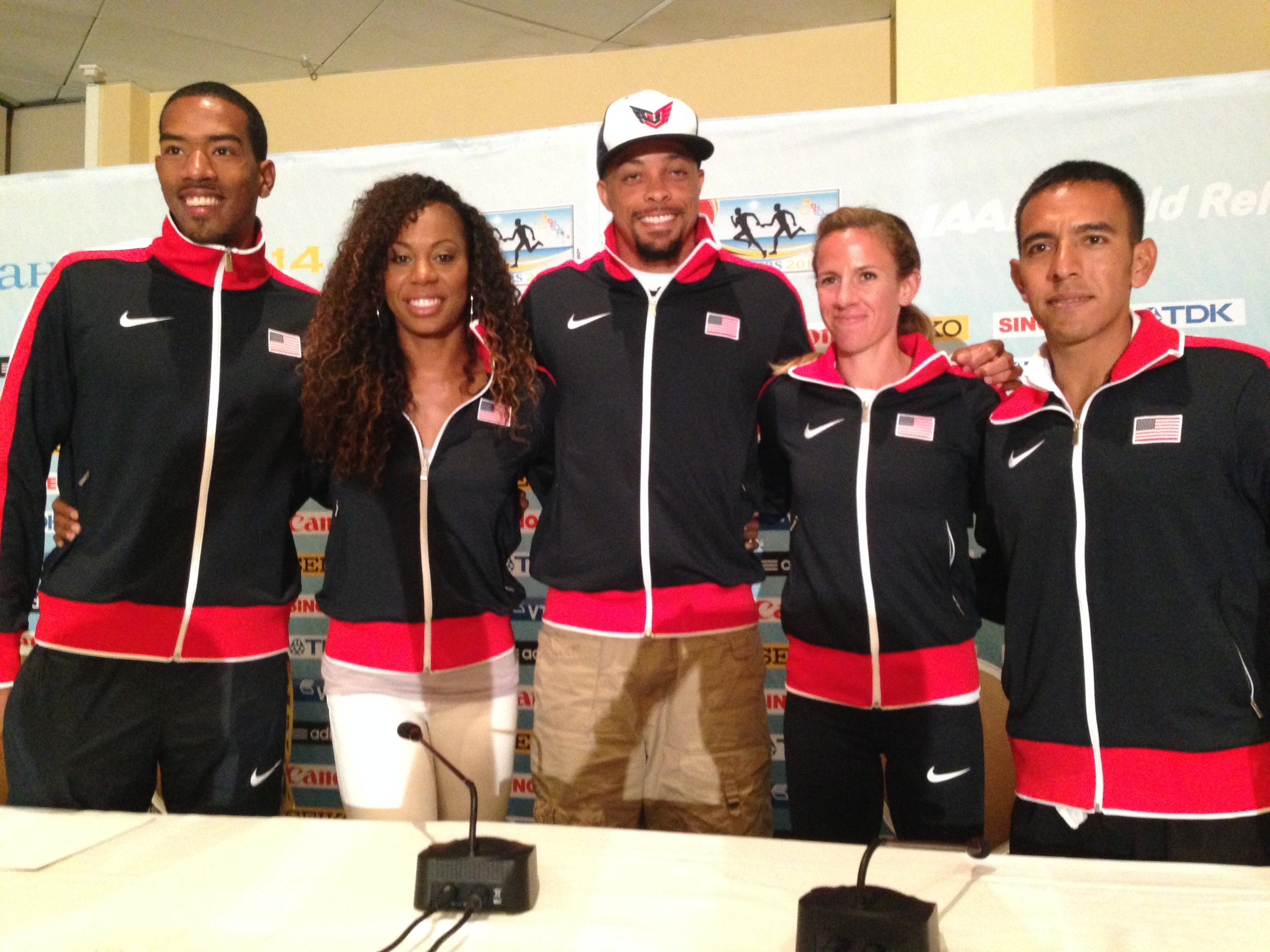
Left to right: Christian Taylor, Sanya Richards-Ross, Wallace Spearmon, Morgan Uceny, Leo Manzano at Friday's news conference

The IAAF can often, and fairly, be accused of being cautious in its nod to tradition.

But let’s give credit where it is due.

It is light years ahead of almost every other international sports federation in the Olympic movement in its understanding and its use of the digital space to promote its sport. The IAAF website is way better — broader, deeper, loaded with stats, more accessible — than anyone else’s. The IAAF’s phone app is superb. There’s now a Diamond League phone app that gives results — provided by Omega Timing — in real-time.

The overwhelming problem with track and field is the presentation of the sport itself. That is, on the field of play.

To make a long story short — a meet now is the same as a meet way back when.

Like, way, way, way back when.

For the track freak, it’s like renewing a long-running love affair.

The overwhelming problem, again, as time and experience have proven, is that there aren’t enough track freaks. To the average consumer, meets are cluttered, confusing and far too long.

Thus the genius of these relays.

Two nights. Easy schedule — 4x100, 4x200, 4x400, 4x800 and 4x1500.

Your mother can understand that, people. Even your grandmother. And there are likely to be a lot of Bahamas grandmas at this meet.

The stadium is sold out. Both nights.

The IAAF has arranged for extensive live television coverage — in the United States, on Universal Sports.

More interestingly, it will for the first time in its history be live-streaming. In Europe, the stream is available here.

If you’re not in Europe, you can find the live-stream via the Eurovision Sports Live app. It’s available both for iOS and Android.

Beyond all that, the mood here is light, easy — genuinely anticipatory.

For one, the weather and scenery are as you’d expect.

For another, pretty much everyone expects two, maybe three, world records to go down — the men’s and women’s 1500s and the men’s 800.

Maybe — though it does seem like a stretch — the sprints as well. “If I’m running 19 [seconds] and having to do a start, imagine what i can do in a relay,” Jamaican star Yohan Blake said of the 200.

All in, there’s a total prize package of $1.4 million, put up by the national sports ministry. Any world record is worth $50,000.

Teams are here from more than 40 nations — with more than 500 athletes — including the U.S., Jamaica, Kenya and Russia.

The unique twist to the upbeat mood is one that took U.S. middle-distance runners Morgan Uceny and Leo Manzano to explain. At the Olympics or world championships, she said, yes, everyone comes as a team. At the same time, you’re still competing against your teammates. Here — it’s truly a team atmosphere.

The last time it felt like this, Manzano said, was college. He said, “I’m excited to be out there and lay it on the line.”

How long before this sort of relay event becomes a fixture on the FINA swim calendar?

How long, too, before the track people take a clue from the swim people, who themselves have an innovative event coming up, the Singapore Swim Stars, a series of match races in September among the series of events opening the new national stadium and aquatic center there.

It’s clear that the Olympic Games and traditional world championships are fixtures, and rightfully so, on the sports calendar — swim or track. But in between there’s room to experiment.

Track needs the energy and excitement of the relays; it already has proven, in places like Manchester, England, that street racing is the way to go. The way forward would seem obvious:

Why not a series of street races — say, five. Pick your venues: Fifth Avenue in New York. Michigan Avenue in Chicago. Bourbon Street in New Orleans. Outside LA Live. The whole thing would culminate on the Strip in Las Vegas, at night, under the lights, with the Bellagio fountain roaring.

Line the worlds great athletes up and let them run for 150 meters.

You don’t think people would watch? Isn’t that made for TV?

If he — or she — wins all five events, it’s worth a grand prize. The Michael Phelps experience with Speedo has taught that a $1 million bonus gets people talking.

Just thinking out of the box here. That’s what track and field needs.

Like these relays.

Now, nothing is perfect. These first Bahamas relays for sure won’t be.

For sure there are bound to be glitches.

Already, there’s a major one in the run-up: Usain Bolt isn’t here. In the same way that Phelps has made it clear he understands fully his responsibility to promote swimming, Bolt should be here promoting these relays.

This, though, isn’t so much on organizers as it is on Bolt, who is for all intents and purposes the global icon of track and field. Even if he’s not running, he should be here as an ambassador of the sport.

“It is the role of our top athletes to do this,” Lamine Diack, the IAAF president, said at Friday’s news conference. “But we also know that he is not there. But we have a full stadium — two days. we have a world championship. We have a lot of athletes who will be competing — very good athletes, who will be competing against each other.”

He quickly added a moment later, “I can’t focus on the one who is not there.”

Or the ones.

The U.S. team is hardly the A team. Missing for a variety of reasons: Justin Gatlin, Carmelita Jeter, Allyson Felix, Mary Cain, Nick Symmonds, Jenny Simpson, Matthew Centrowitz.

All of these absences, individually, can be explained. Nevertheless,  if you are the U.S. delegation and Eugene is bidding for the 2019 world championships, which the IAAF will award in November, Doha and Barcelona also in the running, and everyone who is anyone in track and field leadership circles is going to be here, wouldn’t you, you know, want to put on a red, white and blue smiley face?

It’s not as if the Bahamas is a long flight from the continental United States. Like 30 minutes from Miami.

Which brings us to another matter, way more significant, in fact, for Eugene’s hosting of the World Junior Championships this summer, for its 2019 track and field bid, even for a potential U.S. Summer Olympics bid in 2024, because this exemplifies the chronic refrain you hear from around the world about border, customs and transit difficulties involving the United States:

“I would like to inform you that concerning IAAF World Relay Bahamas 2014, we cannot be able to participate because of we [tried] to get the transit visa USA and other country,” Bililign Mekoya, general secretary of the Ethiopian track and field federation, said in a note emailed May 12 to agents and managers around the world.

At the end, all the Ethiopians could get, for reasons of timing, were visas through the United Kingdom — via historical connections — for one men’s 4x1500 team.

For U.S. sports leaders, indeed for all of world sport, this sort of visa and transit challenge must be addressed.

Of course we live in the real world. At the same time, the 9/11 attacks were more than 12 years ago and, as the International Olympic Committee president Thomas Bach has made clear, sports can prove a constructive tool for dialogue.

The way it is here in the Bahamas.

Keith Parker, the local organizing committee chairman, noted that there are all of 350,000 people in this island nation,. The relays are to be preceded by events featuring local, junior racers.

“We hope,” he said at the news conference, “this great event will influence them to strive for greatness. If you find any shortcomings, please let us know.

“We will do everything possible to correct them and make the event as good as it possibly can be and keep the standard up to other world championships,” he said, adding, “I wish you all welcome …”


Ping-pong for paz, paix, ba dame

There are many versions of the story of the starfish on the beach. This is the one that over the past 15 or so years has guided the remarkable work of the International Table Tennis Federation as it has grown to become a powerful force for one-on-one change and, as well, a vehicle for the notion that sport can help promote peace in even the farthest reaches of our world:

A storm washes up thousands upon thousands of starfish on the sand. An older man walking along the shore notices a boy who seems to be dancing. The gentleman comes close and sees the boy is not dancing but throwing starfish, one by one, back into the sea.

Glenn Tepper running a table tennis clinic in Kiribati in xxxx. In the foreground is 4-year-old xxx // photo courtesy Glenn Tepper

“Why are you doing that?” the older man asks. “You can’t save them all. You can’t possibly make a difference!”

At that, the boy bends down and throws a starfish into the water. And then another. And yet another.

He says: “Saved that one. And that one. And that one.”

Earlier this month, at its annual general meeting, which this year was held in Tokyo, the ITTF brought both Mali, in Africa, and the U.S. Virgin Islands on board as national associations. Those two lifted the total of member federations on the ITTF roster to 220, tying the international volleyball federation, FIVB, for most in the world.

Afghanistan, for instance, became a member in 2005; Papua New Guinea in 2009; Chad in 2012.

Just for comparison: track and field’s global federation, the IAAF, has 212 member federations.

Only five outliers have a national Olympic committee — for context, again, there are 204 formally recognized NOCs — but are not yet recognized as an ITTF national association. Four are African: Guinea-Bissau, Cape Verde, Sao Tome & Principe and Eritrea. The fifth: Bahamas.

The ITTF goal is to have all five in the fold by the Rio 2016 Summer Olympics.

To show you the reach of table tennis:

The Pacific island nation of Vanuatu sent five athletes to the 2012 London Games. Two of the five played table tennis.

Until 2012, the Middle Eastern state of Qatar had never before sent women to the Summer Games. It sent four women to London. One was a 17-year-old table tennis player, Aia Mohamed.

The ITTF story is all the more notable because table tennis — in the aftermath of 1970s ping-pong diplomacy — became an Olympic sport only in 1988, at the Seoul Summer Games.

It wasn’t until 1999 that the ITTF’s formal development program got underway. By then, the ITTF had 180 members. The program was launched with $60,000 — $30,000 from the federation itself and $30,000 from the Oceania confederation of Olympic committees.

Now it has grown, all in, to nearly $2 million annually.

At the beginning, the program had a “staff” of one.

Now it has a full-time staff of 10, part-time of 100, serving over 100 nations -- all of it part of the ultimate goal, according to ITTF chief executive Judit Farago, of table tennis being recognized as a top-five sport in the Olympic movement.

To be obvious:

Soccer is the easiest game to organize, because all you need, really, is a ball. Then come basketball and volleyball, because you need a ball and a net. Then table tennis, because you need the rackets, a ball, a net (or a board or even boxes); and then anything, literally almost anything, can serve as the table, including a door, a table (to be even more obvious), a sheet of marine plywood (widely available throughout the world), school desks pushed together, whatever.

In comparison to the other sports, however, table tennis has an incredibly enviable upside. It doesn’t take up much room. It can be played indoors or out. And it doesn’t take a dedicated space; the “table” can be packed or folded up and put away. Thus it is, practically speaking, a complete winner.

Too often, the administration of sport is derided as (mostly) men in suits. In this instance, some forward-thinking suits recognized the elegance inherent in table tennis. Over the years, they have included:

Monaco-based Peace and Sport, directed by Joel Bouzou; the German table tennis federation, and in particular its president, Thomas Weikhart, and secretary general, Matthias Vatheuer; Butterfly, the Japanese table tennis company founded by Hikosuke Tamasu, who as a young soldier in 1945 was but two kilometers away when the atom bomb was dropped on Hiroshima; and the Foundation for Global Sports Development.

So, too, the United Nations Office on Sport for Development and Peace, headed by its special adviser, Wilfried Lemke.

In particular, the ITTF project has been guided by the vision of Adham Sharara, its president since 1999, and his “P4” philosophy for the federation— popularity, participation, profit, planning — now expanded in recent years to a fifth p, promotion.

Mostly, however, the project has been implemented from the start — and is even now overseen — by Glenn Tepper, an Australian, a former school teacher, national team player and coach whose passport has many, many pages. He’s at nearly 100 countries, most of them developing nations.

Glenn Tepper, now ITTF deputy CEO, who in 1999 was the one-man "staff" of what would become its worldwide developmental program // photo courtesy Glenn Tepper

It might sound romantic beyond imagination to be doing a table tennis course in Bora Bora, in French Polynesia. This was not, however, a honeymoon. Tepper slept in a hammock on a balcony. The mosquitoes were ferocious.

In the early years, there was a lot sleeping in hammocks. Or open-walled huts. Or cement floors. He rode a lot of local buses. He hitchhiked. He walked, a lot.

Tepper was that staff of one, and that $60,000 had to go a long way.

The payoff was in breaking down barriers. In providing something not just different but potentially better — to help even one kid see that a bigger world was out there. In maybe offering a glimmer of hope.

Kiribati is a collection of 33 islands in the central tropical Pacific. Its permanent population is now about 103,000. It was one of the first places Tepper went on this mission. He was struck while there how many people lived in thatched huts — no walls — on platforms raised above the sea and how many had their entire worldly belongings in a single box in one corner of the hut. Most people he encountered lived on a subsistence diet of tuna and tarot. They also thought — and maybe they were right, he said — that they were rich beyond words.

In Kiribati // photo courtesy Glenn Tepper

While in Kiribati, a picture was taken of Tepper running a clinic; in the foreground is a 4-year-old boy. About a dozen years later, that boy, Karirake Tetabo, would go on to represent Team Oceania at the ITTF Global Cadet Challenge.

In a story two years ago Tetabo is quoted as saying, “My aim is to become firstly Pacific Games champion and later become one of the best in Oceania and, who knows, maybe the world?”

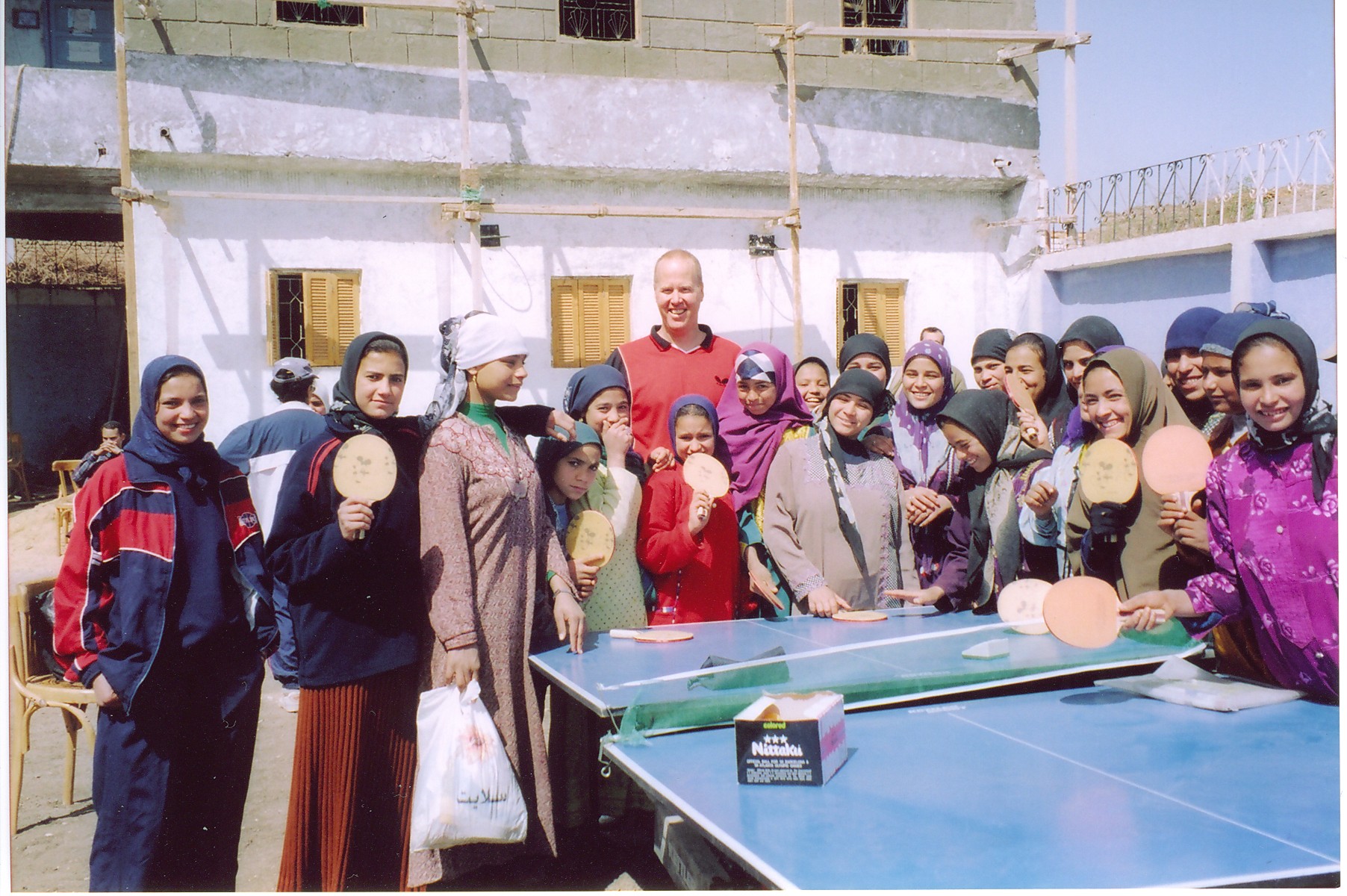
One of the first collaborative projects, it turned out, would be in 2003 in rural Egypt, Tepper and others working with village leaders in a bid to change perceptions of girls who according to tradition were being married off in their early teens and believed at risk for ritual circumcision.

One such leader, in a short ITTF video, calls the project an “excellent initiative” and gives thanks to God, saying it “increased activities” in the village community center, “especially for young women.”

In Egypt in 2003 // photo courtesy Glenn Tepper

Over the last Olympic cycle, 2009-12, ITTF organized 492 courses; 98 were done in accord with the International Olympic Committee’s Solidarity initiative; around the world, these 492 courses reached 24,000 people, 38 percent of whom — up from 33 percent in the previous four-year cycle — were women.

Of those 492, 206 — or 42 percent — included education about Para Table Tennis. That was up from 14 percent in the 2004-08 cycle.

In 2009, a notable ITTF initiative included “Ping Pong Paz.” It focused on children from displaced families living in slums in three cities in Colombia — 600 kids.

In Colombia in 2009 // photo courtesy Glenn Tepper

In 2010, it was halfway across the world, in Dili, East Timor, for “Ping Pong Ba Dame,” with the Swedish champion Peter Karlsson, a relentless promoter of table tennis as an agent for good.

In Dili, Jose de Jesus, president of the local Action for Change Foundation, after recounting the civil war there four years before, asserted that the program would promote  “tolerance, discipline, morals and respect for each other.”

In 2011, the ITTF launched one of its most ambitious projects, “Ping Pong Paix,” reaching across borders in central Africa, two villages in Burundi, two across the line in the Democratic Republic of Congo. The area had been marked for some time by conflict and, indeed, outright skirmishing.

Again, Karlsson was on hand.

“The kids,” Tepper said, “found out they were exactly the same. They weren’t so different. They could have fun and become friends.”

Ultimately, the ITTF would take kids from each village to the 2012 world championships in Germany. Needless to say, these kids had not been on airplanes before. They didn’t have passports. Some didn’t even have shoes. It all got figured out.

At those championships, the kids watched the action, mingled with the sport’s stars, got all wide-eyed. They also presented Sharara with pictures they had drawn from their villages. Tepper said, “There were a lot of people with tears in their eyes who are normally tough customers.”

There’s a video that, in part, features one of the kids at those championships.

Billy Quentin Nkingi, then 12 years old, looks into the camera and, speaking in French, says, “Hello, I am Billy. I am from Burundi. I am happy to be here. This is the first time I have been to such an occasion. I am here for peace.”


The Oslo 2022 conundrum

The International Olympic Committee finds itself early this week in Oslo in a conundrum of its own making. On the one hand, it is assuredly the IOC’s responsibility to encourage strong bids to come forward. Thus Oslo 2022. On the other, in politics – even, perhaps especially, sports politics – perceptions can matter as much as reality. Thus, again, Oslo 2022.

A high-powered IOC delegation, led by the president himself, Thomas Bach, visits Norway Monday and Tuesday for a series of meetings revolving primarily – there are other sessions – around preparations for the 2016 Winter Youth Games in Lillehammer.

Norway's Anette Sagen during a 2013 FIS World Cup ski jump event at the famed Holmenkollen venue // photo Getty Images

The timing comes at a fraught juncture for the Oslo 2022 bid, which all involved are keenly aware.

Thus the dilemma:

Is this good for the IOC? For Oslo 2022? Or, owing to layers of complexities, is this trip ultimately not likely to prove helpful for an Oslo 2022 campaign?

To set the stage:

The IOC agreed to these series of meetings in Norway weeks if not months ago.

As the longtime Olympic British journalist David Miller spelled out in the newsletter Sport Intern in a column published Saturday, the two-day itinerary begins Monday with meetings at the Olympic Sports Center and the Norwegian School of Sports Science.

The IOC president is due thereafter to take lunch with Norway’s King Harald at the Royal Castle along with Norway IOC member, Gerhard Heiberg. After that, Miller reports, the IOC delegation – which includes the likes of senior IOC member Ser Miang Ng, who is the new finance commission chair as well as Singapore’s ambassador to Norway for many years, and Angela Ruggiero, chair of the Lillehammer 2016 coordination commission – is due to “exchange ideas” with Norway’s culture minister, Thorhild Wedvey, and Oslo’s mayor, Stian Berger Rosland.

More meetings Monday are due to follow, with three NGOs, with four labor groups and, finally, with members of parliament.

On Tuesday, the scene shifts to Lillehammer itself, Miller reports, for a series of meetings, including with Ottavio Cinquanta (head of the skating federation), Rene Fasel (hockey federation chief) and Gian-Franco Kasper (ski and snowboard federation No. 1).

Also due to be on-hand from the IOC side, according to Miller: the outgoing Olympic Games executive director, Gilbert Felli, and the IOC director general, Christophe de Kepper.

Wow.

Assuming, indeed, that everyone shows up -- that is some serious IOC star power.

A bit more background:

There are five applicant cities in the 2022 bid race: Oslo; Almaty, Kazakhstan; Beijing; Lviv, Ukraine; and Krakow, Poland.

It’s not clear Krakow will make it past a May 25 referendum.

Lviv, of course, is struggling with enormous turbulence in the eastern part of the country. The IOC last week gave Ukraine’s national Olympic committee $300,000 just so its athletes could make it to training camps and meets this year.

The IOC’s policy-making executive board is due in early July to decide which of the five “applicants” will become “candidate” finalists. The IOC will pick the 2022 winner in July, 2015.

Almaty and Beijing would seem to be shoo-ins. They are both, of course, from Asia.

So who is going to make it from Europe?

It’s not exactly a secret that Norwegians love winter sports, indeed the Winter Games. The 1994 Lillehammer Games are often cited as the “best-ever.” Norway leads the overall Winter Games medal count, with 329, and the gold count, too, with 118 (the U.S. is second in both categories, 282 and 96).

The athlete who has won the most Winter Games medals? Biathlon king Ole Einar Bjorndalen of Norway, the new IOC member, with 13. He won two gold medals in Sochi in February -- just a couple weeks after turning 40.

Next? Cross-country ski god Bjorn Daehlie of Norway, with 12, eight gold.

Next, three athletes, one of whom is female Norwegian cross-country ski legend Marit Bjorgen, with 10 Olympic medals, six gold. In Sochi, age 33, she won three gold medals, among them the grueling 30-kilometer event.

Look, any Oslo bid for the Games would understandably be taken very seriously. For obvious reasons.

Two weeks ago, however, one of two Norwegian government parties voted against supporting Oslo’s 2022 bid. At issue now is whether the government will offer the needed financial guarantees.

The imperative – at least for now – is that the IOC would seem to need Oslo for the 2022 race more than Oslo needs the Winter Games. That is the box. And everyone in Olympic circles knows it.

At the same time, while Norwegians may love the Winter Games, it’s pretty clear there are some strong feelings about the bid, and they may be directly tied to the IOC. And those feelings may not be so positive.

A new poll conducted by the research firm Norstat for NRK, the Norwegian Broadcast Corporation, suggests that 60 percent of the Norwegian public is against an Oslo 2022 bid – with only 35 percent in favor.

“No, it is a considerable skepticism, and I think a lot of the information that has been around the IOC has increased that skepticism,” Christian Democratic Party leader Knut Arild Hareide said.

Bach has been in office for about nine months. He has shown an inclination to lead in a style that evokes some of the ways of Juan Antonio Samaranch, the IOC president from 1980-2001, who understood – appropriately – that the IOC is not just a sports institution but one that moves with nation-states and with influential political leaders.

Thus, for instance, the lunch with the Norwegian king as well as the exchanges with, for instance, the culture minister.

Too, Bach is possessed – this is meant to be a compliment – of first-rate confidence. You have to have such confidence to direct the IOC, a global institution with a multibillion-dollar budget. By definition, the position lends itself to high-pressure decision making. Bach took a decision to have this two-day meeting, and it is on.

He is also riding a wave of can-do. Sochi is in the rear-view mirror. The IOC and NBC just struck a $7.75 billion deal through 2032.

Even so, does the IOC president himself need to assess what’s going on in Lillehammer with regard to the 2016 Youth Games, when those Games are nearly two years away -- Feb. 12-21, 2016 -- and, besides, it’s well-known the Youth Games are way down the IOC priority list?

For this purpose, doesn’t he already have a coordination commission? And the chair of that commission is, you know, in Norway for this trip?

If this trip were just about Lillehammer, why meet with the mayor of Oslo?

It is also the case that the Norwegians doubtlessly would have some interesting – perhaps even some constructively provocative – ideas to offer regarding Olympic Agenda 2020, the far-reaching IOC study program the IOC president has launched that is now working its way toward the all-members session in Monaco in December. That would explain the sessions with the NGOs and the other Monday afternoon meetings, for instance.

But are the Norwegians the only ones in the entire world with suggestions so potentially clever that the president has to hear them in person?

And, this, coincidentally enough, before the July meeting at which the 2022 applicants are going to be passed through?

Earlier this year – the deadline was April 15 – the IOC took email submissions from anyone, anywhere who wanted to weigh in relating to Olympic Agenda 2020. Yet the Norwegians get an in-person audience with the IOC president himself?

Over the years, the IOC has gone to great – some would say extraordinary – lengths, particularly in the aftermath of the late 1990s Salt Lake City scandal, to keep its distance from anything that sniffed of even the hint of the appearance of conflict of interest in the bid cycle.

For instance, the IOC would not entertain sponsorship discussions from the Russian concern Gazprom while Sochi was bidding for the 2014 Games. Similarly, when Doha was trying, it would not entertain an approach from Qatar Airways even between bid cycles.

No one has suggested misconduct or wrongdoing in the slightest by either the Norwegians or the IOC. To repeat: nobody has said anybody is doing anything wrong.

And nobody is likely to.

The only people who would be likely to complain would be rival bid teams, in this instance most likely Almaty or Beijing.

How do you think it is going to go over when they read that the IOC president is in Oslo, and before the July executive board pass-through meeting?

If you were them, how would you react?

In private?

Now – what would you do about it?

Exactly.

Isn’t this, too, the dilemma?


Living in the moment: track's It Couple

2014-04-23-12.37.53.jpg

The world’s greatest athlete is taking his first outdoor runs of the season in the pole vault. His coach, Harry Marra, is here, of course, at the Westmont College track, in the hills above Santa Barbara, California. His wife, Brianne, herself the reigning indoor and outdoor silver medalist in the women’s versions of the all-around event, is here, too, practicing her javelin throws and running some hard sprints.

Ashton Eaton is the 2012 gold medalist at the London Games in the decathlon. At the U.S. Olympic Trials earlier that year, he set the world record in the event. He is the 2013 Moscow decathlon world champion. He is also the 2012 and 2014 gold medalist in the heptathlon, the indoor version of the multi-discipline event. He holds the heptathlon world record, too, and missed setting it again at the 2014 indoor worlds by one second in the 1000 meters.

On this day, a bungee cord takes the place of the bar at 5 meters, or 16 feet, 4 ¾ inches. Eaton takes his practice runs. He doesn’t go one after the other, in sequence. No. He shares pole vault time, and graciously, with a 54-year-old doctor of holistic health, Victor Berezovskiy, and a 77-year-old clinical psychologist, Tom Woodring.

Ashton Eaton and Brianne Theisen Eaton after practice at Westmont College

This scene summarizes perhaps all that is both sweet and unsettling about the state of track and field in our world in 2014.

It’s sweet because the fact that Ashton Eaton would so willingly, humbly take practice runs with these two guys speaks volumes about his character. Obviously, neither is coming anywhere close to 5 meters. It’s no problem. Eaton patiently helps them both with their marks. In turn, they watch his take-off points.

Sweet because Ashton Eaton and Brianne Theisen Eaton – he’s now 26, she’s 25 – are, by every measure, track and field’s It Couple. They are at the top of their games. Yet here they are, at the track, just like everyone – anyone – else, practicing. And practicing some more. And then some more, still.

Because, obviously, that’s how you get better. How even the best get better.

It’s hard work that gets you to the top and for those who have seen track and field tainted these past 25 or so years by far too many doping-related scandals, here are Ashton and Brianne, examples of the right stuff. Never say never about anyone. But Ashton and Brianne? So wholesome, Harry says, and he has been in the business for, well, a lot of years, and seen it all, and he adds for emphasis that they don’t even take Flintstone vitamins.

Ashton follows his pole-vaulting with a series of 400 hurdle splits, trying to get the timing down – how many steps between each? 13? All the way around? Does he cut the hurdle? Float? What’s right? She does her repeat 150s so hard that, when she’s done, it’s all she can do in the noontime sun to find some shade.

This, ladies and gentlemen, is how you rise to the top.

And yet – the questions have to be asked:

Is track all the better because it’s a kind of extended family where one of its biggest names can hang on a sunny morning practice with a 54-year-old and a 77-year-old?

Or isn’t that, in its way, kind of ludicrous?

Does LeBron James practice with a 54-year-old doctor of holistic health?

Do Peyton Manning or Tom Brady run 7-on-7 drills with a 77-year-old clinical psychologist at wide receiver?

Tom Woodring, 77, left, and Victor Berezovskiy, 54, right, with Ashton Eaton

It’s not that James, Manning and Brady don’t understand their responsibilities as stars. But this is – practice. This is not a fan meet-and-greet.

What if things were different for track and field? What if the decathlon champ was The Man, the way it was when Bruce Jenner and, before him, the likes of Bill Toomey, Rafer Johnson and others were venerated the way Manning, Brady and James are now?

It’s not just Ashton. Brianne is herself a major, major talent.

Of course, track and field does not hold the same place in the imagination that it once did. Dan O’Brien, the 1996 Olympic decathlon winner, is not The Man the way Jenner was. Bryan Clay, the 2008 Olympic decathlon winner – not The Man the way Jenner was.

And that’s no knock on either O’Brien or Clay.

Times simply have changed. Jenner won in Montreal in 1976. That is a long time ago.

Yet in Ashton and Brianne, track has a marquee couple.  Here are breakout stars in the making: doping-free, handsome, articulate, passionate about advancing track and field the same way Michael Phelps has always been for swimming. Phelps is on bus stop advertisements in Shanghai. Why aren’t these two, for instance, featured on the bright lights looking out and over Times Square?

For sure that would be better for the sport.

Would it be better for Ashton and Brianne – and Harry?

It’s all very complex.

Right now, track and field is, for all intents and purposes, Usain Bolt.

Isn’t there room for Ashton and Brianne, too?

The scene at Westmont this weekday morning is all the more striking because it comes amid the news Phelps will be racing again. The media attention enveloping Phelps is, predictably, striking.

Yes, Phelps is the best in the world at what he does.

Then again – so are these two.

Yet here are Ashton and Brianne and Harry – and, for that matter, a Canadian delegation that includes Damian Warner, the 2013 world bronze medalist in the decathlon – going about their business at Westmont, along with the others at the host Santa Barbara Track Club, with no interference, no autograph requests, no attention.

Phelps has always sought to live a normal life. But let’s be real: could Phelps walk around Westmont – or, for that matter, any college campus in the United States – with the same quietude?

Coach Harry Marra watches as Brianne Theisen Eaton throws the javelin

After practice, there is a quick session in the Westmont pool. No one swims like Phelps. Then it’s over to the Westmont cafeteria, where lunch is five bucks and the beet salad is, genuinely, awesome.

Brianne says they consistently make a point of reminding themselves that these are the best days of their lives – to live, truly live, in the present and know that they are experiencing special moments.

“To somebody who is in it more for fame or money,” Brianne says, “they would have a lot different outlook on this.”

“The goal is to improve yourself,” Ashton says.

“The goal is excellence,” Harry echoes.

So sweet.