Big problem: no Munich 2022

What is wrong with this picture? Vienna: no.

Rome: no.

Munich: no.

Even Switzerland, home of the International Olympic Committee: no.

The IOC has a huge disconnect on its hands. At issue, right or wrong, fair or not, may well be the IOC itself. Now: will the IOC recognize this disconnect, and be willing to do something about it?

In the afterglow of arguably the greatest Summer Games ever, London's 2012 Olympics, taxpayers in western Europe -- the IOC's base -- have now shot down three separate Games bids before they even got started, the latest Munich's presumptive 2022 Winter Games campaign, killed Sunday by Bavarian voters.

This past March, voters in Austria rejected a Vienna 2028 plan. Innsbruck just put on the 2012 Winter Youth Games; it staged the 1976 and 1964 Winter Games. And Salzburg bid for the 2014 and 2010 Winter Games.

Just days before the Vienna balloting, Swiss voters in the canton that is home to the ski resorts of St. Moritz and Davos rejected a 2022 bid proposal. St. Moritz staged the Winter Games in 1928 and 1948.

In February 2012, meanwhile, the then-prime minister of Italy, Mario Monti, called off Rome's 2020 bid, though it was already well underway. Rome put on the 1960 Summer Games.

Monti pulled Rome out because of uncertain costs associated with the project.

That's always an issue. Environmental concerns are a factor, too. But now there seems to be something more at work,  the reputation of the IOC itself.

Munich had bid for 2018, won by Pyeonchang, South Korea. Since then, of course Thomas Bach, who played a key role in the 2018 bid, has become the IOC president, and a 2022 Munich bid would have been the presumptive favorite, Munich seeking to become the first city to stage the Summer (1972) and Winter Games.

The mountain resort of Garmisch-Partenkirchen, about an hour south of Munich, where some of the 2022 events would have been staged, played host to the 1936 Winter Games.

The bid needed to win elections in four communities were the Games would have been held. Instead, the campaign lost in all four, some badly.

Here is the money quote from Sunday's vote, from Ludwig Hartmann, a Greens Party lawmaker and a leader of the movement, called "NOlympia," that led the opposition to Munich 2022: "The vote is not a signal against the sport but against the non-transparency and the greed for profit of the IOC."

If you are tempted to dismiss the Greens as a fringe party, fine. But when a leading German newspaper like Süddeutschen Zeitung, the day before the vote, runs a column that compares the IOC to both the mafia and the "North Korean regime" -- if you are the IOC, you've got issues.

Fifteen years after the Salt Lake City scandal shook the IOC to its core, the organization has -- this is the truth -- undergone significant reforms. Juan Antonio Samaranch lived to see those reforms effected. Jacques Rogge carried them out.

After having written about the IOC full-time since nearly the day the scandal erupted, it is clearly the case that the overwhelming majority of those who are members now believe -- and wholeheartedly -- in its mission. They give outrageously of their time. Their commitment is profound, indeed.

And yet -- how is it that the image of the IOC can conjure such comparisons? A crime syndicate? A rogue state?

"We proved long ago, when I was with Meridian, the IOC's marketing agency, that consumers around the world love the Games and the Olympic brand. That is irrefutable," Atlanta-based Terrence Burns, now the managing director at Teneo Sports, said.

"We also conducted research about the IOC itself -- as an organization. The results of that were not so glowing …

"The IOC has an image problem -- fair or unfair, real or imagined -- it does not matter."

Just last weekend, Bach chaired a "summit" at IOC headquarters in Lausanne, Switzerland, with more than a dozen senior Olympic officials from around the world. Afterward, the IOC issued a statement in which the new president's agenda, ratified by those in attendance, was made crystal-clear.

The statement identified the "main topics of interest and concern" confronting the movement as these: the campaigns against doping and match-fixing, regulation of the sports calendar, autonomy of the sports movement and, finally, governance issues.

What's missing from that list is elemental. It's what Sunday's rejection by Bavarian voters underscores, and this is way beyond any potential reflection of the vote on Bach, because this is about way more than one individual.

The entire Olympic enterprise is hugely expensive. It depends on cities and countries wanting in.

In our world now, there will always be emerging countries with lots of money -- and the corollary, some measure of risk, possibly significant -- ready and willing to stand up and say, we want the Games.

Is a trend that produces mostly such countries for any given bid cycle in the best interest of the Olympic movement?

If the perception of the IOC in developed nations makes for a bid disincentive, or worse, isn't it thoroughly obvious that the IOC should be doing something about that? Some basic brand management? Some fundamental story-telling about what the IOC itself does?

Munich's defeat, for instance, could well mean no German bid for many years to come. Berlin, which played host to a tremendously successful 2009 world track and field championships, was thought by many to be a viable Summer Games contender.

Michael Vesper, director general of the German Olympic Sports Confederation, which goes by the acronym DOSB, said the rejection of Munich 2022 "clearly means that another Olympic bid in Germany won't be possible for a long time."

Burns, the former president and founder of Helios Partners, served on the winning Beijing 2008, Vancouver 2010, Sochi 2014 and Pyeongchang 2018 bids. He also managed golf's entry to the Olympic program and wrestling's return, and said of the IOC:

"This is an organization that does incredible good in the world, every day on every continent around the world, and no one knows about it. The IOC, for its own reasons, has mistakenly chosen to let the Games themselves be the arbiter of its image. In the consumers' minds, the Games do not equal the IOC in terms of appeal and affection. They are two different things."

The deadline for entering for 2022 is Thursday. Already declared: Oslo; Lviv, Ukraine; Beijing/Zhangjiakou; Almaty, Kazakhstan; and a joint bid from Krakow, Poland, and the nearby mountains of Slovakia. Stockholm is still thinking about it. The IOC will pick the 2022 site in 2015.

The 2018 race produced only three candidates: Pyeongchang, Munich and Annecy, France.

Some will review the early list of 2022 contenders and see a welcome uptick in the number of bids.

Reality check: the IOC is heading to Sochi for 2014 and Rio de Janeiro for 2016, and just awarded Tokyo 2020 with more than one member making it clear amid the 2020 vote, "No more experiments."

Look at the 2022 list again, and Oslo would appear to be your early front-runner. Norway has staged two Winter Games before, in Oslo in 1952 and Lillehammer in 1994. It has a huge offshore oil sector and so it likely can afford the Games, the Oslo 2022 budget already pegged at $5 billion.

But -- what kind of front-runner?

In September, only 55 percent of Oslo voters supported the bid in a city-wide referendum.

To be candid, 55 percent is not a happy welcome mat. Then again, that's better than pre-vote polls had suggested: a survey in the Norwegian daily Aftenposten had put support at 38 percent with 47 percent saying they would vote no, the remaining 15 percent undecided.

"I think that what just happened in Munich," Burns said, "was not a rejection of the idea of hosting the Winter Games, it was a rejection of the IOC itself. That's troubling to me personally because as an insider I have seen what goes on behind the curtain for almost 20 years, and I can tell you the IOC works hard, very hard, on behalf of sport. But no one knows about it.

"Think about it this way:

"Munich, or Rome, had an opportunity to truly make a powerful, positive statement to the world about sport and humanity, frankly on their own terms given the IOC's relatively hands-off approach -- e.g., Sochi -- and they took a pass. How many great cities can the IOC afford to 'take a pass'?

"Isn't it of value to the IOC to have a Munich or a Rome hosting the Games instead of somewhere you've never heard of? There is a mutually beneficial brand transition that takes place and London is a great example -- both the IOC and London greatly benefitted from each other's brand. But London bid for the Games [starting] in 2003 and won in 2005. Would they bid today? Could they?"


At the UN: the Bach Doctrine

The recently elected president of the International Olympic Committee, Thomas Bach, delivered a remarkable speech Wednesday to the United Nations Assembly, a signal declaration of the role of the IOC and what it can and can't do to effect social and political change in these early years of the 21st century. In essence, he laid out what future Olympic historians might well call the Bach Doctrine -- at least as it relates to the complex and never-ending interplay between sport, government and politics.

Here was a clearly defined and articulated vision of the roles of both sport and political entities. Sometimes, as in the endorsement of the Olympic Truce, as the UN did Wednesday, or to promote certain sports projects in a conflict zone, it works to work together. Other times -- when, for instance, it comes to changing the laws of a particular country -- that's beyond the IOC mandate.

061113-ioc-un

"The IOC is above all a sports organization," Bach said. "Sport is our first priority."

That is the key, and Bach's address ought to serve as mandatory reading for activists anywhere in the world seeking to ride the Olympic rings to advance their own interests, particularly when such activists wonder why the IOC can't or seemingly won't do more.

The IOC is not, for emphasis, itself a government. It is "above all a sports organization."

Later in the speech, Bach said, "Of course, we know that, as in ancient Greece, sport and the Olympic Games can not on their own solve political problems or achieve peace.

"Peace-building is a long process. Sport wants to be a part of this process. However, we are aware of our limits -- but we want to use the power of our values and symbols to promote the positive, peaceful development of global society.

"These symbols, and especially the peaceful competition at the Olympic Games, should inspire all the people."

Bach's address was notable not only for what was said but the timing of his remarks.

Bach was elected IOC president Sept. 10, not even two months ago. His comments Wednesday can leave no mistake: he is not gently feeling his way about the office but rather seizing the pulpit that comes with it to lay out his agenda.

The UN has endorsed the notion of an Olympic Truce before each edition of the Games dating to 1994. In acting Wednesday, the assembly urged its 193 member states to respect the "values of the Olympic truce around the world" even as it agreed to cooperate with the IOC and International Paralympic Committee to use sport "as a tool to promote peace, dialogue and reconciliation in areas of conflict during and beyond" the 2014 Sochi Games. They are set to run Feb. 7-23.

It was in the context of the truce resolution that Bach delivered his remarks.

Bach's comments, of course come amid the ongoing controversy stemming from the Russian law enacted over the summer that purports to keep homosexual "propaganda" from children.

Bach did not pound his fists on any lectern and declare, for instance, that the Russian law must change. Why would he? Two weeks ago, Russian president Vladimir Putin told Bach, "We will do everything to make sure that athletes, fans and guests feel comfortable at the Olympic Games regardless of their ethnicity, race or sexual orientation. I would like to underline that."

This, then, is what Bach said Wednesday: "Sport stands for dialogue and understanding which transcend all differences. Sport, and the Olympic movement especially, understands the global diversity of cultures, societies and life designs as a source of richness. We never accuse or exclude anyone."

He also said that it "must always be clear in the relationship between sport and politics that the role of sport is always to build bridges," adding, "It is never to build walls."

Woven throughout Bach's address were references to what in Olympic jargon is called "autonomy."

It stands as a significant Bach priority, as the new president made plain after calling a "summit" Sunday at IOC headquarters in Lausanne, Switzerland, with more than a dozen senior Olympic officials from around the world.

Along with the campaign against doping, for instance, the summit detailed "autonomy" as one of the IOC's pressing prerogatives.

In most nations -- the United States is a significant outlier -- responsibility for the national Olympic committee runs through a branch of the federal government. There's thus inherent potential for interference from that government, or from politicians at federal, state or local levels.

The IOC wants "autonomy." It recognizes that the 204 national Olympic committees need to be funded; again, the U.S Olympic Committee, by act of Congress, has to fund itself. At the same time the IOC wants those NOCs -- and their local governing bodies -- to enjoy the authority to pursue sports-related decisions as sports officials see fit.

Similarly, the IOC wants international sports federations to be free of governmental interference.

In real life, this can sometimes create a delicate balance.

At the UN on Wednesday, Bach turned philosophical in explaining why the IOC believes the pursuit of "autonomy" to be so vital:

Sport, he said, is the "only area of human existence" that has achieved what in political philosophy is known as "universal law" and in moral philosophy as a "global ethic."

For instance, anywhere in the world that you want to put on a soccer game, the rules are the same.

Those rules are based on the same common "global ethic" of fair play, tolerance and friendship, he asserted.

But to extend this "universal law" to all four corners of the globe, he said, "sport has to enjoy responsible autonomy," adding, "Politics must respect this sporting autonomy."

Only then, Bach said, can sport retain its great potential to inspire amid all the "differing laws, customs and traditions" in the world.

In exchange, Bach said, it's entirely reasonable to expect that sports officials will exercise such autonomy "responsibly" and in accord "with the rules of good governance."

At this juncture, Bach took on squarely the notion -- often put out there -- that sports and politics do not mix.

In exercising autonomy, the sports movement must remain politically neutral, he said. But this did not mean being "apolitical."

He said, "Sport must include political considerations in its decisions. It must consider the political, economic and social implications of its decisions," and particularly when the IOC chooses the site of the Winter and Summer Games, the bid process fraught with politics.

"In the mutual interest of both sport and politics," Bach said, "please help to protect and strengthen the autonomy of sport."

Please, the new IOC president said: "I ask you all to take this message back to your countries."


A stealth Olympic summit

The International Olympic Committee held something of a stealth meeting of key power-brokers Sunday at its lakefront headquarters in  Lausanne, Switzerland, a move that illuminates the who's who and what's what behind the developing agenda of the recently elected president, Germany's Thomas Bach. Bach convened the meeting, not widely publicized beforehand and in an IOC release termed an "Olympic Summit," to address "the main topics of interest and concern" confronting the movement.

These the statement identified as the campaigns against doping and match-fixing, regulation of the sports calendar, autonomy of the sports movement and, finally, governance issues.

The scene Sunday at the IOC "summit" // photo courtesy of IOC/Richard Juilliart

Here, then, is a catalogue of how the new president intends to operate, his key list of action items and, perhaps most fascinatingly, a collection of advisers -- a kitchen cabinet, if you will -- that the release identified as "the senior representatives of the Olympic Movement's key stakeholders."

Like any list, it's not just who is on it but who is not that makes for the tell.

Among those who were there:

The three IOC vice presidents: Craig Reedie of Great Britain; Nawal el Moutawakel of Morocco; John Coates of Australia.

Sheikh Ahmad Al-Fahad Al-Sabah of Kuwait, of course. Marius Vizer, the International Judo Federation and Sport Accord president, naturally. Sepp Blatter, the FIFA president. C.K. Wu, the head of the international boxing federation.

In May, the aquatics and gymnastics federations were elevated to the top tier of Olympic revenues, joining the track and field federation, the IAAF. The IAAF president, Lamine Diack of Senegal, was there Sunday; so was Julio Maglione of Urugay, president of FINA, the aquatics federation. The gymnastics federation president, Italy's Bruno Grandi? No.

The entire winter sports scene was represented solely by René Fasel, president of both the ice hockey and winter sports federations.

More: the heads of the national Olympic committees of the United States, China and Russia were invited to the meeting. But -- not France. Hello, Paris 2024?

Beyond that, the important take-aways from the meeting are these:

Reasonable people can quibble with the notion of whether doping, match-fixing, the calendar, autonomy and governance make for the spectrum of pressing issues facing the movement.

The new president, for instance, is keenly aware that the Olympic Games are the IOC's franchise and that keeping the franchise relevant to young people has to be the IOC's No. 1 priority. Nowhere on that list, moreover, is an exploration of the values central to the Olympic movement and how they might, should or do play out in today's world.

The president "invited the participants to share their ideas on these subjects," and a wide range of others, "and to be part of the permanent dialogue and ongoing reflection that the IOC wishes to increase with its main stakeholders," according to the release.

Bach is super-smart. He understands concepts such as "relevance" and "values." For sure.

But the action-item catalogue clearly and unequivocally demonstrates -- as Bach suggested during the presidential campaign, which ended with his election Sept. 10 in Buenos Aires -- that his focus is in problem-solving.

That means: solving the problems, or at least trying to, that are there, directly and identifiably, in front of him and the IOC.

Look at what the release says:

-- The IOC will set up a task force to coordinate efforts against match-fixing and illegal betting.

-- The participants agreed to set up an "experts' network" that will focus on issues of autonomy and governance.

-- The IOC will set up a "consultative working group" to deal with the calendar.

This calendar group, and it should be highlighted that this panel will be "under the leadership of the IOC," obviously has two unspoken priorities:

One, for those thinking long-range, is the 2022 World Cup in Qatar, and whether -- as FIFA has been mulling, or not -- it can or should be moved to the winter. Such a move could well be problematic for a 2022 Winter Olympics. The IOC statement Sunday noted that the working group will discuss "the priority of current and future sports events within the global calendar."

Two, there's Vizer's suggestion, made when he was running last spring for SportAccord president, for a "Unified World Championships" that would feature 90-plus sports all going on at the same time. The group Sunday, Vizer included, the IOC statement said, agreed that "any new initiative has to respect the uniqueness of the Olympic Games."

Then there is the campaign against doping.

The release affirms the movement's "zero-tolerance" policy against drug cheats and backs the IOC's candidate for the presidency of the World Anti-Doping Agency, Reedie, who is expected to be affirmed at a meeting this month in South Africa. At the same time, it calls for WADA to become more of a "service organization," reflecting tensions with some international sports federations, who have suggested that the agency has been telling them what to do instead of serving their needs.

Whether this proves, in the long run, to actually be a good thing or not, and whether it actually gets played out, particularly with such real-world challenges such as the testing of Jamaican and Kenyan athletes now making headlines, remains to be seen.

Reedie, it should be noted, has consistently proven himself to be a shrewd player in sports politics across many constellations.

In the near term, meanwhile, all this shows conclusively that Bach is not only consolidating but demonstrating his own authority while simultaneously showing if not a bent, then at least a nod, toward collaboration.

It's of course absolutely a good thing that Bach seek the input of key constituent groups. In about a month, he will lead not only an executive board meeting in Lausanne but immediately afterward an EB retreat. Of course, how the EB and this new kitchen cabinet will mesh -- there is some overlap -- remains to be seen.

At the same time, as Jacques Rogge before him and Juan Antonio Samaranch before that proved, while the IOC is something of a democracy, the institution has traditionally functioned best when the president demonstrates a clear and decisive hand.

It took Rogge some time to figure this out. He made a show at the beginning of his first term of wanting the IOC to be far more democratic. The 2002 Mexico City session, which devolved into hours upon hours of democracy -- the members voicing all manner of opinion about baseball, softball and modern pentathlon, and their roles in the program, with nothing getting done -- put an end to that. After that, he started acting way more presidential.

Bach, it appears, gets from the start that he is the man. That's the way it should be.

One other thing that is notable is that the IOC, at the end of this one-day summit, had this multi-point action plan more or less ready to go. Anyone who has done committee work knows that committees don't do action work readily or easily. So this was already well in the works -- the deal points already hammered out, apparently via pre-meetings -- well before the new president summoned all "the senior representatives" to Lausanne for the face-to-face summit that produced the news release.

Note, by the way, the careful use of language. These were not "some senior representatives." The release pointedly makes use of the definite article, the word "the," before "senior representatives." The new president is by nature precise -- that's how that list of people got invited Sunday.

That, ladies and gentlemen, is called leadership.


The relay lights the way

2013-10-27-08.26.26.jpg

ST. PETERSBURG, Russia -- Moscow Avenue runs for 10 kilometers. It starts at Victory Square, commemorating the sacrifices of World War II. The street sees the Russian National Library. It carries past the House of Soviets, a major command post during the 900-day siege; out front is a massive statue of Lenin. The boulevard runs over the Fontanka River and then, finally, ends at Sennaya Square. Ten kilometers is roughly six miles. It rained on and off Sunday, the day the Olympic flame relay -- as it is formally known -- came to St. Petersburg. It was cold enough that already winter coats and hats were out. Even so, Moscow Avenue -- in Russian, Moskovksky Prospekt -- was jammed, the street lined on both sides, people everywhere and anywhere, just to get a glimpse of the flame.

They were literally hanging out of second-story windows. They were queueing at gas stations. They came sprinting out of a car dealership. Kids, and there were hundreds upon hundreds of kids,  waved flags and danced and pointed excitedly to their parents and uncles and aunts and teachers and didn't mind the rain and posed for pictures. The children acted -- well, like kids everywhere.

It has been nearly 30 years since Sting suggested in song that the Russians must love their children, too. The relay offers powerful proof of what the Sochi 2014 Games, which this week ticked under 100 days away, mean to this enormous, incredible country -- and, at the same time, an invitation to the rest of the world to find out about Russia beyond the well-worn stereotypes.

The Olympic flame in St. Petersburg, Russia // photo courtesy Sochi 2014

This has always been the power of the relay.

It symbolizes the better urge in the Olympic movement, the powerful impulse toward excellence, friendship and respect that is, in fact, universal.

Kids everywhere know that.

They knew it on my street in Hermosa Beach, California, in 1996 when I took my daughter, who was then 2 years old, out to see the relay go by right our house on its way to Atlanta for the Summer Games and all the neighbor kids were screaming and yelling in excitement.

Just like they did Sunday in St. Petersburg, Russia.

For much of the rest of the world, the onset of the 2014 Winter Games has meant a rash of controversies: a vague new law purporting to ban homosexual "propaganda" to young people, $50 billion and counting in construction, worries over snow or no, concerns over terrorism, all of it overseen by the face of today's Russia, the president himself, Vladimir Putin.

That catalogue underscores a simple truth: the Russians have not done themselves many, if any, PR favors.

Fundamentally, however, the wonder -- after four visits to Russia in not even six months -- is how much of what gets spun up about this country is still rooted all these many years after the end of the Cold War in what can often seem like an enduring dread, if not outright fear, in many quarters of the press.

Of all the stories and all the broadcasts, how many are from reporters who have ever set even one foot in Russia?

Russia takes time and effort. In today's 24/7, what-have-you-got-for-me-now news-cycle, those are resources that can seem most difficult to justify.

Russia is not, in a word, easy. It's not easy to get to; travel visas have traditionally been complicated and expensive. Moreover, once here, the language barrier is often ferocious. Even the alphabet is different.

Sochi itself, way down by the Black Sea,  is hard to get to. Where do you want to transfer through? Moscow? Istanbul? Vienna?

Then there is Putin, who is typically viewed as The Action Man One Dares Not Cross -- for fear he is at all times carrying plutonium-laced sushi, or something, in his pocket. Or, if he is back to riding shirtless on a horse, in his boots. Who knows?

These absurd caricatures are completely at odds with the Putin that the French ski legend Jean-Claude Killy, the International Olympic Committee's primary liaison with Russia and the Sochi 2014 project, described in a recent story in the French weekly Journal du Dimanche.

"The Putin I know is not the one described in the newspapers, where you see real 'Putin-bashing,' " Killy told the paper.

Killy added, "I have no reason to follow the crowd; I trust what I see. When he calls me from Moscow at three in the morning his time to wish me a happy birthday, I find that nice."

It's not that there is an essential misunderstanding in the west of Putin or, more broadly, of Russia.

There seems to be almost no understanding.

This, then, is the opportunity the Sochi 2014 Games present -- if, and this is a big it, the Russians themselves understand it is at hand.

And -- if they care, and want to do something about it.

To be clear:

There is much to criticize about the Sochi project. And there remains the potential for terrorism or other catastrophe that could further re-shape forever the way the 2014 Games are seen or understood.

At the same time, the relay lights the way toward a new understanding, the possibility that -- over time -- things can change. This is the promise and potential of the Olympic movement in every country it touches.

That said, change takes time, especially fundamental change, and especially in a vast and complicated place like Russia.

Consider, for example, this exchange on Monday between Putin and the newly elected IOC president, Thomas Bach, at the Adler Railway Station, one of the infrastructure facilities built for the 2014 Games. Adler is the town immediately next to Sochi.

"Sochi and the entire region have come a long way in their development over these last years, and successfully, too," Bach said. "This makes a deep impression on us. The Olympic sites will contribute to making the Sochi Olympics unique in the movement's history, and the facilities will offer sportspeople the best possible conditions."

Putin, a moment or two later, said, "It seems to me that you liked the railway station, too?"

Bach: "I more than liked it, not just for its functionality, but for its architecture, too. It impresses me very much that you were able to build this railway station in just four years. Aside from the architecture and the unique solutions to link the old and new stations, I was also impressed by the way the facilities have been designed to allow people with disabilities to use them. I learned today, for example, that a special path has been laid in the terminal for the visually impaired. I think this is an optimistic sign for the future, a sign that shows how architecture and construction are developing in general in Russia.

"Of course, this new station will be used after the Olympics, too, and will become part of the Olympic heritage not just for Sochi but for the whole country."

Putin: "Yes, I wanted to say the same words. It will be an important part of the Olympics' legacy."

Is this revolutionary? No.

Is this important stuff? Yes, just like the handicap ramps that were built as a design feature into a nearby hockey arena, also a new idea in Russia.

A recycling program for water bottles -- a new idea.

Another new idea -- the volunteer program that will make the Games go in a country that previously had no volunteer culture.

On a Sunday morning in St. Petersburg, there they were by the dozens in their blue vests, 2014 volunteers, out in the rain, seeing the relay down Moscow Avenue and beyond, bringing the Olympic flame to a part of Russia nearly 1,450 miles away from Sochi. They made lifetime memories for literally thousands of people, and so many kids.

It was not even seven years ago, the summer of 2007, that Sochi was bidding for the 2014 Games. To have imagined such a scene then -- truly, it was unthinkable.


This just has to stop

The international sportswriters' association, which goes by the acronym AIPS, held its two-day executive committee meeting this week in Doha, Qatar. The meeting's guest of honor was Sheikh Saoud bin Abdulrahman Al Thani, the secretary general of the Qatar Olympic Committee, who is keenly sophisticated and moves fluidly between Arab and western cultures. The Qataris bid -- unsuccessfully -- for the Summer Games of 2016 and 2020, cut early on in each round by the International Olympic Committee. Of course, soccer's World Cup is set for Qatar in 2022.

His Excellency told the ladies and gentlemen of the press that sport is fundamentally one of the pillars of Qatar's development plan. This year, the Qataris will organize 40 major sports events. By 2020, he said, the goal is to stage a big event every week of the year.

And, of course, he said, to bid again for the Olympics. Maybe for 2024. Possibly 2028.

If you have been to Doha, actually been on the ground, you know that there is serious commitment there. The new president of the IOC, Thomas Bach, has long had extensive ties to the Middle East, so one would imagine the climate -- so to speak -- for a Gulf bid would be as good as it could ever get.

There's only one thing that could stop a Doha bid dead in its tracks, and it's not the heat. Nor is it the capacity, infrastructure or even the impact on television schedules.

It's this:

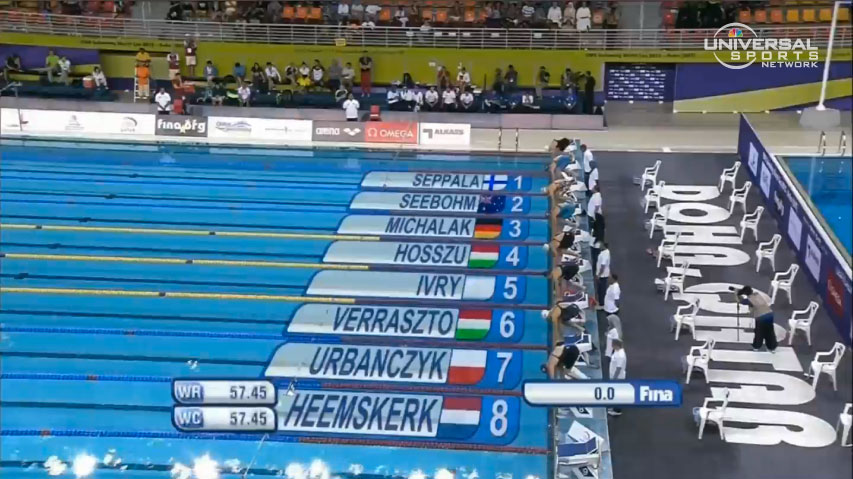
The start of the women's 100-meter individual medley  at the Doha World Cup event // photo courtesy Universal Sports Network

This photo offers irrefutable evidence of everything the Olympic values -- friendship, excellence, respect -- are not.

This sort of intolerance, indeed discrimination, has to stop. Now. And forever more.

This screenshot shows the start of the women's 100-meter individual medley at swimming's World Cup stop in Doha -- happening more or less about the same stretch of time His Excellency and some of the world's leading writers were meeting to talk about all the exciting things happening in the Qatari capital.

In Lane 5 is Amit Ivry of Israel.

The Israeli flag that should be depicted in the graphic display in the host broadcast feed has instead been washed out.

This incident marked just one of several episodes directed against Israeli swimmers at the World Cup stops in both Dubai (Oct. 17-18) and Doha (Oct. 20-21).

On Day 1 in Dubai, Israeli swimmers were not properly identified, either by announcers on the scoreboard. That way, their name and national flag wouldn't have to be shown, a veteran national-team swimmer, Gal Nevo, told a leading Israeli newspaper, Ha'aretz.

Things in Dubai were apparently back to normal by Day 2. Nevo, for instance, announced as from the country "I-S-R" on Day 1, was announced as from "Israel" on Day 2.

He said, "Suddenly, you arrive in a country that has refused to recognize you until now, and know that the next time we'll be here they won't play those games with us. I don't know how many television viewers we're talking about but the people in the emirate saw the Israeli flag over and over again, and were exposed to the country's sporting aspect."

That this sort of thing happened in Dubai can not have come entirely as a huge shock.

After all, this was where in 2009 the Israeli tennis player Shahar Peer was refused a visa for the Dubai Duty Free Tennis Championships; tour officials fined organizers $300,000 and said all qualified players had to be able to play or the tournament's sanctioning would be at risk. Peer has since played in Dubai.

That said, recent years have seen a veritable catalogue of incidents in which politics and sport have mixed in all the wrong ways, consistently with the Israelis as the target.

At the 2004 Athens Olympics, for instance, Iran's judo world champion, Arash Miresmaeli, refused to take to the mat for a first-round match against Israel's Ehud Vaks in the under-66 kg class. Iranian officials later awarded Miresmaeli the same $120,000 given its gold-medal winners at those 2004 Games for what was called a "great act of self-sacrifice."

At the 2008 Beijing Games, Iran's Mohammed Alirezaei refused to compete alongside Israeli swimmer Tom Be'eri in the heats of the 100 backstroke.

At the 2010 Olympic Youth Games in Singapore, in the final of the boys under-48 kg class in taekwondo, Gili Haimovitz of Israel won when Mohammed Soleimani of Iran proved a no-show, officially claiming he had aggravated an old injury to his left leg. Soleimani skipped the medals ceremony as well -- missing the Israeli flag and anthem.

In 2012, Algerian kayaker Nasreddine Baghdadi withdrew from a World Cup event in which Israeli Roei Yellin was entered, and the president of the Algerian Olympic Committee, Rachid Hanifi, said all its athletes might refuse to compete against Israelis at the London Games: "There is an obligation to ask our government if we have to meet Israel in sport."

That prompted the then-IOC president, Jacques Rogge, to declare that only serious injury would be accepted as an excuse for not competing at the London Games, that suspicious withdrawals would be checked by an "independent medical board" and that bogus withdrawals would lead to unspecified sanctions.

Just two weeks ago, Tunisia's tennis federation ordered its top player, Malek Jaziri, ranked 169th in the world, not to play Israel's Amir Weintraub in the quarterfinals of a lower-tier ATP event in Tashkent, Uzbekistan.

International Tennis Federation spokesman Nick Imison told Associated Press he believed the case was a first-of-its-kind in tennis.

The constitution of swimming's international federation, which goes by the acronym FINA, is absolutely clear that discrimination on the grounds of "race, sex, religion or political affiliations" is out of bounds.

True, FINA officials absolutely had been put on notice by events in Dubai. But Doha? This was where a 20-year-old Shahar Peer in 2008 -- the year before the episode in Dubai -- had reached the round--of-16. Moreover, her first night in the city, the tourney director had even taken her and her entourage out to dinner at a Moroccan restaurant in the traditional Souk district marketplace.

And yet -- Doha.

According to a report in the Times of Israel, it's not just that the Israeli flag was not displayed in the computer graphics of the races. Some races in which Israelis swam were not broadcast. The Israeli flag was removed from outside the venue; a tweet was posted Sunday complaining about the flag's presence before it was taken down from outside the swim complex, according to the Doha News.

How this all happened remains entirely unclear. Who precisely was responsible -- also uncertain.

FINA on Wednesday issued a statement saying that it reacted to events in both Dubai and Doha as soon as it knew. In Doha, for instance, FINA officials say they were told the full scope of what had happened only 15 minutes before the end of Day 2.

The statement says FINA "guarantees" that "all steps will be taken in the future for such acts not to occur again."

This is particularly key because the world short-course championships are due to be held in Doha Dec. 3-7, 2014. Dubai and Doha are also scheduled to host further World Cup events ahead of the worlds.

FINA's executive director, Cornel Marculescu, told Associated Press the two organizing committees apologized for what he called these "stupid things." He also said, "Next year we have the world championships and these things will not happen anymore."

Marculescu is absolutely right to label the incidents so forthrightly and to  say enough is enough.

Now: Doha has a huge incentive to bid for the Olympics.

There are all kinds of bold steps that could be taken. For instance, there are apologies of all sorts. Some are private. Some are meant to be much more public.

Or: there are ways of reaching out, gestures of goodwill -- say, swim clinics in which regional stars teach local kids. Could it hurt to invite Amit Ivry, winner of the silver medal in the 100 medley at the Doha 2013 World Cup?

At the least -- all the Israelis all ought to be taken out to dinner next December at the worlds, everyone ought to shake hands and pose for some tourist-like pictures in the Souk and then all hands can get on with the business of swimming.

The Israelis -- just like they were anybody else. That's what they, and everybody, deserve.

After all, that's the fundamental promise inherent in Olympic sport -- that everyone can get along and that everyone deserves a chance to do their best, however good-enough that best might be. If the Qataris want to invite the world in 2024 or 2028 and be taken dead seriously about it -- an Olympics is way different than the World Cup -- that is the deal. Anything less is a non-starter.


Putin: one clever guy

It has been just over four months since Russian president Vladimir Putin signed into law a measure that purports to ban "propaganda of nontraditional sexual relations" to those under 18. In the west, activists have howled. In Russia, those howls have left senior officials entirely unmoved. The International Olympic Committee finds itself in the middle -- akin to the position it found itself in five years ago, in the run up to the 2008 Beijing Games, when activists seeking to draw attention to a variety of issues in China, in particular in Tibet, wanted to know why the IOC wasn't pressuring the Chinese government to do more.

The answer, then as now, is that the IOC is not a government. It is not even a quasi-government. Contrary to public opinion, its ability to exert "pressure" on a state authority is limited.

Russian president and IOC Sochi 2014 coordination commission chief Jean-Claude Killy of France at February 2013 one-year to-go ceremonies // Getty Images

At any rate, an equally intriguing question is why the Russian authorities found it if not necessary then at the least certainly important this past June to pass such a measure. They knew full well the Sochi Olympics were going to start Feb. 7, 2014.

The question is all the more compelling as the University of Southern California's Annenberg Institute of Sports, Media & Society on Tuesday opens a three-day conference in Los Angeles entitled, "Sports & The LGBT Experience."

Surely the Russians had to know they were going to incite a furious reaction. Why invite such controversy?

The answer is telling. No matter the fury, the Russians seem unfazed. The heat to them seems simply more proof their society is different and different is just fine.

"Putin cares less and less about Western outcry -- be it gays or something else," said Sergei Strokan, a foreign-affairs columnist at Kommersant, a leading Russian daily -- and Kremlin-neutral -- newspaper.

"He believes in his superiority over the West. The belief is rooted in understanding Russia as a unique civilization with no Western rot."

A reminder: this law passed the Duma, the Russian lower house, by a vote of 436-0, with one abstention.

Only 12 percent of Russians consider homosexuality fully equivalent to heterosexuality, 35 percent are convinced it is a disease or a result of psychological trauma while 43 consider it a bad habit, according to a survey published in May by the independent Levada Center.

The survey was conducted April 19-22 among 1,600 respondents from 45 Russian regions; its margin of error is 3 to 4 percent.

It is not a crime to be gay in Russia. Then again, homosexuality was decriminalized in Russia only 20 years ago and, obviously, anti-gay sentiment remains powerful.

"It's about politics. It's not about gay people," said Sufian Zhemukov, the Heyward Isham visiting scholar of Russian and East European studies at George Washington University and co-author of a forthcoming book that uses the prism of Sochi and the Olympics as a case study of Russian life.

He added a moment later, "Adopting the anti-gay law gets some points for the current regime because they are adopting a law [about] which most of the population approves."

Then there's this:

When you bid for an Olympics, it's generally the case that you make the campaign all about what you can do for the Olympics. Then the next seven years are all about what the Olympic movement can do for you, the winner. The fixed deadline of the opening ceremony concentrates the mind: you build bridges, metro lines, stadiums, all of that, and then you show off what you've done to the world.

In this instance, Putin seems to have learned the lesson, and ramped it up a notch.

The Sochi Games are reportedly the most-expensive ever, with costs already estimated at north of $51 billion to build a winter destination from a Black Sea summer resort.

In essence, what Putin is doing is using the Olympics not just to assert Russia's place in the world --a reprise of  the Chinese play for 2008 -- but to remind Russians themselves that Russia is, in these first years of the 21st century, still a force with which to be reckoned.

Russia's population is dwindling. Across its multiple time zones there are infrastructure challenges large and small. Yet in Sochi Putin audaciously said, we will build it and you will come.

Of course, most everyone who will come will be Russian. It's too far and too complicated for most everyone else. Is that OK by Putin and senior Russian staff? For sure.

After the Games, what about those facilities in Sochi? For years to come they can be the training base for Russian teams.

One of the things about an Olympics is that exposure to the big, wide world out there tends to bring about the percolation of ideas. But these things take time. Like -- years.

Already, because of the forthcoming Games in Russia, there is a volunteer program, a recycling project for water bottles and handicap ramps at the Sochi 2014 arenas. Those are big new ideas in that country.

All societies evolve.

It wasn't so long ago that the idea of gay marriage in the United States was a political non-starter; this week, New Jersey is just the latest to allow same-sex marriage.

For that matter, it wasn't all that long ago that a law very much like the one at the center of the controversy in Russia was on the books in the United Kingdom.

That law, called "Section 28," outlawed the promotion of homosexuality in Britain's schools. Introduced in the late 1980s, it was finally repealed across Britain in 2003. The current prime minister, David Cameron, has acknowledged himself not having a perfect record in voting for gay rights and in 2009 apologized for Section 28, calling it "offensive to gay people."

One strains to remember American bartenders pouring Scotch whiskey down the drain because of Section 28 in the way that activists earlier this year were calling for vodka boycotts.

Indeed, it is hardly a stretch to observe that it was only the spotlight of the Olympics that brought so much attention to the Tibetan cause five years ago -- and now to the issue of gay rights.

Both sides are, in their way, getting exactly what they want.

In the United States, for instance, the U.S. Olympic Committee this month amended its non-discrimination policy to include sexual orientation. The spark for that change happening now was the Russian law.

The USOC's move is, its senior leadership made plain, the right thing to do.

For Putin, too -- it underscores distinctions in a way he couldn't possibly articulate better. He must be just short of gleeful watching the dominoes do their thing.

"Putin," said Strokan, the Kommersant columnist, "sees no major controversy that can spoil the atmosphere of the Games."

This is someone who, when he came back to office on May 7, 2012, scheduled his very first meeting that day with the-then IOC president, Jacques Rogge. Who, when Thomas Bach was elected last month, managed to track down the new IOC president just minutes later via cellphone, as Bach was working the line with reporters in Buenos Aires, Argentina, and wish him congratulations.

There's zero wonder why this measure came up months before the Sochi Olympics. Vladmir Putin did not get to be president of Russia -- repeatedly -- without being a very smart and calculating guy.

Always -- always -- remember that.


How to decode IOC news releases

The headlines Wednesday were all about Richard Carrión stepping down from his senior positions within the International Olympic Committee in the aftermath of his unsuccessful campaign for the presidency. Carrión, a banking executive from Puerto Rico, resigned from his "different positions within the IOC," the organization said in a news release, in particular his role as chairman of the finance commission. Under his watch, IOC reserves grew to more than $900 million, ensuring the IOC's financial security.

Carrión also resigned as the IOC's point man on TV rights deals outside of Europe but agreed to stay on in that position through the Sochi Games, which end Feb. 23, to afford the IOC -- and new president Thomas Bach -- continuity.

Carrión will remain a regular IOC member. But he will also step down from his position as chair of the audit committee and walk away from his spot on the coordination commission for the 2016 Olympics in Rio de Janeiro.

IOC member Richard Carrión

That's the news that went around the world on the wires Wednesday, and it is 100 percent accurate.

But, as ever, the back stories are way more interesting.

Bach is in the first stages of team-building.

Carrión, meanwhile, runner-up to Bach in the September election, did the honorable -- and classy -- thing by tendering his resignations. It's that simple.

He and Bach met last Friday at IOC headquarters in Lausanne, Switzerland. Any effort to suggest that Carrión is resigning out of anger or spite would be just way off base.

Indeed, Carrión put out a statement that said, "It has been an extraordinary privilege and experience to have chaired the IOC finance commission for the past 11 years and to have fulfilled agreements that have helped secure a solid financial foundation for the Olympic movement.

"I have always thought that a new leader needs room to set a course and select his team. As such, I submitted my resignation for President Bach's consideration. I look forward to continuing my service as an IOC member, and help in any way with the new leadership's transition."

Bach won the Sept. 10 election, at the IOC's landmark 125th session in Buenos Aires, with 49 votes in the second round; Carrión came in second in the six-man field with 29. Also at that session: Tokyo won for 2020 and the IOC reinstated wrestling to the Summer Games program for 2020 and 2024.

Singapore's Ser Miang Ng, another of the candidates, will chair the next meeting of the finance commission in December, the IOC said in that release.

To find the news that Carrión was stepping down from his various positions -- and that Ng would be handling the December meeting -- you had to read all the way down to the fourth paragraph in that release.

The third: Arne Ljungqvist of Sweden, Gerhard Heiberg of Norway and Hein Verbruggen of Holland would continue in their roles as chairmen of the medical commission, marketing commission and Olympic Broadcasting Services until after Sochi 2014, again for the sake of continuity; their terms had been due to run at the end of the Buenos Aires meeting.

Up top: John Coates of Australia will chair the Tokyo 2020 coordination commission, and Frankie Fredericks of Namibia the 2018 Buenos Aires Youth Games, and this is where you start to see Bach's team-building start to take shape.

Concentrating here on Tokyo 2020 because one of Bach's campaign suggestions is a review of the Youth Games project, an initiative launched by his predecessor, Jacques Rogge:

Make no mistake -- Coates is a shrewd pick as coordination chair, absolutely qualified on any number of levels. He is a super-smart lawyer; veteran international federation official (rowing); has experience helping to oversee a Games (Sydney 2000); and has service on two other coordination committees (London 2012, Rio 2016).

Beyond all that, during the campaign season, Coates was well-known to be a Bach supporter. Further, Coates is himself a newly elected IOC vice president with no upward IOC political ambition. The new president can absolutely, totally count on Coates' loyalty.

The vice-chair of the Tokyo 2020 CoCom: Alex Gilady of Israel.

This is a no-brainer, and for three reasons.

One, Gilady is one of the world's foremost experts on television and the Olympic Games.

Two, he has served -- or serves still -- on the Athens 2004, Beijing 2008, London 2012 and Rio 2016 CoComs.

Three, it is the fortunate soul who gets the counsel of Alex Gilady. He was there always and in all ways for Rogge and the IOC president before Rogge, Juan Antonio Samaranch. Now, Thomas Bach.

Also on the 2020 CoCom:

Two up-and-comers, the swimming great Kirsty Coventry of Zimbabwe, and Mikaela Cojuangco-Jaworski of the Philippines, who is a champion equestrienne and an actress.

Also: Anita DeFrantz of the United States, elected in Buenos Aires to the IOC's policy-making executive board, with the backing of Kuwaiti Sheikh Ahmad al-Fahad al-Sabah. After 12 years of being largely on the sidelines, she clearly is seeking a more dynamic role like the one she had during the Samaranch years.

As of Sept. 10, so that it is clearly understood, this is the power structure of the IOC: Bach is, indisputably, at the top;  the sheikh is his ally;  and, in perhaps the most intriguing piece of news in that IOC release, in a note far down that has received almost no attention whatsoever in all the stories that ricocheted around the world, there is the undeniable emergence of Marius Vizer, president of the International Judo Federation.

Vizer, last spring, was elected head of SportAccord, the umbrella federation for the international sports federations.

The IOC release, of course without comment, noted that he, too, would be part of the Tokyo 2020 CoCom, representing ASOIF, the federation of summer sports federations.

His appointment shows how quickly things can change.

Vizer and the sheikh are known to have an excellent relationship. The same, obviously, for the sheikh and the new president.

When Vizer was running for the SportAccord post, he suggested the notion of a "United World Championships" for all federations every four years. That could be seen as a direct challenge to the Olympics.

Bach, months ago when announcing his presidential candidacy, without referring directly to Vizer or Vizer's proposal, emphasized the IOC must work to keep the Olympics the "most attractive event in the world."

He added, "We must ensure that the uniqueness of the Olympic Games is not diluted by other events and that other incentives to not distract the athletes from viewing the Olympic Games as the real peak and ultimate goal of their efforts."

That was then. This is now.

Like a lot of other people in Olympic circles who at first wondered about Vizer but have come to know him better over the spring and summer, the judo federation president has gained a considerable following. They say now he is sophisticated, innovative and backs up his talk when it comes to putting athletes at the center of the experience.

Also, the IJF media output could teach much-larger federations a thing or two, particularly in our digital age.

Further, there's this:

There were many forces -- the sheikh, of course, and more -- that helped secure Bach's election. The dynamics at work in Buenos Aires included wrestling's push to get back into the Games over squash and a combined bid from baseball/softball as well as Tokyo's 2020 showdown with Madrid and Istanbul.

Russian interests in particular, it was said quietly in Buenos Aires, were keen to see what proved to be the winning triple play -- Tokyo, wrestling, Bach -- and it takes literally less than a second's search on the internet to produce a photo of Vizer together with Russian president Vladimir Putin.

The Russian state is overseeing the spending of more than $50 billion to prepare Sochi for 2014. Putin's influence in the Olympic movement is, in a word, profound.

The absolutely reasonable -- and undeniable -- conclusion to draw from the Tokyo 2020 CoCom list is this:

It's nothing less than a trial balloon for Marius Vizer's name as a candidate for IOC membership.

This is the way these things get done. See Japan's Tsunekazu Takeda, who served on the Vancouver 2010, Sochi 2014 and Pyeongchang 2018 CoComs. He was made an IOC member in 2012 and in September led Tokyo to victory for 2020.

Marius Vizer a member, and sooner than later. Remember, you read it here first.


Particle physics and water polo

Krikorian_Adam_Edit_USAWP_Womens_Press_Con_0113.jpg

It is reasonable  to wonder why a story about a water polo coach getting the U.S. Olympic Committee's top award for sportsmanship and fair play would begin with a reference to the award this week of the Nobel Prize in physics for the discovery of something called the Higgs boson particle. The Higgs, as it is known among physicists, has in common parlance come to be called the "god particle," because it explains -- well, everything. It has to do with how things acquire mass. More elementally, as the New York Times' brilliant science writer Dennis Overbye explains, it is that the cosmos is framed by simple, indeed elegant, laws. At the same time, everything interesting -- in particular, us -- happens because of lapses or flaws in that elegance.

That is, because of a mistake.

Krikorian_Ref_Timeout)Edit_USAWP_Women_vs_Australia_Semis_0267

Our world is so imperfect. It's the mistake, and the response, that is forever so compelling.

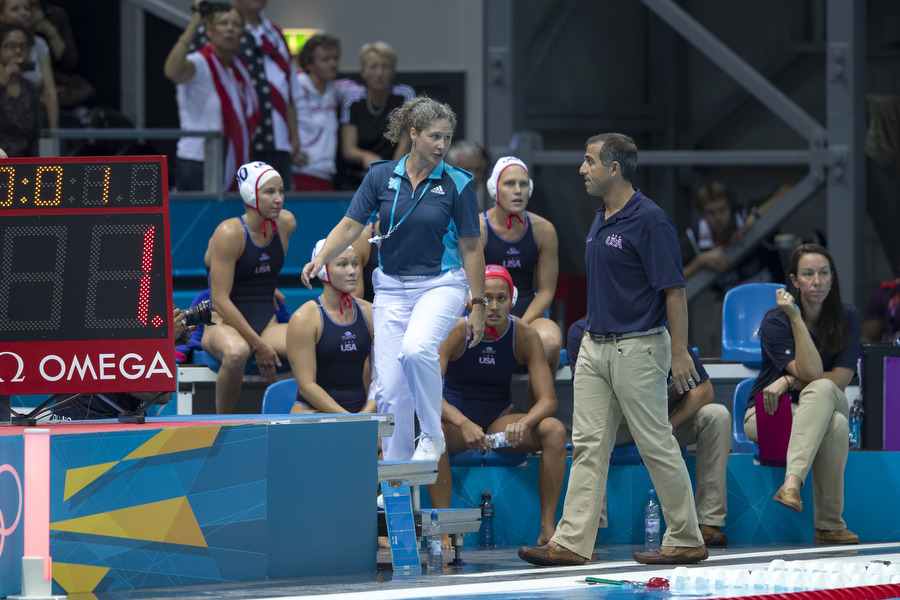
In the semifinal round of the women's water polo tournament at the 2012 London Olympics, Adam Krikorian, the U.S. coach, made a tremendous mistake.

With just one second to go, the Americans up by one goal over Australia, 9-8, he called a timeout.

Australian captain Kate Gynther's shot had just rattled off the crossbar. Krikorian thought the ball had ended up in the hands of the American goalkeeper, Betsey Armstrong. He called time. He thought everything was fine and the Americans were on their way, after a hard-fought game with the Aussies, to the gold-medal game.

Suddenly, it was not fine. The officials began huddling.

It wasn't just that the stakes were obviously high. Here, again, was history.

For more than a decade, the U.S. women's water polo program had been on nothing less than a quest for gold.

In Sydney in 2000, at the very first Olympic women's water polo tournament, the U.S. women lost gold -- to Australia -- on a shot made with roughly one second left in the game.

In Athens in 2004, the Americans finished third.

In Beijing in 2008, the Americans again took second, this time behind Netherlands, on a goal scored with just 26 seconds to go.

Krikorian -- who had been the coach at UCLA -- took over the program following Beijing, succeeding Guy Baker. He instilled a new culture. He said, over and again, we are all in this together.

He also made it plain the moment would come -- he didn't know when -- when the players had so bought into the idea of playing not just with but for each other as well as the staff, the coaches and the United States of America that they would know, they would just know, what to do and how to do it.

That, he made clear, was what a team was about.

And -- more.

In our world, so filled with skepticism and doubt, it is so easy, so tempting, to dismiss the idea of a team becoming truly a family. A family is rich with faith and, indeed, with love.

Physics can make incredible things happen. Love, though, is the strongest force of all. It bends time.

When Adam Krikorian called timeout, the problem was this:

Betsey Armstrong did not, in fact, have possession of the ball.

The rules were, as ever, simple: calling time when you don't have possession means the other team gets a penalty shot.

So, with just one second left in the game, the referees gave Australian star Ash Southern the ball. She whipped it past Armstrong. Just that fast, the game was tied. The horn sounded.

Onto overtime.

At the 2011 world championships in Shanghai, the Americans had finished sixth, their worst performance in over a decade. In the final game of that tournament, Australia had beaten the Americans for fifth place, 10-5.

To get to the Beijing final four years before, the Americans had defeated Australia in the semi, 9-8.

Now the Americans, seemingly on their way to the London final, were -- well, what?

"I just made the biggest mistake of my life," Krikorian said this week, recalling the moment, adding, "Immediately all these thoughts go through your head: 'I just cost my team the chance to play in the gold-medal game,' a dream they had been working toward for three or four years, some of them 12 years. There was a lot of battling inside my own head."

He added a moment later, "I typically pride myself on how I perform under pressure. This was something I had never experienced before. It was a bit overwhelming for me. I just remember being speechless. For once in my life, I didn't have anything to say. They came over to me in the huddle. I might have said a couple words. I mostly stared at them like I was looking at ghosts."

London Olympics - USA Water Polo Womens Press Conference

The time between regulation quarters is two minutes. Between regulation and overtime it's five minutes. There was still a lot of time left to go.

Krikorian looked at the clock -- 4:10 still to go until the whistle would blow to signal the start of overtime. He said, "It hit me like a ton of bricks. I had to get over it."

He called another huddle.

He said, "We are not going to let some stupid mistake by the coach affect the outcome of this game," explaining now, "I knew I had to say something that would immediately allow me to take responsibility for the mistake."

That plain. That simple. That elegant.

"That second meeting Adam had with us, bringing us all together, admitting, 'Guys, I made a mistake,' moving forward from that -- that showed all our team strength," said center Annika Dries, who is now 21 and playing both at Stanford and for the U.S. national team.

There really were no words thereafter: "The one thing I do remember is the eye contact I made with my teammates, the coaching staff, how determined we were and how there didn't even need to be words expressed: 'We got this. We are going to do this together.'

"I was swimming back and forth. I looked up at Adam and I just nodded. He knew and I knew that no matter what, we were in this together."

Attacker Courtney Mathewson, now 27, is also still on the U.S. national team. She had played for Krikorian at UCLA, graduating in 2008.

She said, "We knew he had made a mistake. But we make mistakes all the time. Everyone makes mistakes. This was our time to come together and prove to him that it was really just another bump in the road and we were going to get to where we wanted to be at the end.

"… We nodded. We looked each other in the eye. There was a little touch. We could feel the electricity within us at that moment. We could feel it was going to work out. We had done everything possible to prepare when things weren't going our way.

"After that second meeting, we could have been playing anybody at any time. But we knew. We were playing for each other and for Adam.

'And we dominated. It was straight domination."

Halfway through the first of the two three-minute overtimes, Maggie Steffens, then just 19, hit a skip shot. Then Kami Craig, who had also played on the 2008 Olympic team, hit from close range to make it 11-9.

That's how the game, finally, ended.

Two days later, the U.S. would defeat Spain, 8-5, for gold.

On Friday, amid the USOC's annual assembly in Colorado Springs, Colo., Krikorian will receive an award handed out each year since 1985, the USOC citing him for demonstrating "composure, crediting his players for showing resolve and making the best of a difficult situation."

"Ironically," he said, "for me what was unquestionably the worst mistake in my coaching career [turned out to be] my most rewarding moment," adding, "The culture I wanted to create, and dreamed of creating, was just staring at me in that intense moment. It was a great feeling, a very rewarding feeling."

He also said, "The thing I keep coming back to is as a coach you are in a position of influence. You have a unique opportunity to influence your athletes, your sport, your country, the Olympic Games. That provides a unique opportunity, a unique time to have an influence on the world, even if it's two seconds, five seconds, 10 seconds."

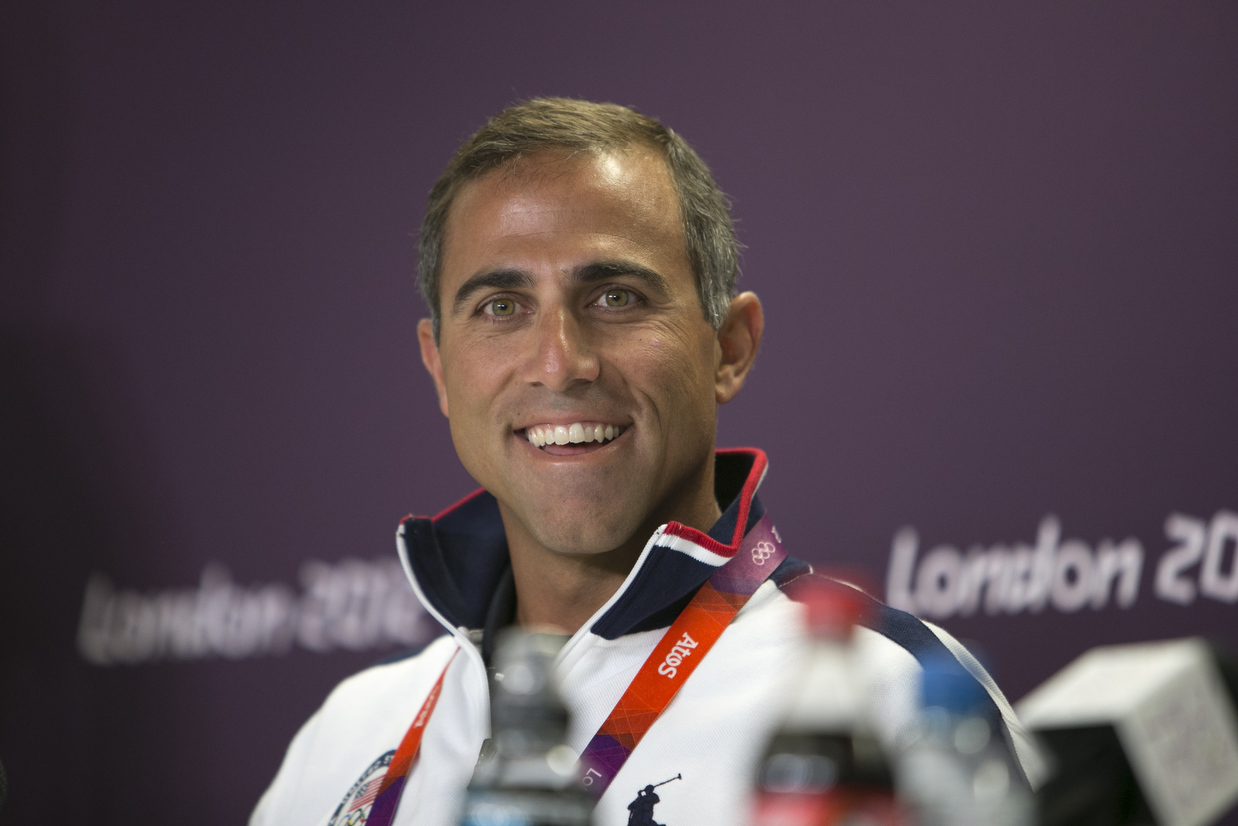
Ladies and gentlemen, particle physics may well be brutally difficult to explain. But in matters of team chemistry, it's easy: Adam Krikorian, winner of this year's Jack Kelly Fair Play Award.

Through the wind and years

As it is, Olympic-style archery is demanding enough. The rules call for an arrow to fly to a target 70 meters distant. That's roughly three tennis courts laid end to end, as the noted Olympic historian David Wallechinsky points out in his authoritative guide to the Games. The bull's-eye in the center of that target is about the size of a grapefruit.

At the just-concluded world championships in southern Turkey, matters were made all the more challenging by winds that grabbed arrows and directed them here, there, hither, yon, pretty much everywhere. On one particularly windy day,  scores more resembled a good club outing than best-in-the-world.

1383733_10151879619164583_2117776189_n

In this kind of tournament, there were three opponents: The ones wearing the other uniforms. The one inside your head. And the invisible one howling across the field at 10, 20, sometimes more than 40 miles per hour.

It took a special kind of fortitude to win.

In defeating the Dutch last Sunday, 214-211, the U.S. men's recurve team claimed their first world title in 30 years. Recurve is the kind of straightforward bow and arrow set-up that evokes the kind they would have shot on the frontier; compound is a much more complicated contraption.

The gold medal follows a silver won by the U.S. men at the 2012 London Games.

Two of the three who competed in Turkey performed in London as well: Brady Ellison and Jake Kaminski. The third, Joe Fanchin, shot the final shot in both the semifinal and final rounds, in both instances securing the victory.

"The worst wind I've personally ever had to shoot in," Fanchin said.

"To win Olympic silver last year and then come back and win world championships gold makes it clear we are here to play," Ellison said, adding, "We are not going away."

France took third, South Korea fourth -- the first time since 1987 the Koreans left the world championships without a medal in the recurve men's team event.

During elimination rounds, the wind was so strong it literally blew arrows off bows.

In a bid to make themselves more stable against the wind, the Colombian women's compound team strapped on weighted backpacks. Apparently it worked; they went on to win gold.

Every single American athlete was knocked out of the individual competition early on.

In the men's recurve team event, the three U.S. guys noticed the Colombian women's compound strategy. But they decided it wasn't worth trying.

Kaminski, who called the windy conditions "outrageously crazy," said, "Nobody could believe we were shooting in this weather."

Cancellation was out of the question, which everyone understood, because of sponsor, logistics and other concerns. So if the show was on, the issue was who was going to be mentally toughest.

There were times, Kaminski said, where -- to make a shot -- he and his teammates would be aiming as much as 15 feet offline. "That," he said delicately, "is a whole lot."

Fanchin said, "You're hoping for a 10," a bull's-eye, "but you'll take a 9, and here an 8 is a great shot. Those first matches, an 8 would be good. We were aiming high left based on where the wind was coming from, trying to hold steady just long enough to execute the shot, just looking for an opportunity, getting up there trying to be really aggressive. You're up there, getting tired, a gust would hit you, you're looking for that split second …"

A perfect score in the team event is 240. To simplify the scoring, it's three guys, eight arrows per guy, a maximum of 10 points per shot. The mechanics of a match don't exactly run like that but that's the max score -- 240.

The world record for 24 arrows is 233, set Oct. 4, 2011, by the Koreans in London.

Some first-round scores in last Thursday's wind: U.S. 169, Australia 160; Korea 170, Britain 168; Ukraine 177, India 172.

"Insane," Ellison said.

The U.S. semifinal match against France came down to Fanchin's last arrow. This is a guy who did not make the Olympic team but who was now being counted on -- in crazy wind -- to be the man.

"It has been a humbling experience learning about myself and archery," Fanchin said about the personal journey he has undertaken since last year, adding a moment later, "I let go of the expectations and I just did the shooting," the U.S. winning by two, 191-189.

In the final, against the Dutch, again he stepped up, the U.S. winning by three.

"We did our best and it worked out," he said. "We were ready to win the matches when they came up, ready to step up and shoot well enough to win."


The Jordan Burroughs problem

Quick. Name the best wrestler on the Olympic and international scene the United States has ever produced. The name most people would name -- if, that is, they could name even one name -- would be Dan Gable, who won Olympic gold in Munich in 1972 while not giving up even a single point. The Gable legend was, over the years, further enhanced by his incredible coaching career at the University of Iowa.

There are, of course, others. Just to name a few, and the proud history of American wrestling means a list like this runs the risk of omitting many others: Lee Kemp, Dave Schultz, Steve Fraser, Bruce Baumgartner, John Smith, Cael Sanderson, Rulon Gardner, Henry Cejudo.

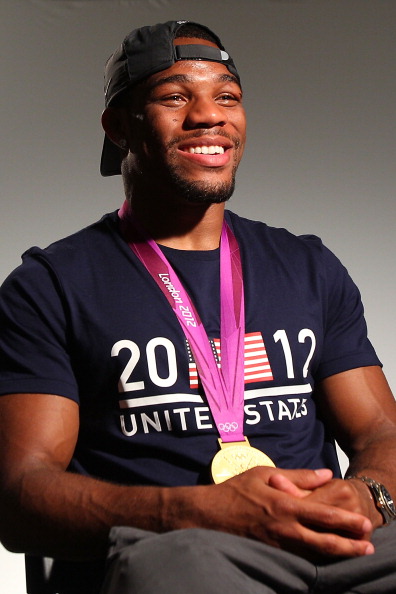
A few days ago, 25-year-old Jordan Burroughs won the 74-kilo/163-pound freestyle class at wrestling's world championships in Budapest, Hungary. The victory ran Burroughs' unbeaten streak to 65. The man has not lost at the senior level since he started competing internationally.

US Olympic Athlete Medalists Visit USA House

The sport of wrestling, as is widely known, got itself back into the Summer Games in 2020 and 2024 via a vote earlier this month by the International Olympic Committee's full membership in Buenos Aires. That's a big win. But, to be blunt, there's still has a long way to go. Wrestling, to sum up, has a Jordan Burroughs problem.

It's not that Jordan Burroughs himself is a problem.

Far from it.

The problem is the other way around. Who knows about Jordan Burroughs?

Now that wrestling is back in, the same energy, enthusiasm and passion that got it there has to go toward building the brand. Right now, wrestling has a window of opportunity. Burroughs is without doubt its biggest current star, particularly in the United States.

So why isn't he on SportsCenter? Leno? Letterman? Conan? The Daily Show? The Colbert Report? Making the rounds of the early-morning TV shows as well? Being offered up for bit roles in movies? For that matter, why aren't people scrambling to make documentaries about him -- or making him the centerpiece of films such as The Great Wrestling Comeback of 2013?

Wrestling is huge in Russia. Wouldn't it score political points to bring Burroughs to Sochi to have him mingle with the IOC bigwigs and maybe even Russian President Vladimir Putin himself this coming February?

Attention, Billy Baldwin. You were front and center in the months up to the IOC vote. By all accounts, you played a significant role in rallying Hollywood and even Wall Street in fund-raising drives that helped lift wrestling's profile.

Now comes Phase Two.

"The Miami Heat," Burroughs said in a phone interview, "had a 27-game winning streak. It was all on SportsCenter. It got huge press. Here I am at 65 and no one even knows.

"This is important to help the sport," he emphasized. "It is not important to me personally. It is something I wish we could do more of. It is not, let me repeat, something to me to be a self-fulfilling guy."

Burroughs is the 2012 Olympic gold medalist; the 2011 world champ; and, now, the 2013 world champion, too. He is a two-time NCAA champion, in 2009 at 157 pounds and in 2011 at 165. In 2011, he won the Hodge Trophy, wrestling's equivalent of football's Heisman.

In the final in Budapest, Burroughs defeated Iran's Ezzatollah Akbarizarinkolaei, 4-0. The victory made him the first U.S. men's freestyle wrestler to win back-to-back world titles since Smith, in 1990 and 1991. Burroughs also became only the second U.S. men's freestyle wrestler to win three straight world or Olympic titles; Smith won six straight world or Olympic titles from 1987-92.

The victory in Budapest is all the more remarkable because, as Burroughs disclosed afterward, he suffered a broken ankle training Aug. 22 in Colorado Springs, Colo.; he had surgery the next day and at the worlds still had five screws in his left ankle for stability. He guessed he was perhaps at 75 to 80 percent when he arrived in Hungary.

Burroughs is thoughtful, well-spoken, an incredible role model. He is just about to get married. He is everything USA Wrestling -- indeed, the U.S. Olympic Committee -- would want.

Even so, Jordan Burroughs could walk down most streets in the United States of America and no one would know who he is.

On most blocks they know who LeBron James is. And Peyton Manning. Switching to Olympic sports -- Michael Phelps and Apolo Ohno, too.

But not Burroughs.

That is a big problem for a sport that is -- and make no mistake about it -- still going to be fighting for its Olympic life.

As Serbia's Nenad Lalovic, the new president of FILA, the sport's international governing body, said in an interview in Buenos Aires, a couple days after the IOC vote, "This job is not finished. We are just starting."

Burroughs is a bigger star in Iran than he is in either New Jersey, where he grew up, or even Nebraska, where he went to college. This fall, Taylor Martinez, the Cornhuskers' starting quarterback, is a way bigger deal in Lincoln.

In Teheran? This past February, the U.S. team took part in a World Cup there. The just-released book "Saving Wrestling," by James V. Moffatt and Craig Sesker, is filled with inside nuggets on wrestling's path back to 2020. As the book recounts, in Teheran, after he won, Burroughs had to be pushed through the crowd by U.S. assistant coach Bill Zadick to get to the team bus.

Mind you, this was a crowd of bearded Iranian men seeking photos or an autograph from an American wrestler. The two countries' political leaders -- until President Obama's telephone call last week to Iranian President Hassan Rouhani -- have had no high-level contact since 1979.

Burroughs says in the book, "I received more attention there than I receive on my home soil. It was kind of like being Justin Bieber with all the attention that I was getting. It was nuts."

The competition in Iran took place just days after the IOC's policy-making executive board move to boot wrestling out of the Games.

As the saying goes, sometimes a crisis presents unexpected opportunity.

In wrestling's sake, the sport effected in seven months the sorts of changes -- political, governance, rules -- that would otherwise have taken 15 or 20 years. Or maybe longer.

"This is the best thing that ever happened to wrestling," said Jim Scherr, the former USOC chief executive who played a key role in presenting FILA's winning case to the IOC.

Among the changes were the development of women's and athletes' commissions. FILA didn't have such boards. So simple. One of the members of the new athletes' commission is American Jake Herbert, a 2012 Olympian. He called it a "step in the right direction," adding, "They are getting there."

This is the thing, though -- they are not there yet.

The sport essentially faces two big-picture challenges, all of which is clear from reading the IOC materials that led to the executive board action in the first instance:

One, it needs to do a much better job of promoting itself at the high end, meaning the creation and promotion of a brand and image for the sport and its athletes.

Two, at the grass-roots and club levels it needs to attract way more kids and young people -- boys and, in particular, girls -- and make the sport more friendly to them and their parents.

Bill Scherr is Jim's twin brother. Bill is chairman of what was called the Committee for the Preservation of Olympic Wrestling, and said, "All sports federations have their problems and issues. 2024 is 11 years away." Referring to FILA, he added immediately, "We face elimination again. I would think they would be motivated to make the changes necessary."

This all leads back to Jordan Burroughs.

It's not complicated. All sports thrive on stars.

When he gets back from his honeymoon, you'd like to think there would be some really smart people waiting to talk to him. With real money for a PR campaign, or two, for the sport, built around this All-American guy.

"What wrestling has done," Burroughs said, "is put itself back in the spotlight." In Rio de Janeiro, at the 2016 Games, "We are going to be one of the 'it' sports -- people are going to be watching, asking, 'Let's see why this sport deserves to be in the Olympic Games.' People are going to be paying attention.

"I think," he said, "we have all the tools."