
George Washington crossed the Delaware. That was for sure an audacious manoeuvre.
It took everything Abraham Lincoln had to organise the Union during the Civil War. Did he realise it would be so hard?
To emphasize: did Allen Iverson famously rant about -- practice? Or are we talking about — practise?
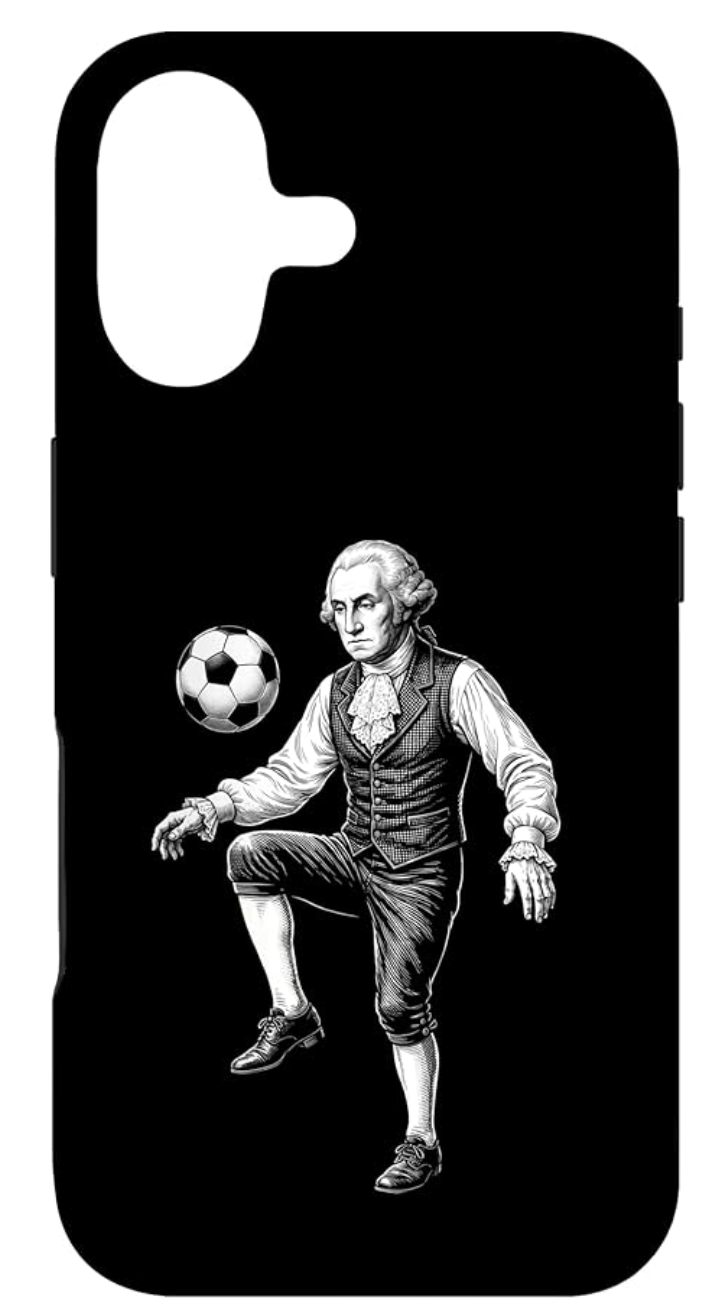
What could be more American than this iPhone 17 case? // “Show your USA pride and love for soccer with this awesome design for USA flag summer,” only $18.95 // screenshot Amazon // MerchbyAmazon
The men’s World Cup is nearly upon us, and with it a telling if not altogether disturbing push in some quarters to turn to Celsius, meters and, worst of all, British English.
We the People! This summer, as the World Cup bracket plays out, marks the 250th anniversary of the Declaration of Independence. The 13 colonies broke away from the British. We won. This is the United States of America. And so this truth ought to be self-evident: let’s speak American English.
To reiterate: this *is* the United States. It’s not: these are the United States. That’s a British English way of looking at us. We are properly an it, one, united, not a they.
This “are” makes for a particularly ridiculous British conceit when applied to American sports. You’re in London, and in stoppage time Arsenal are ahead of West Ham? All good. Here, and the streaming service Fubo has been guilty of sending me these sorts of push notifications on my cellphone (cellphone, not mobile), Ohio State are playing Michigan? No.
Hear how wrong that sounds?
We ought not apologize for the way we say and spell things. Spell it the right way. With a z.
This is easy to analyze (z, people): there are hundreds of millions more American English speakers in the United States than there are British English speakers in the United Kingdom. It’s American English that drives music and movies around the world.
The old quip is that the United States and Britain are two countries separated by a common language.
Screenshot X/Twitter
But why, when it comes to soccer, so much — pretence?
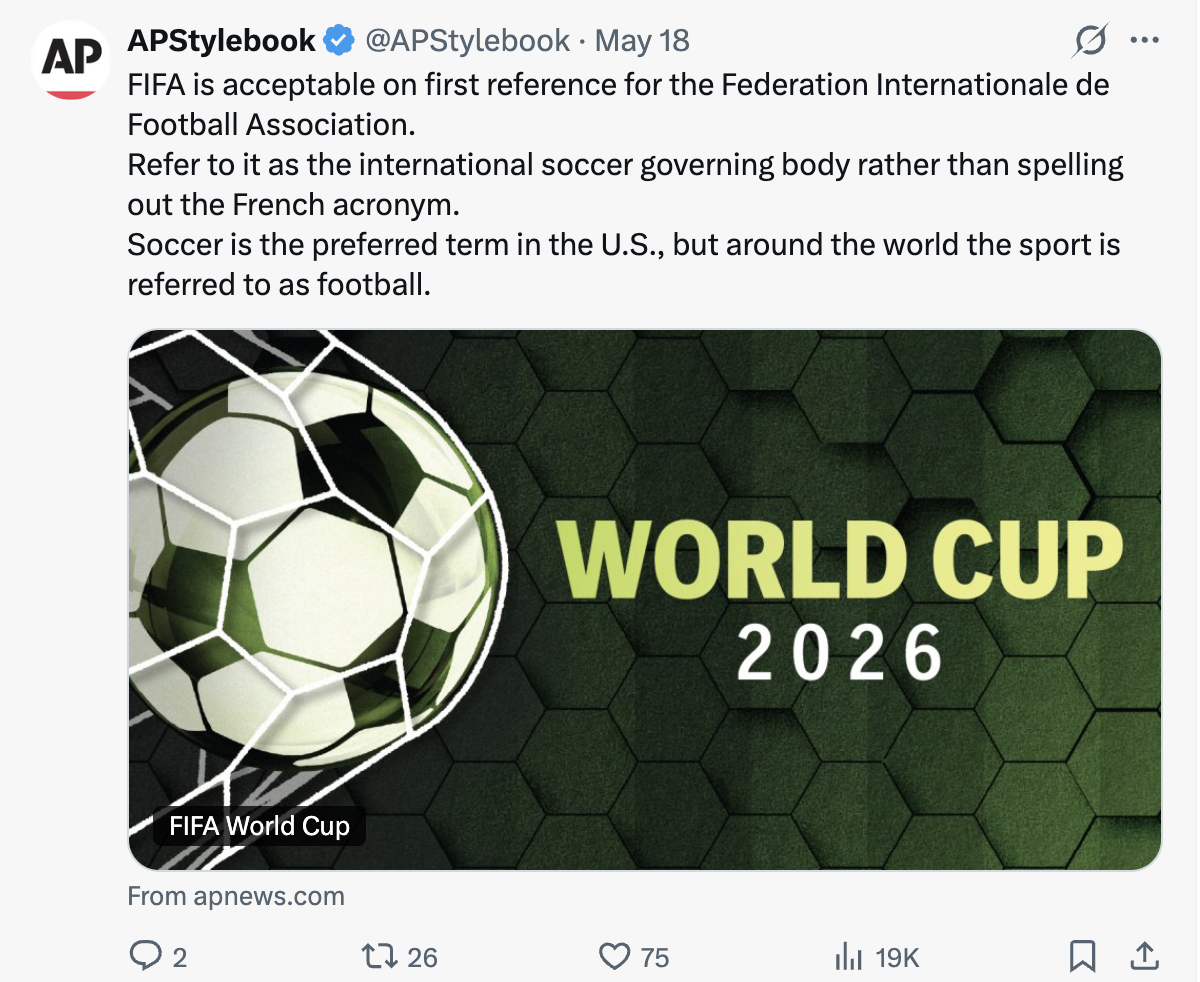
And let’s be clear — even Associated Press is clear that in the United States, the word is soccer.
In the United States, we go to college, not uni. We go to the hospital, not to hospital. Here, punctuation goes inside the quote marks.
A theory:
In the United States, and this is increasingly evident, for those who take on certain aspects of British soccer culture, it’s a status and stratus signifier.
It’s wielding language as a form of elitism, snobbery and virtue signaling — the virtue being class, economic and educational achievement and differentiation.
Not only that, when one uses words that are not American English, especially in talking about soccer, it’s a signal to like-minded souls that you are one of them — and more importantly, not of the others, who would, for instance, never think to use gutted instead of disappointed.
Who are these others? The deplorables.
I live in a beach town near Los Angeles. But I was born in flyover country, Dayton, Ohio, and grew up just northwest of there, in Clayton, amid corn and cows in a vividly rural part of America. No one where I’m from — my Northmont High School classmates are, by and large, decent and honorable people and in innumerable ways the best of America — would say, coach handed out our baseball kit today. No one where I grew up would say, if the baseball team won, I am so chuffed. Or, the Northmont Thunderbolts are top of table.
It’s absurd.
Actually, it’s way worse. It’s deliberately separatist. It’s them and then us. These people are like the uptight Omegas in “Animal House” (candidate, along with “Blazing Saddles,” for best movie ever), while the rest of us normies are, of course, the Deltas.
What’s triggering this is a May 14 article by Matt Slater in The Athletic. That outlet serves now as the de facto New York Times sports section. The New York Times, last I looked, was based in the United States. It’s called “New” York for a reason.
Yet this story about heat-related concerns at this summer’s World Cup repeatedly referred to temperatures at or above 26 or 28 degrees. That’s Celsius. Translation to Fahrenheit: roughly 79 and 82 degrees.
What the story is missing: those conversions.
Slater is an excellent journalist; he and I have met around various Olympic matters; he is based in England.
It’s perplexing that after a World Cup in 2022 in Qatar, the heat in the United States in the summer is a thing. Of course it’s going to be hot. Nonetheless, they play baseball in St. Louis and Kansas City. Day games, even. Buckle up.
It’s understandable that Slater might write in Celsius. But who edited this story? This is — the New York Times.
Not from the New York Times: how about a coffee cup showing Lincoln drinking iced coffee at the soccer field? Just $16.99 // screenshot Amazon // Merch on Demand
Then again, this affectation when it comes to soccer has long been an NYT marker. And the NYT is the bible of the affected class.
See this NYT story — in the main NYT, not the Athletic — from way back in 2014, which offers almost insufferable insight into the them the piece describes and the obvious conclusion about the rest of us:
“This is particularly evident in New York creative circles,” the story says about soccer, “where the game’s aesthetics, Europhilic allure and fashionable otherness have made soccer the new baseball — the go-to sport of the thinking class.”
There’s so much more to wince at:
“For on-trend types with an internationalist bent, supporting (never rooting for) a Premier League club (never team) is not just a pleasant diversion, but a public display of global cultural literacy.”
This reminder: less than half of Americans even have a passport.
Imagine the scene in Clayton, Ohio, when presented with such NYT BS: first puzzlement, then trying to understand, then understanding and, finally, GFY you elitist jerk.
It’s the perfect analogy for why these crazies live in their own insulated fantasyland and are further and further away from the reality of life in most of America.
One more:
“Despite the many soccer offerings from around the globe, and right here at home, the Premier League remains the vogue-ish choice for many New York creative types, according to Mark Kirby, a former GQ editor who in 2012 helped found Howler, a sumptuous soccer quarterly that was hailed by The Guardian as ‘a football magazine fit for aesthetes.’”
Regrettably, this could go on and on. Vanity Fair, 2024, in a story about Spike Lee, an Arsenal fan: “On any given Arsenal matchday [one word, wrong], Lee can be found posted up on his designated corner at FancyFree,” a Brooklyn bar, “bantering among the hordes of other supporters. ‘If you want to watch a game and you’re a Gooner,’ he said,” meaning an Arsenal fan, “‘that’s the spot.’”
Please. Get over yourselves.
The World Cup will likely be a lot of fun. The American team might do OK — home-field advantage (field, not pitch). But probably not. And when it’s over, we can and will go back to real football.
Where the field is 120 yards long (including end zones) and 160 feet across. Even — especially — when they play in London.