
MILAN — It was always going to go one way or the other here at the 2026 Milano-Cortina Winter Games with Lindsey Vonn.
Either she would write a winning story for the ages — Vonn, one of the greatest of all time with nothing to prove, literally nothing, a ferocious competitor out there because she could, and should, be, vying for one more golden moment on her favorite hill, 41, no ACL in that left knee after a fall in Switzerland days before.
Or — she would crash out.
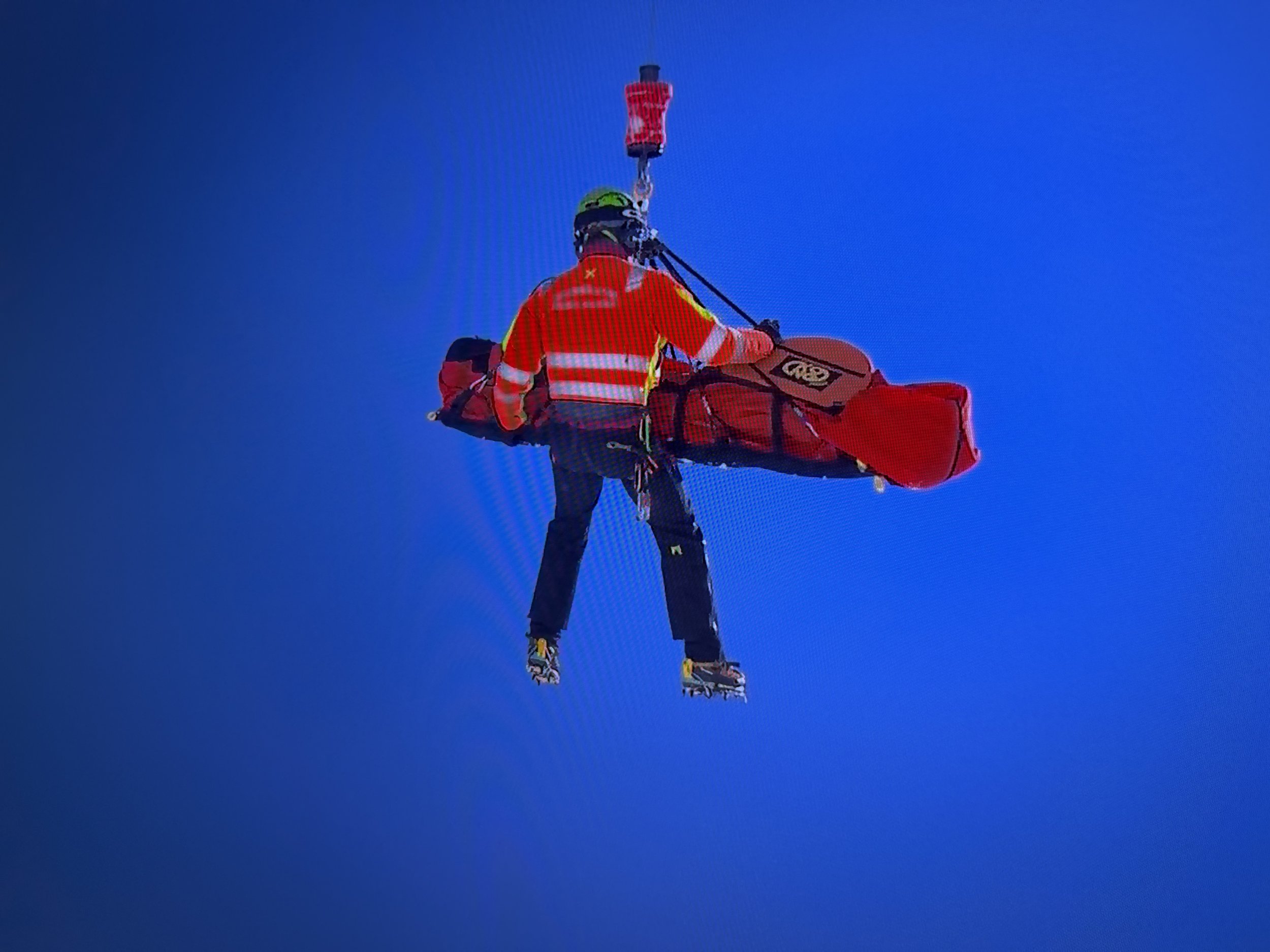
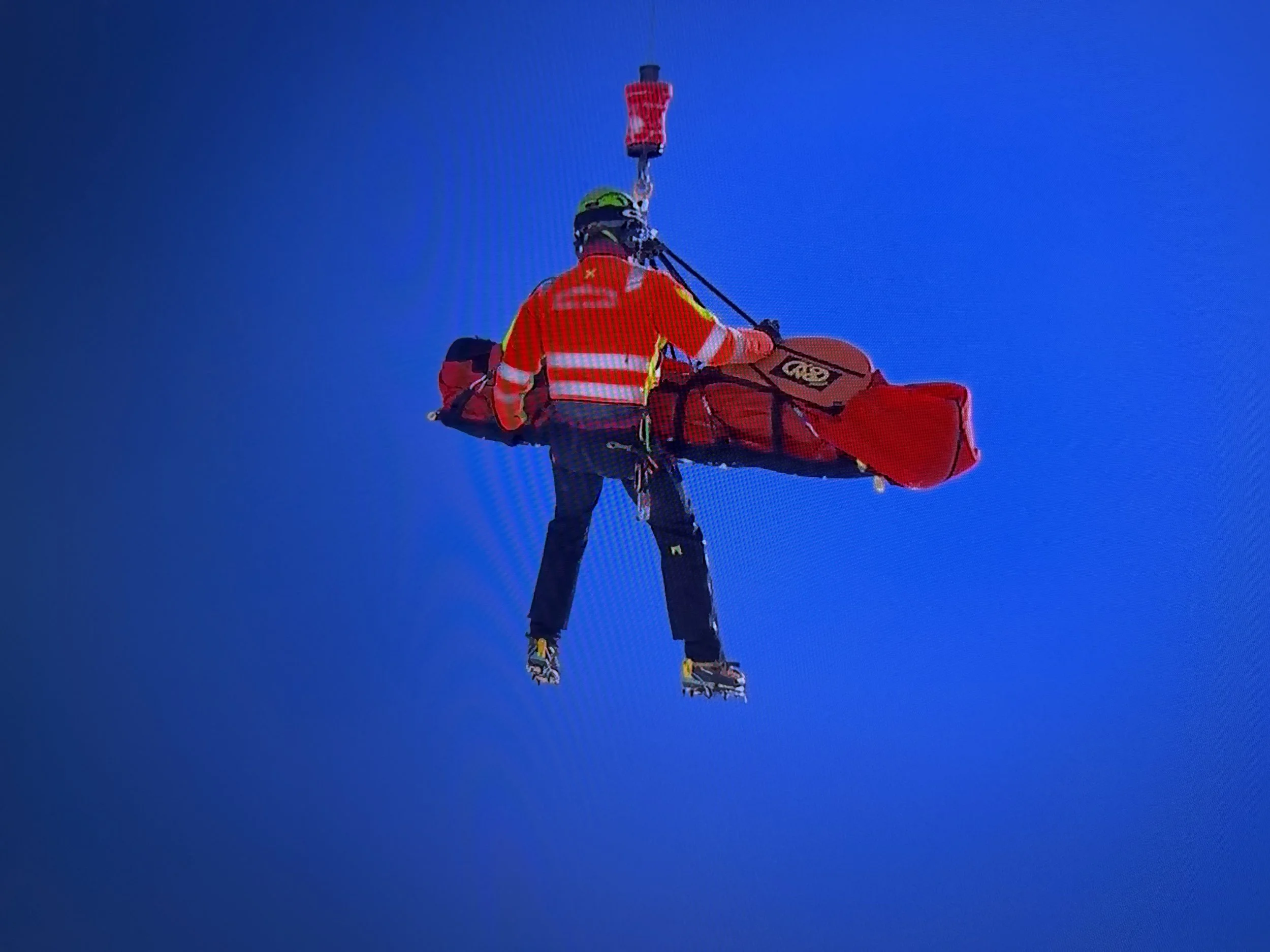
Lindsey Vonn being airlifted off the mountain above Cortina // OBS screengrab
Just 13 seconds into her run in Sunday’s women’s downhill, the pole in Vonn’s right hand caught, ever so slightly, a gate. Thrown off balance just enough, and at the crest of a jump, she crashed, hard, on her right side, and bounced.
Then, for several excruciating minutes, she stayed there, limp, on the snow.
When the medical team got there, the stretcher board came out. They lifted Vonn onto it and wrapped her in a red body bag. Then, for the second time in 10 days, Lindsey Vonn was airlifted off the mountain, the echoes of the wash from the yellow helicopter bouncing off the rock walls of the Dolomites on a picture-perfect day.
The buildup to this moment had been extraordinary. The media worldwide, and in particular in the United States, led by NBC, had all but made Vonn’s comeback a — if not the — leading story of the Games. Too, Vonn, the Vancouver 2010 downhill winner, has long been a favorite in Olympic circles, and the International Olympic Committee’s daily briefing was moved forward Sunday morning so IOC — and Milano-Cortina 2026 — officials could take in the race. On hand in Cortina d’Ampezzo, site of the 1956 Winter Games, were the former IOC president, Thomas Bach, and Giovanni Malago, head of the organizing committee.
And after all that, perhaps the most profound image that will linger from these Games will be Vonn, in that red bag, winched to that helicopter, suspended in the sky — with what’s next a complete unknown. The U.S. Ski Team said Vonn would be evaluated. Reports late Sunday evening said she’d had surgery for a broken leg.
“I mean that definitely was the last thing we wanted to see,” Vonn’s sister, Karin Kildow, told NBC. “It happened quick. When it happens, you’re immediately hoping [she’s] OK. It was scary.
“It’s like the man in the arena,” Kildow said, citing Teddy Roosevelt’s famed speech from 1910. “She dared greatly. She put it all out there.”
The American Breezy Johnson won the race, in 1:36.10.
If Vonn got the bulk of the pre-race buildup, it can come as little to no surprise to anyone who follows ski racing that Johnson, 30, who was born in Jackson, Wyoming, and grew up in nearby Victor, Idaho, won at the Olympics. Johnson won the 2025 world championship downhill in Saalbach, Austria.
There are now, in history, two American women’s Olympic downhill winners: Johnson, and Vonn, in Vancouver in 2010.
Johnson’s gold made for the first American medal at these Games.
“I had a good feeling about today,” Johnson said. “I still can’t believe it. I don’t know when it will sink in.”

Winner of the 2025 world championship downhill, now Olympic DH champ: Breezy Johnson // Getty Images / Mattia Ozbot
A 22-year-old from Germany, Emma Aicher, took silver, just four-hundredths of a second behind Johnson.
Italy’s Sofia Goggia finished third, 59-hundredths behind. Another American, Jackie Wiles, tied for fourth with Austria’s Cornelia Huetter, 86-hundredths back.
Goggia, 33, had lit the cauldron Friday night in Cortina — seven years after she and snowboarder Michela Moioli made a speech to the IOC members that ended with the pair dabbing and is widely believed to have pushed Milano-Cortina past a bid from Sweden for these 2026 Games. Two retired Italian alpine ski legends, Alberto Tomba and Deborah Compagnoni, lit the cauldron in Milan.
The bronze means Goggia now has a complete collection of medals in the Olympic downhill. She won in 2018 in PyeongChang, and came in second in Beijing in 2022.
Vonn took third in 2018 in Korea. She also took third in super-G in Vancouver.
Without question, Vonn is one of the superlative athletes of our — or any — time. She has 84 World Cup wins; only Sweden’s Ingemar Stenmark, with 86, and the American Mikaela Shiffrin, 108, have more.
Also without question, Vonn’s career has been laced with injury and the kind of drama a Hollywood scriptwriter could hardly dare to dream up.
At the 2006 Torino Games, she fell spectacularly in downhill training. She more or less snuck out of the hospital and finished seventh in super-G.
After winning the downhill at the 2009 worlds in Val d’Isere, France, she cut the tendon on her thumb opening a bottle of champagne. She raced with her glove taped to her pole.
In 2011, there was the concussion before the worlds in Garmisch-Partenkirchen, Germany, where, she said, she was “skiing in a fog.”
In Cortina in 2019, after years punctuated by several more injuries, a broken right arm, a broken left knee, a broken left ankle, Vonn was left in tears after she couldn’t finish a super-G. “There’s only so much I can handle and I might have reached my maximum,” she said then.
In November 2024, part of the bone in her right knee was cut off and replaced by two pieces of titanium. Within weeks, she was planning her comeback.
Her results over the past months suggested she was a legit Cortina medal contender.
Then came the crash Jan. 30 in Crans Montana, Switzerland. After, Vonn said her left ACL was no more. Could she nonetheless race in Cortina? In the days before the race, Vonn — in a left knee brace — posted videos to social media showing her doing squats and jumps.
For some if not many, though, the issue Sunday was not whether Vonn could race. It was whether someone could talk some sense into her — to save her from herself.
This notion, however, is nonsense. Vonn finished both training runs here. She was 11th in the first. In the second, third-fastest, behind Johnson.
Here is the thing that delights Vonn supporters and infuriates those who cannot and never will understand her. Vonn has only known one way to race — all out.
A world-class downhill lasts roughly 90 seconds. Years of hard work — all for 90 seconds. As Steve Porino, the longtime analyst, said on NBC, “You pour your heart and soul into this moment.”
The Cortina downhill track, the Olympia della Tofane, has been a favored site for ski races since those 1956 Games. Twelve of Vonn’s 84 wins have come on the mountain above Cortina, six in downhill.
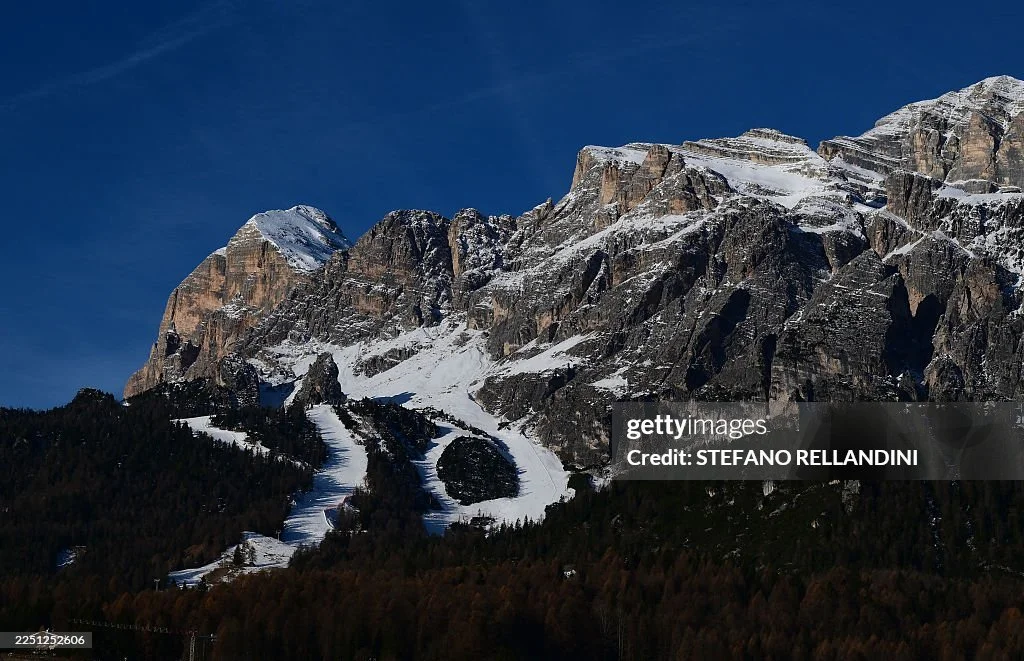
The women’s downhill course in Cortina d’Ampezzo // Getty Images / Stefano Rellandini
The downhill course includes a drop that racers call the ‘Schuss.’ It’s a 64% gradient descent. On either side are walls of rock.
Johnson had said before the race, “It feels like you’re part of the mountain. I mean, that chute was built millions of years ago.”
The march of time led Sunday to high noon, another scriptwriter detail, the precise moment when Vonn, wearing bib 13 (make of that what you will), got out of the start gate. Thirteen (again) seconds later, it was over. She had made a first left turn. Then, as the course veers to the right, came calamity, Vonn thrown backward in an explosive shower of ice and snow. The cameras caught her with her legs splayed, skis crossed. The bright sun glinted on her golden goggles as she dropped her head back onto the hill.

Vonn in the instant after the crash // Getty Images / IOC screengrab
To be clear: it was not the left knee that gave out. “There was nothing her 20-year-old self could have done to save that moment,” Porino, on air, said.
The bottom of the hill at a major ski race is typically a loud, festive affair. In Cortina on Sunday, it grew deathly silent.
There, the president of the international ski federation, Johan Eliasch, was asked about the opinion of those who felt Vonn should not have raced.
“Well then,” he said, “they don’t know Lindsey. That’s all I can say.”
He also said, “Tragic, but it’s ski racing, I’m afraid. I can only say thank you for what she has done for our sport because this race has been the talk of the Games and it’s put our sport in the best possible light.”
Johnson — who missed the 2022 Beijing Games because of a crash in Cortina — said her “heart goes out” to Vonn.
“I hope it’s not as bad as it looked,” she said, adding, “I know how difficult it is to ski this course. And how, sometimes, because you love this course so much, when you crash on it and it hurts you like that, it hurts that much worse.”
Honestly, it looked bad. All the same, nothing and no one was ever going to stop Lindsey Vonn from racing Sunday.
As Teddy Roosevelt put it in 1910 in Paris at the Sorbonne, the exact spot where in 1894 the modern Olympics were born:
“It is not the critic who counts … the credit belongs to the man who is actually in the arena … who at the best knows in the end the triumph of high achievement and who, at the worst, if he fails, at least fails while daring greatly, so that his place shall never be with those cold and timid souls who neither know victory nor defeat.”