
BAKU, Azerbaijan – A judo match runs to four minutes. If there is no score or the match is tied, the two fighters go until someone wins.
For as long as it might take.
Judo is an intricate, beautiful, elegant physical ballet. It is also brutally demanding. Exhausting. Thus, it is often the case that a match that runs to extra time, what in judo is called “golden score,” is over sooner than later after the four-minute bell.
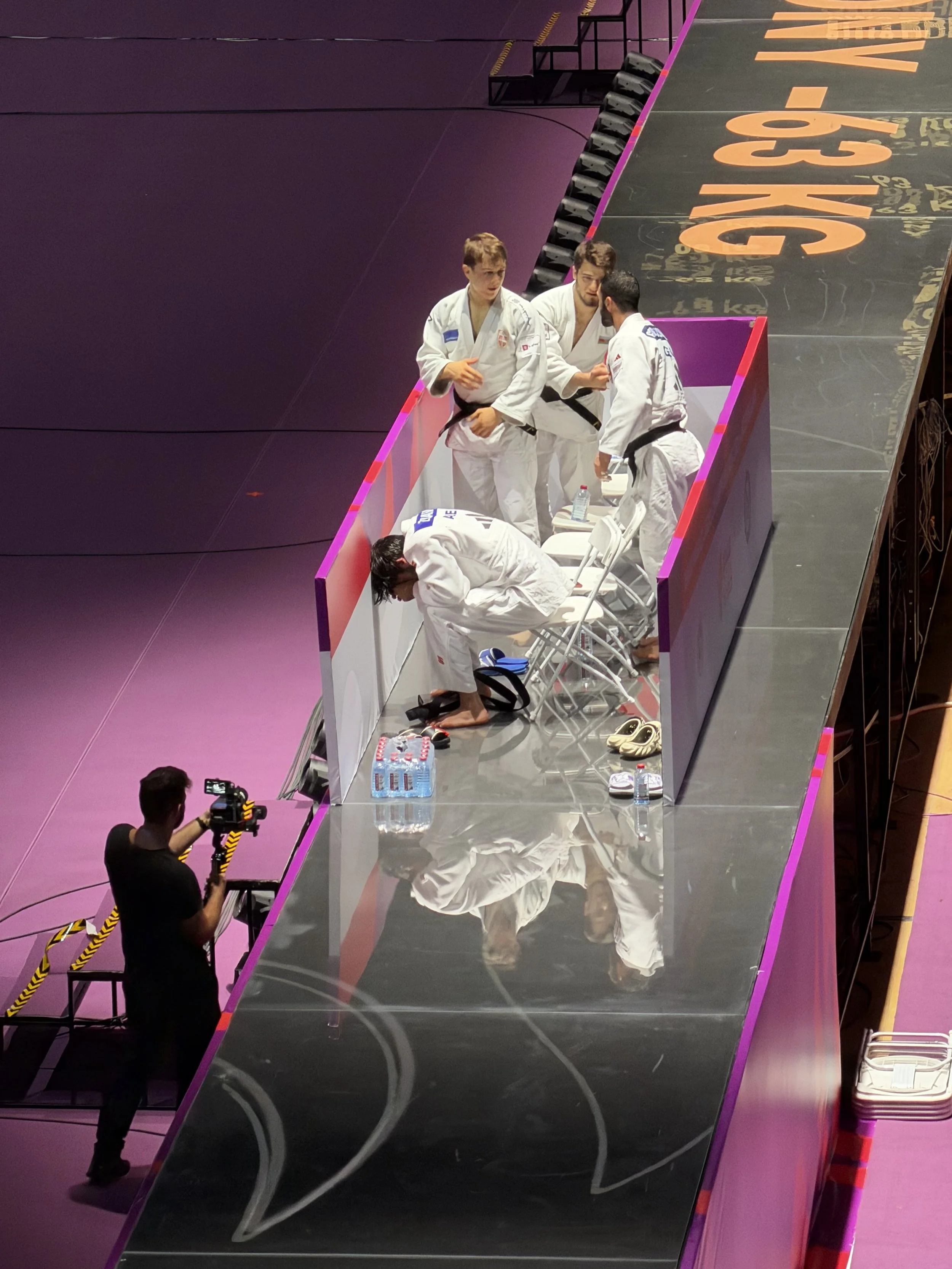
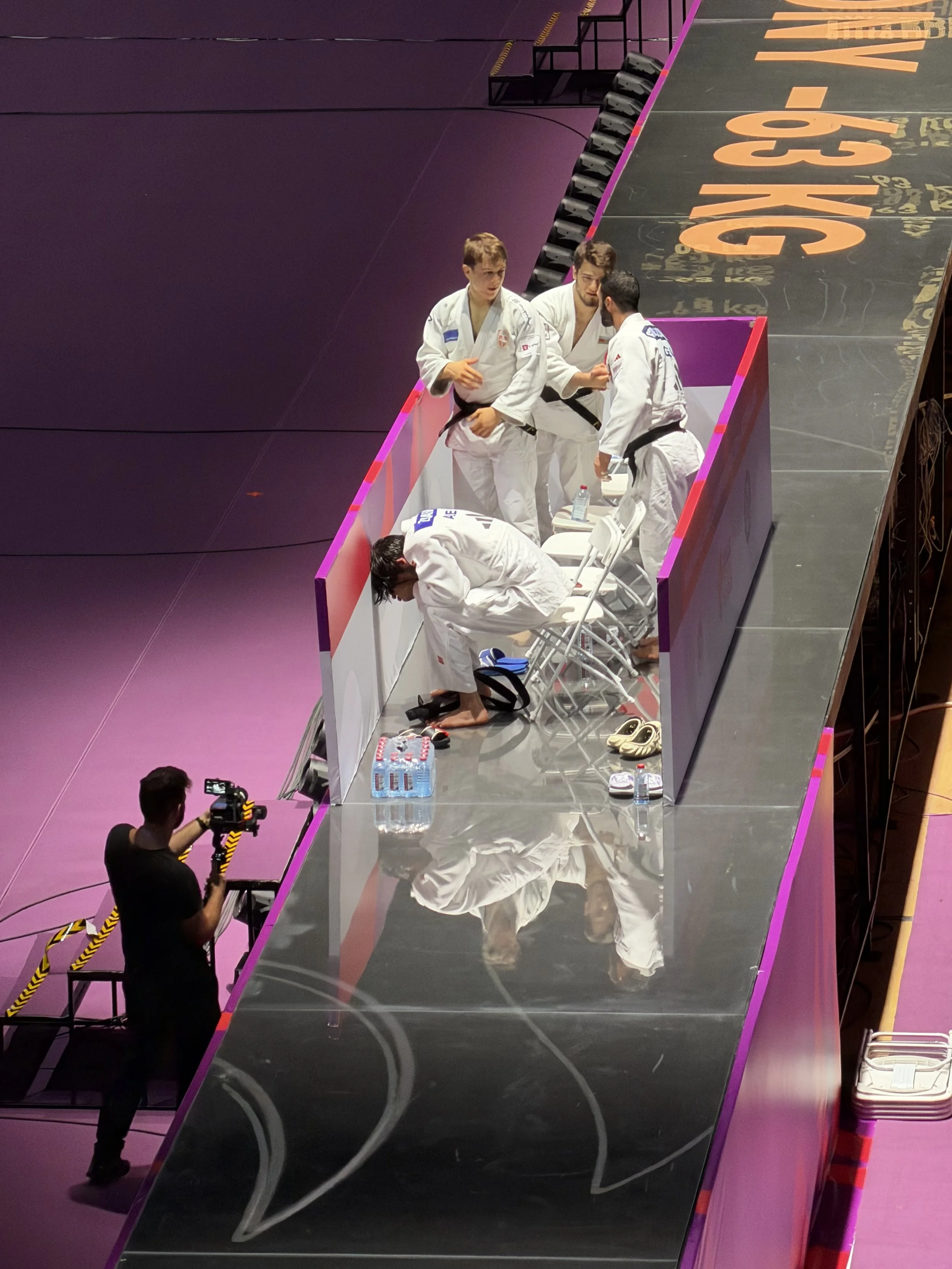
Before the medal ceremony: silver medalist Zelim Tckaev of Azerbaijan is the picture of despair as, behind him, men’s 81-kilo champion Tato Grigalashvili of Georgia congratulates bronze medalists Mihaljo Simon of Serbia, left, and Omar Rajabli, also of Azerbaijan
Here at the 2026 judo world championships, the final of the men’s under 81-kilogram class, 178 1/2 pounds, featured fighters from two former Soviet republics: Tato Grigalashvili is from Georgia. Zelim Tckaev is from Azerbaijan. Overtime ran to 5 minutes and 52 seconds – so, in all, a fight of nearly 10 minutes – before Grigalashvili executed a decisive counter to win.
Grigalashvili, understandably, was ecstatic. The victory marked his fourth world title. And in winning he proved pure class.
Tckaev was, as he would later say, all but shattered.
What, though, does it mean to lose? Moreover, to lose with grace, honor and dignity?
This is the story of one epic fight, when competitors prove rivals but not enemies, and what it says when the best in the world at their sport, in this case judo, show us all what it means to not only bring out but showcase the very best in each of us.
--
It is a truism that the gold medalist on a championship podium is happy. He won.
The bronze medalist is also happy. In the case of combat sports like judo, there are two bronze medalists. Everyone in third is happy. They medaled.
The silver medalist? Not so happy.
Worse, actually.
“At this moment,” Tckaev would say later, recalling the moments after the fight, “destroyed.”
--
The idea in judo is basic: to throw, pin or force your opponent to submit.
The goal in judo is what’s called ippon – an instant win. There are variations but the most important is when a fighter throws an opponent onto his back with speed, force and control.
There are also points for a variety of moves short of ippon.
World-class judo means technique, strength, power, endurance and, key, balance.
The culture of judo, meantime, demands buy-in. Judo, as the signs said at the National Gymnastics Arena here in Baku, where the 2026 championships were staged, “builds values” – including but hardly limited to respect for the sport and everyone and everything connected to it. As Tckaev said in an Instagram post from July, a video showing him carrying an Azeri same-weight teammate, Omar Rajabli, up steep stairs at a camp in Japan, “Good people cannot hate each other.”
The International Judo Federation, under the direction of Marius Vizer, president since 2007, is one of the best-run sports organizations in the Olympic landscape.
An enduring mystery is why in the United States judo – which, like soccer, is great for little kids – is a seemingly eternal scramble. The pipeline is scant. In the last 20-plus years, going back to Athens 2004, Americans have won just six Olympic medals – including Kayla Harrison’s golds in 2012 and 2016. The Americans won none in Tokyo in 2021, none in Paris in 2024.
Compare: at those Paris 2024 Games, France won six bronze medals alone and two gold. The French Olympic medal count dating to Athens: 29.
In many nations around the world, after accounting for soccer, judo is something of a – if not the – national sport. Azerbaijan and Georgia border each other between the Caspian and Black seas. In Azerbaijan, with seven Olympic medals since 2004, more than the United States, judo is huge. In Georgia, the former Soviet republic, with 15 Olympic medals since 2004, the same: huge.
--
Grigalashvili, who turns 27 on Dec. 1, is one of the great judoka of this generation.
The event here in Baku, which wrapped up Sunday, marked Grigalashvili’s sixth straight world championships final. For emphasis – six in a row.
He took silver in Budapest in 2021, then won gold at Tashkent 2022, Doha 2023 and Abu Dhabi 2024. Back in Budapest in 2025, he took silver.
Add to that string the Paris 2024 Summer Games. There he lost in the final to Takanori Nagase of Japan.
There can be no shame in coming second to Nagase. He is not only the Tokyo 2021 and Paris 2024 gold medalist but, as well, the only Japanese, ever, in a sport long marked by Japanese fighters, to win (in 2015) the 81-kilo worlds title.
Coming to Baku, Grigalashvili had been dealing with coaching changes in the Georgian team. But what was really weighing on him, he said, was not Paris but the loss at the 2025 final, to Timur Arbuzov of Russia, who during 2024 and 2025 was formally identified as a neutral athlete.
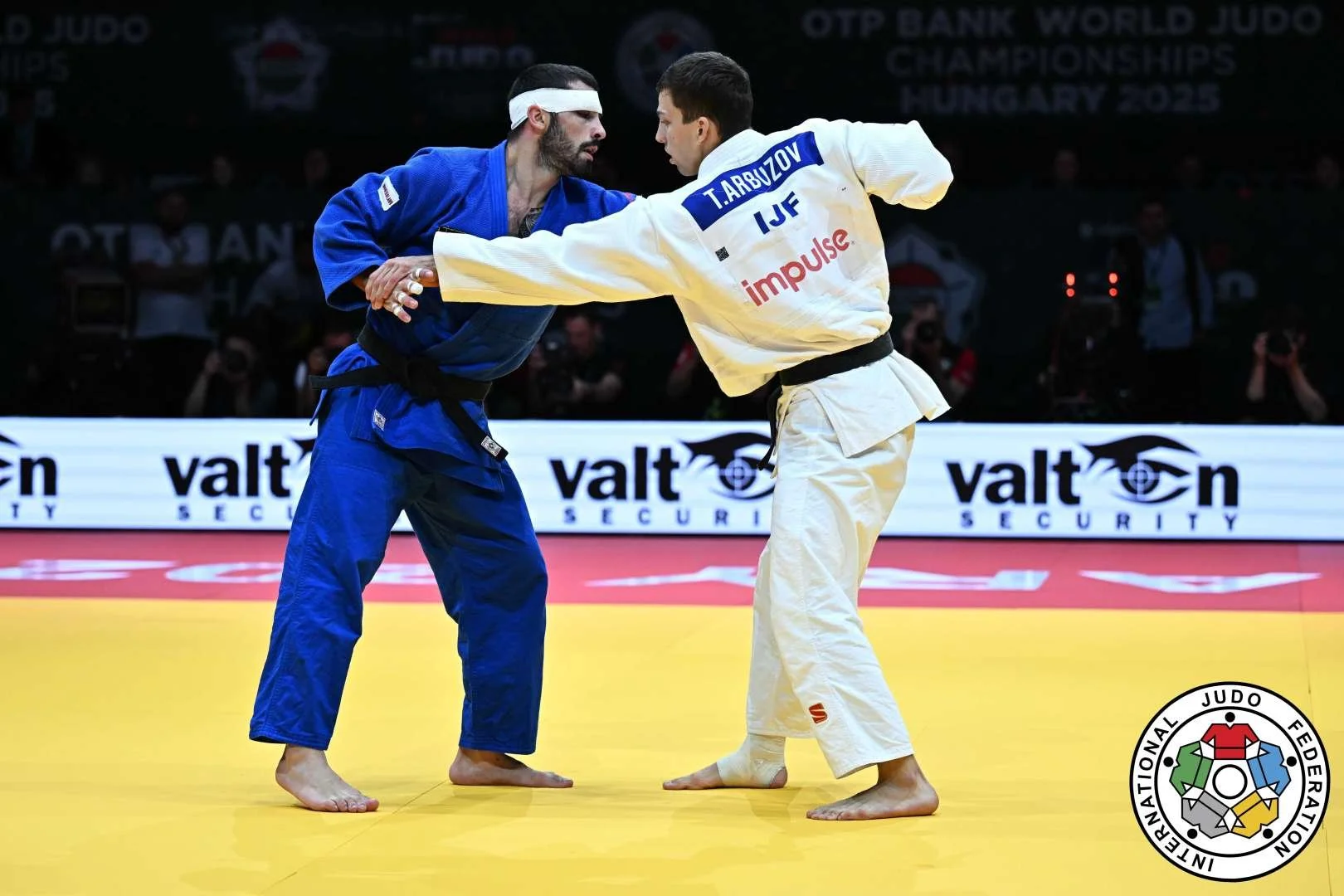
The 2025 final: Grigalashvili, left, and Timur Arbuzov, right // Tamara Kulumbegashvili / IJF
In the 2025 quarterfinals, Grigalashvili sustained a cut over his right eye, in the eyebrow. It wasn’t so much that it hurt, he said – it proved distracting, because it kept bleeding. Three times in the final, he recalls now, he had to stop for medical attention. Into golden score, with a makeshift white headband wrapped tight around the eyebrow, Arbuzov threw him.
Arbuzov would not be in Baku because of injury. Grigalashvili, here, was all the more driven.
“I was three times world champion,” Grigalashvili said in an interview a couple days after the matchup with Tckaev, “and then lost.
“This,” meaning losing, “is the worst.
“But – this is motivation. The title belongs to me.”
--
The arc of Tckaev’s career turned two years ago.
“Before,” he said, “I was always thinking about how not to lose. Now, I think about what I will do when I win.”
At the Paris Games, Tckaev went out in the round of 16. The turn-around: at the 2025 worlds in Budapest, Tckaev took third. This year, he won the tour stop at Qingdao, China, in June; in February, at one of the most prestigious stops on the tour, Paris, he took silver, behind Japan’s Yuhei Oino.
Oino went out here in the round of 32.
Off the tatami, Tckaev, 27, could pass for a graduate student. He wears glasses. He is soft-spoken, reflective and thoughtful. An older brother, Lazar, now 29, competed – for Russia, where the parents still live – roughly 10 years ago. His wife of two years, Diana Tckaeva, 22, is herself a national-level judoka.
Zelim and Diana are new parents: Kamila, their daughter, is 1.
Before the 2026 worlds final, Tckaev and Grigalashvili had fought seven times. Tckaev had won just once, 10 years ago, when both were still juniors. At their most recent fight, in the semifinals of the European championships in April in Tblisi, the Georgian capital, Grigalashvili eked out a narrow victory. Tckaev went on to take bronze. Grigalashvili lost in the finals to Arbuzov.
Here, Tckaev’s wife and brother were at the arena to watch him fight. A rowdy home crowd cheered him at every turn.
“In my mind,” Tckaev said, “the thought was only a gold medal – a gold medal for my family and also for Azerbaijan.”
--
For nearly 10 minutes, Tckaev and Grigalashvili pushed, pulled, probed, searching for any advantage, any weakness.
“Very difficult,” Tckaev said.
“It’s like a chain,” Grigalashvili said. “Every part of this chain has its meaning. OK, when every part of this chain is strong, in your body and ability, it gives you more power. It gives you more strength.
“This chain includes everything,” he went on, speaking in the Georgian language via a translator. “Training, preparation, friends, fans. Coaches. So, it’s like everything is important. If something is missing, then you are not as strong as you should be. Everything must be together: the weak and the strong links. All together.”
From the official IJF recap of the match:
“These two judoka put everything they had on the tatami, all their spirit, their national pride, their heart. They gave the world of judo an epic battle, first of gripping, then of attacks, counters and survival. They took turns collecting penalties, but everyone was waiting for the score that could decide the contest. It could come at any moment.”
From the website Judo Inside: “Grigalashvili knows better than almost anybody how to finish these major contests. Yet Tckaev refused to allow him to dictate the decisive phase.”
Up in the broadcast booth, the announcers already had labeled the fight what it was: “An absolute classic here.”
As the clock kept ticking, five minutes, six, seven, eight, nine, each had collected two penalties. A third for either would end the match. Meantime, the struggle became plainly vivid. Grigalashvili, in white, took any and every chance to squat, to rest, in the brief moments before the action would resume.
“I have to win,” Grigalashvili recalls thinking. “I have to win. One more attack. You have to win. Don’t give up.
“… Only attack. Only go forward. Only victory.”
Tckaev, in blue, said, “You know, when you fight with such a strong opponent, every minute – it’s like one hour. I always try to finish these sorts of matches faster. When possible.”
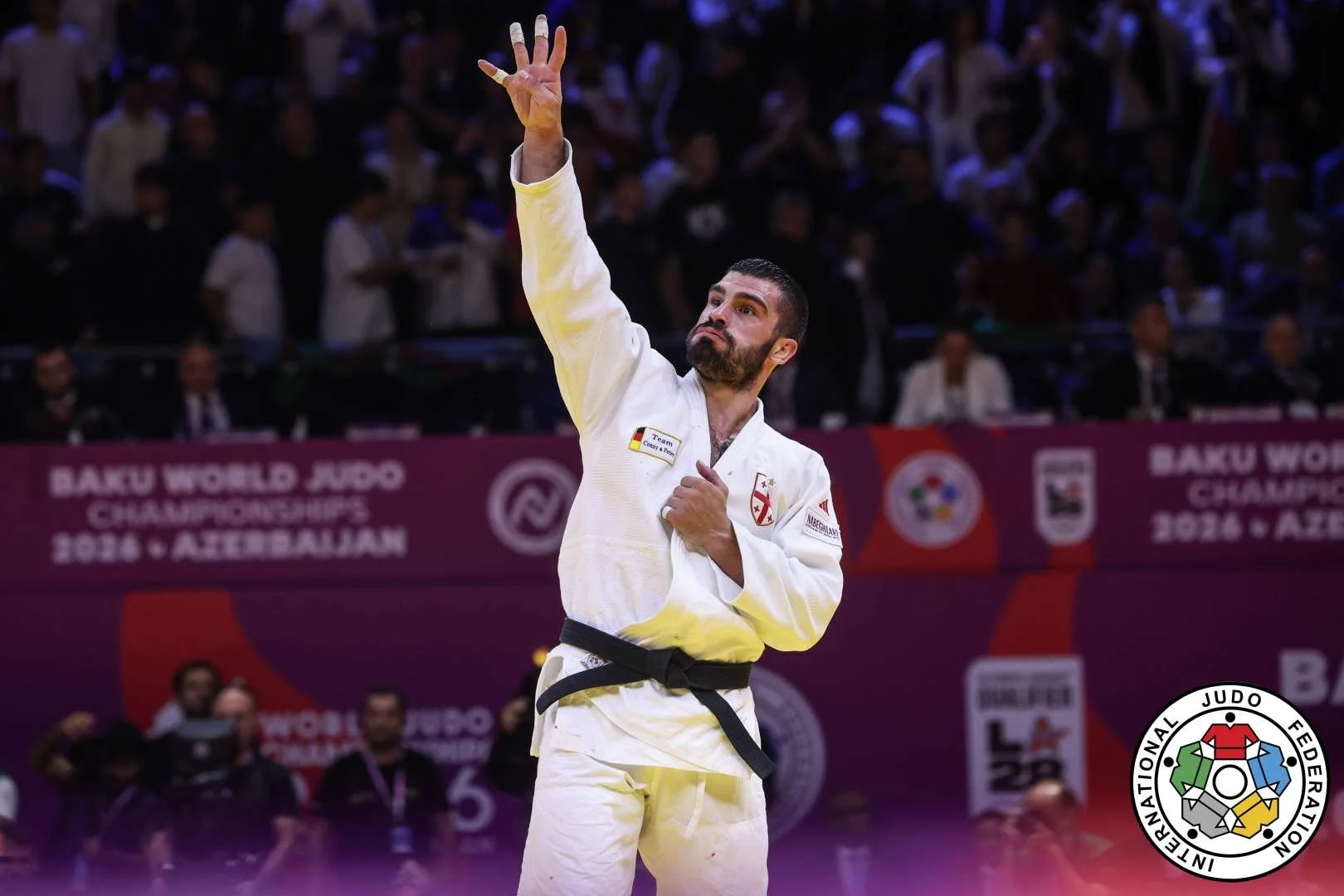
After the 2026 final: Grigalashvili telling fans he just won his fourth world title // Emanuele Di Feliciantonio / IJF
It was not possible.
Instead, Tckaev said, “It’s not like a judo fight. It’s like a gladiator fight.”
Finally, Tckaev committed to what would prove a last attack. Grigalashvili countered. Tckaev fell.
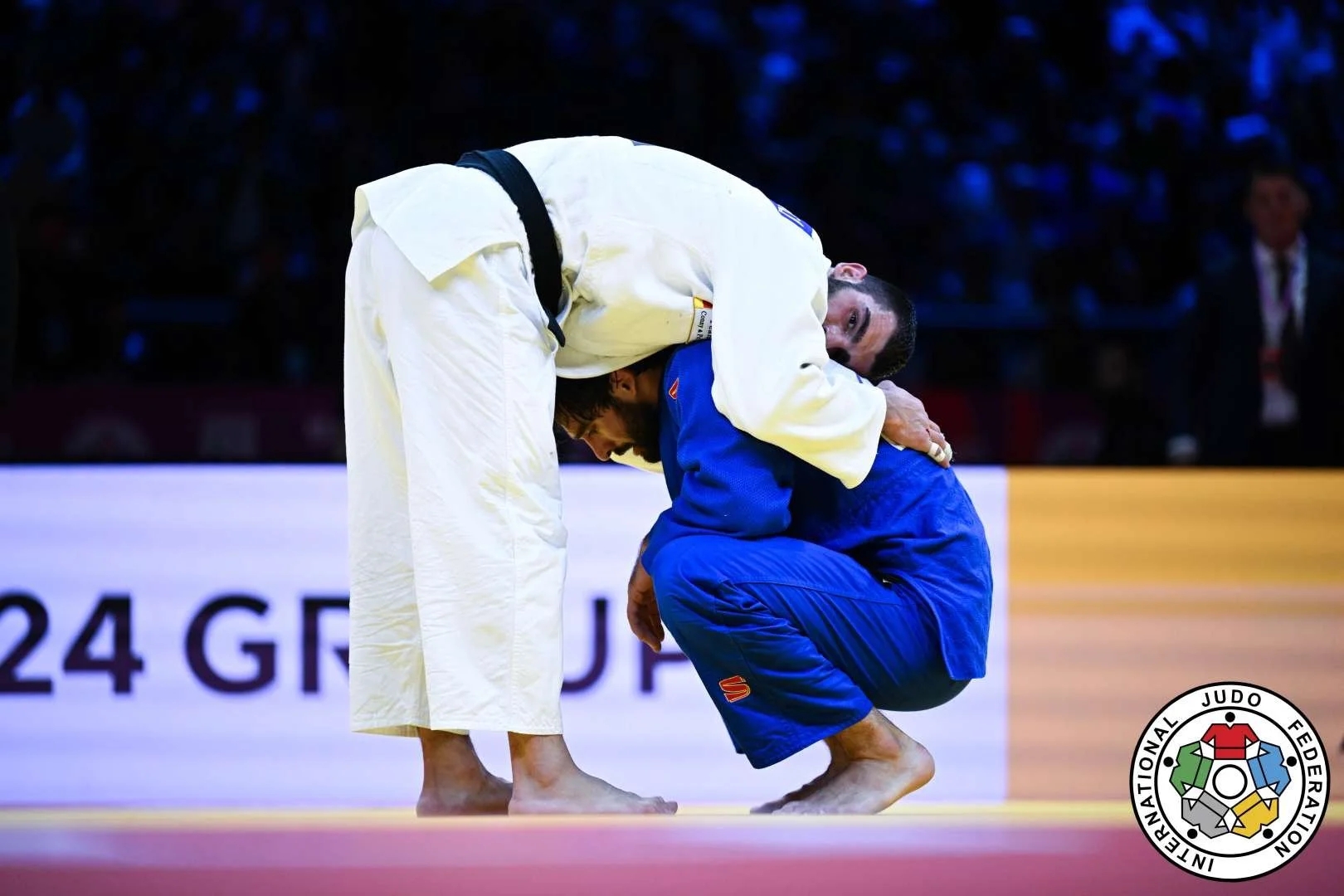
The embrace at the end of their epic fight // Tamara Kulumbegashvili / IJF
Both were drained. Grigalashvili came to Tckaev and offered an embrace, a recognition of what they had been through, together.
“It feels better to win,” Grigalashvili said later. “Oh, it feels better to win.”
--
When the matches end, the custom in judo is that the four medalists – winner, runner-up, the two third-place finishers – change from competition gear into a more formal outfit, dress whites if you will, for ceremonies and photos.
In their dress whites, all four wait in a holding area – folding chairs, hardly fancy – to walk back out into the spotlight.
The two third-place finishers, Azerbaijan’s Rajabli and 21-year-old Mihaljo Simin of Serbia, were already there. Grigalashvili bounded into the pen and greeted each. To do so, he had to slide by Tckaev, who had planted himself on one of the folding chairs with his body bent, his head down against the slight wall.
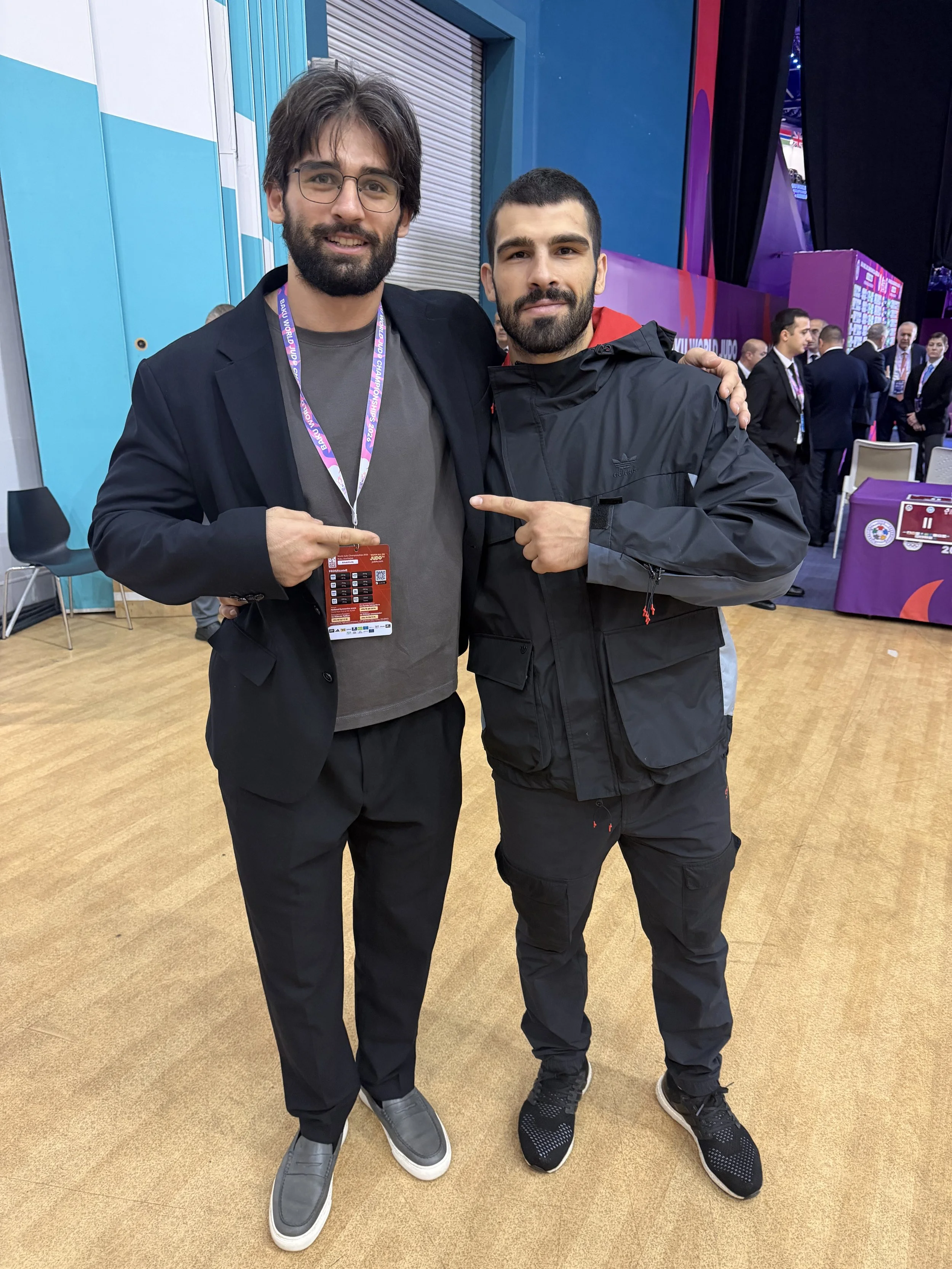
Reflecting later on the championship fight: Tckaev, left, and Grigalashvili
The contrast could not have been more striking.
Here was elation.
“I was very happy,” Grigalashvili said before pausing to say, “But maybe not enough. I need more. I need more titles.”
And complete, thorough, beyond-words dejection.
“Empty,” Tckaev said. “Empty. I was empty. I felt so empty because I gave everything.”
A few moments later, after collecting his silver medal and the pictures, he met up with Diana.
“I love you,” she told him. “It’s going to be OK.”
Maybe not immediately. But, he said, OK, I believe you. “At this moment,” he said later, “I was very weak. Well, not weak. But I didn’t have the result I wanted.” The next time, she said, you will be stronger.
And so he told her, “I know. I know you love me.” He had lost but, as she said, it would be OK. Not immediately but maybe even soon. Because he had her. Because they had their first child. Because, no matter what, they had each other.
“Because, you know,” he said, “she was with me from when I was nobody.”