How to view 28 medals

There are lots of ways to look at the performance of the U.S. team at the just-concluded Sochi 2014 Winter Games. The American team won 28 medals, nine gold.

The optimist says that’s great.

Life is imperfect, for sure // photo Getty Images

The realist says the U.S. not only could have done better but almost surely should have. The International Olympic Committee added 12 new events to the 2014 program, mostly in the so-called action sports, and in those 12 Americans won nine medals. So — what happened around so much of the rest of the team?

Starting with the optimist’s view:

Sochi marked the best U.S. performance at a non-North American Winter Games. Those 28 medals were second only to the host Russians, who won the overall count with 33. Nine tied the mark set in Vancouver four years ago for most-ever gold medals at a non-domestic Games. The U.S. team won 10 in Salt Lake City in 2002.

Mikaela Shiffrin, just 18, won the first gold medal in women’s slalom skiing in 42 years. Ted Ligety won the men’s giant slalom under extraordinary pressure.

The two-man bobsled team, Steve Holcomb and Steve Langton, won the first medal of any color — in this instance, bronze — in 62 years. Holcomb would later drive the four-man sled to another bronze.

Joss Christensen, Gus Kenworthy and Nick Goepper swept the Olympic debut of slopestyle skiing. That marked only the third time U.S. men have swept the podium at the Winter Games. The prior occasions: figure skating 1956, snowboard halfpipe 2002.

Alan Ashley, the U.S. Olympic Committee’s chief of sport performance, declared last Saturday at a news conference at the Sochi 2014 main press center that, overall, the American team had done a “fantastic job.”

The realist’s extrapolation:

Starting from the exact same place: 28 medals, nine golds, and comparing that with Vancouver: 37 medals, nine golds.

Should going to Russia instead of just across the border to Canada make so much difference?

If before the Games Americans would have been a known lock for nine medals in the 12 new events, experts in some circles would not have found it unreasonable to have predicted 40 medals overall for Team USA.

How, then, to appropriately assess 28?

The entire U.S. Olympic Winter team did not win as many medals as the U.S. track and field team did in London in 2012. The track team won 29.

For that matter, the U.S. 2012 swim team won 31.

Overall, there were 98 medal events at the Sochi Games. One potentially very useful metric is how many medal opportunities there were — that is, available spots for Americans to earn a medal.

It’s not a simple case of multiplying 98 times three (the number of medals per event). In some events there might only be one American available to earn a medal; in others, several.

Bottom-line: there were, by the end of the Games, 255 medal opportunities. Again, American athletes earned 28 medals. That’s a return rate of 10.98 percent.

Perhaps this, then, might offer the best measure of the 2014 U.S. team’s performance: is a return rate of 10.98 percent good, or can it — or better yet, ought to be — improved upon?

For comparison, the London track team’s return rate: 29 of 143, or 20.3 percent.

The gold standard is the 2012 U.S. swim team: 31 of 62, or 50 percent.

Of the nine gold medals, five came from new events; four from events that had been on the program before 2014.

As pointed out by Law Murray, a graduate student at the Annenberg journalism school at the University of Southern California who was a credentialed reporter at the Games, all nine of the gold medalists are under age 30.

Much of the pre-Games media attention focused on veterans such as snowboarder Shaun White and speedskater Shani Davis. Neither medaled. As Murray also noted, of the 20 individual medalists, 14 won medals for the first time in Sochi. Only the 20 new medalists from the 2002 Salt Lake Games exceeded that number.

The USOC looks at all these kinds of things, and more. It has two fundamental priorities. One, win medals. Two, inspire the American public. The inspiring depends on the medals. This is the mission. And the mission, so it’s clearly understood, can involve some serious money.

Strictly speaking, the USOC does not, in the manner of a traditional American business, seek ROI, or return on investment. But — when you are laying out $2,724,345 to US Speedskating, as the USOC did in 2012, the year for which disbursements are most recently available, according to the USOC’s tax returns, and the long-track team goes oh-for-Sochi, it’s reasonable to launch a far-reaching inquiry.

As first pointed out by Gary D’Amato of the Wisconsin Journal-Sentinel, the U.S. long-track team’s medal count since 2002 has gone like this: eight, seven, four, zero. That belies an institutional problem that, finally, exploded into the public domain in 2014.

USOC chief executive Scott Blackmun said last Saturday, “If you look at the speedskating results, we weren’t the only nation that got smoked,” the Dutch taking a torch to the rest of the world.

Echoed Ashley: “Our job now is to say, ‘What went wrong, what went right and how do we improve?’ “

Another program that figures to invite scrutiny: the figure skaters won a bronze in the new team event, true, but left Sochi without a medal in men’s or ladies’ singles for the first time since 1936. That is, in a word, unacceptable.

The USOC, according to its tax statements, gave the U.S. Figure Skating Assn. $842,486 in 2012; $866,966 in 2011; $1,023,025 in 2010.

The United States produced the men’s gold medalist in 2010, the women’s silver medalist in 2006 and gold medalist in 2002. Now?

The last U.S. woman to medal at an Olympics or world championships — in an Olympic year, the worlds come after a Games — is Kimmie Meissner, who won the world championship in 2006.

Since 2010, no U.S. man has finished higher than seventh at the Olympics or the worlds.

Figure skating’s scoring system is opaque, surely. But last Thursday, on a night when Americans Gracie Gold and Ashley Wagner were talked up big-time by many of figure skating’s most traditional U.S. supporters — Gold would ultimately would finish fourth, Wagner seventh — the TV ratings underscored the challenge:

The ladies’ free skate, traditionally a highlight of the Games, attracted 20.3 million viewers, as Russia’s Adelina Sotnikova won gold over South Korea’s Yuna Kim amid controversy. The comparable night in Torino, when American Sasha Cohen won silver, drew 25.7 million. That is 5.4 million fewer people, a drop of 21 percent.

The U.S. men’s hockey team came to Sochi proclaiming “gold or bust,” beat the Russians in one of the Games’ most dramatic moments and then, in a 5-0 bronze-medal loss to Finland, proved they really meant it — it really was gold or time to go into the tank. “We didn’t show up. We let our country down. That’s it,” forward Max Pacioretty was quoted as saying in the Los Angeles Times.

There were high hopes this might be the breakthrough year for both cross-country skiing (no medals since 1976) and biathlon (no medals, ever). Didn’t happen.

It’s easy to see how the U.S. team could have more than made up the medals it won four years ago:

Lindsey Vonn did not ski in Sochi because she was hurt. In 2010, she won two.

The Nordic combined team, altogether, won four in 2010. In Sochi, zero.

The long-track team, in Vancouver, four. In Sochi, zero.

Add those together and you get 10. Add 10 to 28 and 38 is almost the 40 that figured to come with the new additions to the program.

Of course, sports — particularly at the Olympics — can often prove a matter of woulda, coulda, shoulda.

For every medal the United States didn’t win, there’s one it surprisingly did — such as Andrew Weibrecht’s silver in the super-G, a reprise of his 2010 bronze in the same event.

Some would suggest that the move to 28 from 37 is also tied to the increasing globalization of the Winter Games. In the men’s snowboard halfpipe, for instance, traditionally the province of White and other Americans, no U.S. man medaled; two Japanese and a Swiss rocked the podium.

Then again, in Vancouver, 26 national Olympic committees won medals. In Sochi, exactly the same number, 26 NOCs, won medals.

“Things don’t always shake out the way you want to,” Ashley, ever diplomatic, said last Saturday. “The surprises are sometimes way more exciting than the disappointments.”


"The new face of Russia"

photo-e1393180338751.jpg

ADLER, Russia — The Sochi 2014 Winter Games drew Sunday night to a close, an Olympics intent on projecting the image of a strong and confident new Russia across this vast country and to the world beyond, with a mighty Russian team awakening the echoes of the mighty Soviet sport system to prideful spectator cheers of “Ro-ssi-ya! Ro-ssi-ya!” Albeit, over 17 days, to the beat of “Get Lucky” by a Russian police choir. And cheerful volunteers yelling, “Good morning!” while dancing to the Black Eyed Peas.

A tableau from the closing ceremony -- brides hanging from helium-filled balloons

“This is the new face of Russia, our Russia,” Dmitry Chernyshenko, the head of the Sochi 2014 organizing committee, said Sunday night at the closing ceremony to more cheers. “And for us, these Games are the best-ever.”

For the rest of this post, please click through to NBCOlympics.com: nbco.ly/1hmiPVk


U.S. alpine: five is plenty fine

KRASNAYA POLYANA, Russia — There were a couple hours Saturday evening when it seemed possible the U.S. alpine ski team — already with a performance here at the Sochi 2014 Olympics that history will judge as fine, indeed— might, just might, sneak away with what would amount to a bonus medal. After Run 1 of the men’s slalom, Ted Ligety, winner three days ago of the giant slalom, had put himself in position for a medal. He was only 11-hundredths back of third.

The U.S. alpine team went into Saturday night with five medals, tied for its second-best performance ever at a Winter Games, with the Sarajevo 1984 team. Only the Vancouver 2010 team, which racked up eight, had done better.

Ted Ligety, left, and Germany's Felix Neureuther after crashing out in Run 2 of the slalom // photo Getty Images

Tantalizingly, six suddenly seemed within reach. Because he already had the GS gold, Ligety was skiing the slalom with no expectation, no pressure. The buzz started building — remember those two killer slalom runs Ligety put down to win his first Olympic gold, the combined, in Torino in 2006?

And then came the buzzkill.

For the rest of this post, please click through to NBCOlympics.com: nbco.ly/1fIwLGB

Shiffrin's 'sure as heck' gold

KRASNAYA POLYANA, Russia — The first Olympics he went to, in his very first race, 15-year-old Michael Phelps took fifth place. He got right back in the pool and, soon enough, he set his first world record. In his next Olympic race — which, because of the calendar, had to wait four years — he won gold. In her first Olympic race, the women’s giant slalom here Tuesday, 18-year-old Mikaela Shiffrin took fifth. She said, “I think this is supposed to happen,” adding, “The next Olympics I go to, I sure as heck am not getting fifth.”

Women's slalom gold medalist Mikaela Shiffrin // photo courtesy Tom Kelly and U.S. Ski Team

There are moments, even at the Olympics, that are genuinely special. These moments make memories that last through the years. They also make cross-over stars, the ones who can make it big outside the confines of a niche like alpine skiing.

Mikaela Shiffrin didn’t have to wait four full years. She sure as heck gave it the full Friday Night Lights treatment here at Rosa Khutor, throwing down two incredible — and very different — runs to win gold in the women’s slalom.

For the rest of this post, please click through to NBCOlympics.com: nbco.ly/1fG8VeG


The contradictory essence of Bode

KRASNAYA POLYANA, Russia — It has been 12 years since Bode Miller won his first Olympic medals, in Salt Lake City. He is 36 now and these are surely his last Olympic Games.  He is at once one of the most accomplished and one of the most complex figures ever to make his way across the American and international sports landscape.

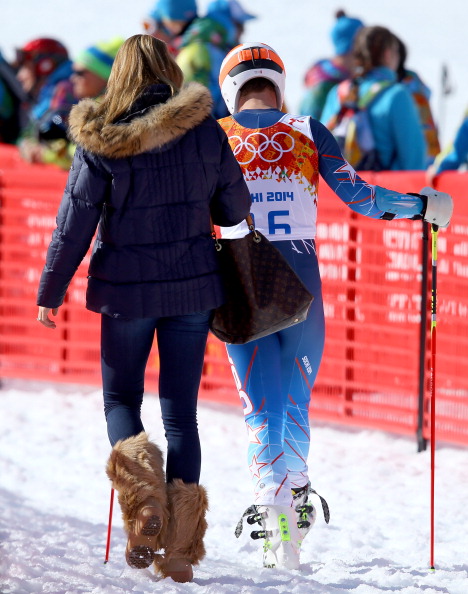
Bode Miller and his wife Morgan leave the course after the men's giant slalom, his last race at the 2014 Sochi Games // photo Getty Images

No question he is the best ski racer the United States has ever produced. He has six Olympic medals, including a bronze in the super-G here. He has two overall World Cup titles, 33 World Cup wins, 78 World Cup podium finishes. He is is also one of only five skiers to win World Cup races in five disciplines.

As Miller has often maintained, he doesn’t ski for the medals.

And it is here that the contradictions of Bode Miller clash, often visibly, sometimes — as in Torino in 2006, when he wasn’t feeling it — to his great detriment. This can be no surprise. Great artists come layered with rippled currents of contradiction that play out to powerful effect and in different directions.

For the rest of this post, please click through to NBCOlympics.com: nbco.ly/OdmEUm


Ted Ligety's 'awesome' GS gold

KRASNAYA POLYANA, Russia — A couple years ago, they made a rules change in the giant slalom. Citing the interest of athlete safety, they made the skiers change to longer, straighter skis. Those skis are way harder to turn. Ted Ligety, the American who had ruled the giant slalom, complained bitterly.

And then he figured out a way to ski on those new skis, lower and longer in the turns, that further separated himself from everyone else in the world. He could now win races by astonishing margins.

Ted Ligety in victory after the giant slalom // photo Getty Images

At Wednesday’s men’s super-G at Rosa Khutor, Ted Ligety put on a clinic to win the first American alpine skiing gold of these Olympics. Indeed, he won big. It was one of the great moments of the 2014 Games. Here, for the entire world to bear witness, was sheer excellence — the excellence the sport demands as well as the excellence the man demands of himself.

It was, in a word, awesome.

For the rest of this post, please click through to NBCOlympics.com: http://nbco.ly/1blt4Lh

Tina Maze's GS poetry slam

KRASNAYA POLYANA, Russia — Slovenia’s Tina Maze calls slalom her favorite discipline, which perhaps is a surprise given that it is, of the five alpine ski events, her weakest. It is giant slalom that brings out her soulful side. “GS,” she says, “is like poetry for me.”

The camera catches Tina Maze making snow angels in victory after the second of her two giant slalom runs // photo Getty Images

In that spirit, after a wild and wet day Tuesday at Rosa Khutor that saw Maze fight through snow, rain, sleet and fog to win her second gold medal of the 2014 Winter Games and indisputably re-establish that she is, no question, the No. 1 female skier on Planet Earth, here is a haiku to commemorate not just the moment but the ski poetry Maze slammed down in winning the GS:

Tina Maze wins

One more Sochi gold medal

What now, Lindsey Vonn?

For the rest of this post, please click through to NBCOlympics.com: http://nbco.ly/1jOcI0E

Shiffrin's 5th hints at greatness

KRASNAYA POLYANA, Russia — When Michael Phelps would stand on the blocks in an Olympic final and do that thing he did, wrapping his arms around and around and making that whap-whap-whap sound, was there really any doubt in his mind — or anyone’s watching — what was going to happen? In the chaos of an Olympic short-track speed skating race, when Apolo Ohno toed the line, his bandana tucked under his helmet, his gaze locked like steel on the first few meters of ice ahead, he was all purposeful calm. He knew what was what, and everyone else — on the line around him — and the thousands in the arena did, too.

Mikaela Shiffrin after Tuesday's racing in the snow, sleet, rain and fog // photo Getty Images

It takes great physical talent to become an Olympic athlete. A select few have something more. They have an extra level of mental awareness, purposefulness, toughness.

Even on a day when there is no medal — there are those in whom the signs are there of greatness assuredly to come.

For the rest of this post, please click through to NBCOlympics.com: http://nbco.ly/1nJPjL9

Bode: skiing for a higher purpose

KRASNAYA POLYANA, Russia — It has been manifest since he strapped his boots into into skis here at the Rosa Khutor complex that Bode Miller was racing with a higher sense of purpose at these Olympic Games. He has wanted it bad, perhaps too badly, sought in the expression of sport and art that has always been his calling, in the rush of a minute or maybe two in the joinder of man and mountain, to find that moment of clarity and, indeed, of transcendence.

Morgan Miller, right, comforts her husband Bode in the finish area after Sunday's super-G // photo Getty Images

At the bottom of the hill Sunday, when the big scoreboard said he was on his way to winning an Olympic medal for the sixth time in his storied career, Bode Miller cried. His wife, Morgan, cried. They hugged each other. Holding an American flag, she helped him regain his composure amid television interviews. Later, on the podium, the flag draped over his right shoulder, before congratulating the others — because Bode Miller has always believed in sportsmanship — he appeared to be alone with his thoughts.

And then it all became clear.

For the rest of this post, please click through to NBCOlympics.com: http://nbco.ly/1lWFEl8

The War Horse rides, again

KRASNAYA POLYANA, Russia — When you check in to the Mirror Lake Inn in Lake Placid, N.Y., owned and operated by Ed and Lisa Weibrecht, there proudly on display is the bronze medal their son, Andrew, won skiing the super-G in the 2010 Vancouver Winter Games. Of all the medals the U.S. Ski Team won in Vancouver, that bronze seems perhaps the most incredible. Andrew Weibrecht? Who?

Super-G silver medalist Andrew Weibrecht on the flower ceremony podium // photo Getty Images

Now there’s only thing more incredible than the bronze he won four years ago. It’s the silver he won Sunday in the 2014 Sochi super-G.

For the rest of this post, please click through to NBCOlympics.com: http://nbco.ly/1bVdxg3