Bach: not a stage "to score points"

SOCHI, Russia — We all make choices. Those choices hold consequences. A few weeks back, the president of the United States opted in his choice of the White House delegation to the 2014 Winter Games not to include even one senior American political figure but, in an obvious protest of Russia’s law against gay “propaganda,” to send, among others, the tennis legend Billie Jean King. In a blunt address Tuesday night opening the 126th session of the International Olympic Committee, with the president of the Russian Federation, Vladimir Putin, on hand, the new IOC president, Thomas Bach, declared, “People have a very good understanding of what it really means to single out the Olympic Games to make an ostentatious gesture which allegedly costs nothing but produces international headlines.”

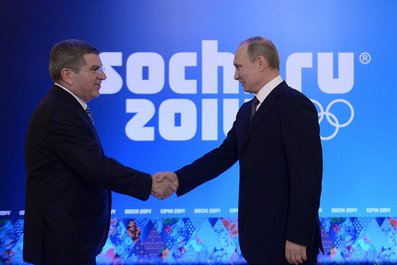
IOC president Thomas Bach and Russian president Vladimir Putin Tuesday in Sochi // photo courtesy Russian president's office

He then added, “In the extreme we had to see a few politicians whose contributions to the fight for a good cause consisted of publicly declining invitations they had not even received.”

Obama is, of course, not here. Neither are the presidents of Germany or France.

Then again, the heads of state of state or government of 52 nations are, believed to be a Winter Games record.

For the rest of this post, please click through to NBCOlympics.com: http://bit.ly/1evqIZ8

Bach: "The Olympic stage is set"

2014-02-03-14.54.35.jpg

ADLER, Russia — The 2014 Winter Games come at an anxious moment in our world, and these Olympics arrive attended by all manner of controversy, and so it was with intense symbolism that the new president of the International Olympic Committee, Thomas Bach, made his first appearance Monday at a formal news conference.  

The president made his entry into the huge conference hall from a door at the front, on the left. There would be no suit and tie. He wore a blue shirt and a cream-colored sweater. He bounded up the stairs, squinted into the bright lights, settled into his seat at the center of the dais and, relaxed, comfortable, confident, made clear he expects these Games to be a huge success.

“The Olympic stage,” he said, “is set.”

For the rest of this post, please click through to NBCOlympics.com: http://bit.ly/1fFfPUc


2024: LA's time again?

2014-01-29-12.04.00.jpg

Shutters on the Beach, the Santa Monica hotel, is one of those Southern California legends. The beautiful people go there, and for excellent reason. You get there by heading west down Pico Boulevard until it dead ends at the sand. The president of the University of Southern California, C.L. Max Nikias, had them in full roar Wednesday evening for an alumni event at Shutters. It was not even two and one half years ago that USC announced a $6 billion fundraising campaign. Already, the president said, the university is more than halfway to its goal.

A few blocks away from USC itself, the 73-story Wilshire Grand Hotel is going up at 7th and Figueroa streets, a $1-billion downtown Los Angeles complex with 900 rooms and 30 floors of office space. It will be the tallest building west of the Mississippi River.

2014-01-29 12.04.00

Just steps away from that, of course, is the LA Live complex, anchored by Staples Center, where the Lakers, Clippers and Kings play, and where ESPN has its West Coast studio. The Ritz-Carlton and Marriott there have already become destinations. In 2011, it’s where the International Olympic Committee held its Women and Sport conference; just a few weeks back, USA Swimming’s Golden Goggles gala took place in the same ballroom.

There really can be little doubt Wednesday why USA Track & Field chose Los Angeles — over Houston — as the site of the 2016 U.S. Olympic marathon Trials.

In short: LA is rocking, especially downtown LA, which used to be dreadful but is now staking a claim to be hipster central.

The intrigue, really, is whether the U.S. Olympic Committee will see what is becoming increasingly obvious as it weighs not only whether to get into the race for the 2024 Summer Games but what U.S. city to pick: Los Angeles just might be — again — the right place at the right time.

There’s only one Los Angeles Memorial Coliseum. Athletes from all over the world want to compete there, to make history, the way it was made in 1932 and 1984.

It’s why there could be only place for the announcement that the marathon Trials were coming to LA — the famed peristyle end of the Coliseum.

It was just after 12 on a glorious January afternoon, the California bear flag swaying overhead to one side, the American flag on the other by those three stately palm trees reaching up high into the sky.  The new Los Angeles mayor, Eric Garcetti, fixed LA’s place in the sun for one and all, saying, “Los Angeles is the western capital of the United States, the eastern capital of the Pacific Rim and the northern capital of Latin America.”

To be clear, the USOC is in no hurry to make any sort of announcement. The IOC won’t pick a site until 2017. The USOC has more pressing concerns — like the impending Sochi Games — before it resumes its focus on 2024.

Yet as the IOC members begin arriving over the weekend in Sochi for the meetings that precede next Friday’s opening ceremony, the issue of what the USOC will do for 2024 will be gathering increasing relevance.

Sochi and the Rio 2016 Summer Games are seen by many within the Olympic movement as “adventures.”

In 2018 and 2020, the Games will be in Asia, in choices seen as involving less risk, in Pyeongchang, South Korea, and Tokyo.

The 2022 race is just now taking shape. But insiders are already suggesting it would be little surprise to see Almaty, Kazakhstan, and Beijing emerge as frontrunners. Both, again, are seen as choices involving less risk. The IOC will pick the 2022 city in 2015.

Again for 2024 — at this very early stage, the IOC is known to be keen to be soliciting a U.S. bid.

The USOC wants in only if it has the closest thing to a guarantee — of course there is no such thing — that it is going to win. It can not afford another debacle like Chicago 2016 or New York 2012.

If the USOC jumps in, the obvious question is, what city gives it the best chance?

Chicago? With its amazing lakefront? And great technical plan for 2016? Not likely. The mayor was President Obama’s key adviser when Chicago got bounced.

New York? The new mayor seemingly has other priorities.

Boston? Not once over the last year has even one IOC member been heard to say, you know what, I would really, really love to spend 17 days in Boston, Massachusetts. Also, if Mitt Romney — who, genuinely, did a first-rate job running the Salt Lake 2002 Games — is serious about getting back into the Olympic scene, advising the Boston 2024 people, he had better brush up on some reading. He told Fox News two weeks ago that the Munich Games had issues with Hitler; the Munich Games were in 1972, 27 years after Hitler’s death. (Mr. Romney’s staffers: see Berlin, 1936.)

Dallas? The state of Texas could for sure meet the IOC’s financial guarantees. But not a chance Dallas can win. Among its several challenges, beyond being in the American South, and the South is where Atlanta is, and the IOC still recalls Atlanta 1996 all too well: the first thing that comes to mind for some who don’t know about Dallas is, believe it or not, the JFK assassination. Not a positive vibe for an IOC election.

Houston? Not running.

There is sound reason to consider San Francisco, and seriously. It has technology assets the IOC, bluntly, needs. It is typically seen as every European’s favorite American city, and the IOC is heavily dominated by European interests. USOC board chairman Larry Probst is based in the Bay Area. Moreover, San Francisco has never played host to the Games and LA, of course, has done it twice.

It’s that twice-before thing that, over the past several bid cycles, has been a considerable strike against LA.

Now that London is a three-time host, though, that has opened the door for LA, and perhaps in a big way.

A significant faction within the IOC is known to favor New York and LA, and if New York truly ends up being a non-starter — that tilts things considerably.

The New York thing is all about the 2012 bid. It’s about what people remember.

LA: the same, and more. Given all the uncertainties in our uncertain world, it may be, as a symposium at the LA 84 Foundation last Saturday suggested, that the IOC needs Los Angeles — the same way it did in 1984, when Los Angeles was essentially the only city in the world that wanted the Olympics, and 1932, the first Games to last 16 days and the first with an athletes’ village.

The Games, it must be understood, are part of the fabric of civic life in Los Angeles.

Olympic Boulevard? That’s 10th Street. Named after the X Olympiad, the 10th Olympic Games, in 1932.

For most Angelenos, the period from the moment Rafer Johnson lit the cauldron in 1984 until the day Rodney King was beaten by police in 1991 were golden years in Southern California, and they want a new version of those years.

The LA city council, the county board of supervisors, other local political figures — they all support the idea of a 2024 Games. There’s no political opposition. Only support.

To emphasize that point, Garcetti keeps a 1984 LA Olympic torch in his office. How many mayors do that kind of thing? For real — not for show.

Thousands of would-be Olympic athletes train in Southern California. Hundreds of Olympians live in the area.

You want shopping? There’s Beverly Hills and more. Disneyland? Right. You want celebrities, Hollywood, the beach? Check, check, check.

The weather? Only perfect.

That blockbuster hotel complex going up downtown? Yang Ho Cho, who runs the South Korean conglomerate, Hanjin Group, is not only a USC trustee — he led the winning Pyeongchang 2018 Winter Games bid.

In an era in which the IOC is avowedly seeking to minimize costs, 85 percent of what’s needed for a 2024 LA Games is already on the ground.

And then, of course, there’s the Coliseum.

Garcetti, speaking in Spanish — the mayor is so fluent he asked a reporter whether she wanted a question answered in English or Spanish — called the Coliseum “a grand symbol of Los Angeles’ Olympic history,” which is, of course, the essence of the thing.

USC now has a 98-year master lease for the place. They’d have to put a new track inside; it’s football-only now. But, you know, these things can be worked out if that’s what everyone wants.

The mayor, back to English, said of the 2016 marathon Trials, “This is a great thing on its own.” And then he also said, “Los Angeles is truly a great Olympic town.”


Toronto out, is U.S. in for 2024?

The 24/7 Olympic news cycle is consumed right now, and understandably, with security issues for the forthcoming Winter Games in Sochi. Then, too, there are the construction woes over the 2016 Summer Games in Rio de Janeiro, where the International Olympic Committee president, Thomas Bach, is paying a visit this week. You had to be tuned in very, very carefully to hear the bolt that came Monday from Canada — even though it carries huge implications not just for the United States but for the race for the 2024 Summer Olympics.

Toronto will not bid for the 2024 Games, its chance of winning “next to none,” councillor Kristyn Wong-Tam told the city’s economic development committee.

Without Toronto in the race, the coast would now seem to be clear for a U.S. bid.

Meanwhile, in a development that absolutely should raise screaming alarms that ought to go viral at IOC headquarters in Lausanne, Switzerland, not even one person showed up Monday at Toronto City Hall to try to persuade the economic development committee to support a 2024 bid.

This from a city that is due to stage the 2015 Pan-American Games. Such a regional event typically is a precursor to an Olympic campaign.

Toronto bid for the 2008 Games, finishing second, behind Beijing. It tried for 1996 as well, coming in behind Atlanta and Athens.

Vancouver, of course, played host to the 2010 Winter Games. Calgary staged the 1988 Winter Games, Montreal the 1976 Summer Olympics.

The Toronto move Monday follows rejections last year by voters in Munich and St. Moritz, Switzerland, of 2022 Winter Games bids. In early 2012, Rome dropped out of bidding for the 2020 Summer Games. Common threads: financial worries and unfavorable perceptions of the IOC itself.

Toronto Mayor Rob Ford said a possible Olympic bid could end up costing $45 million. That figure would almost assuredly be low, given what Istanbul and Tokyo are believed to have spent on the 2020 campaign, won by Tokyo in September. Madrid, a third entry for 2020, spent far less.

The U.S. Olympic Committee is currently going through a roster of potential cities — San Francisco and Los Angeles are believed to be among leading possibilities — with an eye toward announcing later this year whether it is, in fact, going to jump in to the 2024 campaign.

Other possibilities that have been discussed for 2024: Paris; Rome; Doha, Qatar; and a South African candidate.

There are two schools of thought about an American entry for 2024.

— One, Bach and the IOC want the U.S. not only to bid but to win.

The rationale: it’s time.

The U.S. has not held a Summer Games since 1996. The U.S. provides significant financial underpinning to the movement, including but not limited to NBC’s $4.38 billion investment in televising the Games to an American audience through 2020. The USOC and IOC have had their differences over the years, including over certain revenue and marketing shares, but those differences have now been patched up.

USOC chairman Larry Probst, now an IOC member, and chief executive Scott Blackmun have for the past four years assiduously worked hard at the relationship business so key to winning IOC votes. Finally, Bach was elected IOC president last September, replacing Jacques Rogge of Belgium, who served 12 years; Bach understands the import of having a U.S. Games at the earliest opportunity.

— Two, Bach and the IOC for sure want the U.S. to bid. Any American city automatically would make the 2024 race better. But does the IOC really, truly want the Americans to win?

This is the gut question. This is what the USOC is trying to figure out. Because the USOC gets in on one condition only — it expects victory.

Nothing in life is certain. Olympic bid races are by definition unpredictable. But the USOC can not afford another debacle like New York 2012 or Chicago 2016.

Simply put, from an American perspective, for 2024 the U.S. must win.

And, for as much progress as Probst and Blackmun have made over the years, and for all the right signals that are being sent, it’s still a hugely difficult call and the environment is yet enormously layered and complex.

Here, for instance, is one constructive signal:

In 2015, the 204-member Assn. of National Olympic Committees, led by the influential Sheikh Ahmad al-Fahad al-Sabah of Kuwait, is due to hold its annual meeting in Washington, D.C.

Why Washington? Among other reasons, to prove to the three or four dozen IOC members expected to attend that entry in and out of the United States, and not just the United States but the capital itself, can be effected easily and graciously — always a stumbling block to any U.S. bid.

There is yet a ways to go. In recent weeks, two high-profile Olympic visitors have flown into the United States. Both, at very different airports, waited in long, long lines at passport control.

Any American bid, meanwhile, is bound to face an array of lingering issues.

The United States right now has about 450 people giving of their time and energy worldwide in the Olympic movement. Numbers-wise, that’s huge — maybe more than any other country anywhere. The challenge is that for all those numbers, for all that energy, the United States is still struggling to find influence that matters.

The U.S. now counts zero — repeat, zero — presidents of Olympics international sports federations.

On another front, the U.S. was recently awarded the international volleyball FIVB women’s Grand Prix in 2015, in Omaha, Nebraska. Next year, too, Houston will play host to the international weightlifting federation championships.

The USOC is working to attract more such events. But there’s sound reason there’s a perception the U.S. has not done its part in putting on such key championships. Outside of the Olympic Games in Los Angeles in 1984 and Atlanta in 1996, that Omaha Grand Prix will be the very first major FIVB event the United States has ever staged.

Another perception is that Olympic sport in the United States is an every-two-year kind-of deal — with the rest of the time Americans seeming to care mostly about the four professional sports leagues. In Europe, by contrast, you can see all manner of Olympic sports on TV seemingly every day of the week.

Then there is the political challenge.

Why, again, is that 2015 meeting in Washington?

Perhaps to show the rest of the world strong national support is, indeed, possible.

The American Olympic system is set up differently than everywhere else. Around the world, Olympic sport is largely run by — and funded by — each country's national government. In the United States, by formal act of Congress, the USOC must be self-supporting — not a dime from the federal government.

This has led some to believe there is little interest in Washington in Olympic sport. Compounding this perception in recent weeks: President Obama’s decision to send to Sochi a delegation that includes no senior political figures but does include Billie Jean King, in a pointed commentary obviously aimed at Russia’s law on gay “propaganda” purportedly designed to protect minors.

In the IOC, memories can run long. Every single vote counts.

Certainly, it is well-remembered that President Obama lobbied the IOC on behalf of Chicago’s 2016 bid. It is also remembered that his security detail kept the IOC members waiting.

The IOC will vote for the 2024 site in 2017. By then, President Obama will be out of office.

Just to play politics, Olympic and U.S. presidential, for a moment: When she was First Lady, Hillary Clinton, the presumed Democratic frontrunner for 2016, led the U.S. delegation to the 1994 Lillehammer Games. President and Mrs. Clinton led the U.S. delegation to the Atlanta Games in 1996.

The USOC — obviously — would never, ever bring up such a possibility. But anyone reading Time magazine this week — with the cover story, “Can Anyone Stop Hilary?” — can play simple deduction.

At any rate, the IOC, in a key part of the bid process, demands a financial guarantee. In virtually every other country, the national government steps up to provide that guarantee. In essence, that makes the bid — from wherever it is — a de facto national bid. The American system of federalism makes such a guarantee impossible.

A Los Angeles or San Francisco bid, as an example, would have to be guaranteed by the respective city and then, too, by the state of California — not by the federal government. Same goes for any city in any state.

That immediately positions the American candidate differently from the others in any Olympic bid campaign.

Chicago and New York sought different options to meet the guarantee.

The IOC was different then — voting in 2009 against Chicago (Rio won) and in 2005 away from New York (London won).

It is still three long years until 2017. Will it be different enough by then for an American city, whatever that city might be?

The hard part is trying to guess this year what the world is going to be like in 2017.

Truly, we don’t even know yet what it’s going to be like by February 23. That’s the day the Sochi Games come to an end. By then, we will all know then a good deal more about the world we live in.

 

Giving up a spot in the Games

tLLrBarnes100309cm037VancouverWC.jpg

What would it feel like to have a spot on the 2014 U.S. Olympic team and then, selflessly, give it up? It would be easy.

“Love,” Tracy Barnes said of giving up her spot on the U.S. biathlon team to her twin sister, Lanny, “is selfless dedication.

“Love means giving up your dream so someone else can realize theirs.”

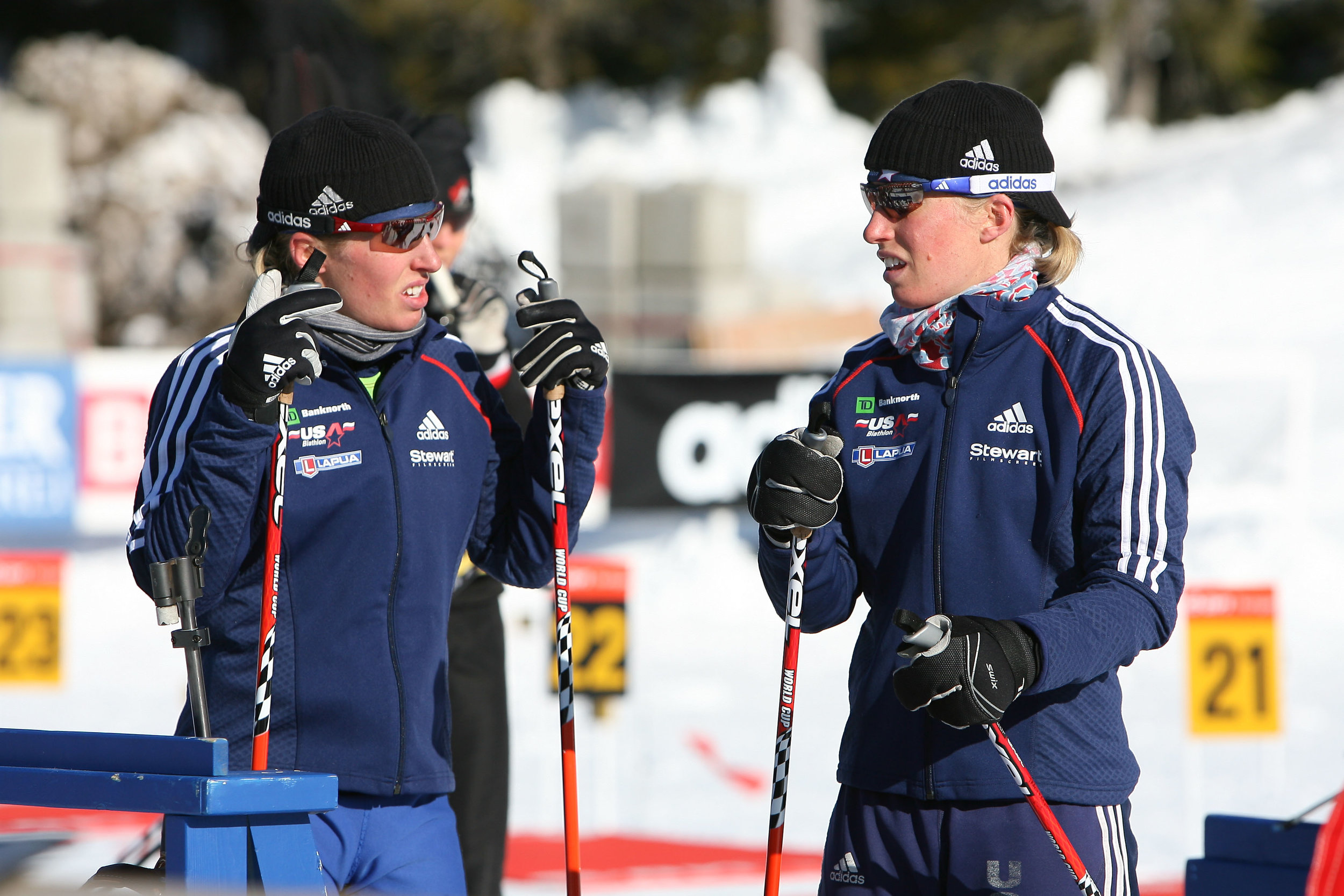
Tracy (left) and Lanny Barnes at a biathlon event in Vancouver // photo courtesy US Biathlon/Nordic Focus

Understand the numbers. The U.S. Census population estimate for the start of 2014: just over 317 million. The U.S. women’s biathlon team that goes to Sochi in just a few weeks: five. Essentially, by the time it got down to Sunday’s final qualifying race, there was one spot up for grabs. One in 317 million. For comparison, your chance of winning the lottery on a single ticket is one in 175 million.

Really, Tracy Barnes said. It was easy.

“If I were to sum up the decision,” she reiterated, “it’s not hard to make a decision like that when you care about someone. Anyone who cares about someone can relate to making a sacrifice for someone they care for.”

Tracy and Lanny Barnes are 31 years old. This is, probably, their last best chance at the Olympic Games.

Biathlon is the ski-and-shoot combination. The United States has never won an Olympic medal in the sport. Many observers believe 2014 could well be the breakthrough year.

The twins are from Durango, Colorado. Their dad, Thad, is a contractor; mom, Deborah, was a long-time schoolteacher; older sister, Christie, who lives now in Burlington, Vermont, is on her way to becoming an ENT surgeon and, Tracy said, is “a big inspiration to us.”

Tracy is the younger of the twins by five minutes. Even so, she said, “Most people think I am the older one because I take on that role. I like to take care of her,” adding a moment later, “I think I have always taken on that motherly role. She would roll her eyes. I have always looked out for her in whatever way I can, the way an older sister or sibling would do. Just take on that role. I do what I can for her.”

The sisters didn’t get on skis, or even think about combining shooting and skiing, until they met a US Biathlon coach at a local competition.

When they were 18, they made their first junior world championship team. Two years later, Lanny medaled at the 2003 junior worlds.

Both made the 2006 Torino Games. At the time, they were 23. Lanny finished 64th in the 15-kilometer event, Tracy 57th. Tracy also came home 71st in the 7.5km sprint; the twins were part of the 15th-place U.S. finish in the 4x6km relay.

Tracy said: “We were so young and inexperienced. You always want to follow up with another Olympics. Your first one — just so you can have that first one under your belt so you’re not so green. There’s more to the Olympics than just going and competing. I think that’s a big part of it for me.”

In 2010 in Vancouver, Tracy did not qualify. Only Lanny. Her best individual finish: 23rd in the 15k.

As the Olympic qualifying season unfolded, two of the five spots on the Sochi 2014 team were locked up early, dictated by results on tour. They went to Susan Dunklee of Barton, Vermont, and Annelies Cook of Saranac Lake, New York.

Then Sara Studebaker of Boise, Idaho — like Lanny, a 2010 Olympian — and Hannah Dreissigacker of Morrrisville, Vermont, earned their spots.

Dreissigacker clinched her spot with 18-for-20 shooting, and a 10th-place finish, at an IBU Cup event Saturday in Ridnaun, Italy. She and Dunklee grew up skiing together in northern Vermont.

Thus it came down to Sunday’s racing, at that same IBU Cup in Italy.

Sunday’s race: a 7.5k sprint.

Tracy Barnes finished 10th. She shot clean — no penalties.

That clinched it for the committee, which by rule had a discretionary spot — Tracy Barnes was not just the U.S. athlete with the next-best record over the qualifying period, she seemed to be peaking, and just in time for the Games.

But — wait.

Before that race, Tracy had already made her decision.

During the final four team-selection races, Lanny had been sick, unable to compete in all but one.

Tracy knew the rules, her status and her sister’s, too — if she turned down the spot, Tracy knew Lanny had the next-best record over the entire qualifying period and thus would be the athlete the committee was all but sure to turn to.

“For me, this decision was pretty easy,” she said again.

“It’s a pretty heavy situation, I guess,” she said with a laugh. “I have been through a fair number of Olympic Trials in my career. I know they’re pretty brutal emotionally. I know there can be a chance where bad luck can on the side of an athlete. Just having watched Lanny through this week and how she even tried to race one race sick, that never works, even — especially — at the level we are trying to race at.

“I have trained with her almost every day now, almost half our life, 15 years now. I have seen her dedication. So I could definitely see she deserves to be on the team.”

After Sunday’s racing was over, the two sisters went for a walk -- actually more of a hike up into the mountains.

“I told her,” Tracy said, “I had something to tell her.”

She added, “Of course she protested.”

There were tears. A lot. On both sides.

“I told her,” Tracy said, “I had been inspired by her performances this year and I really think she is on a great path and I really want to see how far she can go.”

From high in the Italian mountains, Tracy then called Max Cobb, the president and chief executive of US Biathlon, at his home in Vermont. He ended up having to call her back from a landline. The cell reception was scratchy. Even so, he understood.

“It’s a remarkable thing, even for a sister -- even for a twin sister -- to be selfless enough to understand that another athlete would have a better opportunity to perform at the Games,” he said, “and give that away.”

He called it “one of the most inspiring gesture of sportsmanship I have ever seen. It is exactly what you hope Olympic sport inspires,” adding, “To see Tracy do this for Lanny speaks volumes about their character and what it means to represent the United States at the Olympics.”

“I can’t even begin to describe," Lanny Barnes said, "what it means to me that Tracy made such a huge sacrifice for me.

“It’s hard to put into words what she did and what it means to me.”

She added a moment later, “Often times during the hype of the Games we forget what the Olympics are really about. They aren’t about the medals and the fame and all of that. The Olympics are about inspiration, teamwork, excellence and representation. I can think of no better example of the true Olympic spirit than what Tracy did this past weekend. It took a lot of courage and sacrifice to make such a powerful decision.”

She also said, “It’s not every day that you are given a second chance like this. I thought my chance at the Olympics was over. But now I’ve got a second chance and will do everything I can to bring honor to her,” meaning Tracy, “ and our country in Russia.”

Why this disconnect?

Now that the U.S. State Department has issued a travel advisory to Americans that all but screams don’t go to the 2014 Winter Games in Sochi, you have to wonder: Why is the U.S. government taking such a contrary position about these Olympics? And what will be the consequences?

Security personnel on patrol at Fisht Olympic Stadium in Sochi at sunrise last Friday // photo Getty Images

For any travelers who do go? For the U.S. team? The U.S. Olympic Committee? Longer-term, for the prospect of an American bid for the 2024 Summer Games — the International Olympic Committee tending to have a long memory about governments that don’t play ball the Olympic way, especially when it’s the American government.

Seriously: why this disconnect?

The State Department does not always issue travel alerts; it does so to “disseminate information” when the U.S. government identifies “short-term conditions” it believes “pose significant risks to the security of U.S. citizens.” The government issues “travel warnings” for more serious situations in which it urges Americans not to go.

In this instance, one wonders whether the distinction makes a difference, given the publicity the advisory generated — Associated Press, the New York Times and other major outlets — and the language it contained.

The advisory also runs the considerable risk of putting the USOC — and, worse, American athletes — in an awkward, or worse, position. At the 2014 Games, the USOC has to rely on the State Department, some number of FBI agents and other American assets but, mostly, the Russians themselves for security.

In Sochi, the U.S. team will also be largely at the Russians’ disposal for logistics and transport.

To be clear, since the attack by Palestinian terrorists on Israeli athletes and coaches at the 1972 Munich Games, security has been priority No. 1 at the Olympics, Winter or Summer. Further, at any edition of the Games, the Israeli and American teams always get special security attention.

All of life is a relationship business.

One has to hope the relationships the Americans have forged and cultivated with their Russian colleagues at the staff level will now carry on without disruption through the 2014 Olympics.

Everyone, and especially President Obama and the State Department, knows full well the Sochi Games are a prestige project for Russian President Vladimir Putin.

The issue is whether the White House and State Department have, indeed, fully thought out the consequences of their approach.

The advisory comes weeks after President Obama announced the White House delegation to the Sochi Games would not include any senior political figures but would include notable gay athletes, including Billie Jean King.

Last week, Olympic insiders were being told there was no State Department advisory.

Then late Friday, one appeared, in two parts, the alert itself and a corollary Sochi Games fact sheet.

In sum, the State Department cautioned Americans that terrorists have threatened attacks on the Games. It expressed concern about the scope and nature of medical care in the region. It also drew attention to the Russian law passed last summer that purports to bar “propaganda” aimed to minors about nontraditional sexual relations.

The alert itself noted the suicide bombings in recent weeks in Volgograd, several hundred miles from Sochi. It also noted that “other bombings over the past 10-15 years” have occurred at Russian “government buildings, airports, hotels, tourist sites, markets, entertainment venues, schools and residential complexes,” adding, “There have also been large-scale attacks on public transportation including subways, buses, trains and scheduled commercial flights, in the same time period.”

Volgograd: understood. The document notes radical militant Doku Umarov has threatened the Sochi Games. He has called them “satanic.”

As for attacks around Russia over the past “10-15 years”: really?

If that is the standard, what about the 2012 Games, and the bombings that shook the London transport system in 2005, literally the day after London won the right to stage them?

If that is the standard, what about any of the horrific episodes of mass murder by automatic weapon in the United States over the past decade? In Connecticut? Colorado? Texas? Should those prompt warnings to Russian tourists not to visit anywhere in the United States?

The alert expressly notes it is unaware of any specific threat to U.S. interests related to the Games. The opening ceremony is set for Feb. 7.

The day before the advisory was issued, on Thursday in Washington, the FBI director, James Comey, had said, “The Russian government understands the threat and is devoting the resources to address it.”

The fact sheet, meanwhile, under a section entitled “personal privacy note,” reminds all potential travelers that Russian law “permits the monitoring, retention and analysis of all data that traverses Russian communication networks, including internet browsing, e-mail messages, telephone calls and fax transmissions.”

Connoisseurs of irony might find that delicious, of course.

Here are the Americans, caught up in a long-running controversy with the Russians over the former intelligence contractor Edward Snowden and the National Security Agency, warning Americans who might be traveling to the 2014 Olympics that Russian law permits the collection of virtually anything and everything.

Again — really?

As for the LGBT issues, the fact sheet notes the law is vague. It then goes on to declare, in what seems less like "fact" and an awful lot like "opinion," indeed advocacy and outright politics creeping in to a State Department document avowedly set up to “disseminate information”:

“The United States places great importance on the protection of human rights and fundamental freedoms of all people,” including the LGBT community and Olympic athletes and spectators, adding, “The U.S. calls on Russia to uphold its international commitments regarding freedom of assembly and association and freedom of expression, now and in the future.”

Once more — really?

This even as the Kremlin was announcing the very same day -- of course, Moscow is several hours ahead of Washington, so you'd think the State Department would be on it enough to notice -- that political demonstrations would be allowed during the period of the Games at a specially designated site in the village of Khost, about seven miles from Olympic sites.

To use the site, activists must secure a special permit from the authorities; the police assuredly will be on hand. Then again, you generally have to get a permit for a rally in the United States and, typically, the police show up, too.

Who knows whether, as in Beijing in 2008, the site may go relatively unused? The fact is, it has been made available.

Here is a call on behalf of all people of good will to nothing bad happening.

Here’s also to the Russians winning, or at least winning a medal, in one of the very first events of the Games, the men’s 10-kilometer sprint in biathlon, due to start at 6:30 p.m. on the first Saturday of the Olympics, Feb. 8.

Nothing will take the focus off security and everything other issue as much as the home team winning; biathlon, the ski-and-shoot double, is one of Russia’s national sports. To be blunt, the Russians are not likely to win boatloads of medals in Sochi, and they already know it.

So one here would go a long way toward a good mood.

For everyone.


Sochi corruption allegation

Gian Franco Kasper, the president of FIS, the influential international ski federation, says one-third of the more than $50-billion cost of the upcoming Sochi 2014 Winter Games has simply been embezzled. A Swiss member of the International Olympic Committee, Kasper made the provocative assertion in an interview Wednesday with Switzerland’s state broadcaster, SRF.

Kasper did not provide details. Instead, speaking in German, he said corruption appeared to be an “every day” matter in Russia.

Ski federation president Gian-Franco Kasper speaking on Swiss TV

The question now — to evoke a famous aphorism in Russian history — is what is to be done with Kasper’s remarks.

And, of course, what, if anything, is behind the timing of such allegations. As of Friday, the Feb. 7 opening ceremony is 28 days away.

In a follow-up interview Friday with Associated Press, Kasper stood by his remarks: “I didn’t say anything which I wouldn’t have said two years ago.”

He said the one-third figure for corrupt spending is “what everybody says in Russia,” not based on inside knowledge or direct evidence.

In Friday’s telephone interview with the AP’s Graham Dunbar, a respected Geneva-based sports correspondent, Kasper said, “One-third is disappearing. It’s not only in Russia that in certain businesses there is always a part disappearing.”

Kasper said money purportedly diverted for illicit reasons involved Russian sources, not the IOC or its commercial partners. He said $13 billion was specifically allocated toward the Games; the rest, he said, was for separate transport or construction projects.

In the SRF interview, Kasper noted that security at the 2014 Games would likely be intense.

He declared, too, that Russian president Vladimir Putin had an “ice-cold” personality. He said the recent release of prisoners — such as two members of the feminist band Pussy Riot, Maria Alyokhina and Nadezhda Tolokonnikova, as well Greenpeace activists and the former oligarch Mikhail Khodorkovsky — were PR stunts aimed at boosting Russia’s image ahead of the opening ceremony.

Kasper said he feared “heartless Games.”

In speaking Friday with the AP, Kasper said Putin was a passionate sports fan but politically calculating: “He is [a] very strong, ice-cold man. That was not negative.”

Kasper has been an IOC member since 2000. He sits on the Sochi 2014 coordination commission, the IOC’s primary link to the project, a panel led by France’s Jean-Claude Killy, the 1968 triple ski gold medalist, himself an IOC member since 1995.

Again, Kasper leads the ski federation, arguably the most important of the seven winter sports. That lends his remarks a certain gravity.

It was just a little over 15 years ago that another Swiss, Marc Hodler, himself the FIS president from 1951 to 1998, launched the corruption scandal tied to Salt Lake City’s winning bid for the 2002 Winter Olympics. Is this the start of another such episode?

Activists and critics of the Sochi project have for many months now sought to gain the world’s attention about cost overruns connected with the 2014 Games. Examples abound.

It can be very different, however, when a member -- particularly a very senior member -- of the IOC levels such an accusation.

The Christian Science Monitor on Friday reached out to Boris Nemtsov, a former Russian deputy prime minister who has since turned Kremlin critic, the author of a study that alleges up to $30 billion has been stolen in the lead-up to the 2014 Games. He said of the IOC, “They are obliged to pay attention to this.”

In Salt Lake City, it must be noted, accounting was transparent. An open media and the pressure of a vibrant court system helped lead, too, to the truth. Can the same circumstances be said of Russia?

Moreover, of Kasper’s credibility it must be observed he is the gentleman who said in 2005, when women ski jumpers were vying for a place in the Winter Games he was not sure it was suitable for their bodies.

“Don’t forget,” he said then in an interview with NPR, “it’s like jumping down from, let’s say, about two meters on the ground about a thousand times a year, which seems not to be appropriate for ladies from a medical point of view.”

Women’s ski jumping makes its Olympic debut at the 2014 Sochi Games.


Figure skating's got problems

If you are lucky enough, as I am, to be the father of teenage daughters, you learn quickly that teen girls are the knowers, indeed the arbiters, of all things. The 19-year-old is back at college, enduring the frozen winter quarter of her sophomore year at Northwestern. So the 14-year-old ruled the dinner-table focus group. Just the way she likes it.

The Sochi Winter Olympics, as we all know, are just weeks away. Name a figure skater, I said. Just one. She couldn’t do it. Now, I said, name a snowboarder. She perked right up. “The ginger guy,” she said. “Shaun White!”

Ladies and gentlemen, in journalism school long ago, they cautioned us not to rely on anecdotal evidence. In this instance, that axiom must give way to the teen-girls-know-everything rule.

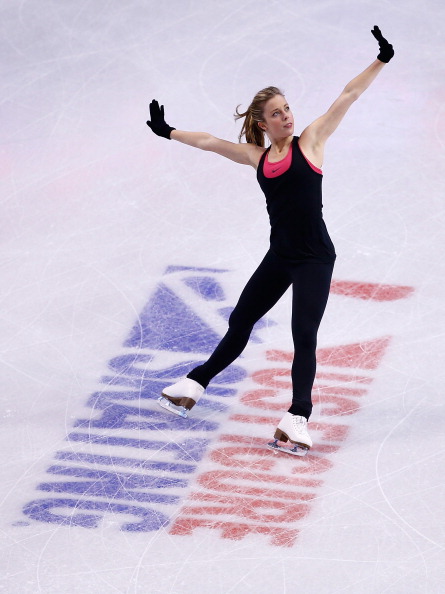
Ashley Wagner practicing Wednesday ahead of the U.S. Olympic figure skating Trials in Boston // photo Getty Images

Which is why, as the U.S. figure skating trials get underway Thursday in Boston, it has to be said: figure skating has big, big problems.

Figure skating is seemingly so stuck in the past it doesn’t know what it is now or what it wants to be. The generation gap is immense, intense and profound.

A Sochi prediction or two: Yuna Kim of South Korea, the ladies’ champion from Vancouver 2010, will again be ethereal. The ice dancing competition will be fine, with Americans Meryl Davis and Charlie White fighting for gold with their training partners in Detroit, Canadians Tessa Virtue and Scott Moir of Canada. Aside from that — what?

All these anniversary stories this week about Tonya Harding and Nancy Kerrigan and the specials yet to come — people, that was 20 years ago. My college sophomore wasn’t even born yet! She doesn’t know about either of them and, frankly, why should she?

To turn the infamous tagline from the sordid affair around, my sophomore might as well ask if confronted with a Tonya-Nancy story: why me?

Snowboarding, snowboardcross, slopestyle — those are the events that are now, that are fun, that are riveting. At the Sochi Olympics, these are the disciplines that are going to go flying across cellphones and tablets. It’s no wonder Shaun White’s new trick, the Frontside Double Cork 1440, is already up on YouTube.

In a little-noticed decision taken at its general assembly in South Africa in the summer of 2011, the International Olympic Committee approved the introduction of a variety of new events for Sochi 2014, including (for both men and women) ski halfpipe and ski slopestyle as well as snowboard slopestyle.

For the unfamiliar, slopestyle requires a rider to execute tricks for amplitude and style while ripping through rails, jumps and other obstacles. White is trying to make the U.S. team riding the snowboard in the halfpipe and again in slopestyle.

Math for a moment: in all, there will be 10 medal events in both snowboarding and freeskiing … multiplying 10 (medal events) across those two disciplines equals 20 … three medals apiece times 20 means 60.

In this instance, the IOC understand the teen-age girl rule, too. It gets where the action is at. It’s in action sports.

You know who else gets it? Bob Costas. The longtime NBC host made a joke about it in a conversation earlier this week with Matt Lauer on the Today show:

“Basically,” Costas said, “I think the president of the IOC should be Johnny Knoxville. Because basically this stuff is just ‘Jackass’ stuff that they invented and called Olympic sports.”

Lauer, laughing: “You mean that in the best possible way, though?”

Costas: “I mean it in the kindest possible sense, yes.”

Lauer: “We could see Shaun White, though, take center stage in slopestyle.”

Costas: “We could very well — and, god knows, if there’s anyone who knows slopestyle, it’s me.”

You know who should have gotten that — who should have appreciated the in-joke — but didn’t? The snowboarders, especially the slopestyle riders. The round of social-media criticism that ensued seemed aimed primarily at Costas. Dudes, it was a joke — lighten up. He gets you. Stay tuned. Or would you rather be at the figure-skating rink?

True, figure skating did get one new gig for 2014, a “team event.” That upped the number of figure-skating medals events in Sochi to all of five, meaning 15 medals.

If you were running things and your job was to win medals and you had to allocate resources … just looking at those numbers alone … 60 opportunities against 15 … what would you say is more relevant? Action sports, or figure skating? Where would you cast not just the present but the future?

Shaun White competing in slopestyle Dec. 22 in Copper Mountain, Colorado // photo Getty Images

Doubtlessly, however, figure skating will be at the core of most television production of the 2014 Games — whatever network. Another life rule: no sensible dad grabs the remote when mom declares, let’s watch skating. That said, the metrics charting the sport’s decline are irrefutable, particularly in the United States, and especially at the elite level:

Eight years after Tonya-Nancy, the French judge scandal at the 2002 Salt Lake Games put figure skating in worldwide disrepute.

In response, the sport did away with perhaps the one thing that everyone understood come the Olympics, the 6.0 scoring system. Scoring now is somewhat more fair. But who — aside from coaches, skaters and a few broadcasters and sports writers — understands it?

Skating retains significant allure in South Korea — any appearance by Kim sells out in, literally, minutes — and in Russia.

Here’s how much of a challenge it now faces in North America:

At last year’s world championships in London, Ontario, in purportedly ice-crazy Canada, they couldn’t even fill a 7,000-seat arena to capacity for any single event until more than halfway through the competition. The president of the international skating union didn’t go. The event wasn’t televised live in the (neighboring) United States. Of course there was, inevitably, a judging controversy.

As for the U.S. team, it has traditionally been so strong that you have to go all the way back to 1936 to find a Games with no medals for the Americans in men’s and women’s singles. It might well happen in Sochi.

The top American woman, Ashley Wagner, has said she would have to be nearly perfect to reach the Olympic podium.

At those 2013 world championships, the two best Americans, Wagner and Gracie Gold, went 5-6. In 2012, Wagner finished fourth; the next-best American, Alissa Czisny, 22nd. In 2011, Czisny took fifth while Rachael Flatt managed 12th.

No American woman medaled in Vancouver,  the first time a U.S. woman had not won a medal at the Games since 1964.

On the men’s side in 2010, American Evan Lysacek won gold. He won’t skate in Sochi because of injury. At last year’s worlds, the two best Americans finished seventh and 14th.

In Vancouver, the contrast between the way Lysacek won and Shaun White’s win in snowboard halfpipe speaks volumes.

Lysacek skated a technically brilliant but safe program. He could have opted to but did not throw any quadruple jumps, only triples. His main rival, Russia’s Evgeny Plushenko, did throw some quads, on the theory that he was — as they would say in snowboarding — progressing the sport.

Plushenko’s quads were slightly off-axis. The judges went for Lysacek.

At the pipe, White won gold with the first of his two runs.

White competing in the halfpipe in Vancouver // photo Getty Images

For his second, he chose to unveil a new trick, the Double McTwist 1260, three and a half spins inside two somersaults. He did not have to do it but did so, anyway; at issue was an ethos, the snowboarder’s quest to be ever better through progression; he was thinking not just of the sport’s present but its future.

White landed the McTwist.

For Sochi, White has added another 180 degrees of revolution inside the somersaults. Thus it’s now the Frontside Double Cork 1440.

You want to know why teenagers want to be like Shaun White? Why the IOC shrewdly wants to tap into that energy?

Here’s why: because, standing on top of that hill that night in Vancouver, Shaun White dared to dream big, and then he went big. That is what the best of the Olympic spirit is all about. And that is why snowboarding, and slopestyle, and snowboardcross are where it’s at.

What does figure skating have that even begins to match that?

Sequins? Dreamy music? For real?

Four years after Vancouver, the best male skaters are seemingly all trying to throw quads. Some can even land them.

Is it already, however, a case of too little, too late?

My 14-year-old couldn’t tell you who Max Aaron, the 2013 U.S. champion is, if her life depended on it.

Shaun White — he’s the cool ginger guy.


Vonn to miss Sochi

No one on Planet Earth — repeat, no one — has more heart, will, desire, call it what you will, than Lindsey Vonn. So her announcement Tuesday that she won’t be able to ski next month at the Sochi Games can reasonably mean only one thing, and by this no one should draw any conclusions about any NFL players who have made incredible comebacks but under their rules don’t get tested for, say, human-growth hormone:

It is absurd, far-fetched indeed, to come all the way back from a world-class knee injury in under a year when you must comply with Olympic-style drug-testing protocols.

Lindsey Vonn and Tiger Woods on Dec. 21 at the World Cup ski event in Val d'Isere, France // photo Getty Images

Four years ago, at the Vancouver Games, Vonn became the first American woman to win the Olympic downhill. In an announcement she posted Tuesday to her Facebook page, Vonn said she was “devastated” she would not compete in Sochi.

The “reality,” she said, is “my knee is just too unstable to compete at this level.”

Last February, at the world alpine ski championships in Austria, Vonn tore two ligaments in her right knee and broke a bone in a spectacular fall. In November, she crashed again; that tore the surgically repaired ACL. In December, she sprained her MCL during a downhill in Val d’Isere, France.

Vonn also said she is having surgery now in a bid to be ready for the 2015 alpine world championships in her hometown, Vail, Colo.

Since no one works harder, she will — barring any more setbacks — be ready.

A few more realities:

Vonn was widely expected to be the biggest star on the U.S. team in Sochi.

She — like short-track speed skater Apolo Ohno in 2010 — is one of the few who have crossed over from the comparative anonymity of winter sports to become a mainstream celebrity. And then there’s the whole Tiger Woods thing.

She will be missed.

That said, the U.S. alpine team should still be very, very good.

Ted Ligety is the best giant-slalom skier in the world, and won three golds at last year’s alpine world championships. Bode Miller is simply the best male skier the United States has ever produced and, after taking last year off, has shown signs of coming back strong this season.

All six of the women on the U.S. “speed” team — that is, downhill and super-G — finished one, two or three in a World Cup event last year. Teen Mikaela Shiffrin is last year’s slalom champion. Julia Mancuso has not had a top-10 finish this season, true, but does have three Olympic medals and a track record of consistently rising to the pressure of the big stage.

Math for a moment or two:

The U.S. alpine team won eight medals in Vancouver. Vonn won two, that downhill gold and a super-G bronze. Would she have won medals in Sochi? Was the U.S. Olympic Committee counting on Vonn in its medals calculations (which it insists it doesn’t do)? Again, realities here.

Same deal with Evan Lysacek, who won gold in men’s figure skating in Vancouver but hasn’t  competed since. Do you really, seriously think the USOC was counting on him to win in Sochi? When he bowed out a few weeks ago, did that alter anyone’s projections?

Reality, everyone.

The U.S. Ski Team — everyone from the Nordic combined guys to snowboarders to the alpine racers — won 21 medals in Vancouver.

Overall, the U.S. team won 37. That topped the medals table.

In Sochi, the U.S. team could legitimately figure, conservatively, to win 30. Aggressively, 40.

For real.

For sure the Vancouver Games were akin to a home Olympics, and that probably helped the U.S. team. But here is what is going to help the U.S. team in Sochi:

In Vancouver there were 24 snowboard and freeski medal opportunities. In Sochi, 48. These are the actions-sports events in which Americans typically rock.

In Vancouver, moreover, the Americans didn’t win even one medal in cross-country or biathlon.

To return to football, as it were: it is an enduring football cliche that when one guy goes down, another steps up.

Translation: the U.S. Olympic Team itself is still loaded with talent. Barring further injury:

Shaun White, who threw the Double McTwist 1260 to win gold in the snowboard halfpipe in Vancouver, has now added another 180 degrees of twist. The thing is now called a Frontside Double Cork 1440.

A simple explanation: the winning run in Vancouver was two flips and three and a half spins. White has now added another half-revolution of twist inside the two somersaults.

The U.S. women’s cross-country team, led by Kikkan Randall, stands ready to win its first-ever Olympic medals. The Americans haven’t won a medal of any kind in cross country since Bill Koch in 1976.

America, meet Nick Goepper. He is 19 years old, 20 in March, and does slopestyle — skiing, not boarding. (White does it boarding as well.) Slopestyle is when you navigate a course filled with rails, jumps and other obstacles and do tricks for amplitude and style points.

Did you know you can become a champion slopestyle artist from Lawrenceburg, Indiana? Growing up on a hill with a vertical drop of all of 400 feet?

Goepper won gold at the X Games in Aspen last January.

On Dec. 21, Goepper became the first skier to grab a spot on the first-ever U.S. freeski Olympic team by virtue of his second-place finish in a Grand Prix slopestyle event at Copper Mountain, Colorado. The third of five Olympic qualification events gets underway Wednesday and runs through Sunday in Breckenridge.

Nick Goepper on the podium in Copper Mountain, Colorado, after securing an Olympic berth // photo Getty Images

When he qualified for the Olympics, Goepper was naturally asked about it.

“It’s not grueling at all,” he said. “It’s a dream come true. It’s super-fun. The Olympics add a bit more pressure but we’re just out here trying to get creative and have fun.”

The thing is, every Olympics produces its own history. One of the new realities of the 2014 Olympics is that slopestyle — in both its board and ski iterations — is poised to explode in super-fun on television screens, tablets and cellphones across not just the United States but the world.

It won't be the same without Lindsey Vonn in Sochi.

But she would be the first to tell you — it’s not all about her.

One more reality: it never was.

Sochi and security

If bombs went off in San Francisco, would that stop you from making a trip to Los Angeles? The Bay Area is roughly 400 miles — 640 or so kilometers — from LA.

Volgograd, where a suicide attack Sunday rocked the train station and another Monday destroyed a trolley bus, is roughly 400 miles northeast of Sochi, site of the 2014 Winter Games, which begin in 36 days.

Experts have suggested the attacks might signal the onset of a wave of terror attacks directed by Russia’s most-wanted militant, Doku Umarov. Last July, he vowed to disrupt the Olympics. He called the Games “satanic.”

“Dear friends,” the Russian president, Vladimir Putin, said in televised remarks amid visits to the Russian Far East and then Wednesday to Volgograd itself, where the death toll in the two attacks has reached 34, “we bow our heads to the victims of violent terrorist attacks.

“I am sure we will continue to fight against terrorists harshly and consistently until their complete destruction.”

What the Volgograd attacks have done already is add another layer of complexity to what may be —this is no hyperbole — the most complicated project in the history of the modern Olympic movement.

Thirty-four years ago, the Olympic Games were held in Moscow. The United States, and several other countries in the west, boycotted, under intense pressure from Jimmy Carter’s White House.

Now, of course, we are within weeks of the first-ever Winter Games in Sochi, in the country that was the main part of the Soviet Union, that is now Russia.

The International Olympic Committee president, Thomas Bach, is new to the job, elected in September. That said, he has in his first few months on the job shown formidable energy and capacity, and he and Putin also appear to have a remarkable relationship; Putin tracked Bach down within minutes of Bach’s election at the IOC meeting in Buenos Aires, on a cellphone, to wish Bach good luck.

Putin has been involved from the outset in oversight of these 2014 Games. They will have cost a reported $51 billion, the most-ever, at least $10 million more than the 2008 Summer Games in Beijing.

These Games have always marked a vehicle to assert Russia’s standing in our world — and, perhaps even more important, within Russia and to Russians, as the nation finds its way in these first decades after communism.

The 2014 Games have been enveloped for months in political controversy.

How much of that, one wonders, is left over from the old Cold War days, when the Soviets were “them” and the west was “us”?

How much, as the controversy over the Russian law purporting to ban gay “propaganda” aimed at minors has underscored, is because some Russian cultural values may be more conservative than in some quarters in the west, and yet many activists in the west believe Russians must be just like our most progressive precincts?

How much from the simple fact the Russians use a different alphabet?

Russia can be different.

Different, however, doesn’t mean worse. Or, for that matter, better. It just means different.

And that is entire purpose of the Games, indeed of the Olympic movement.

We are all, each of us, different.

The point is to celebrate our humanity. You can’t do that at separate world championships. You can’t do it unless you all come together in one place, at one time.

The reality is that security at the Sochi 2014 Games is going to be highly visible and, probably, heavy-handed. The feeling of being there is probably going to be akin to being in an armed camp, and the Volgograd attacks will probably ratchet things up a degree or two more.

It’s going to be something like being in Salt Lake City at the 2002 Games, five months after the 9/11 attacks.

The difference for most visitors to Sochi is that the language and cultural barriers are bound to be ferocious. And there’s yet another layer to the security system for many in Sochi, a pass system to get in and get out of whatever it is they’re going to see. In all, the scene is likely to be tense, perhaps even intense.

Is it going to be safe? Life holds no guarantees. The probable reason the bombs are going off 400 miles away is because Volgograd is the sort of “soft” transport center a terrorist can target to sow fear when the harder target — Sochi — would be far, far more difficult to strike.

Have the perpetrators of the Volgograd attacks done their job? Now my mother, across the time zones, wants to know whether I’m still going to Sochi.

Of course. I wouldn’t miss it for a second. The 2014 Winter Olympics are going to be the place to be.

This is not bravado talking. I went to Iraq in 2003 and have no need to see more war zones. Beyond which, I have a wife and three children and for sure want to come home safe and sound.

Here, though, is the reality: Life must hold passion, and meaning. You have to play your part in things that are meaningful. The idea that people from around the world can come together and perhaps find not only a way to talk to each other but common ground, even if in our mixed-up world it takes some soldiers and rifles to do it — that’s worth finding a way to make happen. Then to be able to tell the story when something good happens — that’s great stuff.

As Bach said in his New Year’s message, the enduring appeal of the Games is that they provide a means for the athletes of the world to “experience first-hand the ability” to “build bridges and break down walls.”

He also said, “The Sochi Olympic Games should be a demonstration of unity in diversity and of remarkable athletic achievements — not a platform for politics or division. This is even more important after the cowardly terrorist attacks in Russia, which we utterly condemn. Terrorism must never triumph. We trust that the Russian authorities will deliver safe and secure Olympic Winter Games for all athletes and all participants.”

The Russians will get their next likely test of whether they can, indeed, deliver safe and secure Games on Jan. 20. On that date the Olympic flame relay goes to Volgograd. The swim school there has produced such notables as Alexander Popov (four gold, five silver medals), now an IOC member; and Evgeny Sadovyi, who won three gold medals at the 1992 Barcelona Games swimming for the Unified Team, including the 400 freestyle, in 3:45, a time that would have gotten him fourth at the 2013 world championships. The pole vaulter Yelena Isinbayeva (two gold, one bronze), was born in Volgograd.

Sadovyi is due to be one of those running Jan. 20 in his hometown.

Marius Vizer, the president of the International Judo Federation as well as Sport Accord, the umbrella organization for the international sports federations, wrote a year-end message as well. His words, too, are on-point:

“The Sochi Winter Games,” he wrote, “represent not only a magnificent financial effort from Russia and the exclusive attention of President Vladimir Putin but they are also an outstanding effort of respect and solidarity towards humanity, a noble gesture of appreciation from the Russian people towards all the countries of the world that will participate in this event. These Games are staged to welcome all those who have a special role in sports, politics, media and human values.

“I consider that athletes, politicians, media and all the entities that define the human values must be not only [in] solidarity with Russia’s efforts of respect, but on the occasion of this event, they should also support and celebrate together a total gesture of solidarity, unity and appreciation in order to become themselves an example for humankind.”