Mo Farah's double double-double

Distance running is a hard, lonely affair. The tell is the last kilometer. The crucible is the last lap. In our time, one man has emerged -- from among the Kenyans, the Ethiopians, the Eritreans -- to dominate, truly dominate, track's two distance events, the 5,000 and the 10,000 meters. He is Mo Farah, a global citizen who was born in Somalia, trains in Oregon, runs for Great Britain.

Farah won the 5,000 meters Friday night at Moscow's Luzhniki Stadium by the narrowest of margins, crossing in 13:26.98. In so doing, he won not just a double-double but has now performed an amazing double double-double.

That is -- he won both the 5 and 10k here in Moscow. At last year's London Olympics, he won both the 5 and 10k as well. At the 2011 worlds in Daegu, South Korea, Farah won the 5k; he lost the 10k by 26-hundredths of a second to Ibrahim Jeilan of Ethiopia, whom he beat in this year's 10k by two steps.

Only Kenenisa Bekele of Ethiopia has done the worlds double, in 2009. Bekele also doubled up at the 2008 Beijing Games. And the word "legendary" is typically attached to Bekele now as if it were his first name instead of Kenenisa.

14th IAAF World Athletics Championships Moscow 2013 - Day Seven

"It was a lot harder work than last year." Farah said afterward. "I never thought in my career that I'd achieve something like this."

The finish of Friday's 5k was so fantastic that it was, genuinely, an instant classic.

Hagos Gebrhiwet of Ethiopia finished second, Isiah Kiplangat Koech of Kenya third. Both were timed in 13:27.26. They had to go to the thousandths to separate them: Gebrhiwet crossed, the clock said, in 13:27.259, Koech in 13:27.260.

It couldn't get any closer.

Of course, for track freaks it made for a sort of holy grail. But for anyone who appreciates will and effort, it shows why track can still claim such a powerful hold on the imagination -- and why, despite the malevolent ill of doping that has corrupted so much in the sport over the past several years, a race like Friday's 5k and its finish offers such tangible evidence of what it can still be all about.

It's three guys pushing themselves, to their limits, to get to the finish line first. Who wants it most?

Of course, this all assumes -- and there is no, repeat no, evidence to date -- that Farah is guilty of anything other than being very, very good.

With that caveat:

With three laps to go in the race, Farah went to the front. The others in the race lined up behind, among them his training partner, the American Galen Rupp, the silver medalist in the 10k in London.

A little math, for those unfamiliar with the 5k on the track.

A track is of course 400 meters. The 5000 -- this is fourth-grade math, but just to make it easy -- is 12 and one-half laps.

The races tend to start slow but then pick up toward the end. That, too, is only sensible.

A little more math, for reference:

The best 400-meter runners, like the American LaShawn Merritt, run championship races in about 44 seconds. A truly exceptional 400 winner goes 43-something.

What happens in the 5 and 10k is that after lap after numbing lap, the body starts screaming, "Stop - this hurts, and bad." That, though, is precisely when the best distance guys have to turn on the jets and run a last kilometer of about 2:20-something and a last lap of roughly 51 to 53 something. Anything less -- no chance.

In Farah's winning 10k in Moscow, he needed a 2:26.23 final kilometer to hold off Jeilan.

In Friday's 5k, he ran a 2:22.29 last kilometer. That is simply flying.

His last 800: about 1:51.

Last 600: 1:21.93.

Last lap: 53.51.

The difference between first and third in Friday's 5k, 28-hundredths of a second, is the smallest-ever in a world championships. The previous smallest differential: 33-hundredths, at the 2003 worlds in Paris.

Rupp finished eighth, in 13:29.87.

Farah also said this: "Anything is possible, I guess."

In other action Friday, Jamaica's Shelly-Ann Fraser-Pryce also doubled up, winning the women's 200 meters to go with the 100 she won Monday.

She became the first winner of the women's sprint double since 1991.

Fraser-Pryce made it look like a breeze: 22.17.

Murielle Ahoure of the Ivory Coast, the silver medalist in the 100, took second in the 200, too, in 22.32. They had to go to the thousandths in the women's 100 as well; Ahoure was timed in  22.313.

Blessing Okagbare of Nigeria, who is also having a fantastic meet, took third, also in 22.32; precisely, 22.319. Okagbare won silver in the long jump on Sunday behind American Brittney Reese, with a jump of 6.99 meters, or 22 feet, 11-1/4 inches. On Monday, she ran sixth in the 100, finishing in 11.04.

American Allyson Felix, going for a record fourth world title in the 200, didn't make it out of the curve, crumpling to the track, holding the back of her leg. She was carried off by her brother, Wes, who is also her manager; an ultrasound revealed a tear of her right medial hamstring, USA Track & Field announced.

She said later she was "extremely devastated" but in classic Allyson Felix form took the time and effort to nonetheless wish "all of my teammates the best for the rest of the meet."

The U.S. men's 4x400 relay won -- and the only drama was whether there would be a dropped baton.

There was not.

David Verburg ran a 44.37 to open things up. Tony McQuay, the 400 silver medalist, split a 44.68. Arman Hall ran 44.92. Merritt, the 400 gold medalist, ran 44.74 to close things down, and the Americans won by more than a second, finishing in 2:58.71, 2013's best time.

Jamaica took second, 2:59.88, Russia third, 2:59.9.

For Hall, it was his fifth world championship medal in three years -- 2011 world youth 400 and sprint medley relay champion, 2012 world junior 400 champ and 4x400 relay and, now, his first senior title.

The United States, minus Merritt, took silver in London last year.

Germany's David Storl defended his shot-put title with a throw of 21.73 meters, or 71-3 1/2, the first back-to-back winner since American John Godina in the mid-1990s. To celebrate, he put on a silly hat.

American Ryan Whiting came in second at 21.57, or 70-9 1/4.

Canada's Dylan Armstrong, with a throw of 21.34, or 70 1/4, got third. That medal is Canada's fourth, its best-ever total at a worlds.

In the men's long jump, American Dwight Phillips, 35 years old, the 2004 Athens Games gold medalist, four times a world champion -- most recently in 2011 -- had hoped Moscow would produce one final leap for the record books.

It was not to be.

The oldest man ever to jump in the final of a world championships, Phillips jumped 7.88 meters, or 25-10 1/4, on his third attempt. But he did not advance, and finished 11th.

"Today I gave everything I had, and it just wasn't enough," Phillips said. "Obviously I was looking for that storybook ending but I'm so proud of myself."

In the men's 200, Usain Bolt ran a 20.66 in the first round, 20.12 in the semifinals. The finals go down Saturday.

The heats of the women's 100-meter hurdles got underway with American sensation Brianna Rollins qualifying in 12.55.

Australia's Sally Pearson, the 2012 Games gold medalist, served notice that she may be -- finally in 2013 -- ready to rock with a season-best 12.62. Dawn Harper, the London silver medalist and 2008 Beijing gold medalist, got through easily in 12.84.

The 100 hurdles semifinals and finals are also set for Saturday.

Rainbow fingernails stir it up

There was a terrific track meet Thursday at Luzhniki Stadium at Moscow. But the central action came -- unsurprisingly -- courtesy of Russian pole vault diva Yelena Isinbayeva, underscoring the controversy over Russia's new anti-gay law. It all started when Swedish high jumper Emma Green Tregaro posted an Instagram picture of her fingernails painted "in the colors of the rainbow," with the hashtags #pride and #moscow2013. Also, Swedish sprinter Moa Hjelmer ran in the heats of the 200-meter heats with her nails painted in rainbow colors as well.

Isinbayeva, who got her gold medal Thursday after Tuesday's captivating pole-vault action, told reporters, in English, "If we allow to promote and do all this stuff on the street, we are very afraid about our nation because we consider ourselves like normal, standard people. We just live with boys with woman, woman with boys.

"Everything must be fine. It comes from history. We never had any problems, these problems in Russia, and we don't want to have any in the future."

Green Tregaro is one of the world's best jumpers, a consistent top-10 performer; she is due to return to the track Saturday for the high jump finals. Isinbayeva said even painted fingernails were out of place.

14th IAAF World Athletics Championships Moscow 2013 - Day Six

"It's unrespectful to our country. It's unrespectful to our citizens because we are Russians. Maybe we are different from European people and other people from different lands. We have our home and everyone has to respect (it). When we arrive to different countries, we try to follow their rules."

Isinbayeva's comments in defense of the Russian law, which prohibits the promotion of homosexuality to minors or holding gay pride rallies, need to be fully understood in context.

Who thinks that someone of her stature made such remarks without the full support beforehand of the leading authorities in Russia? After all, she is due to be the honorary mayor of the Sochi 2014 Winter Games athletes' village.

This, too: the demonstration by the Swedish athletes makes for an interesting test. There were no immediate reports of Green Tregaro being arrested. Nor, for that matter, Hjelmer.

Back to the track:

In the same way that Isinbayeva captivated fans Tuesday night with her victory in the pole vault, the men's high-jump thrilled fans Thursday, with Ukrainian Bohdan Bondarenko coming out on top in a duel with Qatar's Mutaz Essa Barshim, Canada's Derek Drouin and Russia's Ivan Ukhov.

For the first time since 1995, a 2.35-meter clearance in the high jump -- 7 feet, 8-1/2 inches -- would not even be good enough for a medal.

Bondarenko's winning jump: a championship-record 2.41 meters, or 7 feet, 10-3/4 inches.

Barshim and Drouin tied for bronze last year in London; here, Barshim took silver, Drouin, bronze. Ukhov, last year's gold medalist, settled for fourth. American Eric Kynard, the 2012 silver medalist, took fifth.

With a huge contingent of fans from Ukraine on hand, in their blue and yellow shirts, Bondarenko, seventh last year in London, made three tries at a new world record -- 2.46 meters, or 8 feet, 3/4 inch -- but no go. It was quite a spectacle; he wore one yellow shoe and one red.

In the men's 3,000-meter steeplechase, Kenya's Ezekiel Kemboi continued his dominance with an 8:06.01 victory.

14th IAAF World Athletics Championships Moscow 2013 - Day Six

If track and field were more of a mainstream sport, particularly in the United States, Kemboi would be a dream. As it is, in many precincts, he is a virtual unknown. Amazing, considering he has two Olympic golds and, now, three world championship golds.

For this race, Kemboi showed up with a Mohawk. He is a character and celebrated his win -- which he ensured with his typical kick into overdrive down the homestretch -- with, per usual, a dance, using the Kenyan flag as a makeshift skirt.

Under his singlet, it turned out, he was wearing a shirt that proclaimed he was wearing his victory -- he had a certain confidence, apparently -- to Kenyan president Uhuru Kenyatta and deputy William Ruto, "my heroes my kings I love Kenya."

Kenya's Conseslus Kipruto -- he's just 18 -- took silver, in  8:06.37, and France's Mahiedine Mekhissi-Benabbad bronze 8:07.86.

As a measure of their county's dominance in the event, check out the rank of Kenyans in top 10 in the order of finish: 1, 2, 4, 7.

Meanwhile, Evan Jager of the United States ran fifth in 8:08.62, the best finish for an American man since Mark Croghan in 1993. Jager's marked the fastest fifth-place time, ever, in a 3,000-meter steeplechase at a world championships.

Jager now has the three fastest 3k steeple times in American history. And he has only run the event 12 times.

"I'm definitely happy with how far I've come, and I'm excited for the future," Jager said. "But I really wanted a medal. I wanted it real bad."

Jehue Gordon of Trinidad and Tobago became the island nation's second-ever world champ -- behind sprinter Ato Boldon, now an NBC analyst -- winning the men's 400-meter hurdles, in 47.69, the fastest time in the world this year. American Michael Tinsley finished in a personal best 47.70.

Both men ended up sprawled on the blue track just after the finish line, the race too close to call for a few moments.

Serbia's Emir Bekric, the European under-23 champion who almost seems too big and too tall to be running track -- he looks like a linebacker for the Green Bay Packers, or something -- took bronze, in a national-record 48.05.

Felix Sanchez, the 2004 and 2012 Olympic champion, got fifth, in 48.22.

In the women's 400 hurdles, Zuzana Henjova of the Czech Republic, who had served notice all week that she was the one to beat, came through for the gold in 52.84, the best time in the world this year.

Americans went 2-3, Dalilah Muhammad catching Lashinda Demus at the line for the silver. Muhammad finished in 54.09, Demus in 54.27.

Caterine Ibarguen's win in the triple jump marked Colombia's first-ever gold medal at the worlds.

Finally, in the women's 1500 -- the start of which was held for 10 minutes while the men's high jump wrapped up -- Sweden's Abeba Aregawi kicked past American Jenny Simpson, who had led for most of the race.

Aregawi -- who ran for Ethiopia at the 2012 Olympics, finishing fifth -- crossed in 4:02.67, Simpson in 4:02.99. Ethiopia's Genzebe Dibaba took their in 4:03.86.

Simpson's silver proved emphatically that her victory in the event two years ago at the worlds in Daegu, South Korea, was no fluke.

"I think the last 200 I was almost unconscious," Simpson said. "I just kept telling myself, just run as hard as you can."

Mary Cain, the 17-year-old from Bronxville, N.Y., finished 10th, in 4:07.19.

She said, "I think later tonight I'm going to be really, really angry in a good way, and I think I'm going to be really motivated. I think you guys are probably a little scared. Normally you see me like, 'Oh, ducks, puddles,' but I'm going to go home and I'm going to get into this. I think this is going to motivate me so much for next year.

"Next year there are no worlds. It's just me and learning how to race."


Not yet a 'pregnant penguin'

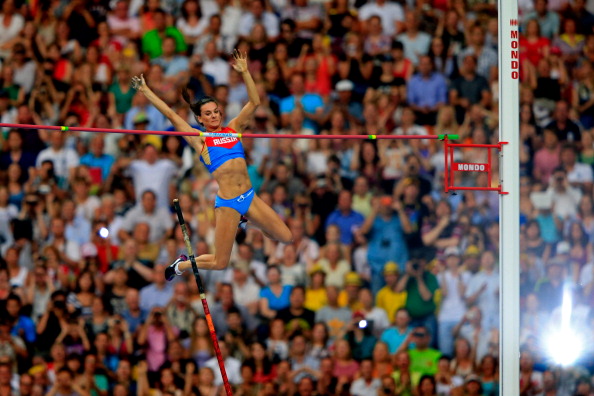
MOSCOW -- The clock said it was a couple minutes past 10 in the evening. All the action on the track was over. The only matter left to be decided was at the pole vault, and there was only one jumper left. Yelena Isinbayeva had all of Luzhniki Stadium to herself. Just the way she likes it.

The greatest female pole vaulter in history, the first-ever in history to clear five meters, won the third world title of her incredible career, the only one in Tuesday's field to clear 4.89 meters, or 16 feet and exactly one-half of an inch.

The world record is 5.07, or 16-7 1/2. Isinbayeva made three tries as the clock ticked past 10. None were really close. No matter. The crowd came to see the Pole Vault Diva, Isinbayeva. They were thrilled, roaring at her every attempt, at what -- for the first time -- felt like a real world championships here at Luzhniki.

"I am so happy the era of Isinbayeva is back again," she said at a news conference that stretched into early Wednesday. "It was never finished."

14th IAAF World Athletics Championships Moscow 2013 - Day Four

Perhaps this is the last of Isinbayeva's world titles. Or not. She says now she is going to take what she called a "small woman's break," intending to have a baby next year. She is due to be the honorary mayor of the athlete's village at the Sochi 2014 Winter Games and said she intends to be walking around -- she really said this -- like a "pregnant penguin" offering the world's skiers and skaters "the traditional bread and salt" like a good Russian host.

The world has never seen anyone quite like Yelena Isinbayeva. And the scene at the pole vault runway -- Isinbayeva's catwalk -- capped a fantastic night of track and field, one that saw the U.S. team win four medals: one gold, three silver.

LaShawn Merritt simply blew away all comers, including London 2012 Olympic champion Kirani James, to win the men's 400 meters, in 43.74 seconds, 2013's best time. Fellow American Tony McQuay took silver, in a personal-best 44.40.

Luguelin Santos of the Dominican Republic -- 19 years old -- finished third, in 44.52.

James? An improbable seventh, in 44.99.

On his way out, James told Universal Sports, "I just died. I don't know what happened."

For Merritt, the 2008 Olympic champion, this marked redemption, and in a big way. He has overcome injury and the embarrassment of a ban relating to the purchase of a male-enhancement product at a convenience store and weathered it all with dignity. McQuay was far from alone when he said at a late Tuesday news conference that he considered Merritt a "great role model."

Merritt said winning Tuesday was a "sweet moment." He also said, "I guess you could call it a comeback. But I don't feel like I ever left. I always continued to work hard and keep faith in my ability -- spiritually, physically and mentally. To come here … I was ready for it."

In the men's 800, Nick Symmonds took silver, in 1:43.55, the best-ever finish in the event by an American and the first medal for a U.S. man since Rich Kenah's bronze in 1997.

Ethiopia's Mohamed Aman won, in 1:43.31 -- the 2012 world indoor champ adding the 2013 outdoor title to his collection. He is just 19. Djibouti's Ayanleh Souleiman took third, in 1:43.76, the first medal for his country since Ahmed Salah won silver in the marathon at the Tokyo worlds in 1991. Souleiman is just 20.

Well before anyone even got to Moscow, the 800 was going to be a wide-open affair. Not one of the three medalists from the 2012 Olympics was here. Gold medalist David Rudisha of Kenya, who set a world-record 1:40.91 in London, was hurt. So was silver medalist Nijel Amos of Botswana. Timothy Kitum didn't make the team Kenya sent to Moscow.

No one in the world had run under 1:43 this year.

In the heats and semifinals, astonishingly, all the Kenyans were eliminated. That meant that -- for the first time in the 30-year history of the world championships -- the men's 800 final would be Kenyan-free.

Symmonds had finished fifth in London; fifth at the worlds in Daegu in 2011; sixth at the Berlin worlds in 2009. He is 29. He had blogged before coming here about how significant it would mean to him personally and professionally to leave Moscow with what he called a "shiny medal" around his neck.

Coming down the stretch, it looked like it might be gold. But with about 20 meters to go, Aman proved just too strong.

"Nothing is impossible," Aman said. "You have to believe in yourself and train."

Echoed Symmonds, "To be a medalist takes a lot of hard work, it takes a lot of luck as well. A lot of experience. At the age of 29 ... it feels like all the hard work and the sacrifice has paid off."

All of that set the stage for the pole-vault drama.

There are three superb female pole-vaulters right now in the world. The American Jenn Suhr won Olympic gold, the Cuban Yarisley Silva silver in London. And then, of course, there is Isinbayeva -- the 2004 and 2008 Olympic champion who won bronze in London.

Isinbayeva is also the 2005 and 2007 world champion. But in Berlin in 2009, she no-heighted. In Daegu in 2011, she took sixth.

Last year in London, she was back to her old ways -- with that third. But for her, third is not -- well, first. And, as she acknowledged after the jumps were all over Tuesday, referring to the last few years, "Sometimes I was desperate … sometimes I thought I should quit."

When all three cleared 4.82, or 15-9 3/4, it marked the first time since 2007 that three women had cleared that height in the same competition. This was, in every way, world-class stuff.

Plus, the crowd was totally into it. The runway and pit were set up in what, in an American stadium, would be a football end zone. The stadium was not filled -- not quite -- but attendance was, because of Isinbayeva, eminently decent. Plus, because of Luzhniki's overhanging roof, the crowd noise was loud, indeed.

Isinbayeva would later say it was the best crowd support she had received. Ever.

"Yes," she said, through a translator in Russian, "that was the best-ever. It was my home crowd. I felt like I was at home. What can you say? Being at home helps you. If we had the Olympics in Moscow [instead of London], the results would be different.

"I've gotten support in other countries. But tonight I knew. Tonight, everyone was behind me. I felt all my emotions. I absorbed it. The support was just colossal."

To have the stadium all to herself? She smiled. In English, she said that was "nice feelings."

Suhr held the lead until she missed her first try at 4.89. Then the pressure was on.

Isinbayeva cleared.

Game over, pretty much -- though the other two women tried to clear, it was not their night.

Suhr took silver, Silva bronze.

Suhr called it a "great competition," adding, "If I was a spectator, that's exactly what I would want to see."

She also said, "When I think of where pole vaulting was and where it is now, you have to thank Yelena for getting us there. making the spotlight, making it one of the premier events to watch. Look at today. Every event was over but everyone stayed to watch it. We have to thank her for really paving the road for that."

People, the era of Isinbayeva is back again. For emphasis, it was never finished.

Empty seats everywhere

2013-08-12-21.09.26.jpg

MOSCOW -- If Luzhniki Stadium were, say, Staples Center, you'd be tempted to say that the crowd that "filled" the seats for the third full day of the 2013 track and field championships was like something you'd see at a mid-season women's basketball WNBA game featuring the Los Angeles Sparks against, say, the Tulsa Shock. That underwhelming.

It was so disconcerting, in fact, that one American business executive sent a text message Monday evening to a reporter friend saying he had a section of the stadium all to himself.

This on a cool, beautiful night when Olympic champion Shelly-Ann Fraser-Pryce of Jamaica rocked the women's 100 meter finals in 10.71 seconds, winning by an almost unheard-of 22-hundredths of a second; American David Oliver made himself the comeback king in the 110-meter high hurdles in 13-flat; New Zealand's Valerie Adams proved herself, yet again, unstoppable in the women's shot put with a winning throw of 20.88 meters, or 68 feet, 6 inches; and more.

It's embarrassing, no two ways about it, and whether the blame is to be apportioned to the city of Moscow, the Russian government, the IAAF, the fact that it's summer and the Russians are quite naturally at their dachas and someone should have known that when they were planning a world championships for August -- whatever, it absolutely does not reflect well on what is supposed to be the No. 1 sport of the entire Olympic movement.

2013-08-12 19.04.41

If it's this way here, in Moscow, it makes you wonder: what are the attendance figures bound to be in six months in Sochi, down in southwest Russia, for the 2014 Winter Games?

To be super-obvious: Moscow is one of the world's great capitals. Sochi is not. You can get to Luzhniki on the Moscow metro, one of the world's best. You get to Sochi, down in southwest Russia, on the Black Sea, by significant planning. The Sochi airport is not big. Only so many planes can land there in so many days.

These championships mark the beginning of Russia's so-called decade of sport. The 2014 Games will be followed by the 2015 swimming championships in Kazan and then, in 2018, soccer's World Cup.

One suspects the World Cup final, which will be back here in Luzhniki, will draw better than the track championships. Here, through three days, are the official numbers:

Saturday:

Morning -- 9,420

Evening -- 31,895

Sunday

Morning -- 12,861

Evening -- 40,461

Monday

Morning -- 9.350

Figures for Monday evening were not immediately available.

As always, the fine print:

-- The numbers are based on ticket scans at stadium gates. Someone who goes in and out multiple times counts only once.

-- Luzhniki is ordinarily an 81,000-seat stadium. As it has done in prior championships, the IAAF has blocked out blocks of seats to lower capacity. On Saturday and Sunday, capacity was 59,000 -- 43,000 spectators and 16 "accredited guests," meaning VIPS, media, athletes and others. On Monday, capacity was lowered further still, to 50,000 -- 34,000 spectators and 16,000 "accredited guests."

"It's dead. There's no atmosphere," Olympic champion Felix Sanchez told reporters after winning his 400-meter hurdles heat Monday morning.

"It's like day and night compared to London last year," he said, referring to the 2012 Summer Games.

As the attendance figures underscore, the contrast is especially marked in the morning heats.

In London, even the morning sessions were jammed. Here -- there are pockets of fans, in particular Ukrainians, noticeable in their blue and yellow, in the yellow, orange and red seats. Mostly, though, there are reporters and camera crews. Some are complete track junkies and love every single tidbit. Others are here on the off chance something unusual happens.

David Johnson, who runs the Penn Relays each spring and is here as a correspondent for Track & Field News, has been to every IAAF world championship since the first edition in Helsinki in 1983. He said of Moscow, "It feels like the smallest attendance, based on the men's 100 meters, in my experience."

That race, Sunday night, saw the stadium filled to roughly two-thirds capacity even though the biggest star in Olympic sports, Usain Bolt, was in the house. Bolt ran 9.77 to win; lightning struck at precisely the moment he crossed the finish line, creating not just one of track and field's but indeed all of sport's most iconic photographs in not just this but any year.

Luzhniki features an overhanging roof that circles the stadium. "Despite the size of the crowd," Johnson said, "the architecture of the stadium produces a noise beyond the crowd. It's the visual effect that's lacking."

That same overhanging roof, however, makes the scene -- particularly in the mornings -- even more eerie. The public-address system announcements ricochet, unintelligibly, around the empty seats.

2013-08-12 20.02.12

2013-08-12 21.09.26

Ticket prices started as low as 100 rubles, roughly $3. Even for Sunday night.

That's right -- you could have seen Bolt run Sunday night for 3 bucks.

Name a better deal in all of sports.

And yet -- the place could only manage two-thirds capacity?

Organizers allege that next weekend, which includes the four relay finals, is sold out. They also said before the event began that they had sold more than 80 percent of the ticket inventory.

Over the weekend, IAAF vice president Sergei Bubka, quoted by Reuters, said the weather might have been to blame:

"It was hot and very sunny and I know for Muscovites -- they always go to their dachas, they go outside, and maybe someone has bought a ticket and they don't attend.

"We insisted very seriously and very strongly regarding a promotion campaign and a lot of money was invested."

Journalist Elliott Denman has also been to every edition of the IAAF championships. A member of the U.S. Olympic track and field team at the Melbourne Games in 1956, he then turned to sportswriting and has been at the business -- one of the best -- for more than 50 years. He called attendance here at Moscow "sparse."

"Like everywhere," he surmised, "people have other opportunities."


Lightning strikes in 9.77

176024653.jpg

MOSCOW -- A few minutes before the men's 100 meter final here Sunday night, lightning began flashing in the sky over Luzhniki Stadium. Just in time for the Bolt show.

As the rain came down hard and fast, Usain Bolt rocked to victory Sunday night in the men's 100-meter final in a season-best 9.77 seconds.

Lightning flashed, literally, as Bolt crossed the finish line. Some things are just too fantastic for even scriptwriters to dream up. "I need to get that picture right now," Bolt said later. "That is pretty cool."

ATHLETICS-WORLD-2013-100M

Track and field is, right now, in many ways, Usain Bolt. It made no difference that his winning time Sunday was not close to his world record of 9.58, not even close. Indeed, it marked only Bolt's sixth-fastest time. His time was, in fact, two-hundredths of a second slower than the fastest mark in the 100 this year, 9.75, run in June by American Tyson Gay, who has since reportedly failed more than one doping test. Gay has acknowledged that he has failed at least one test.

Just imagine if Tyson Gay had won this race. What if his doping matter had come out not before these worlds but -- after? What then for track and field?

American Justin Gatlin, who took second Sunday behind Bolt in 9.85, is the 2004 Olympic 100 champion but then served a four-year doping ban. What if Gatlin had won? What then for track and field?

The sport woke up Sunday to a report that Trinidad and Tobago's Kelly-Ann Baptiste, the  2011 world championship bronze 100 medalist with 2013's third-fastest time in the women's 100, reportedly failed a doping test and had withdrawn from the championships. "Drug Blow," screamed the front page of the Sunday Express, the West Indies' islands main paper.

The list of high-profile sprinters now known or believed to have failed doping tests this year alone: Gay, Baptiste and Jamaicans Asafa Powell, Sherone Simpson and Veronica Campbell-Brown.

Baptiste, as the newspaper noted, trains in Gay's group in Florida. Campbell-Brown and Gay are longtime friends.

Last week, Australian javelin thrower Jarrod Bannister was suspended for 20 months for missing three out-of-competition tests; French hurdler Alice Decaux has been provisionally suspended after testing positive for a supplement.

Forty Turkish track and field athletes have been suspended in recent weeks for doping. Several are just teenagers.

And then there is Bolt -- who has said up and down, this way, that way, every which way that he is clean.

Marion Jones said she was clean, too. So did Lance Armstrong. Everybody says they're clean -- until they're proven not.

“If you’ve been following me since 2002, you would know I’ve been doing phenomenal things since I was 15,” Bolt said last month in London. “I was made to inspire people and made to run. I was given a gift, and that’s what I do.”

Is Bolt the real deal? Is he, finally, the one star the world can believe in?

Or -- like so many other big names who have been unmasked -- too good to be true?

Time ultimately reveals the truth. Always.

Four of the five top finishers in Sunday's men's 100 were Jamaicans: Nesta Carter, who took third behind Bolt and Gatlin in 9.95, as well as Kemar Bailey-Cole and Nickel Ashmeade, both in 9.98.

This from a country that saw its national anti-doping agency perform a total of 179 tests in all of 2012, according to a letter published Aug. 7 in the Jamaica Gleaner. That letter, from the former executive director of the agency, sought to update the figure published in late July in the World Anti-Doping Agency 2012 global statistics database. That 106 figure, R. Anne Shirley said in the letter to the Gleaner, was mistakenly low, due to a reporting error.

All tests carried out by the he Jamaican agency, which goes by the acronym JADCO, were urine tests; JADCO performed not even one blood test, according to the letter.

Arguing that 179 is "somewhat better than what has been previously reported," the letter also said it's still "not as much as the agency or the Government would have/might have wished for …"

At a news conference late Sunday night, Bolt was asked about his connection with the German doctor Hans-Wilhelm Müller-Wohlfahrt, and whether he -- Bolt -- had ever used Actovegin, an amino acid preparation derived from calves' blood.

Actovegin is not on the WADA banned list.

Even so, WADA "closely monitors" its use. In part, that's because, for instance, Lance Armstrong and his team were regularly administered it on the grounds it was believed Actovegin would enhance a rider's performance, according to the brief against Armstrong filed by the U.S. Anti-Doping Agency.

"I don't know," Bolt said. "I really don't know the name of any substance. We just give that to my team. My team checks out any doubt. They clear it with everybody, make sure it's not on any IAAF, WADA [list] -- they have no problems with it."

So far, Bolt has had no testing problems.

Which leaves us with what we had Sunday in the rain:

Bolt, as ever, got off to a slow start. After the fiasco at the world championships in Daegu two years ago, in which he was disqualified for false-starting, it is his now way to stay in the blocks and make sure he starts safely.

Ashmeade, for instance, got out in 0.142 seconds. Bolt -- and Gatlin, too -- 0.163.

Gatlin went out hard. But anyone who has watched Bolt race since he burst onto the international scene big-time in 2008 knows that the last 50 meters are his for the taking, and that was the case Sunday as well.

Gatin acknowledged "feeling Bolt next to me" at about 45 meters. For his part, Bolt said, "I had to do what I do the last 50."

It was the sixth world title of Bolt's career -- two in the 100 (2013, 2009), two in the 200 (2009, 2011, with the 2013 race yet to come), two in the 4x100 relay (again, this year's relay still to go).

Of course, Bolt is the 2008 and 2012 Olympic champion as well as world record-holder in the 100, 200 and the 4x100 relay.

It is not just that Bolt wins but that he does it with such dominance. Here are the margins of his 100-meter Olympic and world championship victories:

2008 Beijing Olympics: .20.

2009 Berlin worlds: .13.

2012 London Games: .12.

2013 Moscow worlds: .08.

"I'm going to try to continue with these championships," Bolt said. "I want to be among the greats after I retire from track and field.

"Pele, Maradona, Muhammad Ali, all these guys -- I want to be mentioned among these greats."

For all that he has done on the track, Usain Bolt absolutely, unequivocally deserves to be mentioned among the greats. The challenge for Usain Bolt is that he is the best in his sport, and his sport greatly deserves special scrutiny.

"If he tests positive, he tests positive," Lamine Diack, the president of track and field's international governing body, which goes by the acronym IAAF, said recently of Bolt. "It would be a disaster for our sport but we would have to say he is positive.

"But I hope that doesn't happen because we don't need that."


A marathon, or an ordeal?

MOSCOW -- It is said by sport executives at the highest level, almost as if it is a prayer refrain offered in complete sanctification and utter devotion, that athletes are at the heart of everything they do. What to make -- once again -- of the women's marathon at the track and field world championships? The race, the first showcase event of the 2013 championships, started at 2 in the afternoon. The temperature at the start: in the mid-80s. Under an unrelenting sun, with no clouds in a high blue sky, it stayed hot throughout. The humidity: over 60 percent.

Forty-six women finished. Twenty-three did not. That makes for easy math: half as many did not even finish the race as did.

That's not a marathon. That's survival.

Edna Kiplagat of Kenya won the ordeal, in 2:25.44, becoming the first female back-to-back marathon world championship winner. Valeria Straneo of Italy finished second, 14-hundredths back. Japan's Kayoko Fukushi took third, in 2:27.45.

14th IAAF World Athletics Championships Moscow 2013 - Day One

American Deena Kastor, the Athens 2004 Olympic Games bronze medalist, finished ninth Saturday in 2:36.12. Hours after the race, she would post to her Twitter account that it was the "hardest marathon ever," the word "ever" in all capital letters, adding that she couldn't walk on one foot and now had a "blood blister on my lip (of all places) and a horrible sunburn." She added this hashtag: #MyDermoWillHateMe

Why did this race start at such an absurd hour, in such ridiculous conditions? Consider this possibility: 2 in the afternoon in Moscow is 7 in the evening in Tokyo -- prime time Saturday evening viewing. And TV rights fees can be worth a lot of money, it's true.

On the one hand, what race organizers have asked the best female marathoners to run through in recent years at these world championships ought to forever put to rest any argument over whether women are tough enough to handle any and everything. On the other, going forward, organizers need a cold dash of common sense before something dreadful -- like, fatal -- happens.

The 2011 women's world championships marathon in Daegu, South Korea, went off with the temperature at 79 and humidity at 72 percent. At the 2007 race, in Osaka, Japan, the temperature was a searing 90; that race won by Kenya's Catherine Ndereba in 2:30.37, the slowest-ever world championship, hardly a surprise, seven minutes slower than Ndereba ran to win the 2003 marathon.

"I was just trying to endure the race, to get to the finish," Fukushi said after Saturday's third-place effort.

"The time of the race is unusual because I am used to run most of my races in the morning," Kiplagat said.

Chris Turner, a spokesman for track and field's governing body, the IAAF, pointed out that in Daegu and Osaka, some of those who did not finish -- colloquially known as DNFs -- had to be hospitalized because of the brutal conditions. "Here," he pointed out, "none of the DNFs had to be hospitalized."

It should be self-evident that "did not need to be hospitalized" should not be the baseline of running a world-class marathon.

The marathon served as the warm-up -- literally -- to the only final of the night on the Luzhniki Stadium track, Britain's Mo Farah's victory in the men's 10,000, and to Jamaican superstar Usain Bolt's first appearance in the heats of the men's 100 meters.

Bolt eased through in 10.07 seconds, the seventh-fastest time of the day.

"I didn't try to run too fast," he said later. "I was trying to work on my technique to get it right. Tomorrow, I will put more speed into it."

The semifinals and finals of the men's 100 go down Sunday. Bolt will be the huge favorite. Fellow Jamaican Yohan Blake, who won the 100 in 2011 when Bolt false-started, is injured. And American Tyson Gay is out because of a positive doping test.

In the men's 10k, in what proved to be a relatively slow and tactical race, Farah and Ethiopia's Ibrahim Jeilan dueled down the homestretch, just as they did in 2011 in Daegu.

Two years ago, Farah didn't have enough finishing speed. Last year in London, he proved he certainly did, winning not only the 10 but the 5,000 meters as well.

This year, he won by two steps, in 27:21.72. Jeilan crossed in 27:22.23.

Farah said later, "I was thinking on the home straight, 'Not again, not again, not again.' "

The victory now gives Farah the full set -- world and Olympic titles in the 5 and 10k. The only other man to win all four is Ethiopia's Kenenisa Bekele.

Farah is due to run the 5k next Friday.

Kenya's Paul Tanui finished third. American Galen Rupp, Farah's training partner and the silver medalist in London, placed fourth.

"I just didn't kick," Rupp said. "It's not that complicated."

In the mens' decathlon, Americans finished Day One 1-2.

Ashton Eaton, the London gold medalist, ran the 400 meters in 46.02, the fastest 400 ever at a worlds. That gave him a lead of 4,502 to 4,493 after five events over 20-year-old Gunnar Nixon.

Two-time defending champ Trey Hardee dropped out with a hamstring injury. He failed to clear a height in the high jump.

"I'm out there having fun -- no pressure," Nixon said.

Anti-gay law controversy

2013-08-08-19.29.03.jpg

MOSCOW -- Over the past few weeks, Russia's controversial anti-gay law has suddenly become a driving narrative in the lead-up to the Sochi 2014 Winter Olympics. At issue is both the power of the Games to focus attention on social change as well as the very real limits of the Olympic movement to drive such reform. Nick Symmonds, the U.S. 800-meter runner, here for the track and field world championships, put it beautifully in his blog for Runner's World magazine.

He  "disagreed" with the controversial new law, which outlaws the promotion of homosexuality to minors or holding gay pride rallies, saying our "LGBT (lesbian, gay, bisexual and transgender) neighbors deserve all the same rights as the rest of us. However, as an American who is about to reside in Moscow for 12 days, this will be the last time I will mention this subject.

"I say this not out of fear of prosecution by the Russian government, but out of respect for the fact that I will be a guest in the host nation. Just as I would not accept a dinner invite to a friend's house and then lecture them on how to raise their kids, neither will I lecture the Russian government on how to govern their people.

"If I am placed in a race with a Russian athlete, I will shake his hand, thank him for his country's generous hospitality, and then, after kicking his ass in the race, silently dedicate the win to my gay and lesbian friends back home. Upon my return, I will then continue to fight for their rights in my beloved democratic union."

2013-08-08 19.29.03

One of the wonders of the Games is that it can open up a country in ways that take time -- years -- to appreciate. Consider Seoul in 1988, and South Korea now. The city and country are very different, and the Games were a catalyst. Barcelona 1992 -- the same.

We don't know what having the Games in Beijing will mean in and to China -- the impact of having had thousands of foreign visitors there, mingling -- by 2018 or 2028.

In the same vein, it's now six months before the 2014 Winter Olympics. In no way can we judge what having the Olympics in Sochi in 2014 will mean in and to Russia by, say, 2024 or 2034.

This is a country that, as Sochi 2014 leaders consistently point out, hadn't seen a recycling program for its water bottles and didn't have a culture of volunteering before it won the Winter Olympics.

As Johnny Weir, the gay U.S. figure skater, observed in his latest blog post, "The Olympics will be 14 days of direct reporting, from the source, and shedding light not only on the best athletes in the world, but also the many ways in which we can help our fellow man in a repressive nation."

That's why calls for a boycott -- which, aside from the obvious, that boycotts only hurt athletes -- are so stupidly wrong.

In his open letter to British Prime Minister David Cameron and International Olympic Committee President Jacques Rogge, the British activist Stephen Fry said an "absolute ban" on Sochi 2014 is "simply essential." The letter, delivered this week to the IOC, also compared the "barbaric, fascist law" to the persecution of Jews in Nazi Germany and said of Russian president Vladimir Putin, "At all costs, Putin can not be seen to have the approval of the civilized world."

For one, barring something unforeseen and extraordinary, the Games are not going to be moved. There are six months to go. A Winter Olympics is not a middle-school ski meet that you just pick up and move on short notice to, say, Vancouver. There's sound reason the IOC awards it seven years out.

For another, this is not 1936. The parallel between Russia now and Germany then simply does not hold, and further does a disservice to the memory of the 6 million Jews and others who were slaughtered without mercy in the Nazi death camps.

For sure, rhetoric such as Fry's has its purpose. The open letter was said to have been delivered with more than 300,000 signatures. Experience reveals the IOC is often ultimately unmoved by such displays. In 2008, the Olympics were, in fact, held in China amid great pre-Games controversy over Tibet.

Moreover, isn't it perhaps a bit presumptuous for Fry to assert that Russia is not part of the "civilized world"? The country that boasts of -- just to name one of any of a number of great institutions -- the Bolshoi Ballet? That gave the world the literature of, among others, Anton Chekhov and Leo Tolstoy? One of the world's superb art museums, the Hermitage in St. Petersburg?

The IOC, its senior vice president, Singapore's Ser Miang Ng, said earlier this week, was engaged in "quiet diplomacy" with the "highest authority" in Russia.

In that context, the IOC is obviously trying to buy time. Rogge said Friday at the briefest of news conferences -- 10 minutes, six questions in all -- the IOC was still trying to translate the law itself from Russian to English to understand it fully. Of course, why the IOC didn't already have a copy of the law in hand, translated, is confounding. Email went down? Fax machines didn't work?

President Obama said this week he had "no patience" with the Russians over the issue. With profound respect for the president, who has issues with Russia over Syria, the former intelligence contractor Edward Snowden and other matters, he also said, "Every judgment should be made on the track, or in the swimming pool, or on the balance beam, and people's sexual orientation shouldn't have anything to do with it."

The last part -- dead-on right.

The rest -- it's the Winter Olympics, not the Summer, and of course here some IOC members would be inclined to take note of Mr. Obama's off-point remarks and again call up, say, the U.S. presidential security detail tying things up before the 2009 vote in Copenhagen at which Chicago got whacked in the first round, Rio winning the 2016 Summer Games.

The Russians have already spent north of $50 billion on the Sochi project. They have a lot at stake in making it work.

So, too, the IOC.

The IOC should -- as it assuredly is doing in its "quiet diplomacy" -- oppose in the strongest possible terms any move that would jeopardize the principle, laid out in the Olympic charter, that the Games should be open to all, free of discrimination.

To be sure, the IOC will have in turn received from the Russians -- again, at the highest levels -- assurance that the legislation will not affect those attending or taking part in the Games. That is the way this works, Russian sports minister Vitaly Mutko urging critics Thursday at a news conference to "calm down."

Referring to criticism, Mutko was quoted Friday as saying by Interfax, according to an Associated Press report: "I wouldn't call the pressure light. Russia must understand that the stronger we are, the more other people aren't going to like it. We have a unique country."

"We don't have to be afraid of threats to boycott the Olympic Games. All sensible people understand that sports demand independence, that it is inadmissible that politics intervene."

All the same, the expectation of what is -- and is not -- possible must come through clearly:

The IOC is not a government. It is not even quasi-governmental. Its role is to inspire the best in human beings around the world -- to promote friendship, excellence and, yes, respect.

That does not mean, however, that we are all going to agree. Or that we should. Or that the way we do it this year in the United States, or the west, is the way it should be done everywhere.

Diversity means, you know, "diverse."

For instance:

A number of the states in the United States consider the death penalty sound public policy.

Weigh the following: a new law that allows Russian authorities to impose fines for providing information to minors about the gay community against American state-sanctioned execution.

The United States is seriously considering a bid for the 2024 Summer Games. Would Americans welcome a petition campaign by Russians, western Europeans, or for that matter, anyone anywhere demanding the state of Texas, for example, change its capital murder policy -- or else deny any U.S. city the right to stage the Games?

Back to Symmonds, who went out in the 800 semifinals in Beijing, finished fifth in London and who is considered a strong medal contender here this week, the world championships getting underway Saturday:

"I will say now what I said before the 2008 Olympic Games in Beijing, China, when people asked me how I felt competing in a foreign country with questionable human rights standards: The playing field is not a place for politics. In a world rife with never-ending political battles, let the playing field be where we set aside our differences and compete for national pride and the love of sport."

As Nick Symmonds would be the first to tell you, that can't happen unless everybody who is invited  shows up. The Winter Games start in Sochi on Feb. 7. You know how pin-trading at the Games is a big deal? Here's guessing the rainbow pin will be much in demand.


On the WADA presidency

MOSCOW -- Consider what just these few weeks have brought: A massive scandal in Turkey, with revelations of teenagers being doped. A rash of doping cases in Russia. Allegations that West Germany's government tolerated and covered up a culture of doping among its athletes for decades, and even encouraged it in the 1970s "under the guise of basic research."

Positive tests involving American and Jamaican track stars: Tyson Gay, Asafa Powell, Sherone Simpson and Veronica Campbell-Brown.

Meanwhile, the election for the presidency of cycling's governing body, the UCI, is, after years and years of the sport's drug-ridden history -- and to describe it this way is perhaps even too gentle -- fractious.

In the United States, Major League Baseball moved to suspend more than a dozen players because of doping violations but the biggest star of all, Alex Rodriguez, with $95 million at stake, is fighting the matter vigorously.

IAAF Centenary Gala Show

The reason Edwin Moses, the two-time Olympic gold medalist, is now in the running for the presidency of the World Anti-Doping Agency, is elemental: "I believe I am the right person to help protect clean athletes' right to compete. That," he said, "is what it is about, ultimately."

Moses, 57, entered the race to become the next WADA president in late July, becoming the third -- and final -- candidate for the job. Also in the contest: International Olympic Committee vice president Craig Reedie of Great Britain and former IOC medical director Patrick Schamasch of France.

Moses is indisputably one of the greatest track and field stars of all time. He won the 400-meter high hurdles at both the 1976 and 1984 Summer Games. He won 122 consecutive races from 1977-87.

Since his retirement from competitive running, he has been especially active in the anti-doping movement, serving since September, 2012, as chairman of the U.S. Anti-Doping Agency.

The three would-be WADA presidents had until Tuesday to submit position papers to the IOC; it's now the Olympic movement's turn to nominate a successor to former Australian government minister John Fahey, who has been in the job for six years.

At a meeting here Friday in Moscow, the IOC's policy-making executive board is due to nominate one of the three. That nominee will be put up for formal election at the World Conference on Doping in Sport in Johannesburg Nov. 12-15.

Schamasch -- no one doubts for a second his technical expertise -- is considered a long-shot.

Moses got a late start. He knows that. Even so, if the anti-doping campaign is supposed to be all about athletes, who better than one of the most superb athletes of all time -- who since has virtually done it all -- looking out for athletes?

Moses earned an M.B.A. from Pepperdine University in Malibu, California. His undergraduate degree, from Morehouse College in Atlanta, is in physics. He serves now as director of the Laureus World Sports Academy, the association of sports starts that seeks to use the positive influence of sport as a tool for social change worldwide. He has served the IOC on its athlete, medical and ethics commissions and on various U.S. Olympic Committee panels as well.

"I think the position needs a person of strong will," Moses said in his first public comments since the IOC announced he was in the race, adding a moment later, "There aren't a lot of people with the experience I have had at every level."

Even so, to know the IOC is to recognize the subtle if unmistakeable signs that Reedie -- himself accomplished, sophisticated, experienced, and particularly in the ways of international sports politics and diplomacy -- may have the nomination all but sewn up.

Within the IOC, there is considerable feeling that it -- the IOC -- should play a more direct role in its dealings with WADA.

Ser Miang Ng of Singapore, currently the IOC's senior vice president, said at a press briefing Monday in London, "I feel there needs to be a shift in the IOC's stance with WADA. Perhaps the IOC should fund a higher percentage of the finance, say two-thirds, which would then justify WADA being more directly led by sport, by the IOC and by the IFs," that is, the international federations.

The IOC set up WADA in 1999. The IOC and the federations currently provide 50 percent of WADA's annual budget. Governments fund the other half. WADA's 2013 budget: $26 million.

In recent months, the federations in particular have intensified their criticisms of WADA, saying it spends millions of dollars annually on drug-testing but doesn't routinely catch the most serious cheaters. The return rate has for years hovered at about 1 percent given the usual test methods.

A more-expensive test, the carbon-isotope test, catches cheaters at a rate of about 5 percent, statistics WADA made public at the end of July suggested. But each carbon-isotope test costs about $400. Where such funding would come from is uncertain.

Moses said he understands fully and fundamentally what is what.

"I'm optimistic about it," he said. "That's the approach I'm taking …

"What I can do is lay out a philosophy: to give the athletes the confidence that the war against doping in sport is the most important aspect of competition and all the resources are being put to the task; to give these athletes the assurance that when you compete, no matter who you are, no matter what country you come from, that if you are using illegal substances you are going to be caught and sanctioned heavily."


Turkey's awful doping scandal

LONDON -- Most of the news accounts about the 31 Turkish track and field athletes hit Monday with two-year bans for doping have centered on four main points: One: Istanbul is in the race for the 2020 Summer Games, along with Madrid and Tokyo. The International Olympic Committee will choose the winner Sept. 7. To be blunt, the timing for Istanbul is not good. Lamine Diack, the president of track and field's international governing body, which goes by the acronym IAAF, has said, "They cannot bid for the Olympics if they cannot control their athletes. They need to clean their house."

Two: three of the 31 athletes competed at the 2012 London Games.

Three: one of those three, Esref Apak, is also the 2004 Athens silver medalist in the hammer throw.

Four: The bans came five days after the IAAF confirmed nine other Turkish athletes got two-year suspensions for using anabolic steroids.

Those are, of course, all relevant and material.

But here are the two central points in what is perhaps one of the biggest doping scandals in track and field history -- and, even given everything that has happened in the sport, that assertion may prove not to be an overstatement.

One: of the 31, 20 are 23 or younger.

Two: eight are teenagers.

Ebru Yurddaş, a hammer thrower with a top-10 result this year in her category, is 16.

For emphasis: she is just a teenage girl.

Thus the fair question: who is doping teenagers -- nearly a quarter of those who were named -- and on what authority?

Or did Ebru Yurddaş, at 16, have the wits, the will and the cash to obtain performance-enhancing drugs herself?

This is on a level completely and profoundly different than the headlines involving sprint stars Tyson Gay of the United States or Asafa Powell and Sherone Simpson of Jamaica, all of whom recently confessing to failed drug tests.

Two-time Olympic 200-meter champion Veronica Campbell-Brown tested positive for a stimulant a few weeks back. This is way different than that as well.

Those cases represent, if you will, individual choice.

So, too, the Biogenesis matter -- which led Monday to the sanctions from Major League Baseball. It is of course an absurd joke that Alex Rodriguez can be "banned" for 211 games but then start that very same night at third base for the New York Yankees, and if you want evidence about why the rest of the world looks at the U.S. professional sports leagues and thinks something is askew -- it does not understand collective-bargaining agreements and does not necessarily care to -- that is Example A.

To be clear:

The point is not that doping is a Turkish problem. There have been plenty of doping cases in, for instance, the United States. See, for example: Armstrong, Lance. Or, Jones, Marion.

The point is that in Olympic sport the doping cases in United States have almost exclusively involved young adults, some well into their 20s and 30s, making choices -- bad choices, surely -- in, again, the exercise of individual self-determination.

This, though -- to be doping teenagers?

The news in Turkey erupted on the same day it was disclosed that West Germany's government encouraged and covered up a culture of doping among its athletes for decades, participation "conspicuously similar to the systematic doping system of [East Germany]," according to a comprehensive report.

Last week, the chairman of the Turkish track and field federation, Mehmet Terzi, resigned. He had been in office for nine years.

The IOC, or IAAF, or the World Anti-Doping Agency -- some entity -- should find him when he's out of Turkey, if he ever is allowed out again, and ask: what did he know, and when did he know it?

The president of the Turkish Olympic Committee, Ugur Erdener, who is also an IOC member, issued a statement Monday saying that the 31 suspensions should be taken as a "clear signal" of how seriously the country is responding.

He also said in that statement, "Led by the Turkish government, Turkey has zero tolerance for doping and it is our intention to have clean, young athletes competing on the international stage in the future."

Note it's his statement that invoked the government.

Thus the obvious, and reasonable, question: what, exactly, is the government's involvement in all of this?

Further, all high-level sports officials have to issue a public-relations statement that says something like that at a moment like this.

Reality check: this is not a "clear signal."

How do you know? Because the list of the 31 names provided by the Turkish track and field federation provided no other details: what kind of drugs are at issue or the dates of the suspensions.

That is simply not transparency at work. There is more, much more, to come.

For instance, those nine Turkish athletes who got the two-year bans for using anabolic steroids? Two were teenagers, a 17-year-old discus thrower and an 18-year-old hammer thrower.

Those anabolic steroids?

Six cases, according to the IAAF, involved stanozolol. That is the same substance that Ben Johnson used at the 1988 Seoul Olympics.

Among those six, the IAAF says, three also tested positive for oral turinabol. That's the steroid that was used in the state-sponsored East German doping programs in the 1970s and 1980s.

Beyond which, two of the country's most successful athletes are still awaiting disciplinary proceedings.

Asli Cakir Alptekin, the London 1500-meter champion, could lose that gold medal and be banned for life; abnormalities purportedly were detected in her biological passport. Meanwhile, two-time European 100-meter hurdles champion Nevin Yanit, fifth in the event in London, allegedly failed a doping test.

The 31 suspensions announced Monday stem from tests ordered by the IAAF in and out of competition amid the Mediterranean Games, an Olympic-style competition held June 20-30 in the Turkish city of Mersin.

In a neat bit of irony, the track and field events there were staged at the "Nevin Yanit Athletics Complex."


Not just one super swimmer

BARCELONA -- No, Michael Phelps did not swim even one stroke at the 2013 world championships. Yes, his presence hung over the meet -- it being a year to the day that he touched the wall for the last time in the winning medley relay in London, as was helpfully noted in a Facebook post by the U.S. Olympic Team. Is he coming back? Who knows? Whatever Phelps ultimately opts to do, keep at his golf game or again take the plunge, these championships, which wrapped up Sunday in memorable fashion, with the bang of the medley relays, will be long remembered because -- if this is indeed the post-Phelps era -- swimming now boasts not just one super-amazing swimmer.

It has a bunch of them.

Swimming - 15th FINA World Championships: Day Sixteen

Phelps has always said he wanted, first and foremost, to grow the sport. Evidence came shining through across eight days at the Palau Sant Jordi.

American Missy Franklin, 18, won six gold medals. She joined Phelps, Mark Spitz and East German Kristin Otto as the only swimmers to win as many as six at the worlds or the Olympics. Otto won six at the 1988 Seoul Games.

Last year in London, Franklin won four golds and a bronze. She is -- at the risk of understatement -- an extraordinary talent.

At a late-night news conference, she was asked: "Missy, after all you have achieved here in Barcelona, do you start feeling like the female Michael Phelps?"

She smiled. "No," she said. "I just feel like Missy. I think that's all I ever want to be, is just Missy.

"I don't ever want to want to take after someone else, because in swimming everyone leaves their own unique mark. No one will ever do what Michael did, or how Michael did it. It has been incredible watching him. But I hope to kind of have my own unique traits that make me known for just being me in the swimming world instead of anyone else."

Franklin's immediate reaction after her final medal, a big win Sunday night by the U.S. women in the medley: she is taking a break from swimming until she shows up in a couple weeks at Berkeley for her freshman year.

The U.S. team dominated the swim medal count, with 29 overall in the pool, 14 gold. Including open water, the U.S. total: 31. Even so, these worlds underscored swimming's phenomenal worldwide growth, and the emergence of stars from all over.

For some context:

At the height of the craziness that was the plastic-suit craze, the 2009 world championships in Rome, swimmers set 43 world records. There was talk then that those marks might last 10 or 20 years.

Here, swimmers set six world records -- three in one day, Saturday.

All six records, intriguingly, were set in women's races.

Lithuania's Ruta Meilutyte, just 16, set two world records herself, in the 50 and 100 breaststroke. Her mark in the 50, in Saturday's semifinal no less, came mere hours after Russia's Yulia Efimova had in the preliminaries shaved two-hundredths of a second off the 29.8 record that American Jessica Hardy had set in 2009; Meilutyte lowered the new mark, 29.78, by a whopping three-tenths of a second, to 29.48.

Then, in Sunday's final, as if to emphasize just how brutal the competition has become, Efimova won the race, touching in 29.52. Meilutyte came in second, in 29.59. Hardy finished third, in 29.8 -- which, until just Saturday, had been world-record time.

"For her to swim so fast -- this is an amazing time," Efimova said. "But today I win. And this is great."

In Sunday's night's men's 1500, China's Sun Yang prevailed, in 14:41.15. That meant he won all three distance races, the 1500, 800 and 400 -- pulling off the distance triple that Australian legend Grant Hackett did at the world championships in Montreal in 2005.

He was named the male swimmer of the meet.

The female swimmer of the meet?

American Katie Ledecky, also 16. She also set two world records -- in the 800 and the 1500, the mark in the 1500 going down by six seconds. She also won all three distance races -- again, the 400, 800 and 1500. Moreover, she swam a leg on the winning 4x200 relay.

Ledecky said she had hoped for three wins and one world record -- in any of the three races, she said.

Though "it means a lot to me to get this award," Ledecky said, Franklin "deserves it probably more than I do" and "we are all so proud of her."

This must be understood about Katie Ledecky:

Out of the pool, she is as pleasant, charming and delightful as any model teen-ager -- who plans now to head home and apply for her driver's permit -- can be.

When she steps onto the blocks, however, she acquires -- this is meant as the highest of compliments -- a cold-blooded instinct to win.

She explained on Saturday where it comes from: "I've always had it, from the time I started swimming. When you love it, you want to do well." Comparatively, it's not a big deal to her to swim against the world's best: "When you get to a [big] meet, it's nothing new. You just compete against the girls next to you. That is what swimming is all about."

At a news conference Sunday, Ledecky was asked why it is that the world records here fell only to women.

She said, "Michael Phelps just retired. He left a really great legacy. I think a lot of great people have been inspired by him. Not just the male swimmers but definitely female swimmers as well. I think the world of swimming is really fast right now. I think the women are stepping up. The men are trying to chase some of Michael's records, which are really tough. I don't know -- it's just a handful of female swimmers that are starting to do this."

South Africa's Chad le Clos won the men's 100 and 200 butterflys, coming from behind in the 100 -- he was fifth at the turn -- just the way Phelps used to.

Cesar Cielo of Brazil won the men's 50 free in 21.32 but the race produced a new star, silver medalist Vlad Morozov, who touched in 21.47. Morozov, who moved to Southern California from Siberia when he was 14 and swam for USC in college, tore up the 2013 NCAA meet, breaking the 100-yard sprint record set by -- who else -- Cielo.

The U.S. medal count in the pool, incidentally, would have been an even 30 -- and the gold total 15 -- but for an unusual disqualification Sunday night in the men's medley.

On the first exchange, with Matt Grevers finishing the backstroke leg and Kevin Cordes jumping off to do the breaststroke, the electronic timer caught Cordes jumping precisely one-hundredth of a second too soon. The U.S. team finished the race in first place, with Ryan Lochte swimming the fly and Nathan Adrian swimming the anchor freestyle, and by more than a second -- but was promptly disqualified.

The incident was evocative of an exchange at the worlds in Melbourne in 2007, when Ian Crocker jumped off in the medley prelims exactly one-hundredth of a second too soon as well. That kept Phelps from winning eight gold medals there.

Grevers said the mix-up might have been as much on him as on Cordes, a promising breaststroker expected to be one of the world's best by the 2016 Rio Games. Adrian said, "It falls on all of our shoulders. It's up to all of us to help bring it back. I have said this before. If us four ever step up again, we are never going to have a disqualification. That's for sure."

Bob Bowman, Phelps' longtime mentor who is the head U.S. men's coach here, similarly called the episode Sunday a "great learning experience."

He urged perspective: "DQ'ing a relay in the first world championships of the quad is one thing. Doing it in the Olympics … would be 10 times worse, right?" The trick going forward: to "re-think how they're gong to react to things in this environment and just do better."

Earlier in the week, Phelps had been in the stands texting Bowman when the U.S. was racing.

Asked if Phelps had sent a text or two with some thoughts on the medley, Bowman said, "Not yet."

Then again, that was just moments after.