The IOC presidency Top-10 list

The next president of the International Olympic Committee, whoever it will be, takes over an organization that is, in these early years of the 21st century, at a crossroads. By many indicators, one would look at the Olympic movement and see positive trend lines. The Games in Beijing in 2008 and London in 2012 were memorable, indeed. The five rings are, without question, one of the world's top brands. The IOC itself seems to have weathered the global economic downturn.

At the same time, the pace of change in today's world is ever-increasing and the paramount challenge facing the movement is not merely to remain a source of connection and inspiration. Bluntly, and above all else, it's to remain relevant.

The new president will be elected in September at an all-members IOC assembly in Buenos Aires. He -- the presumed candidates are, at this moment, all men -- will replace Jacques Rogge of Belgium, who has served as president since 2001.

The potential candidates are believed to include, in alphabetical order, Thomas Bach of Germany, Sergei Bubka of Ukraine, Richard Carrión of Puerto Rico, Ser Miang Ng of Singapore and C.K. Wu of Chinese Taipei.

Mr. President-to-be, you did not ask for a Top-10 list of what you need to do when you set up shop on Day One at the Chateau de Vidy, the IOC headquarters by Lake Geneva in Lausanne, Switzerland. Please consider this merely an early expression of goodwill in the form of constructive suggestion, along with a healthy measure of good luck -- because, sir, you're going to need that, too.

1. Be a thought leader

There is a lot to be said for making money. Every other sporting concern -- the soccer leagues, American football, the NBA, the NHL -- is there to make money. But that's not what the Olympic movement, and by extension the IOC, are about. The movement stands for a set of ideals, and for values such as excellence, friendship and respect. The Games are the expression of those ideals and values, and at their best they produce moments that remind us of the best in each of us. As IOC boss, given that you get to meet with presidents, prime ministers and with school kids, too, your job is to promote those values. Relentlessly. Creatively. The mission is not to organize good Games. That's too narrow. Instead, it is to make the ideals and values shine so brightly that they draw in young people and communities. The money will follow.

2. Fix the Summer Games program

In Vancouver in 2010, there were 24 medal opportunities in freeskiing and snowboarding. In Sochi next winter: 48. That speaks to the IOC's understanding of how to keep the Winter Games program fresh and current. As for the Summer Games program? Not so much. The IOC has added rugby and golf for 2016 and 2020. Under Rogge, it has dropped baseball and softball. It now threatens to drop wrestling. The controversy over the policy-making executive board's move in February to drop wrestling from the 25-sport "core," and the uncertainty over the process by which sports might be added to the program underscores the wider bewilderment. Beyond process, there is also substance. It says everything you need to know that skateboarding is not even on the shortlist for inclusion. Or that dual trampoline and synchronized diving are in but wrestling is fighting for its Olympic life. This might make sense to IOC insiders -- who understand the distinction in Olympic jargon between "disciplines," "events" and "sports" -- but to much of the outside world looking in, it can be all too difficult to fathom. Is that a good thing?

3. Make wholesale changes to the bid city process

Every two years, the roughly 100 IOC members award the next edition of the Games -- whether  Winter or Summer, each is a multibillion-dollar proposition -- to a city and country that has spent millions chasing the prize. The members, because of rules imposed after the late 1990s Salt Lake City corruption scandal, are not allowed to visit the bid cities. Instead, an IOC evaluation commission tours the cities and issues a report. Problematically, many members acknowledge not reading that report. Is this best practices? Short answer: no. The time has come to thoroughly re-visit the bid city rules. The bids cost too much. For that matter, the members should be permitted once again to visit the cities. Some things really do have to be seen to be -- well, if not believed then at least perceived. The problem is not trusting the members -- it is, as it always has been, about trusting the cities. Here are some further assumptions for a thorough review of the bid process: since the Games are supposed to be about sport, not nation-building, perhaps future bids should meet some metric of preparation. Examples for consideration: Should x percent of venues already be completed? Should non-organizing committee budgets not be over $x billion? Should total budgets not exceed $x billion? In 2003, the IOC adopted a report calling for prudence, indeed modesty, in Games build-out and venue construction; the 2014 Sochi price tag is now known to be at least $51 billion. That sort of disconnect merits some hard reflection.

4. Fix the Youth Games, or get rid of this experiment

Why are the 2014 Summer Youth Olympic Games in Nanjing, China? Originally, the notion was that YOG was a vehicle for cities and nations that couldn't possibly stage the "regular" Games. Example: the inaugural version, in Singapore in 2010. Already, though, the second Summer YOG will be in China, where the Summer Games themselves were staged in 2008? With, it must be said, a budget of more than $300 million? Why? Is that only to keep this initiative alive? Big picture -- what, exactly, is YOG doing? Originally, again, the idea was to connect teenagers more actively with the Olympic movement. Where is the real evidence YOG is achieving that goal? The Young Reporters project run as part of YOG has proven an unqualified success. But what metric shows YOG itself gets the Olympic spirit moving in teens? It is true, for instance, that South Africa's Chad le Clos won five medals in swimming in Singapore and then won on to defeat Michael Phelps in the 200-meter butterfly in London. But le Clos wasn't inspired to swim with Phelps because of what happened in Singapore. It had been his dream to race against Phelps ever since he saw Phelps compete in the 2004 Olympic Games in Athens.

5. Decide: who, really, are the IOC members, and what are they doing?

The Rogge years have seen a concentration of power in the executive board and in the growing numbers of staff at Vidy. This has left many members wondering what, exactly, they're there to do. They vote for the bid cities -- but don't get to see them. They vote on the sports -- but not for sports that many would like to see on the ballot. The IOC's sessions, as the annual assemblies are called, are not -- repeat, not -- exercises in robust floor debate but, rather, a succession of reports read out, often numbingly, to the members. To quote Peggy Lee: is that all there is? For all that, the line to get in as an IOC member remains long, and that needs to be addressed, too, because the current rules -- again, adopted in the wake of the Salt Lake affair -- make it difficult to recruit someone not affiliated with an international federation or particular national Olympic committee. Has that proven a sound notion or too limiting? As for the athlete members -- in theory, that is a good idea but in practice they can be treated as second-class citizens because everyone knows they're done after eight years. One essential -- the mandatory retirement limit, again a function of the Salt Lake reforms, is now 70. It should be raised to 75.

6. Re-balance the "pillars"

Juan Antonio Samaranch, the IOC president for 21 years before Rogge, used to talk about how the Olympic movement depended on the unity of certain "pillars," likening the entire thing to a table stool and insisting all the legs needing to be equal. There are the national Olympic committees, he would say. The international federations. The IOC. The IFs? How many of them right now could stand to be more accountable in terms of governance, use of IOC funds and anti-doping efforts? The more than 200 NOCs? How many of them could stand to have their governance brought into line with 21st century IOC practices? The Samaranch era, of course, has given way to a far more complex time in which there are other "pillars" that must be included in the calculus. While the IOC has always moved with governments around the world, the pressures on state-funded sport -- which but for the United States means virtually everywhere -- are now especially pronounced. And yet at the Games, if the IOC were called to produce records, how would it say it treated sports ministers, particularly from developing nations? Life, as Samaranch always taught, is a relationship business.

7. Re-think the broadcast strategy

This is the elephant in the room: NBC is the cash cow (apologies for mixing cows and elephants) that keeps the Olympic movement funded as we know it now. Its most recent deal is for broadcast rights to the Games in the United States from 2014 through 2020, and is worth $4.38 billion. NBC is paying $775 million for the 2014 Winter Games, $1.226 billion for the 2016 Summer Games, $963 million for the 2018 Winter Games and $1.418 billion for 2020. Three obvious questions: 1. How long can the IOC expect an American television network to keep carrying the financial load, as NBC has done for a generation? 2. How long is it reasonable to expect the U.S. Olympic Committee to remain politically sidelined -- as it has been, partly because of its own internal issues, for most of the Rogge years -- while an American network is so economically potent? 3. Compare: Brazilian TV rights for 2014-16, $210 million (after a 2012 Games that saw disappointing ratings there). China, 2014-16: $160 million. France, 2014-16: $120 million. Now, please, refer once more to the NBC sum and then to obvious questions 1 and 2 in this section, and ask, what is wrong with this picture?

8. Make the anti-doping campaign a priority, and betting, too

Rogge, a doctor, has talked a good game about trying to stamp our performance-enhancing drugs. He genuinely means it. A fair reading of the record during his term, however, will detail the BALCO and Lance Armstrong scandals in the United States; widespread doping in Russian sport; the Operation Puerto matter in Spain; and more. To be clear, the IOC president is not -- repeat, not -- to blame for cheating in elite sport. That would be absurd. He has the authority, however, to help engineer an even more coordinated effort -- and way less infighting -- between the IOC, the IFs, governments and the World Anti-Doping Agency. Governments need to understand the plain truth, and get serious about spending real money: sports stars are role models and the entire Olympic enterprise depends on the credibility of clean competition. For their part, the IFs need to stop fighting WADA over the truth, too -- athletes cheat because they can, and they do because performance-enhancing drugs work. To read the U.S. Anti-Doping Agency's "reasoned decision" in the Armstrong case is to sit down with a legal brief that reads like a John le Carré thriller. For its part, WADA needs to figure out what to do about a system in which doping tests prove almost nothing -- Marion Jones, a serial cheater, passed 160 tests without a problem, and Armstrong got through hundreds cleanly -- and far too many cases are marijuana-related positives, which burn up time and resource, and prove -- what? Illegal betting, meanwhile, represents the next systemic threat to the Olympic movement. The IOC -- along with police and prosecutors -- must make it clear, as Rogge has done, that it will tackle match fixing aggressively.

9. Make equality count

On the field of play, especially at the Summer Games, the IOC is nearing gender equity. In London, every nation sent female athletes -- a first. Women made up 44 percent of the competitors in London; that's up from 23 percent in Los Angeles in 1984. In Sochi next February, women will, finally, take part in ski jumping -- evidence, too, of how the IOC moves, if sometimes too slowly for some, toward increasing the number of women's events on the program. The next issue: the percentage of women in executive and management positions. Simply put, it is way too low. The NOCs, IFs, national federations and others within the movement originally set a target of reserving 20 percent of all decision-making positions for women by 2005; this objective was not met. The current numbers, based on survey responses from 110 of the 205 NOCs (a 53.7 percent rate -- itself showing that not enough take the matter seriously) and from 70.4 percent of the IFs: women account for only 4 percent of NOC presidents and 3.2 percent of IF presidents; as well 17.6 percent of the seats on NOC executive boards, 18 percent on IF boards. Those numbers must -- to repeat, must -- go up. Doubters? The IOC Charter -- rule 2, paragraph 7 -- declares that one of the roles of the IOC is to "encourage and support the promotion of women in sport at all levels and in all structures, with a view to implementing the principle of equality of men and women."

10. Communicate, communicate, communicate

The IOC needs a 21st century media department and press officer. Two reasons: 1. External communication is far too dependent -- almost to the point of ridiculous exclusion of everyone else -- on the wire services to get its message out. But the media landscape is changing -- if not changed already. Moreover, in far too many cases, the IOC -- for whatever reason -- can seem defensive in relaying whatever the message might be. That's mysterious. The IOC so often has a great story to tell. Again, it is the only enterprise rooted in ideals and values. 2. The IOC's internal communications system is so lacking that any number of members and staff have created their own ad hoc networks to find out what's what. Fixing both elements, external and internal communications, ought to be a pressing priority.


Wrestling with it: US v. Iran

Iran is a mainstay in international wrestling. The United States has a long and proud wrestling history, too. In February, the International Olympic Committee's policy-making executive board moved to exclude wrestling from the 2020 Summer Games program. Sports officials in both countries would like to change that. Thus USA Wrestling is now promoting two meets: May 15 in New York, May 19 in Los Angeles. Both days: U.S. v. Iran. It's an example, a press release notes, of "international goodwill through wrestling," and follows an American wrestling trip in February to Teheran.

It is often said that sports and politics don't mix.

In this case, the sports is all about politics. It's sports politics. It's geopolitics. It's politics with ramifications yet uncertain.

It's "outrageous," Rabbi Abraham Cooper of the Simon Wiesenthal Center in Los Angeles said of the wrestling exhibitions, asking rhetorically, in a reference to the Berlin Games used by the Nazis for propaganda purposes, "Did we not learn anything since 1936?"

The challenge for USA Wrestling is that it has an elemental goal: get back in the 2020 Summer Games. That is its narrow focus, and that is why the Iranians have been extended an invite.

"We think this an opportunity to use sport for good and maintain our position on the Olympic program," said Rich Bender, executive director of USA Wrestling.

The bigger-picture complexity is that Iran's Olympic-sport athletes have for the last several years withdrawn, purposely lost or suddenly reported feeling ill so that they wouldn't have to compete against Israelis.

The Olympic values purport to exemplify excellence, friendship and respect. Consider the record since 2004 in particular, and ask how USA Wrestling is -- simply by giving the Iranians this platform and the media attention that goes with it -- advancing those values.

Iran does not recognize Israel. It bans contact with the Jewish state.

New York and Los Angeles make up -- outside Israel -- the largest Jewish communities in the world.

At last summer's London Olympics, Iranian officials declared for the record that their athletes would indeed compete against Israelis.

But the only Iranian athlete who could possibly have faced an Israeli opponent -- judo champion Javad Mahjoob, competing in the 100-kilogram class -- pulled out immediately before the Games, claiming a digestive infection.

At the 2011 world swimming championships, Iran's Mohammed Alirezaei opted out of his qualifying heats in the 100-meter breaststroke. Israeli Gal Nevo was in the same race. Alirezaei told Associated Press he was "so tired and drowsy" from flying the day before the race.

At the 2008 Beijing Olympics, Alirezaei pulled out of the 100 breaststroke, which included another Israeli, Tom Beeri. The IOC accepted the explanation that Alirezaei was ill.

That both withdrawals came against Israelis, Alirezaei said when asked about it in 2008 -- that was simply a coincidence.

At the 2004 Games in Athens, Iran's Arash Mirasmaeli showed up the morning of his match against Israeli Udi Wax. But Mirasmaeli -- an experienced two-time world champion -- inexplicably did not make weight, "disqualifying" himself.

And more:

In 2006, Iran withdrew from the World Judo Championships, to avoid a match with Israel. A year later, Iranian referee Ahmed Kaspandi declined to referee a match in which an Israeli player was participating.

At the 2010 Youth Olympic Games in Singapore, Israel's Gili Haimovitz won the 48 kg/106 lbs. gold-medal match when Iran's Mohammad Soleimani defaulted; he claimed to have aggravated a leg injury.

Moreover, at the medal ceremony, Soleimani did not show up. The Israeli flag went up; the anthem was played; the silver-medalist's spot went vacant.

Cooper, associate dean of the Wiesenthal Center, listed in 2007 by Newsweek as one of the most influential rabbis in the United States, is a longtime sports fan. He said, "I was pretty shocked wrestling was removed because it's a dynamic sport. It brings people from around the world together. A lot of other things should have been cut first and they should restore it."

He also is a fan of the Games: "It is compelling. There are rules. There is no shtick. This is what sports are supposed to be."

In London, Iran won six wrestling medals, fully half its total of 12. Three were gold, third-best, behind only Russia and Japan. In Iran, wrestling really matters.

For comparison: the United States won four wrestling medals, two gold, out of 104 total.

Wrestling is not just about force and power. It's also about leverage. USA Wrestling had it but didn't use it, Cooper said, asserting that the federation should have have "had the guts" to invite a third party -- the Israelis.

If the conclusion had been that to invite the Israelis meant the Iranians wouldn't come -- well, Cooper said, "that rests the case."

As it happens, the May 15 event in New York, at Grand Central Terminal, is indeed a doubleheader. There's the U.S. v. Iran. And the U.S. v. Russia -- Russia is the world's leading wrestling power. Russia won 82 medals overall in London, 11 in wrestling.

The Israelis have not been invited.

The May 19 show in Los Angeles is set for the Sports Arena.

As further evidence that this tour is motivated by interests other than pure sport: international wrestling is hardly on the radar screen in LA, home of the Lakers, Clippers, Dodgers, Angels, Kings, Ducks, USC and UCLA.

Indeed, while USC and UCLA now field women's varsity sand volleyball and USC even has a women's lacrosse team, there is no USC nor UCLA varsity wrestling team, men's or women's. Olympic-style wrestling is simply just not part of the Southern California culture.

What is, though, and indisputably, is the Persian influence. Estimates vary, but there is no question there are hundreds of thousands of people who can claim ties to Iran in Los Angeles and Southern California, and the phrase "Teherangeles," especially for the area immediately south of UCLA, is a well-known part of LA life.

Iranian wrestlers have not competed in the United States since 2003, when the world championships were held in New York.

The Iranians are expected to bring two-time world champion Mehdi Taghavi Kermani at 66 kg/145.5 lbs., and two 2012 bronze medalists, Ehsan Lashgari at 84 kg/185 lbs., and Komeil Ghasemi at 120 kg/264.5 lbs.

The U.S. team in LA will be led by 74 kg/163 lbs. gold medalist Jordan Burroughs and 60 kg/132 lbs. bronze medalist Coleman Scott. Two other 2012 U.S. Olympians are on the U.S. roster: Tervel Dlagnev, the 2009 world silver medalist, at 120 kg/264.5 lbs, and Sam Hazewinkel at 55 kg/121 lbs.

The U.S. v. Russia meet is due to be held under some experimental rules designed to press wrestling's case before the IOC. U.S. v. Iran will feature the current international freestyle wrestling rules.

"It's too bad the Iranian sports system corrupts and debases what sports stands for," Cooper said, adding a moment later, "I am also disappointed the U.S. State Department did not put a caveat on this: the Iranian team would be welcome to come but not by debasing what America stands for.

"At best it's a lost opportunity and at worst it's sending a wrong signal. It's sending the signal that will be received by the mullahs that was the same signal Hitler got: you can do all these terrible things, make a mockery of human rights and still get invited to the dance. That's a shonda," Yiddish for shame.

He laughed a wry laugh and said, "That's a famous wrestling term. And you can quote me on it."


SD + TJ = DOA

San Diego likes to call itself "America's Finest City." The nature of is location means it is geographically and culturally isolated from the rest of the civilized world. To the west, there's the ocean. To the east, desert. To the north, the U.S. Marine base at Camp Pendleton provides a buffer between the sprawl of Orange County and Los Angeles. To the south, there's literally a fence between San Diego and Tijuana.

The weather in San Diego is almost perfect. The thinking -- sometimes not so much.

All that isolation can lead to a bad case, in hindsight, of -- seriously?

The U.S. Olympic Committee on Tuesday finally delivered the dose of common sense to San Diego Mayor Bob Filner that some junior staffer in the mayor's office should have brought -- and maybe even did bring -- long ago.

San Diego and Tijuana can not bid as one for the 2024 Summer Games. The International Olympic Committee charter simply does not allow for two countries to jointly host Summer Games.

"There's no opportunity for them to bid together," USOC spokesman Patrick Sandusky said.

There never was any such opportunity. They absolutely knew this in San Diego, or should have. How? Because a few years back, the possibility of a San Diego-Tijuana 2016 bid came up, and was tossed out for the very same reason.

Look, even the most cursory Google search turns up this:

In 2011, the IOC president, Jacques Rogge, was asked about the notion of North Korea co-hosting the Winter Games with South Korea. This was when the South Korean city of Pyeongchang was in the midst of bidding for the 2018 Winter Games.

Rogge's answer:

"The IOC awards the Games to one city in one country. As far as spreading venues between the two countries, that's something we do not consider.

"We're not going to change the Olympic Charter because otherwise you complicate the organization."

Filner is reportedly "undaunted."

"The true spirit of the Olympics embodies my conviction that we should vigorously pursue the dream of having two countries host the Olympics in the greatest bi-national region of the world," Associated Press quoted the mayor as saying upon being told that a San Diego-Tijuana bid would be dead on arrival.

"Rules and bylaws can be changed."

Mr. Mayor, please. You should be daunted. In this instance, rules and bylaws are not going to be changed, and especially not for the United States of America -- not after Chicago got booted in the first round for 2016, and after an in-person appearance by President Obama, and New York in the second for 2012.

That is not the way the IOC works.

Nor is the IOC likely to look with favor on a bid from, say, Tulsa, Oklahoma.

AP quoted a Tulsa city councilwoman, Karen Gilbert, as describing the prospect of Tulsa bidding for the Games as a "good kind of crazy."

Um.

"It's going out there and saying, 'We want the big stuff," Gilbert said. "It doesn't hurt to shoot for the stars, you know?"

Absolutely not, Ms. Gilbert.

But here's the deal:

The USOC, as it has made plain from the start, is going to put forward a 2024 bid under one condition.

The USOC is in for 2024 if, and only if, it believes it can win.

To be gentle, because there's no point in knocking the star-shooting-for nice folks, Tulsa can not win. So there's no point in perpetuating what would otherwise be a charade.

The Summer Games are the IOC's primary franchise. Tulsa is Oklahoma's second-largest city. The Games are well beyond the scope of a city Tulsa's size.

It has 13,000 hotel rooms; the USOC demands more than 40,000. The city would have to finance and build a suitable stadium. And so on.

The USOC is going to take its sweet time this year going through the list of potential American candidates. Why? Because it can. There's no rush. The 2020 election -- Istanbul, Madrid, Tokyo -- isn't until September, and the variables involved in assessing 2024 may shift depending on how that 2020 race plays out.

It's likely, however, that in the end -- just as in the beginning -- there will be three likely choices: San Francisco, New York and Los Angeles. And of those three, probably only two: San Francisco and New York.

The challenge for LA, which has played host to the 1932 and 1984 Games, is obvious -- why No. 3?

Never say never for other possibilities. Philadelphia, for instance, has a track stadium. Dallas has an array of facilities and tons of money.

But, again, if the USOC gets in, it's in to win. Tony Bennett left his heart in San Francisco. Stanford set a new record in 2012 in college fund-raising, becoming the first school to raise more than $1 billion in one year. The IOC is forever looking to appeal to young people and Silicon Valley is the tech capital of the world. You walk down the street in Palo Alto and you literally run into billionaires.

And -- you can't run a joint San Diego-Tijuana cross-border bid.

Some things are just super-obvious.


It's 2013, not 1750 - a call for vision

Here's a revolutionary idea -- revolutionary, that is, only if this were 1750, not 2013. What about having each of the candidates for the International Olympic Committee presidency actually present his vision -- "his," because it appears the candidates are likely to be men -- before the July 3-4 extraordinary session in Lausanne, Switzerland?

As it happens, this is the subject of ferocious internal IOC debate.

It should be a no-brainer.

Of course, each of the candidates should present, and publicly, what in IOC terms is typically called a "manifesto."

The IOC has in many ways made great strides since the Salt Lake City corruption scandal shook the organization in the late 1990s.

At the same time, it suffers still from a lack of accountability and transparency and -- remarkably, given that the institution, alone among all major sports entities, is rooted in a sense of values -- a defensiveness when it comes to meeting the press and explaining, in any number of areas, its position.

Frankly, it's something of a mystery.

Jacques Rogge's 12 years as president are winding to a close. In September, at the session in Buenos Aires, the IOC will elect his successor. Even now, the presumed candidates are traveling the world, assessing their chances and, as well, their rivals.

The list of probable presidential candidates, in alphabetical order: Thomas Bach of Germany, Sergei Bubka of Ukraine, Richard Carrión of Puerto Rico, Ser Miang Ng of Singapore, C.K. Wu of Chinese Taipei.

This list is not final nor official. Nothing is allowed yet to be official; formal declarations aren't even't allowed to be forthcoming for a few more weeks yet.

Even so, pretty much everyone within Olympic circles knows who's going to run; who's not; and who's on the fence.

The last contested election -- the one that saw Rogge succeed Juan Antonio Samaranch -- took place in 2001.

The tension that's at issue -- then and now -- is that the IOC is of course in some ways a very public institution, and the IOC president in every way a worldwide public figure. At the same time, the IOC itself, while obviously carrying on with the attributes of a multibillion-dollar, multinational business, is at its core an exclusive, per-invitation members-only (101 right now, thank you) club.

As a club, it writes its own rules.

It changes or modifies those rules in response to a variety of interests. For those who might believe otherwise -- the IOC is typically a hugely rational institution.

In 2001, Rogge circulated a manifesto among the members.

It suggested that "common sense should incite us to look at ways of slightly reducing the size, cost and complexity of the Games in order to make them less vulnerable to the future. This approach would enable all continents and regions to organize the Games more easily and would encourage geographical rotation."

Two years later, the IOC adopted a study that called for curbs on the costs and size of the Games. Even so, Beijing 2008, London 2012, Sochi 2014 and now Rio 2016 have all gone on to be blockbuster, bank-busting projects.

At the same time, the notion of geographical rotation has for sure been fulfilled -- in addition to those projects, the 2018 Winter Games will be held in Pyeongchang, South Korea.

More from Rogge's 2001 manifesto:

The role of the individual IOC members, he wrote, must be "redefined" and "strengthened," each member "constantly kept informed and consulted," the sessions themselves "more interactive and [allowing] for debates on the fundamental subjects of Olympism."

One of the Salt Lake reforms is that the sessions are televised on closed-circuit TV. The Mexico City session in 2002 erupted in full-on debate on the nature of the sports on the Summer Games program. Since then, Rogge and the policy-making executive board have largely run the show and the sessions have for the most part consisted of the dry recitation of reports read to the members.

This, too, from the 2001 Rogge manifesto:

"The IOC could make better use of the high potential of its members, who are its ambassadors and who must be given material and financial backing for this task where required. The President and the members must remain volunteers."

Just a couple days ago, Rogge suggested in an interview with a German newspaper that the IOC president ought to be paid.

The point of bringing up his 2001 manifesto now is not to call out the president. People are entitled to change their minds, especially after 12 years on the job.

There are challenges galore with the notion of having a paid president -- as the U.S. Olympic Committee found out a few years ago when it made a board member, Stephanie Streeter, its paid chief executive officer. To make a long story short, it didn't work out.

The point of bringing up what the president thought about the matter in 2001, now, is this:

Rogge's 2001 manifesto was not circulated then except within the club. It is marked "confidential."

Perhaps it could be said then but it is certainly the case now -- in 2013, the business of the IOC is too important to remain a matter for just the members to debate among themselves. Yes, the IOC is a club. But it is so much more.

Moreover, there is a sense among many that the IOC is, in many ways, at a crossroads. Whoever is the next president takes over an organization with multiple challenges -- starting with Sochi and Rio, doping and betting, the make-up of the sports on the program and going from there -- and his vision ought to be out there, for everyone to know and understand.

Leadership is measured by accountability. Trust is rooted in transparency. The IOC is better when it truly pays heed to the values it purports to stand for.

That's why this should be a no-brainer.

A CNN campaign-style debate? That's probably a step too far.

But the manifestos will make for excellent reading. No one should have anything to be afraid of. Indeed, the candidates who get it, who understand where the movement is now and where it needs to go, would want their visions published. For everyone to see.


The Samaranch legacy -- still "amazing"

2013-04-21-10.28.04.jpg

TIANJIN, China -- The past, present and future of the International Olympic Committee intersected here Sunday in this northern China port city of 13 million people. Exactly three years to the day after he passed away, the Juan Antonio Samaranch Memorial Museum was dedicated, its 16,578 pieces on rich display to tell the story of the former IOC president's unparalleled impact on the modern Olympic movement.

Misunderstood by so many in the American and British press but beloved by so many within the Olympic movement, and particularly in China, the ceremony attracted nearly a fourth of the current IOC membership as well as a crowd of more than 300 leading sports figures, personalities and dignitaries from all four corners of the world.

"Dear friends," the current IOC president, Jacque Rogge, said in inaugurating the museum, "we know what we all owe to Juan Antonio Samaranch.

"If our movement is today strong and united, it is thanks to his visionary qualities and extraordinary talent. His knowledge of the world of sport and his deep attachment to the Olympic values were unquestionable. Juan Antonio Samaranch left us a great legacy that we must conserve and perpetuate. This memorial is the greatest homage we can pay to him."

Juan Antonio Samaranch Jr. in front of the statue of his father

That, and the business at hand Saturday night in the lobby of the Renaissance Hotel in Tianjin, because as Samaranch always understood, the business of the Olympic movement is relationships, and with so much at stake this historic election year, the scene in the lobby served as an intriguing prelude of what's to come.

This was, to be candid, a power get-together. Samaranch would have loved it.

At the IOC's session in Buenos Aires in September, the IOC will elect a new president; decide the 2020 Summer Games site (Madrid, Tokyo and Istanbul are in the race); and perhaps make changes to the Summer Games program (as of now, wrestling, baseball and softball and other sports are in the mix).

This museum dedication drew together a clutch of those often mentioned as potential presidential candidates -- nothing being official because nothing is allowed yet to be official, but in alphabetical order: Thomas Bach of Germany, Sergei Bubka of Ukraine, Richard Carrión of Puerto Rico, Ser Miang Ng of Singapore, C.K. Wu of Chinese Taipei.

Bach and Ng are IOC vice presidents.

Bach is a gold medal-wining fencer turned lawyer who for years has been a senior IOC presence. Ng, a businessman and diplomat, oversaw the enormously successful 2010 Youth Games.

Carrión, a banker, has negotiated the IOC's most complex television deals; he had served on the IOC's policy-making executive board until just last year.

Juan Antonio Samaranch Jr. of Spain, was here, naturally, along with his sister, Maria Teresa, and some of their extended family; he now sits on the IOC EB.

So does Bubka, the former pole vaulter, now a mainstay in track and field and IOC politics.

So, too, Wu, an architect who sparked the construction of the museum. An IOC member since 1988, he is now president of the international boxing federation, which goes by the acronym AIBA.

Also here: Sheikh Ahmad Al-Fahad Al-Sabah of Kuwait, head of the Assn. of National Olympic Committees and the Olympic Council of Asia.

To be precise, this dedication attracted 24 IOC members (out of 101); four honorary members; and eight international federation presidents.

Those numbers are all the more remarkable because the IOC is staging a major assembly in just a couple days in Lima, Peru, the 15th "World Conference on Sport for All." It is testament to the elder Samaranch's hold on the imagination that so many opted to come here.

"His wisdom and genius inspired all those who loved the Olympics," Wu said in his speech Sunday.

IOC president Jacques Rogge, IOC executive board member C.K. Wu and Chinese dignitaries immediately after unveiling the Samaranch statue in front of the museum

Wu and Samaranch shared an interest in collecting, and before his death Samaranch donated his lifelong collection to Wu, who had become a good friend. It includes books, stamps, souvenirs, paintings, letters, photographs, personal items, manuscripts and texts on Olympic-related themes.

Samaranch went to the Chinese mainland authorities in December, 1987, to express his intention to nominate Wu for IOC membership at the session in Calgary in February, 1988. In those days, the relationship between Beijing and Taiwan was sensitive, indeed.

Wu went on to be elected without opposition at that Calgary session. He said here: "I really appreciate what he has done for me. He has changed the entirety of my life. I might still be working as an architect in my profession. After this, it totally changed my life. Now -- I want to build a museum. In Chinese, we say, when you drink water, you always think of who gave you the water. This is an important philosophy."

The project broke ground in 2011 -- 205,000 square feet, in all, amid a park 45 minutes from central Tianjin. But construction really got underway only last July, finishing for good just before Sunday's formal opening. The project, which cost $61 million, was largely financed by the Tianjin municipal government.

The project required express approval by various branches of the Chinese national government -- the first time it had granted such OK to a memorial for a foreign figure, evidence again of Samaranch's stature here.

Why Tianjin? Why, for that matter, China for such a memorial? Because Samaranch visited China many times and believed powerfully in the possibilities of the movement here. Indeed, it was at his final IOC session -- in Moscow in 2001 -- that Beijing was selected as site of the 2008 Games.

Just a few days later, Rogge was picked as Samaranch's successor. The museum shows a picture of the two men shaking hands on that day.

Time keeps turning. Buenos Aires nears. It is three years already, and yet Samaranch's influence on the movement is still considerable.

"He was a real human being, with big passion, who loved sport," Bubka said Sunday afternoon, adding a moment later, "His legacy is -- amazing."


Boston Marathon bombings: 'For what? For what?'

The particular cruelty of the attack near the finish line of the Boston Marathon is not just that bombs killed and injured real people with real lives and real families who loved them. Who love them still. That is only the starting place.

The pictures from the scene, the descriptions of witnesses -- runners nearing the finish line, the roar of the two explosions, runners suddenly legless, the street awash in blood and gore -- are so horrifying in their brutality that they must shock any and all of us who adhere to the markers of a civil, decent world.

This picture from the Twitter feed of PR professional Bruce Mendelsohn shows some of the finish-line carnage

It is said that sport can show the path to a better world. It offers windows to a world in which we can talk to each other in ways we might not otherwise find. Through the tests of body, mind and soul, sport can illuminate such things as friendship, excellence and respect -- the so-called Olympic values.

There is in all of sport perhaps no greater individual test than the marathon. It's just you and yourself out there. No matter how many thousands of people are in the race with you, it's really just you and however much will you can summon to keep going.

This would seem what the blasts were really aimed at Monday.

They were timed to do maximum damage not just in the real world we live in.

They were aimed at an idea -- more, at an ideal.

The blasts were of course a statement. Why else did they go off near the finish line of the marathon that is, of all the road races in the world, the most venerated?

Three people were killed and more than 100 injured in the two blasts, authorities were reporting late Monday evening. The explosions went off, seconds apart, about four hours after the start of the men's race.

Roupen Bastajian, a state trooper from Rhode Island, was receiving his finisher's medal after completing the race in 4 hours, 2.42 seconds. He crossed at 2:43 p.m., about seven minutes before the first explosion, as he told the New York Times. He thought at first it might be a symbolic cannon. Then he heard the second blast and started running toward the white smoke. He saw at least 40 people on the ground:

“These runners just finished and they don’t have legs now. So many of them. There are so many people without legs. It’s all blood. There’s blood everywhere. You got bones, fragments. It’s disgusting. It’s like a war zone.”

President Obama, in a statement from the White House, said, "We will get to the bottom of this. We will find out who did this, and we will find out why they did this. Any responsible individuals, any responsible groups will feel the full weight of justice."

The president did not refer to the attacks as an act of terrorism. He cautioned everyone from "jumping to conclusions."

You can be sure, however, that federal, state and law enforcement authorities are going to treat this as terrorism. You've got multiple explosive devices. On a stage designed to attract national and international attention. That equals an act of terror.

The pressing question, of course, is -- what is the motive behind Monday's attack?

Monday was tax day in the United States. Is that it?

Or:

It was the Patriots' Day holiday Monday in Massachusetts, which commemorates the opening battles of the American Revolutionary War, the battles of Lexington and Concord, on April 19, 1775. Massachusetts switched its observation of the day itself to the third Monday in April in 1969, and Patriots' Day there in recent years is as much known for the marathon as for the holiday.

The holiday, however, carries significance for anti-government activists and this third week in April carries a number of anniversaries with potential significance: the assault in Waco, Texas, that ended a 51-day standoff and left 80 members of a religious group called the Branch Davidians dead (April 19, 1993); the bombing of the Alfred P. Murrah federal building in Oklahoma City, which officials have said was carried out in part as a response to the Waco event (April 19, 1995); and, as well, school shootings in Columbine, Colo. (April 20, 1999) and at Virginia Tech (April 16, 2007).

The shootings at Virginia Tech and the Waco assault took place on a Monday -- Patriots' Day itself those particular years.

Is there a connection to any or all of those events?

As everyone knows, security at all sports events has ramped up considerably since the Munich 1972 Games and again since 9/11.

International Olympic Committee spokesman Mark Adams, quoted by Associated Press, said "first thoughts" were with the victims of Monday's attack and their families. Rio 2016 organizers expressed their "deep thoughts and condolences" and Brazil's president, Dilma Rousseff, condemned what she called an "insane act of violence."

Brazil, host to not just the 2016 Summer Games but the 2014 World Cup, has never confronted a significant threat of terror attacks.

The inescapable truth is that a marathon is 100 percent impossible to make safe. The corollary: that makes a marathon, especially one of the majors, a hugely attractive target.

The 2004 Athens Games marathon was disrupted when Neil Horan, a defrocked Irish priest who that day was wearing a red kilt, knocked race leader Vanderlei de Lima off course with just five kilometers to go. Stunned, de Lima picked himself up and continued to race, eventually finishing third. Horan, who had a history of mental illness, was given a 12-month suspended jail term, a 3,000-euro fine and banned from all future sports events.

What happened Monday in Boston is, needless to say, several orders of magnitude beyond that.

At the same time, it reinforces the point -- a marathon can not be made "safe."

The London Marathon is due to take place Sunday. Officials there, according to a statement released by the London Marathon Twitter account, are already reviewing security arrangements.

Whoever set off those bombs Monday in Boston sought to effect maximum damage. Literally, figuratively and -- perhaps most important -- to our collective imagination.

Lauren Fleshman, one of America's top female runners, was in Boston, cheering on friends. She  wrote on her blog that the "area by the finish was so packed that you couldn't even move."

She also wrote, "The Boston Marathon has so many stories from thousands of people that won't be told, because a few people are cruel and crazy and impossible to understand, and that makes me even sadder than I already am."

Paul Thompson, a 29-time finisher of the race, a sports cardiologist who has made a career out of studying the health implications of running the Boston Marathon, talked with the Wall Street Journal as he was driving away from the bloody scene near the finish line. He was crying.

"For what? For what?" he said. "These people are totally innocent. They're not engaged in combat."


Armstrong's 2001 Swiss Tour: no cover-up, "suspicious" tests

page-0-2.jpg

For nearly a dozen years, speculation has swirled that Lance Armstrong failed at least one doping test at the 2001 Tour of Switzerland, in particular for the blood-boosting drug erythropoietin, or EPO. Even as Armstrong has in recent months acknowledged the serial doping that won him seven straight Tour de France championships from 1999 to 2005, the matter of the 2001 Tour of Switzerland has remained contentious.

Anti-doping officials have made plain their assertion Armstrong’s tests were “suspicious” for EPO. Many have wondered if there was a cover-up. Leaders from cycling’s international governing body, which goes by the acronym UCI, have said there was nothing to cover-up because Armstrong never tested positive.

Now, finally:

During the 2001 Tour of Switzerland, according to the lab reports themselves, Armstrong never tested positive.

At the same time, two of his samples were, indeed, categorized as “highly suspicious.” But after extensive testing – all of it conducted in the summer of 2001 – neither met the standard to be formally declared positive.

The lab results are included with a five-page letter sent Thursday from UCI president Pat McQuaid to World Anti-Doping Agency director general David Howman. USADA, copied on the letter, concerned with what it called “numerous inaccuracies and misstatements,” issued a seven-page response on Friday, signed by general counsel William Bock III.

Both letters, now circulating in the international sports community, were obtained by 3 Wire Sports.

In the UCI letter, McQuaid asserts the lengthy explanation and the documents themselves “finally puts pay to the completely untrue allegations” of a positive 2001 test and “any subsequent cover-up by the UCI.”

For the UCI, it must be understood, this is a – if not the – key point: no cover-up.

To emphasize that point, McQuaid says the UCI would be “very grateful” if WADA or USADA would make a public statement “confirming the information in this letter,” keeping in mind the “great damage” done to UCI’s reputation “by these false and scurrilous allegations.”

The USADA response: if UCI officials had “strong evidence” way back in 2001 that Armstrong was using synthetic EPO, why didn’t they do something about it then?

To that end, the USADA reply includes a “short list” of 10 “new concerns” and a request for seven buckets of new information relating to Armstrong tests for the years 1999-2010.

Its letter asserts the documents the UCI turned over were “quite incomplete” but also says, “USADA is thankful that the UCI has now belatedly come around to USADA’s position that it is appropriate for the UCI to share with USADA and others in the sports world Mr. Armstrong’s test results.”

As recited in the USADA “Reasoned Decision,” issued last October, which sets forth in detail Armstrong’s pattern of doping, the 2001 Tour of Switzerland – a warm-up for the Tour de France – took place from June 19-28.

Armstrong won the event.

Tyler Hamilton and Floyd Landis, both former Armstrong lieutenants, provided USADA with affidavits. Armstrong said or implied he had tested positive in the Swiss race but had been able to “make the EPO test result go away,” according to USADA’s case.

Armstrong’s conversation with Hamilton was in 2001, with Landis in 2002. Landis recalled Armstrong saying he and team leader Johan Bruyneel “flew to the UCI headquarters and made a financial agreement to keep the positive test hidden.”

It has long been public knowledge that Armstrong made a significant contribution to help the federation in its anti-doping efforts. UCI documented the payments last October, two contributions totaling $125,000, McQuaid saying then it was “absolute rubbish” to suggest they had been given to cover up a test.

In his January interview with Oprah Winfrey, Armstrong said the donations were “not in exchange for help. They called and said they didn’t have a lot of money; I did. They asked if I would make a donation, so I did.”

McQuaid, last October, contrasting UCI’s finances with those of soccer’s wealthy governing body FIFA, said UCI would still accept such a donation – even now. “But,” he said, “we would accept it differently and announce it differently than before.”

The intent with regard to the lab documents, McQuaid said in the UCI letter, was to present them to a so-called “independent commission” that was under consideration after release of the USADA case against Armstrong. That commission, though, never got going, disbanded earlier this year after discussions with WADA.

Given that development and other issues related to USADA, UCI opted to send the lab results Thursday to WADA.

Armstrong’s “public confession has now lifted any confidentiality issues,” the UCI letter notes.

Armstrong was tested five times during the 2001 Tour of Switzerland – on June 19, 20, 26, 27 and 28.

Three of those five included EPO tests – June 19, 26 and 27.

The accredited lab at Lausanne, Switzerland, conducted the battery of tests.

“As you can see,” the UCI letter says, “every analysis result for Lance Armstrong is reported by the lab as being negative.”

Even so, both the June 19 and June 26 samples contain the same remark. Translated from the French: “strong suspicion of the presence of EPO, the positivity criteria are not all met.”

The June 27 sample simply says, negative.

The June 19 sample was originally tested on July 6; the June 26 sample on July 12. They were sent to and received by the cycling federation after the July 7 start of the 2001 Tour de France, the UCI letter says.

Both samples were then run through more extensive testing.

To simplify the complicated science:

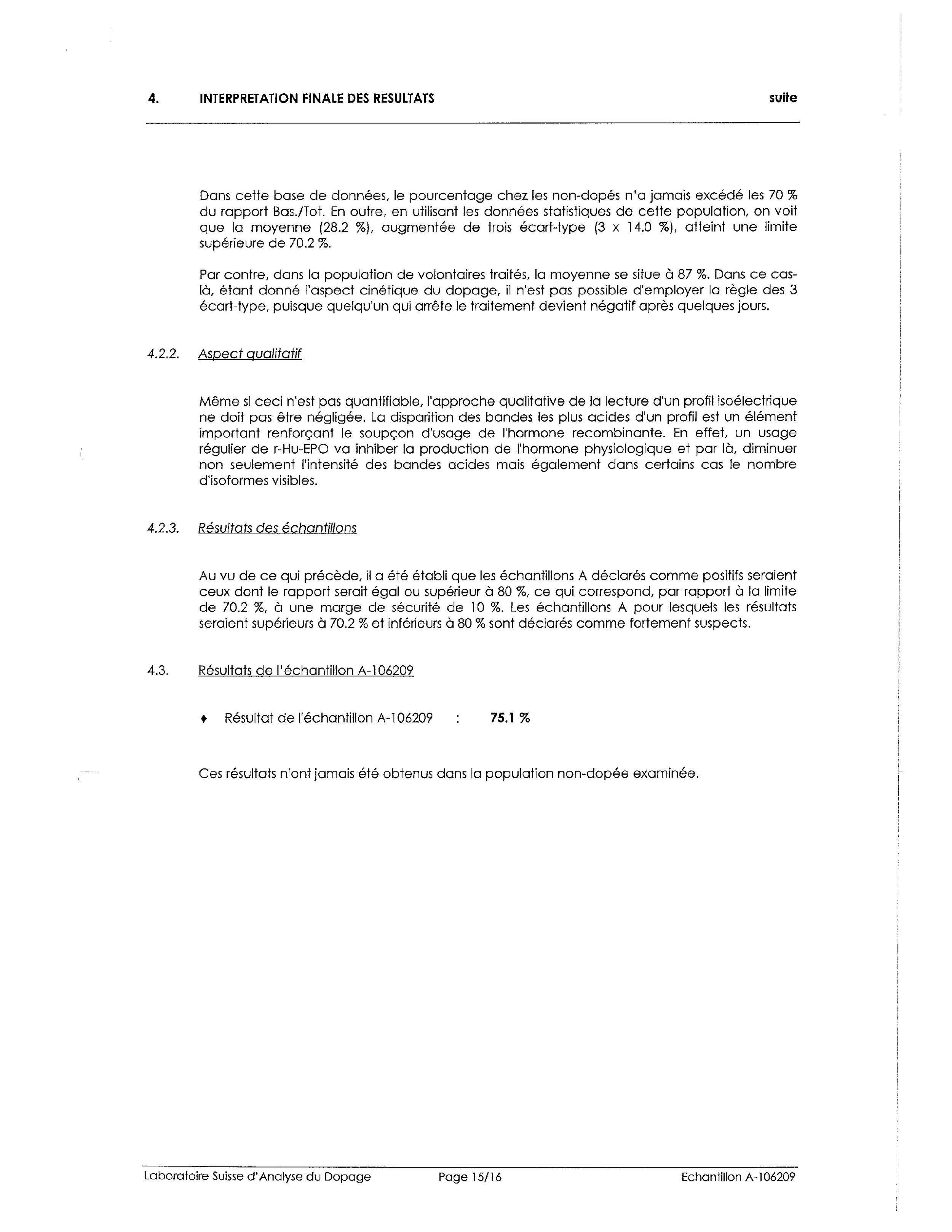
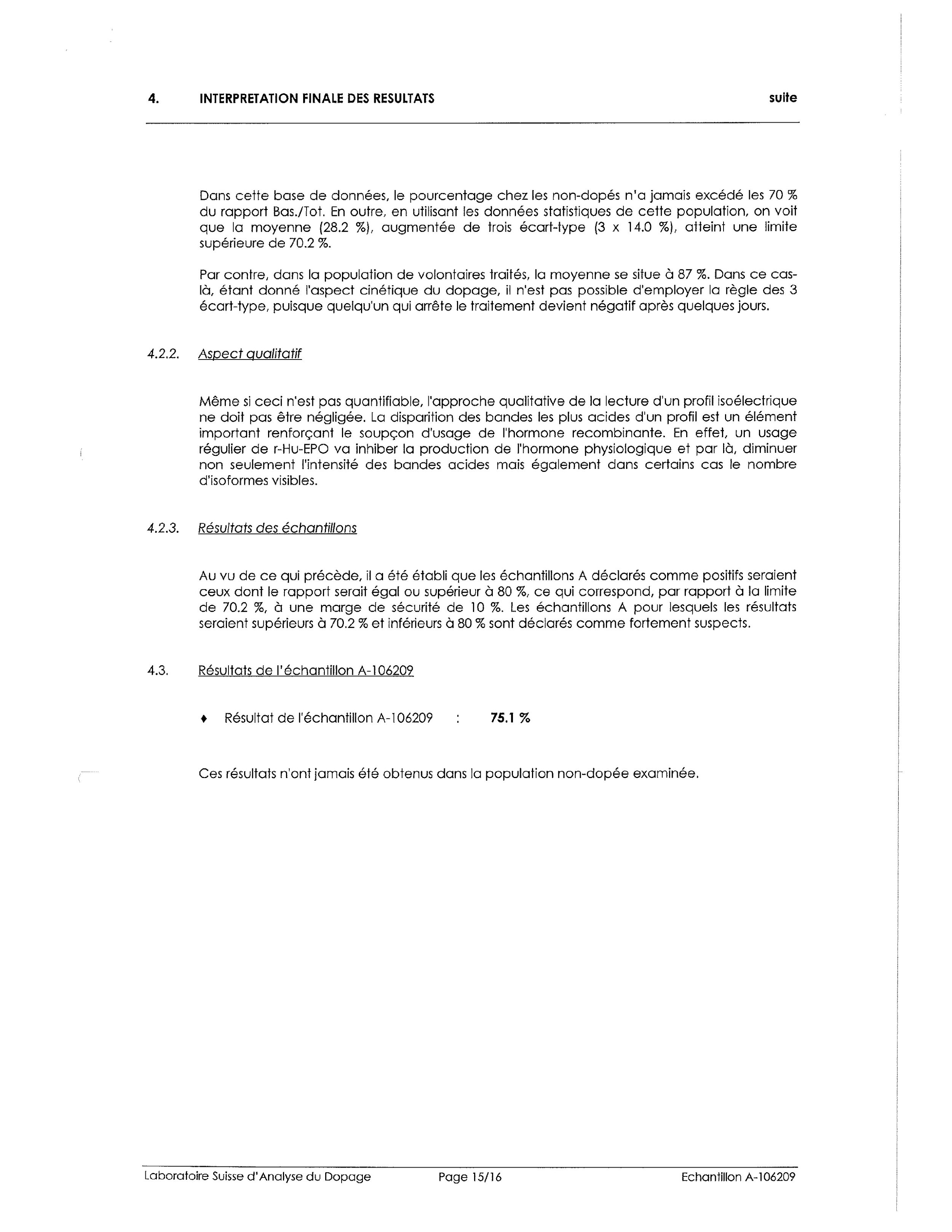
The Lausanne lab considered a sample positive if what are called “basic bands” registered above 80 percent. It considered it “highly suspicious” if it fell above 70.2 and below 80.

Armstrong’s June 19 sample was numbered 106209.

The secondary report was done on Aug. 10, 2001.

The percentage: 75.1.

The July 6 test results from the June 19 sample, with the French notation for "strong suspicion" of EPO usage, triggering further testing

The results page for the June 19 sample, established Aug. 10, 2001, showing a 75.1 percentage: "highly suspicious"

Armstrong’s June 26 sample was numbered 106106.

The latter report was done on Aug. 7.

The percentage: 70.0.

Even though it fell just outside the category of “highly suspicious,” it was nonetheless categorized that way.

To McQuaid, the conclusion was thus, as he declares on page 3 of the UCI letter: “I reiterate therefore that not one of Armstrong’s samples could in any way have been considered to be positive results.”

The USADA response asserts, in part, “It is now apparent that the UCI has long had in its possession multiple samples from Lance Armstrong which contained synthetic EPO and which raised strong concerns regarding the legitimacy of all of his competitive results since at least 1999. It is shocking and disheartening that the UCI would accept cash payments from Armstrong after the UCI had test results in its possession demonstrating that Armstrong’s samples contained synthetic EPO.”

The USADA letter asks why, among other issues, the UCI did not pursue a case against Armstrong based on those samples and samples from other races in combination with other so-called “non-analytical” evidence, such as witness statements. To not do so, the USADA letter asserts, “appears to have been grossly negligent or worse.”

Armstrong and Bruyneel were told about the suspicious tests during the 2001 Tour de France; Armstrong categorically denied doping, according to the UCI letter. He also questioned the reliability of the EPO test, which had been put into practice just four months before, on April 9, 2001.

During the 2001 Tour de France, Armstrong was tested 10 times, and five times for EPO at the request of the UCI, according to the UCI letter.

The French lab, outside Paris, reported all the results as negative. The highest percentage: 72. This result was not even reported as suspicious, the UCI letter says, noting that the Lausanne and French labs did not use the same criteria.


DeFrantz tries anew for IOC board

This election year, at its history-making session in September in Buenos Aires, the International Olympic Committee will elect a new president. It will pick the site of the 2020 Summer Games. It will also decide what sport, if any, goes on to the 2020 program -- a decision that may or may not involve wrestling. Or, perhaps, squash, karate, baseball and softball, or others. Beyond all that, the IOC will also, as it always does at its sessions, elect members to its policy-making executive board. Anita DeFrantz of Los Angeles is in the running.

Within the past few days, DeFrantz sent a note to her IOC colleagues announcing her intent to stand for election. It says, in part, "I hope that you will be willing and able to vote for me when the time comes."

DeFrantz had similarly announced an intent to run for an EB seat at last year's session in London. But shortly before the balloting she withdrew her candidacy. She said Wednesday in an interview, "I didn't think I had done the groundwork to have a winning outcome."

Anita DeFrantz, IOC member since 1986

This time, she said, "The stars are shining more brightly. It feels better. People know I have been serious about all my work. The work of women in sport has come to a very important point -- the point where we move forward."

As DeFrantz points out in the note to the other 100 IOC members, only nine others have now served longer than she has. She is only 60. Even so, she has been a member since 1986.

She is due to remain a member until 2033.

Her institutional memory -- both about the IOC and the U.S. Olympic Committee -- can be formidable.

Her dedication and commitment to the movement can hardly be unquestioned.

She is a True Believer, no apologies, and has been ever since the 1976 Montreal Games, when as a rower -- she would win a bronze medal -- she stayed in the Olympic Village, and saw with her own eyes how sport could be a force for changing lives by promoting the Olympic ideals. A dedication to those values has since driven her through service to the 1984 Los Angeles Summer Games, the LA 84 Foundation, the USOC, the international rowing federation (which goes by the acronym FISA) and the IOC.

"It really is important," she said, referring to the Olympic movement. "It is amazing that it exists in this world It is a great privilege to be a keeper of that trust. I believe it is a trust for the world."

For emphasis, she said, referring to life in the Village at the 1976 Games, "That was where my life changed.'

To look around that Village and know that there weren't enough medals to go around for everyone there -- and, still, there was everyone, not just together but all together, from wherever. "It's a powerful thing," she said, "to live in an Olympic Village."

DeFrantz has for years played a key role in urging the IOC to move toward equality on issues involving women's rights, both on the field of play and -- increasingly -- in the executive suite. Since 1995, she has chaired the IOC's Women and Sport commission; last year, she helped lead an IOC convention on the topic in Los Angeles.

During the years that Juan Antonio Samaranch was president, DeFrantz served on the IOC executive board, from 1992 through 2001, as a vice president from 1997 through 2001. She was the IOC's first female vice president.

In 2001, at the IOC session in Moscow, she ran for the IOC presidency itself. She received nine of 107 votes -- coming in last in the field. Of course, Jacques Rogge won. His term ends in September in Buenos Aires.

In 2007, at the session in Guatemala City, she ran for the executive board. She received six of 92 votes. Again, last.

In Guatemala, she said, "I am stunned. I hope this is not something to suggest women can never be elected to the executive board again. I will remain stunned for a while."

Three women currently serve on the 15-member board: Nawal El Moutawakel of Morocco, Gunilla Lindberg of Sweden and Claudia Bokel of Germany.

It remains uncertain how many candidates ultimately will be drawn to run in September for the IOC board.

It will of course prove tempting for some to view DeFrantz's candidacy as a test of where the USOC stands in the aftermath of the resolution last year of the longstanding revenue dispute -- over certain broadcast and marketing shares -- that had strained relations between the USOC and IOC.

It's more apt, however, to view her candidacy as what it really is -- a measure of DeFrantz's standing and political skill after years all these many years within the IOC.

When Samaranch was president, she could command dozens of votes. But his time is years ago.

The Rogge years are almost over, too -- all 12, nearly gone without DeFrantz spending even one on the IOC executive board.

And, now?

"I have a great deal to offer," she said. "I wish to take responsibility at the executive level of this organization. I wish to share that."


USOC's "stewardship": how you do it

It's a fact that the U.S. Olympic team won the overall medals count at both the 2012 London Games, with 104, and 2010 Vancouver Games, with 37. There is no federal sports ministry in the United States. Unlike virtually every other country in the world, the U.S. Olympic team is on its own. Congress set it up that way, in 1978. It said the USOC would have to raise all its own money. Then the USOC figures how to best dole it out.

A USOC report made public Tuesday underscores the keys to the Vancouver and London success: revenues and program spending are up, direct support to athletes increasingly significant and administrative expenses accounted for a mere eight percent of the budget.

The document, entitled "Stewardship Report," compiles a series of facts and figures available in other USOC materials -- say, for instance, multiple years of USOC tax filings -- and neatly wraps them into a colorful 24-page brochure.

U.S. diver David Boudia celebrates his gold-medal platform win in London // photo Getty Images

As USOC spokesman Patrick Sandusky said, "It's a way for us to continue to tell our story."

There's humility in calling it a "Stewardship Report," of course. That theme is consistent with the leadership of chief executive Scott Blackmun and board chairman Larry Probst, who have stressed the so-called Olympic values and organizational goals over any cult of personality.

In its graphs and bar charts, all markedly filled with upward trends, the report also highlights the stability and international outreach efforts that Blackmun and Probst have brought to the USOC, including the resolution last year of a longstanding revenue dispute with the International Olympic Committee over certain television and marketing rights.

That has opened the door to a potential 2024 Summer or 2026 Winter Games bid from the United States, most likely 2024.

It must be noted that the USOC issued this report for its own reasons: it's essentially a one-stop document.

And though the USOC certainly did not intend to raise this question, it's only reasonable: one might wonder why, when there has been so much focus on the USOC from so many quarters over so many years, a considerable amount of that focus critical, some of that criticism on the mark but some of it fantastically misguided, other national Olympic committees aren't, in the interest of transparency, producing the same or a similar report?

Why nothing like it from, say, Germany? France? Britain? Better yet, Russia? Or China?

Indeed, why isn't it best-practice that every Olympic committee, or at least every national Olympic committee of consequence of the more than 200 worldwide, not only be obliged to produce such a report but also -- just like the USOC -- make it public?

In Olympic jargon, a four-year cycle is called a quadrennium, or quad. Over the 2009-12 quad, USOC revenues totaled $733 million, against expenditures of $675 million.

Administrative costs: $53 million, or eight percent.

Nearly $568 million, or 84 percent, went to U.S. athletes and national governing bodies through direct support and programming, according to the report.

Of that roughly $568 million, $218 million, or about 38 percent, was direct support -- meaning cash grants or benefits such as health insurance, medical services or tuition.

Another $274 million, about 48 percent, went for what the USOC calls "sport programming" -- high-performance support programs as well as funding for its Paralympic efforts and three training centers. Those centers are located in Colorado Springs, Colo.; Chula Vista, Calif.; and Lake Placid, N.Y.

The balance, $76 million, roughly 13 percent, was spent on programs such as international relations, communications and other initiatives.

The report notes that direct athlete funding nearly doubled over the 2009-12 quad, to $71.3 million, from the 2001-04 quad, when it was $38.2 million. Support to national governing bodies, which had been $144.7 million in the 2001-04 quad, dipped to $134.7 million in 05-08 but climbed back to $146.3 million in 09-12.

Obviously, this funding produced results in Vancouver and London. It also has drawn critics. Here's why:

The USOC now divides sports into three categories -- foundation, medal-opportunity and development.

"Foundation" sports are those such as track and field, swimming and skiing. These sports are defined as those with a tradition of winning multiple medals; they have a strong sports infrastructure and a development pipeline.

If you are an athlete in one of these sports, as the report notes, "direct support is strategically allocated to give the number of American athletes the opportunity to reach the podium."

In London, the swim team won 31 medals, the track team 29. In Vancouver, the ski team won 21 of the 37.

"Medal-opportunity" sports are those such as diving, archery and boxing. In London, all three came up big -- diving for sure, including David Boudia's platform gold, and even boxing, in which U.S. women won medals. In Sochi next February, biathlon has been targeted as a medal opportunity even though the U.S. has never won an Olympic medal in the sport; Tim Burke of Paul Smiths, N.Y., won a silver in the 20-kilometer individual event at the 2013 world championships.

Then there are the "development" sports, which for now include the likes of canoe/kayak, weightlifting and table tennis. As the report notes, sports "with strong track records and international success receive a higher proportion of the available funds (75 percent in the 2009-2012 quadrennium). The more that U.S. athletes earn medals, the more resources the USOC is able to generate."

Which of course begs the question: if you don't have the money to win in ping-pong, how are you supposed to win in ping-pong to beat the Chinese, so you can get more money from the USOC to win in ping-pong?

Switching gears, the report notes the obvious revenue point -- that broadcast rights make up the largest chunk, 37 percent, $272 million, of the $733 million.

Domestic sponsors and licensed merchandise come next, at $183 million, 25 percent.

Worldwide sponsors rank third, at $124 million, 17 percent, with everything else in single-digit percentages.

What's also abundantly clear is the largely untapped revenue stream that awaits the USOC, if it could ever figure out how -- major gifts account for a mere 4 percent, just $32 million.

A Sports Business Journal report Monday said the USOC plans to create a new foundation with the aim of raising $35 million in the coming years, Blackmun saying in the story he intends to spend half his time this year on the effort.

Building the foundation and identifying a potential 2024 bid city are his two top priorities, Blackmun also said in that story.


Fast times for Istanbul's 2020 bid

ISTANBUL -- No one ever said they weren't anything but smart and clever here. They knew coming in, because the working group report last spring from the International Olympic Committee said so, that transport issues are -- and will be -- problematic in a city growing so fast it's hard to keep up.

The rhythm of the four-day IOC evaluation commission package inevitably features afternoon site visits. On Day Two, the members checked out, among other locations, a waterfront cluster, which naturally enough includes the marina for Olympic sailing. The sun started sinking lower; time to get back. Uh-oh -- it was rush hour.

Ah, but these Turks had thought of that. Truth be told, traffic was not so bad for a Monday workday. Even so, the IOC made its way back to its hotel base not on the roads but by fast boat, the sea breeze brisk and refreshing.

Istanbul made an "excellent impression," Sir Craig Reedie, the head of the evaluation commission said at a Wednesday news conference, quickly adding that in his world "excellent impression" was "exactly the same" as "hugely impressed," the phrase he used to describe Tokyo, or "greatly impressed," what he said about Madrid.

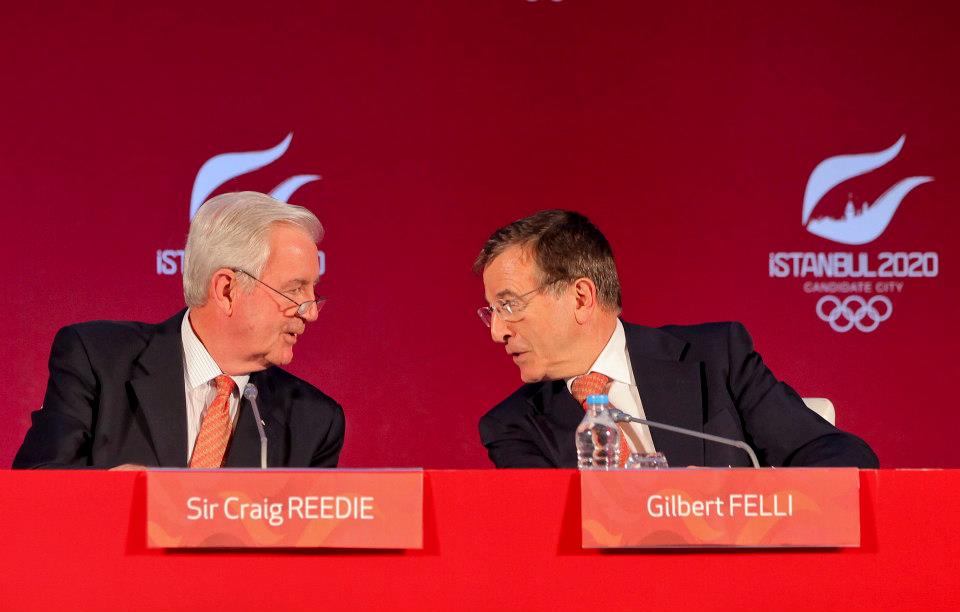
IOC evaluation commission chief Sir Craig Reedie and IOC Games executive director Gilbert Felli at the closing news conference in Istanbul // photo courtesy Istanbul 2020

The news conference Wednesday wrapped up the evaluation commission's tour of the three 2020 cities. It saw Madrid last week. It visited Tokyo March 4-7. It will now set to work on producing a report that will be released at some point before the IOC's all-members July 3-4 session on the 2020 candidates in Lausanne, Switzerland.

The IOC will pick the 2020 winner Sept. 7 by secret ballot at a vote in Buenos Aires.

The evaluation report will by design focus on the so-called "technical" process of the campaign -- how many roads, subway lines, sports venues, hotel rooms and so on are already on the ground or would need to be built for each of the cities to get ready by 2020.

Already, however, the outlines of the three bids can be fairly characterized:

The Tokyo bid, it can be said, is spearheaded by city government. Madrid might be portrayed as a sports project. And Istanbul is for sure a national effort.

Istanbul's bid would spend $19.2 billion on infrastructure costs. That's 10 times more than Madrid, at $1.9 billion. Tokyo's capital costs come in at $4.9 billion.

This is Istanbul's fifth bid. It is Madrid's third in a row, Tokyo's second straight.

The commission will be keen to write a report that offers a clear differentiation. That way the members can be offered a distinct choice. As it turns out, this 2020 race, even if it can not be said at this preliminary stage to have a front-runner, will likely present many if not most IOC members with a threshold decision.

It's -- what to do about Istanbul?

Madrid and Tokyo absolutely have their cases to make.

Madrid, with 28 of 35 venues already on the ground, wants to re-define the idea of "legacy," to re-purpose the Olympic movement so that it becomes something well beyond just buildings and metro lines, instead a source of inspiration for "healthy living and healthy habits," as Spanish Olympic Committee and Madrid 2020 president Alejandro Blanco put it, and particularly for young people.

That $4.9 billion for Tokyo? It literally is just sitting there, banked, waiting, in today's uncertain economic climate. You want safety and security? Along with Japanese high-tech? The economic clout of the world's third-largest economy? Tokyo's amazing metro and rail system? Plus, like Madrid at night, Tokyo is -- fun.

Not to say Istanbul isn't. They even put on a fireworks show here Tuesday night for the IOC.

Here is the difference:

Istanbul fits the mold of recent IOC winners. The Turks -- again, they notice these things -- picked up on what worked, and have more or less designed their bid to fit that mold.

The issue is whether this strategy will still prevail, or whether -- and especially in light of developments in Sochi and Rio de Janeiro, sites of the 2014 Winter and 2016 Summer Games -- it has played out.

In the 1982 movie "Fast Times at Ridgemont High," a shirtless Sean Penn, playing the surfer dude Jeff Spicoli, walks into a hamburger joint with two of his buddies and says, ever-so-memorably, "Who's got the beaucoup dollars today?" Actually, Spicoli pronounces "dollars" as "dolares," so much the better.

Does the IOC want to keep spending the beaucoup dolares? Or not?

If it does, your winner Sept. 7 will be Istanbul, where $19.2 billion buys you powerful "legacy" in the form of another huge construction project on the order of Beijing 2008, London 2012, Sochi 2014 and Rio 2016 -- all, obviously, winners.

The corollary question, perhaps, is whether it also buys you headaches like in Sochi (construction costs already north of $50 billion) and Rio (significant delays evocative of Athens 2004, officials announcing Tuesday they are closing the stadium due to host track and field at the 2016 Games because of structural problems with the roof, and this at a facility built for the Pan Am Games in 2007).

Reedie -- and it should be emphasized that he was speaking generally, not referring to any bid specifically -- addressed the topic at the closing news conference last week in Madrid. He said, "The IOC are very well aware that the Games simply can not get more expensive, more expensive and more expensive."

Next:

There's no getting around the fact that traffic in Istanbul is congested. They are making a huge -- repeat, huge -- effort to do something about that, including construction of a $4.5 billion metro tunnel under the Bosphorus (that amount is included in the $19.2 billion).

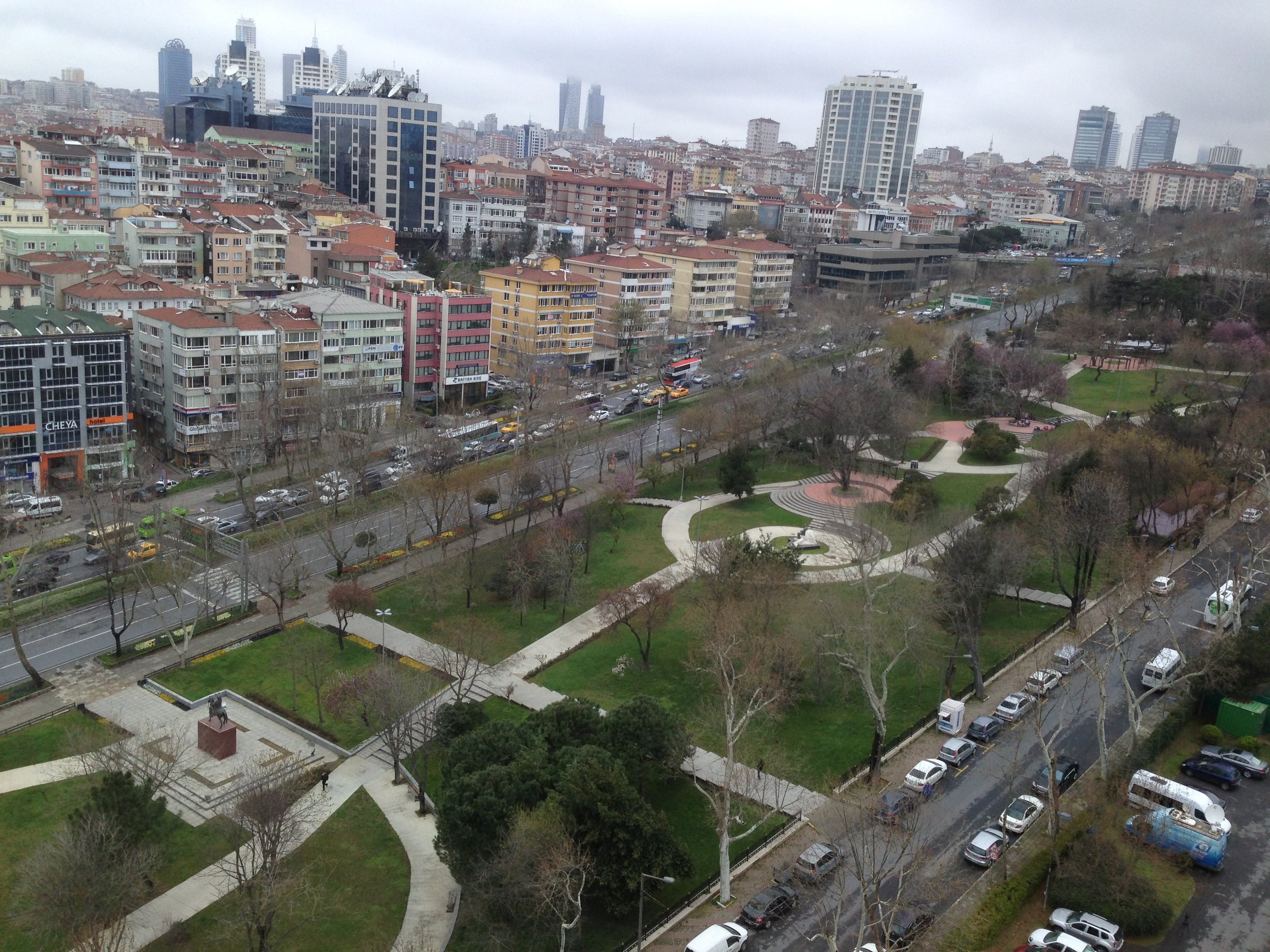
Normal traffic on a rainy Wednesday in Istanbul -- going nowhere fast in one lane, the other wide open

Deep down inside the construction project that is the cross-Bosphorus metro tunnel

They might experiment with flex-time work schedules, special congestion pricing for inner-city road usage, PR campaigns for mass-transit use -- anything and everything to get people out of their cars and onto the trains, in hopes of reducing car use by 30 percent in 2020. Will it work?

They made a point of saying, repeatedly, that such projects are all part of Istanbul's master plan -- that they're going to get done whether the Olympics are coming or not. Yet they're right there in the bid book budgets. So which is it? Both?

The four-cluster venue plan in Istanbul virtually guarantees, meantime, that transport is likely to be the No. 1 technical issue in the evaluation report. Last spring's report noted travel times would be "substantial" and average estimated speeds seem "too optimistic for current traffic conditions."

Speaking of Turkish optimism, a senior transport minister, Muzaffer Hacimustafaoğlu, at a news conference Tuesday, declared that in 2020, "We will aim to make the transport experience immune from unforeseen events." Asked a few moments later to clarify, he said, "I don't think there will be any big surprises."

Meanwhile, a factor that has gotten virtually no scrutiny whatsoever -- yet -- is that the current IOC Games executive director, Gilbert Felli, will be stepping down soon. He has more than 20 years experience. If the IOC votes for Istanbul, these Games presumably would be in the hands of his successor, Christophe Dubi. On Dubi's watch, does the IOC want to take on another massive project?

These are all legitimate questions.

As are other factors, some geopolitical, that also may weigh on the vote:

-- The IOC has in recent years not just opted for big projects but gone to cities and countries keen to make plain their station in the world -- China, Russia and South Korea, in particular. Turkey would fit that pattern precisely, bid chairman Hasan Arat noting in an interview Wednesday with a small group of international journalists the impact the 1988 Seoul Games had on Korea and in turning Barcelona into a world-class destination after 1992, declaring, "It's a great opportunity."

-- Istanbul is a hot tourist destination. Feza Solaklar, the bid's head of accommodation, said Tuesday, that it is now the third-most popular destination in Europe, after London and Paris.

-- One of Istanbul's major selling points is that it would offer the IOC the chance to take the Games to a Muslim nation for the first time. In the Eurocentric IOC, how does that play -- positively, not or makes no difference?

-- Unsaid in that selling point -- but well-understood in IOC circles -- is that a vote for Istanbul would probably take Doha, the Qatari capital, out of the bid game for 20 years. There are elements within the IOC who would view that with favor and those who assuredly would not.

-- The conflict in Syria, on Turkey's eastern border -- they sought here this week to downplay that, understandably enough. How, if at all, will that conflict, figure into the vote?

In Istanbul, they know they have a real chance at 2020. Indeed, they have a confidence that borders -- already -- on something close to bravado.

The president of the country, Abdullah Gül; bid leader Arat; the sports minister, Suat Kiliç -- each of them used the word "deserve" this week. As in, Istanbul deserves the Olympics.

Asked to explain the word choice, Kiliç said at a Monday news conference, his comments translated to English, "As a Turkish delegation, we did not say anything negative. We did not make negative comments about the other candidates. Olympic ethics and morals are involved. We are competitors. That doesn't mean we should treat them bad. We don't belittle them. We don't underestimate them. We don't treat them bad. We don't make negative comments. But I am a Turk. I am minister of youth and sport.

"… I share what I believe is true regarding Istanbul. I have used the appropriate discourse for that. Istanbul is a candidate city. I have to use a discourse which fits this identity. We are also a modest city. We are open to all diversities.

"… Istanbul will show itself to you. We are trying to tell you to what extent we are ready to host the Games, to what extent we want and are willing to host the Games. The words we are using reflect our excitement [and] the commitment of the government … please look at my words from this point of view."

For a group that is indeed very smart and very clever, "deserve" -- and such a round-about way to explain it -- seems off-message, indeed. Typically, humility plays better in bidding campaigns within the International Olympic Committee.

After all, it's a long, long way until September.