Istanbul 2020's triple-play up-day

ISTANBUL -- Olympic bids are generally an exercise in crisis management. Rarely do you get a triple-play up-day like Istanbul's 2020 Summer Games campaign engineered Monday.

For starters, the International Olympic Committee's evaluation commission made public poll results that showed 83 percent of local residents support the Games, 76 percent nationwide.

The 83 percent is not only the highest of the three cities in the 2020 campaign -- Madrid and Tokyo are also in the race -- but also marks a 10 percent jump from a similar IOC poll last year.

Next: Istanbul unveiled its new bid slogan, "Bridge Together," the country's sports minister, Suat Kiliç, asserting that it highlighted the city's role as a "bridge between East and West, Europe and Asia, between civilizations, faiths and religions."

Finally: a leading Turkish businessman, Ali Koç, a board member of Turkey's Koç Holding conglomerate, said the nation's business leaders were ready to "help one of the most important projects in Turkey's history," adding that the country is "truly experiencing a "dramatic transformation."

So what is the import of all this?

Turkey's sports minister, Suat Kiliç, reveals the Istanbul 2020 bid slogan // photo courtesy Istanbul 2020

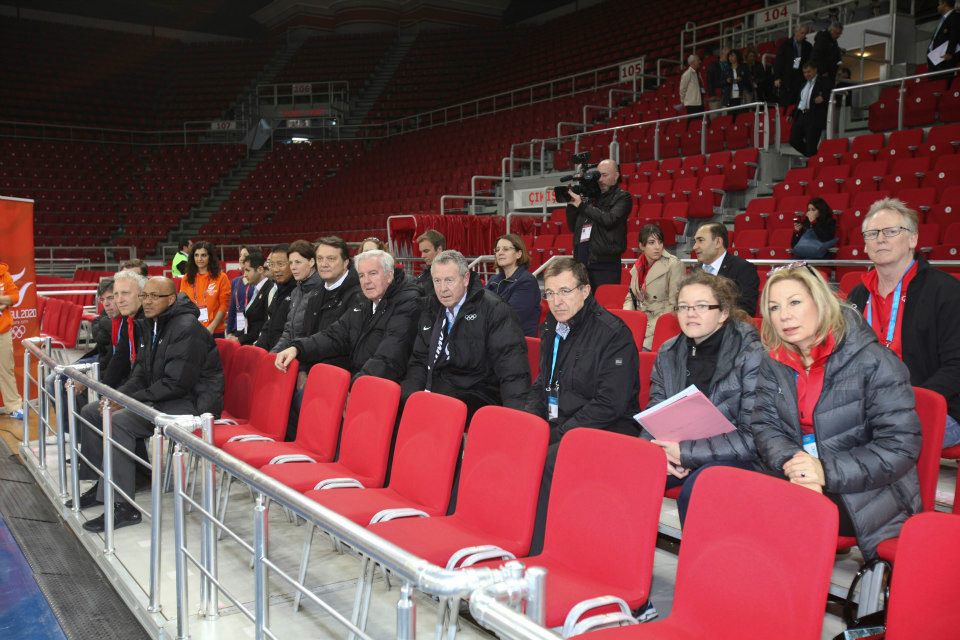
IOC evaluation commission and Istanbul 2020 officials checking out the local sports sites // photo courtesy Istanbul 2020

No one knows. This is all, if you will, positioning. If this were a U.S. presidential election, it would be primary season. The real deal is yet to come.

The IOC will select the 2020 winner Sept. 7 in balloting in Buenos Aires.

Istanbul is bidding for a fifth time, after tries for the 2000, 2004, 2008 and 2012 Games. This is Madrid's third straight bid, and Tokyo's second in a row.

Tokyo's poll showed 70 percent local support, up 23 points from 47 percent last year, the evaluation commission said when it was there earlier this month. Madrid got 76 percent local support in its IOC poll, a figure officials there last week said was evidence of the power of the Games to move people emotionally amid the economic hard times that have battered Spain.

Margin of error, survey methodology and other data are due to be provided when the evaluation commission report is made public in advance of the IOC's all-members meeting on the 2020 race at its Lausanne, Switzerland, base.

Also hard to know is what difference, if any, the slogans make. Tokyo's is "Discover Tomorrow." Madrid's: "Illuminate the Future."

Amid the drumbeat of public-relations good vibe for Istanbul, there was this intriguing note from Tokyo:

Carl Lewis, winner of 10 Olympic medals, nine gold, said in appearance there that he hoped Tokyo would win for 2020. Both Associated Press and Reuters deemed the story newsworthy; moreover, AP distributed a 690-word take, which in today's web-oriented environment made for a remarkably long story.

Clearly, Carl Lewis generates press. Of course, no one knows whether there's a shred of evidence that he moves votes in the IOC one way or the other.


Istanbul 2020: James Bond's new hangout

2013-03-24-11.44.19.jpg

ISTANBUL -- There once was a time, and candidly it was not all that long ago, when if you said, "Turkey," referring to the country, not Thanksgiving, the reference that not infrequently came to the minds of many might well have been the Oscar-winning movie "Midnight Express," depicting American Billy Hayes' time in an infamous Turkish prison, caught trying to smuggle two kilos of hashish at the Istanbul airport. In some ways, Istanbul now is as it was when Hayes was here. As it ever may be. When the sun rises over the hills, it reveals the beauty of mosques and minarets reaching toward the sky. Several times a day, the cry to prayer still beckons the faithful.

Yet this city -- now teeming with nearly 15 million people -- is, in many ways, unrecognizable from the time Billy Hayes met his fate, moving to embrace a new era.

Skyscrapers now dot the skyline, too. Billboards are everywhere, and some of them show pretty girls in nothing but fetching green camisoles. A fancy upscale mall on one of the city's main streets features not only shops like those you could find in London but Wagamama, the noodle chain, too.

This is the message Istanbul is carrying to the International Olympic Committee as it presses its bid for the 2020 Summer Games: it, like Turkey, has arrived on the world stage, and the Games would not only cement that arrival but further propel Istanbul's development as one of the world's great centers in the 21st century.

As Turkey's president, Abdullah Gül -- who bears a resemblance to the American actor, George Clooney -- said in an interview with a small group of international journalists Sunday, the meeting taking place at a former hunting lodge about a half-hour from Istanbul's historic waterfront, "We are very ambitious in this bid."

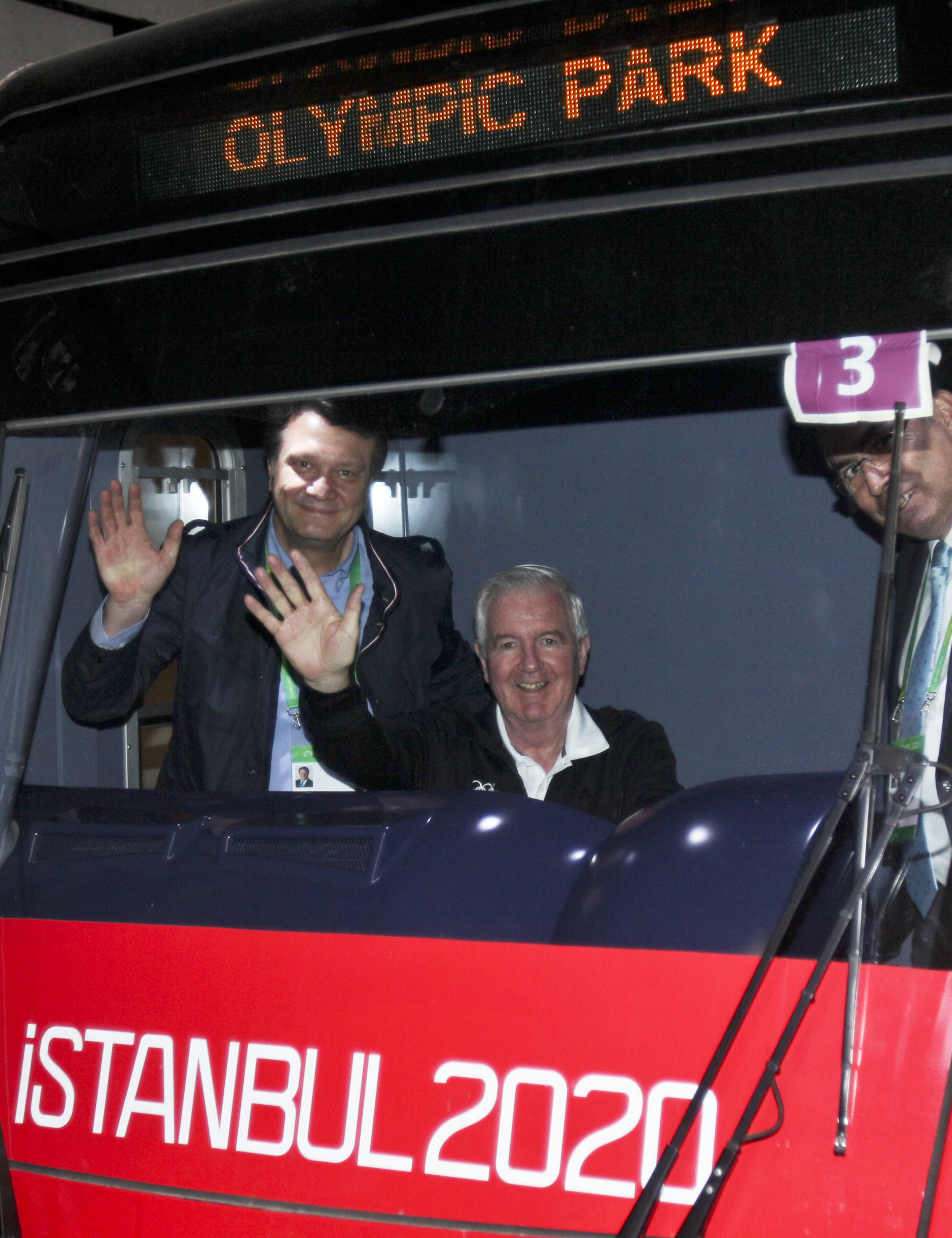
Istanbul 2020 bid leader Hasan Arat, left, and Sir Craig Reedie, head of the IOC evaluation commission, aboard a new Istanbul metro subway car en route to the would-be Olympic Park // photo courtesy Istanbul 2020

Madrid and Tokyo are also in the 2020 race. The IOC is due to pick the winner Sept. 7 in Buenos Aires.

An IOC evaluation team on Sunday went through the first of a four-day tour of Istanbul's plan. It spent last week in Madrid. It saw Tokyo March 4-7.

Madrid and Tokyo are both well-developed world capitals. Each already has most of the infrastructure needed to stage an Olympics. Tokyo would spend $4.9 billion to ready for 2020, and has it in the bank; Madrid's infrastructure costs -- this is its third straight bid -- are estimated at $1.9 billion, which in this kind of competition is remarkably low.

For those two cities, the challenge is to present a compelling narrative about why the IOC ought to pick one or the other.

In Istanbul, it's a completely different story.

Here the sell is full of strands and would seem, at first blush, crazy easy. It's a "bridge to excellence," or whatever their new slogan is going to be -- they're going to unveil it sometime this week.

This is Istanbul's fifth bid. It tried for the 2000, 2004, 2008 and 2012 Games. The 2012 bid was cut before the final round; the 2008 campaign, which took place in 2001, made it to the finals but then was eliminated in the second round, with only nine votes, Beijing winning handily with 56.

"Turkey bid four times as an emerging nation. This time," bid chairman Hasan Arat said at a Sunday night news conference, "Turkey is bidding as an emerged nation."

These would be the first Games in a Muslim country.

These would be Games linking -- literally -- Europe and Asia. Imagine, Arat said, seeing rowing in Asia in the morning and golf in Europe in the afternoon.

These would be Games befitting the IOC's expansionist trend in recent elections in recognizing the strength of assertive regional and global players (see, for instance, China 2008, Russia 2014, Brazil 2016, South Korea 2018).

In Turkey, the challenge in this 2020 election is not why but how.

Because rarely in life is anything worthwhile ever crazy easy.

And for as compelling a narrative as they might be able to present in Istanbul, the issue here is also super-straightforward:

It's not just the technical piece -- meaning, can they get it done, and on time, and on budget?

It's -- in this environment, can they get roughly 55 voters in the IOC to believe all that can happen?

The Istanbul 2020 plan proposes the spending of $19.2 billion in infrastructure.

That is 10 times Madrid's figure, and that is certain to be an issue in a world in which finance makes for front-page headlines day after day.

That infrastructure is, by design, spread out. It would link four sports-related clusters.

For better or worse, the Rio 2016 plan is also a four-cluster plan. As everyone who moves in Olympic circles knows, the Rio project is dogged by delays so significant that comparisons to the Athens 2004 Games are now matter-of-fact.

Istanbul is not Rio. The comparison is hardly perfect. Nor is it, maybe, fair. But IOC elections are not fair. What matters are perceptions. And this election is going to take place in September with Rio absolutely part of the dynamic.

And Sochi 2014, too. Costs there have risen to more than $50 billion.

Getting around and between the four Istanbul clusters is going to be one of the issues sure to draw close attention in the evaluation commission report, when it is released before the IOC's all-members meeting July 3-4 in Lausanne, Switzerland, on the 2020 race.

The IOC came here knowing the traffic was a bear. Usain Bolt runs 100 meters in nine-pus seconds. Along the waterfront Saturday night, it took more than five minutes to go the same distance in a car. The locals shrugged the same way they do when they talk in Los Angeles about the 405 -- it's life.

The Istanbul team, for its part, came prepared to show the aggressive tack they're taking in building a metro system, aiming to change the way people get around town. The commission even took a ride Sunday on a brand-new line out to what is already being called Olympic Park, a development northwest of the waterfront.

By 2018, Arat said, the metro system will feature some 264 kilometers -- 164 miles -- of rail lines.

The president of Turkey, Abdullah Gül, meets the press

On the road, it took just under 45 minutes to get back from the would-be Olympic Park to the waterfront. This was on a Sunday night. It's life.

There are two schools of thought about such a drive.

One is that this is precisely why you have an event like the Olympics. It super-charges development; for public policy wonks, you get done in seven years -- because of the fixed deadline of an opening ceremony -- what might otherwise take 20 to 40.

The other school holds that this is exactly why you don't plunk an event like the Olympics in a place like Istanbul. If it already takes 45 minutes and you are about to load in thousands more people, most of whom don't speak the language and it's the middle of summer -- is that a recipe for racing in the streets?

Proponents of the second school, moreover, would point to, say, Beijing. It's four and a half years after the 2008 Games, they would note, and given all the infrastructure improvements there, would the pollution levels now in Beijing suggest that people are driving less, or more?

To say here in Istanbul, however, that they prefer the first of those arguments would be a gentle understatement. They are brimming with confidence.

It's almost as if they feel as their time has come. Indeed, Gül went so far Sunday as to list the several reasons why, in his words, "we deserve" the 2020 Games -- political stability, economic growth, meaningful physical legacy, an event that at the center of the western world that could cross cultural, religious and racial boundaries.

"Deserve" in Olympic bidding is a concept fraught with peril. Even so, in Turkey, right here, right now, they might ask -- remember James Bond? The guy from the London 2012 opening ceremony? He didn't lack for confidence. That guy filmed his last movie here, "Skyfall." And it was a blockbuster.

What else is there to say?

Arat, welcoming a handful of international reporters to town Saturday evening, said, "We believe very much in our concept and in our city. We are in it to win it."


Madrid's intriguing test: is IOC ready to listen?

887158_10151362825519220_1473632939_o.jpg

MADRID -- This is of course a thoroughly developed city, rich in history and culture. Indeed, it is the only major European capital never to have played host to the Games. By combination of circumstance, economic and otherwise, Madrid's bid for the 2020 Summer Olympics has put itself more or less at the metaphorical point of the spear.

It represents nothing short of a test case, perhaps even a clash of philosophies, because it seeks to re-frame in a significant way for the Summer Games the idea of what Olympic "legacy" should be about in these early years of the 21st century.

"We were greatly impressed by what we saw," the chairman of the International Olympic Committee's evaluation commission, Britain's Sir Craig Reedie, told a packed news conference here Thursday evening after a four-day site visit.

Tokyo and Istanbul are the other two candidates in the 2020 race. The IOC will pick the winner Sept. 7 in a vote in Buenos Aires.

The commission heads next week to Istanbul. It visited Tokyo at the beginning of the month, where Reedie proclaimed the panel was "hugely impressed."

Sir Craig Reedie, left, chairman of the IOC evaluation commission, and Gilbert Felli, the IOC's Games executive director, at the closing news conference // photo courtesy Madrid 2020

"If you want to translate 'hugely' into 'greatly,' or the other way around," he said Thursday, immediately launching betting pools on what adverb will prove suitable in Istanbul, because the news conference Thursday capped a tour of one of the most intriguing propositions presented in recent years for IOC consideration.

Of course, the question is whether the IOC is anywhere ready to listen.

To explain:

Spain is in the midst of recession, its second in three years. The unemployment rate stands at 26 percent.

This, though, marks Madrid's third straight bid for the Summer Olympics. Say what?

The reality is that, over the past several years, even though the 2012 and 2016 bids came up short, nearly everything they would need to put on an Olympics is already built -- 28 of 35 venues. The huge T4 terminal at the airport opened just seven years ago. Subway lines have been extended. All of that.

Thus Madrid's infrastructure budget for 2020 is $1.9 billion, which by Olympic standards is remarkably low.

For comparison, Tokyo's capital costs: $4.9 billion. Istanbul's: $19.2 billion, or 10 times the Madrid figure.

In recent bid cycles, the IOC has bought into the notion that "legacy" means big construction projects that leave tangible reminders afterward that the Olympics were there: Athens 2004, Beijing 2008, London 2012, Sochi 2014, Rio 2016.

The issue is that these projects also tend to come with huge cost over-runs (Sochi, where the bill is now known to be north of $50 billion). They also tend to run to delay (Rio, where the IOC is pushing hard to keep things on track). And then those reminders not atypically sit empty afterward (Athens, Beijing). Or just get torn down (the bobsled track in Torino, after being built for the 2006 Games at a cost of $100 million).

Around the world, many cities in developed nations -- even if they don't have 28 of 35 -- already have some combination of the things that Madrid has, ready to go, like, right now. The Madrid team showed the local flavor this week to the evaluation commission.

The commission saw one of the world's best tennis facilities, the Caja Mágica.

Golf? The Club de Campo course, around since 1932, with stunning views of the city.

Equestrian? La Zarzuela, the hippodrome in existence since 1936 and still looking fresh.

Traffic? In rush hour Wednesday evening, it was all of 15 minutes, door to door, from the Caja Mágica back to the IOC hotel, the Eurostars Madrid Tower.

You'd think, particularly since this is a third-time bid and the IOC rewards persistence (see, Pyeongchang, winners for 2018 after coming up short for 2014 and 2010), this might be an easy sell.

You'd think some of the IOC members might even have noticed that their president, Jacques Rogge, was quoted as saying Sunday in El Mundo, a Spanish newspaper, that the economic crisis "won't affect Madrid 2020 because 80 percent of the facilities are already built."

Here, they were almost giddy about that quote. Not so fast. The president doesn't vote in the bid city elections and he was for sure not publicly favoring Madrid nor sending out a signal; he was just saying, in his way, facts are facts.

The only thing for sure about Madrid 2020 is that this is March and the election is September.

For Madrid's bid, the language barrier remains a challenge, perhaps formidable. They mostly speak Spanish. The IOC mostly moves in English.

The layers of bureaucracy here can sometimes prove a struggle.

The Operation Puerto doping matter hardly is going to disappear before Sept. 7. "It has been a problem for Spain. It is a problem for Spain," Alejandro Blanco, the president of both the Spanish Olympic Committee and Madrid 2020, acknowledged Wednesday in an interview with a small group of international reporters.

The economic issue remains, candidly, significant. Who knows how good or bad circumstances are going to be on Sept. 7? Any prediction for conditions seven years from now is just a guess. Trying to convince 55 members of the IOC to have confidence you have money to do something -- even when you say you for sure have it -- is, well, a confidence game.

And re-purposing the idea of "legacy" as something other than buildings on the ground is going to take a profound articulation of what the Olympic movement is about in the year 2013, and where it is headed by 2020.

If, though, Madrid and Spain can do it, it might well open the door wide open to bids in the coming years from all over the world, including the United States, where Michelle Obama has been pushing her "let's move" campaign. Because then there would be undeniable proof that "legacy" doesn't just mean throwing up a new Olympic Park in your town.

Vancouver, it must be noted, won for 2010 with much this same argument. But that vote was already 10 years ago; it hasn't proven compelling since; and it was for the Winter Games.

The Summer Games -- and in Europe, the IOC's traditional base -- would send an entirely different signal to the world.

"The Games proposition in Madrid is very different from any other proposition for the Summer Games in recent history," Juan Antonio Samaranch Jr., Spain's member to the IOC executive board, said -- in English -- in a conversation Tuesday with a small group of reporters.

"Here in Spain, we are at the bottom, or near the bottom, of [the] economic crisis. With little further investment -- let me repeat the No. 1 point, $1.9 billion over a seven-year period -- we would be able to generate a significant economic growth.

"Economic growth -- you probably already know, it's not just about numbers, it's about sentiment. What this country needs very, very much is sentiment at this stage. The moral boost and the moral effect that might have, we believe, would be extraordinary. I am very confident that is the pill, one of the medicines, we need at this stage."

At Thursday's news conference, Blanco -- speaking in Spanish -- said, "All we really want to say to the IOC is, 'Trust us, because we are ready and our Games will be great Games.' "

On Wednesday, meeting with a small group of international reporters, he was far more expansive. He said, "The great legacy we are trying to obtain through these Games is not about improving our sports performances or our results or the organization of events. It's about sport transforming the life of people in this country."

A moment later, he asked rhetorically, "What is sport?" Again speaking in Spanish, his remarks translated to English, he answered, the philosophy underpinning the bid fully and clearly on display:

"Of course it is physical activity. As well, it is just that, it is health, it is education, it is culture, it is work, it is social affairs. In any country, sport should be mainstreamed right across six or seven ministries, at least.

"That is the whole point. Sport is so important in any country. Sport can't be straight-jacketed or pigeon-holed into one specific ministry. Sport runs right across the whole country.

"I think for all of us here, and I mean for all of us, the most important legacy we can leave from these Games is an education in healthy living and healthy habits -- that young people will then learn about respect and hard work. That is far more important than winning another 10 or 12 medals."

He paused, then added one more thought:

"Results in sport for any country go through ups and downs, certainly. You win some, you lose some. But if sport is to become part of life in a country's society, there's no ups and downs there at all. That must be a firm upward track, always."



Madrid: Games as hope to city, country that needs it

MADRID --- Despite the economic hammering this country has taken, an International Olympic Committee survey indicates 76 percent of local residents want the 2020 Summer Olympics and 81 percent throughout Spain, the Madrid 2020 bid team saying at a Tuesday evening news conference that such figures show the Games offer a measure of hope to a city and country that wants and needs it. The poll numbers stayed relatively even from from IOC survey results released last May, which showed 78 percent support for the Games in Madrid and the surrounding area. That polling remained consistent, even as the Spanish economy remains mired in recession, Spain's second in three years, with the nation's unemployment rate at one in four, is proof indeed of the power of the Olympic spirit, bid leaders asserted.

"During a crisis," said Alejandro Blanco, president of the Spanish Olympic Committee and Madrid 2020, as "everything is being questioned," when "you see a poll that says 81 percent of all citizens in Spain support this and 76 percent of Madrid residents support it, that's not to be laughed at."

The bid, he said, has three easy-to-understand big-picture non-sports goals:

One, to improve the image of Spain. Two, to attract foreign investment. Three, jobs. "Keeping that in mind," Blanco said, "looking at the support we are receiving -- it's major."

Madrid is competing against Tokyo and Istanbul in this 2020 race. The IOC will select the winner Sept. 7 at a vote in Buenos Aires.

Tokyo's poll showed 70 percent support, up 23 points from 47 percent last year, the evaluation commission said when it was there two weeks ago.

Current public support levels in Istanbul will be released next week when the IOC commission visits there. The IOC poll last year showed 73 percent support for the Games.

Margin of error, survey methodology and other data are due to be outlined when the evaluation commission report is made public in advance of the IOC's July all-members meeting on the 2020 race at its Lausanne, Switzerland, headquarters.

The release of the poll results came as Spain's IOC executive board member, Juan Antonio Samaranch Jr., walked the commission Tuesday through perhaps the key element in the Madrid bid, the financial details underpinning what they are calling here their "prudent" and "financially responsible" Games model.

Because this is Madrid's third straight bid, and because so much that would be needed to stage the Games has already been built, construction costs are -- by Olympic standards -- a relatively low $1.9 billion. Tokyo's estimated construction bill: $4.9 billion. Istanbul's: $19.2 billion, or a full 10 times Madrid's.

Over the course of those three bids, Samaranch said, Madrid has spent perhaps $100 million. Further, billions have been spent in infrastructure in and around the city. "Madrid's transformation has been considerable," Mayor Ana Botella echoed.

Of course, Samaranch said, everyone knows the Spanish economy is having it rough. But, Samaranch said in an interview with a small group of international journalists, "The truth of the matter is that ...  for Spain to continue bidding for the Games -- it is an act of responsibility.

"We have put in the money. It would be hugely and vastly irresponsible to walk out now and not wait there and get the financial and economic and social return of all the money we have invested and paid for already.

"Contrary to other bids, to other cities, like Rome that said we can't afford it," bowing out of the 2020 race last year, "in our case, we can not afford not to continue. You have invested all that money and you are ready to walk out and let go before trying to get what it brings, the windfall? We believe it's our perseverance, financially and from an economic point of view -- [to continue] is an act of responsibility."

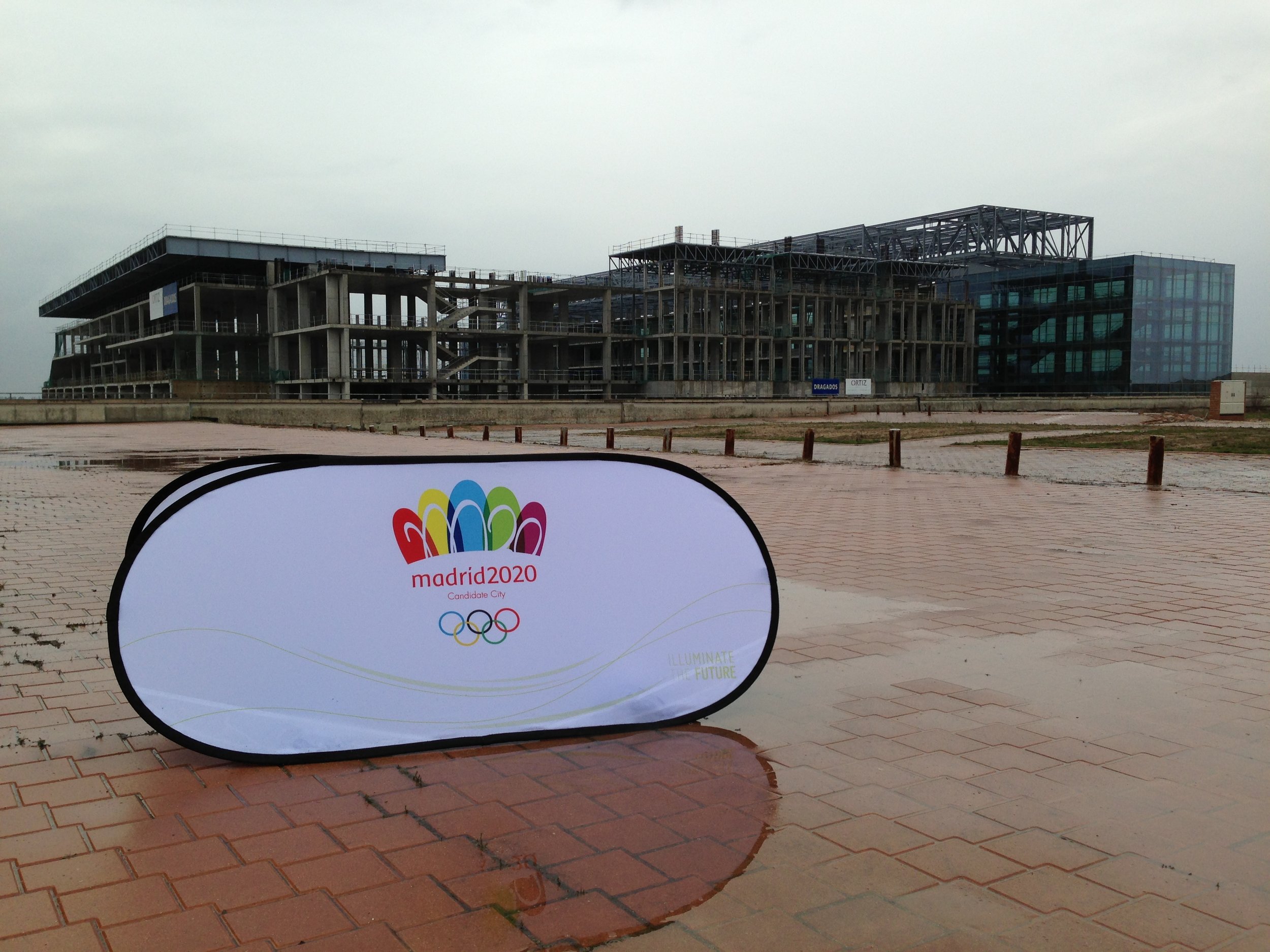
photo courtesy Madrid 2020

Meanwhile, as a steady rain lashed the city Tuesday, the evaluation commission toured what would be Olympic Stadium, the aquatics center and several other sports pavilions.

The mayor said later, with a smile, "It's good news that it's raining. The level of the dams has risen. Therefore the visit of the evaluation commission has brought us the rain which is always good for our city."

Blanco, also smiling, said, "We scheduled the rain as of 6:30," meaning p.m. "It started as of 1:30. We got it slightly wrong."

Madrid 0319-3

Here is the what the inside of the stadium -- built in 1994, site of a Bruce Springsteen show in May, 2003 - looks like now:

2013-03-19 15.44.48

The bill to re-do the stadium for Olympic purposes: $210 million.

And here is the aquatics center, just a few steps away:

2013-03-19 15.52.27

The aquatics center up-do would cost about $70 million.

"We have done [the] investment [and now] we need to see if we can put into value -- know, it's billions of dollars. Building an airport, extending the subway system, building the stadiums, building the Magic Box [stadium] for tennis, all that investment that has been done," Samaranch said.

"Many candidates, they think that if I get the Games I will do the improvement. Madrid did it the other way around -- continue to improve the city in order to get the Games."


Madrid's prudent, fiscally responsible 2020 play

0.390817747990699-10.jpg

MADRID -- The rules of these Olympic bid contests do not allow the rival cities to compare and contrast each other's campaigns. At least in public. But, you know, facts are facts. So as the International Olympic Committee's evaluation commission tour got underway here Monday in the second of its three stops, here's what they don't dare say but is nonetheless obvious:

There is more of the infrastructure for the Games already built and ready to go in Madrid, 80 percent, than there is popular support, 70 percent, for the Games in Tokyo.

If these IOC campaigns were only, solely about such so-called "technical" merit, Madrid would be your slam-dunk winner. As they know full well here, though, this being Madrid's third straight bid for the Games, there's way more to it. The sports venues, hotels, roads, all of that -- there has to be a story beyond bricks and mortar to win IOC votes.

And that is the part of the game where an entirely different set of numbers comes into play. Here the challenge is the economic crisis that has beset Spain. The unemployment rate hovers at 26 percent.

Fundamentally, Madrid's bid presents the IOC with a fascinating proposition: can a prudent, indeed fiscally responsible, bid that comes along at an important time in the Olympic movement's history make its case?

EVALUACION DEL COI A LA CANDIDATURA MADRID 2020

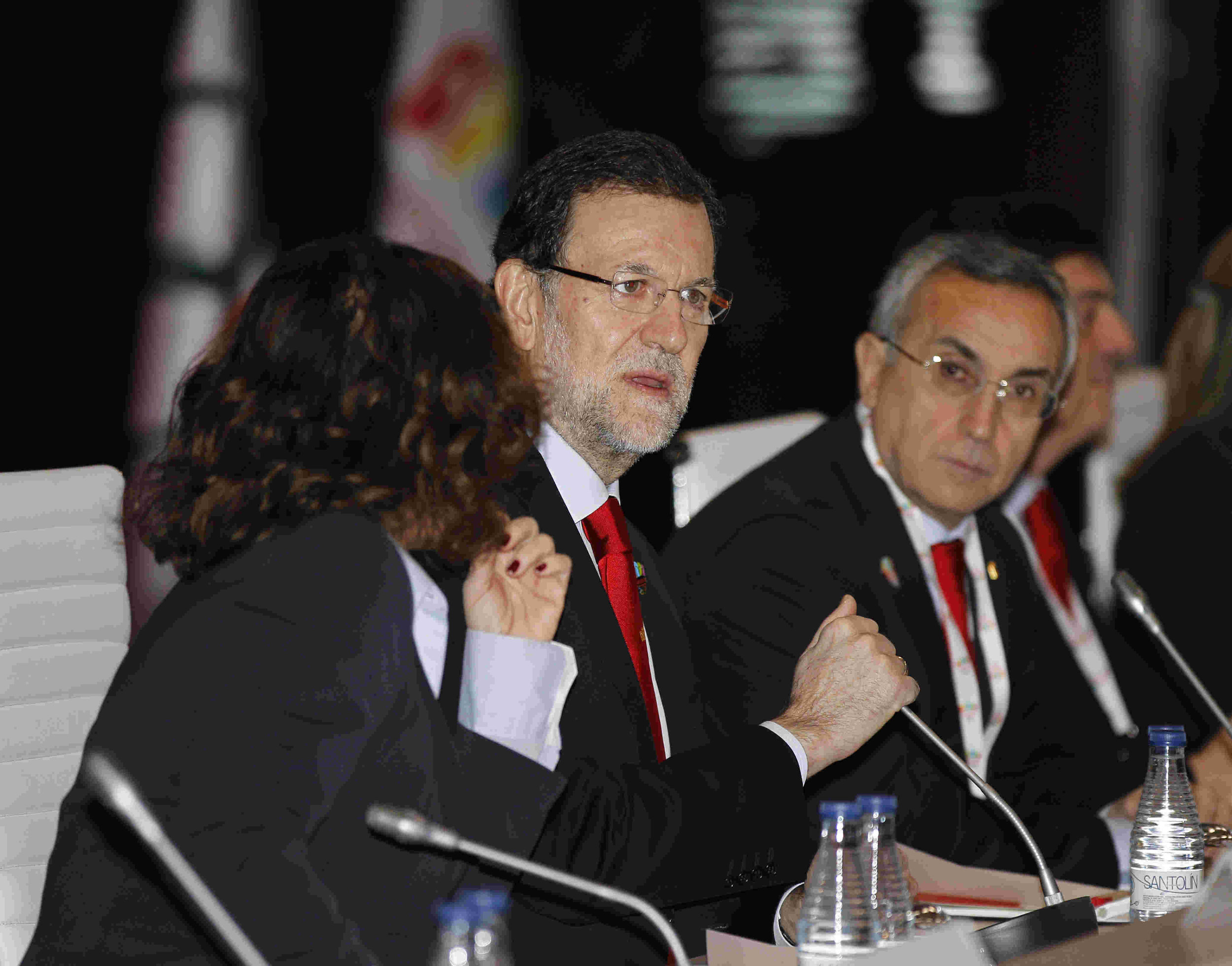
"Madrid has already attempted to win the bid on two previous occasions and was not successful then," the prime minister, Mariano Rajoy, said Monday. "But now we are convinced it can -- so we are going to battle hard to win now."

Madrid, Tokyo and Istanbul are the three candidates in this 2020 race. The IOC will pick the winner Sept. 7 at a vote in Buenos Aires.

The evaluation commission visit to Tokyo ended March 7. Its tour of Istanbul begins March 24.

As in the other two cities, its stop here will take up four days.

Back once more to some numbers. Because, as the saying goes, numbers don't lie.

Despite the recession, Spain's second in three years, public support for the Olympics has trended remarkably high. An IOC poll conducted last year in Madrid and the surrounding area showed 78 percent support for the Games. Talk to the locals, mayor Ana Botella said Sunday in welcoming reporters to town: "They are the best asset."

Of 35 proposed venues here, 28 are already built. The budget to get the rest done: $1.9 billion.

Botella, again, now at a Monday evening news conference: "The funding of the infrastructure is fully guaranteed."

Spain's sports minister, Miguel Cardenal, sitting next to her: "OK, it's a large figure but in proportional terms it's almost insignificant, and the economic benefits that are referred to in the comprehensive forecasts are reasonable and encouraging, too."

In Olympic terms, $1.9 billion for all-in infrastructure needs to be appropriately understood. For comparison: the cost to re-build the stadium alone in Tokyo is $1.9 billion. Their infrastructure estimate runs to about $4.9 billion -- the Japanese stressing they have the money sitting in the bank.

Madrid's $1.9 billion, meanwhile, is one-tenth the size of Istanbul's $19.2 billion capital cost budget.

One-tenth.

Madrid's venues are indisputably world-class. On Monday afternoon, commission members kicked around soccer balls at the Santiago Bernabeu stadium, where Real Madrid plays. A novel turn to the 2020 bid would see the Las Ventas bullfighting ring, where the 2011 Davis Cup final was played, covered with a retractable roof, and turned into a 20,000-seat men's and women's basketball venue.

The IOC likes to talk a good game about asking host cities and countries not to spend egregiously. But in recent years it has all the same opted for major construction projects. See Beijing 2008, London 2012, Sochi 2014 and Rio 2016.

If you factor in the predilection to try new destinations, you would also include Pyeonchang 2018.

All this will have some inevitably suggesting it's Istanbul's time.

But there is only one hard and fast rule about trying to predict the IOC: it is entirely unpredictable.

And perhaps there are broader currents at work that indicate the time has come for the IOC to finally and fully pay attention to the Pound Report, the 2003 study it adopted wholly, that says prudence and fiscal accountability are actually sensible notions.

Rome, for instance, backed out of this very 2020 derby last year, saying it was too expensive. On March 3, voters in Switzerland turned down funding for a campaign for the 2022 Winter Games in St. Moritz and Davos; at issue was a study that said public money should cover $1.06 billion of the projected shortfall from staging the Games. Last Tuesday, in Vienna, voters said no to a referendum to the city's plans to bid for the 2028 Summer Games.

Another fact: within the IOC there will remain some measure of implacable opposition to Madrid's plans, simply and bluntly because of the economic crisis. How, some members will rationalize, can you come here when the place seems to be under siege?

There didn't seem to be any evidence Monday of a siege mentality in Retiro Park in central Madrid, where they would play beach volleyball in 2020. The sun was out. So were bunches of young families with their strollers. And skateboarders, too.

As Rajoy reminded the commission, 58 million tourists come to Spain annually. It's the world's third-leading tourist destination.

There must be a reason.


Super high-vision: a green bottle with a long neck

When high-definition television came along, it revolutionized the game. Watching sports got way better all over the world for literally millions, if not billions, of viewers. For fans of American football: think, for instance, of Mario Manningham's clutch 38-yard catch that sparked the New York Giants' winning drive in Super Bowl XLVI, and the sideline tap-dance that was part of it. High-def made it all so real.

Now comes super high-vision technology.

Watching SHV is what is like when you made that jump a few years back from your standard TV set to high-def, only way better. After seeing SHV, even high-def feels like watching Super Bowl clips from the 1970s or '80s.

You can hardly believe the level of detail that all of a sudden snaps into crystal-clear focus. It's that good. That amazing.

In a word, SHV is a game-changer.

And it's one the Olympic world has already begun to embrace.

In London, the Olympic Broadcasting Services helped the Japanese broadcaster NHK -- and the BBC -- put together substantial coverage, including the opening ceremony and the men's 100-meter final.

This still shot  hardly begins to do justice to the SHV resolution. Even so, see Ashley Gill-Webb's blue shirt.

IMG_1342

IMG_1343

Developers at NHK recently showed off the technology to a small group of journalists. It was all part of the International Olympic Committee evaluation commission's assessment of Tokyo's 2020 Summer Games bid.

Of course the commission saw, too, what the technology could do. The members got to see some of the imagery -- "tape" seems such an outmoded word -- from the ceremony and Bolt's 9.63-second victory.

One of the highlights of the ceremony, of course, was when the five Olympic rings were moved into place atop Olympic Stadium. In SHV, the sparks from the molten medal appeared to literally leap off the screen. The sound from the 22.2-channel surround-sound speakers -- again, 22.2-channels -- provides a ridiculously immersive experience.

Bolt's victory was noteworthy not just because, as he proclaimed time and again, it set him toward becoming a "legend."  He would finish that off later in the Games by winning the 200 meters and then the Jamaican team would win the 4x100 relay in world-record time. Before the start of the 100, 34-year-old Ashley Gill-Webb, who somehow made his way into the stadium and into the seats near the start line without a ticket, threw a bottle at Bolt, hoping to disrupt him.

Gill-Webb, who suffered from bipolar disorder and was having a "manic episode," was found guilty in January in a British court of public disorder.

In SHV, you can see not only that Gill-Webb is wearing a blue-sleeved shirt in the middle of the crowd but that he is preparing to throw the bottle.

Too, that it's a green bottle and has a long neck.

That the bottle bounces in the middle of the track behind the runners.

That, as the field makes its way toward the finish line toward the cameras, American Ryan Bailey, in Lane 8, steps across Bolt's lane line, in Lane 7. There was no protest filed; indeed, there was no violation in this instance, as there would be in, say, a 200-meter race, because technically Bailey was running farther by stepping into Bolt's lane.

The level of granular detail makes it so evident, however, that Bailey steps across the line -- a fascinating aspect to add to the historic context of the race.

This kind of forensic clarity, moreover, would be invaluable in helping to analyze races such as the 110-meter hurdles final at the 2011 world championships in Daegu, South Korea, in which Cuba's Dayron Robles crossed the line first, only to be disqualified after tangling with China's Liu Xiang after the ninth hurdle between Lanes 5 and 6; Liu was declared the winner.

Another example: the now-infamous third-place tie at last summer's U.S. Trials between Allyson Felix and Jeneba Tarmoh in the women's 100-meter dash.

Would SHV have definitively resolved the tie? No one can say.

Would it provide more evidence? For sure.

Where 3D has tried -- and is still trying -- to make its way, SHV seems poised to be the next advance in broadcasting technology.

Even if it's maybe years away from being in your living room, maybe five or so if you live in Japan or South Korea, and though if you were an actor or actress of a certain age it might keep you awake at nights with the level of potentially frightening stuff it would enable audiences to see about you, it also just might mean -- eventually -- the end of bad refereeing.

It's that crystal clear.

At the Sochi 2014 Winter Games, OBS will again cover the opening ceremonies; this time the showcase sport will be figure skating.

NHK will be flying the recordings to Tokyo for later review. Yuna Kim dominated this week's world figure skating championships. In SHV, she figures to be, in a word, spectacular.


America's new teen sweetheart: Mikaela Shiffrin

Mikaela Shiffrin, who turned 18 this week, is going to be making the rounds this coming week in New York City. Tuesday night it's the David Letterman program. Wednesday morning it's the Today show. This is what happens when you have the sort of breakout season Shiffrin struck for herself on the alpine ski racing tour, the kind she cemented with a fantastic, come-from-behind victory Saturday to win the season-long slalom title at the World Cup finals in Lenzerheide, Switzerland.

Shiffrin was not only down by 1.17 seconds after the first run, which is a huge margin, she was behind Tina Maze of Slovenia, who has had the best season of any skier -- male or female -- in ski racing history.

Shiffrin then went out in her second run and simply scorched it in a 56.76-second run. No one was remotely close. Her winning time: 1:55.60.

Bernadette Schild of Austria took second, her first-ever World Cup podium finish, in 1:55.8; Maze dropped to third, in 1:55.95.

Her win came on the same day that Ted Ligety, also skiing in Lenzerheide, won his sixth giant slalom of the season. He and the legendary Ingemar Stenmark of Sweden are the only racers to have  won six or more World Cup giant slalom races in a single season.

Ligety locked down the season World Cup giant slalom title last weekend after winning in Kranjska Gora, Slovenia.

Ted Ligety and Mikaela Shiffrin with their crystal globes, his for giant slalom, hers for slalom // photo courtesy of Mitchell Gunn ESPA and U.S. Ski Team

Maze, meanwhile, started Saturday with a seven-point lead in the season slalom standings. With Saturday's 1-3 finish, Shiffrin ends the season with 688 slalom points, Maze 655.

For the season, Maze has 2,314 points. And counting. There's a giant slalom scheduled for Sunday.

This was Maze's 23rd top-three finish of the year.

She said, in remarks published on the FIS website, "23 podiums in a season [is] of course positive. It has been an amazing season and it is not easy to keep up the pace that I had, standing on the podium week after week.

"As far as the season goes, I am really proud but of course on days like today, especially right after the race the disappointment is high. The sadness will go away but it's normal to feel disappointed when you have an opportunity like the one I had today. You have to learn from your mistakes. Mikaela has been dominating slalom the whole season and I don't think I lost the globe here today but somewhere else."

Shiffrin becomes the first U.S. slalom champ since Tamara McKinney in the 1984 season.

Shiffirin is the first non-European to win four World Cup slalom races in a season.

She also stands as the third non-European to win the slalom title. The others: McKinney, and Betsy Clifford in the 1971 season.

For emphasis, once more -- Mikaela Shiffrin is only 18.

After the race, she made three comments that speak to what a special talent she is.

Here is the first. It underscores characteristics alpine racers have to have: confidence, indeed fearlessness:

"After the first run, I went directly to our athlete tent and just tried to sit quietly and figure out what I needed to do to make it better. That's something that I've always done, is just analyze what I could do better and make it better. It's hard to do that between runs in a race But my mom helped. My coaches helped. My dad helped. Everybody.

"They all said the same thing: 'You have to let it go. You can not hold back. There is nothing to lose.' So I tried to do that."

The second shows off what a class act she is.

"I think half of this globe belongs to someone else. I want to thank Tina Maze. She has really helped inspire me. It felt good that second run but I was freaking out.

"She's my greatest idol this season and I respect her so much. Some part of me wanted her to win just to prove once again that she's the greatest skier in the world this season. But I wanted to win because it was my goal and I don't want to give up my goal. It happened that I won today and I'm really grateful for that."

The third is maybe the best. Mikaela Shiffrin, again, is just 18. The Sochi Olympics are coming straight up. Wait until she shows up on Letterman and the Today show and they see what she is about. Because she is -- genuine.

"Yeah, Letterman! I'm so excited about that. It's going to be really cool. Hopefully I don't trip when I'm gong on stage. If you knew me for longer than a day you would know that I spill things and I break things and I trip a lot. You would not think I'd be good at slalom. So we'll see how that goes."


Randall takes second straight sprint title

Twelve years ago, in Soldier Hollow, Utah, Kikkan Randall made her first World Cup cross-country skiing start. She finished 24th and, at the time, as she recalled Saturday, "That was so exciting." Times certainly have changed.

On Saturday, after qualifying 11th and powering through the heats, Randall skied past world champion Marit Bjoergen by a boot length to win a freestyle sprint in Lahti, Finland.

"My skis were awesome today and it's really cool to see what a well-oiled machine we have become," Randall said afterward, underscoring the emphatic reality: in the sprints, the U.S. cross-country program has emerged as a genuine threat to win.

The victory Saturday clinched Randall's second straight World Cup sprint championship.

Barring injury, Randall will start next season as one of the favorites for an Olympic medal next February in Sochi.

Maybe more than one.

A few weeks ago, Randall and Jessie Diggins won the team sprint title at the world championships.

An American has not won an Olympic medal in cross-country skiing since Bill Koch in 1976.

No American woman has ever won an Olympic medal in the sport.

The race Saturday marked Randall's 100th career World cup start. As she said, she was "really hoping to make it a special one."

It turned out to be her 11th career World Cup or World Cup Stage victory. For the season: her sixth World Cup or World Cup Stage win.

The win gives Randall 488 World Cup sprint points; Justyna Kowalcyzk of Poland has 280. That's a 208-point lead; there are two sprint races remaining, meaning the most anyone could make up is 150 points.

On the men's tour, Sweden's Emil Joensson wrapped up the men's sprint title by defeating Ola Vigen Hattestad of Norway; Joensson now has 466 points. Andy Newell of the United States is second, with 236.

Bjoergen was the only woman Randall had yet to face in a skate sprint all year; the Norwegian skier, long viewed by many as the best in the world, had missed every skate sprint before Lahti because of heart trouble in December.

The race Saturday -- on a short, twisty course -- came down to a photo finish.

Bjoergen didn't quite have the lunge, Randall did, Randall winning by seven-hundredths of a second.

After the finish, the two racers shared a hug.

Bjoergen understandably said later, "I have not raced that much so I feel like the World Cup season has just started for me."

As Randall told the website fasterskier.com, "We're good friends and we got to laugh about it. I asked her what World Cup start this was for her. I said, 'You're probably over 200 by now.' And she said, 'Yeah, probably.' "

Randall also said, thinking back to her first start 12 years ago: " … It's pretty funny that, 100 starts later, we're in the hunt for the win every time in the skate sprint now. I got to go up against one of the world's greatest athletes today and it was definitely close there at the end.

"She was coming on strong but it's just nice to know that … it's taken me a lot of races and a lot of time to get to this point but if you put in the work and stay dedicated then you can be the best in the world.

"And it's pretty fun."


Ligety reigns over giant slalom

It rained Saturday in Kranjska Gora, Slovenia. That's a crummy way to race a ski race like a World Cup giant slalom. To see out your goggles is kinda-sorta like seeing through the windshield of your car, and in the second of the two runs several racers had to made like windshield wipers, reaching up to wipe off their goggles. Aksel Lund Svindal of Norway wiped off his goggles. At least he finished, a more-than-respectable sixth. Fritz Dopfer of Germany wasn't so lucky. He hit a gate with his head; that knocked his goggles off; reaching for them, he appeared to get stuck in slushy snow and went flying off into the protective fencing.

These were the conditions Ted Ligety had to navigate to lock down his fifth giant slalom victory of the season and, in the process, his fourth World Cup giant slalom title.

Ligety led Austria's Marcel Hirscher by six-tenths of a second after the first run. In the second run's rain, Hirscher ended up finishing 45-hundredths back.

France's Alexis Pinturault took third, 77-hundredths behind.

Ligety's winning overall time: 2:35.43.

Ligety's lead in the giant slalom standings: an insurmountable 620-495.

In the World Cup overall standings, Hirscher leads Svindal by 69 points. Ligety stands (a distant) third.

Ligety's three prior giant slalom titles: 2008, 2010, 2011.

"It's a big weight off my back," Ligety said. "I had an awesome season in giant slalom but Hirscher was with me the whole season. It makes it tough going for the title. It was a head game when he was so close all along."

"For me this is a very successful day," Hirscher said. "In the second run I was faster than Ted Ligety and that makes for a fantastic day. Conditions were tough. It was raining pretty strong and it wasn't an easy run on the soft snow."

This was Ligety's 16th career victory, all in giant slalom, and his fifth win at Kranjska Gora (2008, 2009, 2010, 2012). As he said, "This hill is awesome. It has everything. I'm super-proud to win here again."

More history books: Ligety is now third all-time, behind Ingemar Stenmark (46) and Michael von Gruenigen (23) for World Cup giant slalom wins. He had been tied with Alberto Tomba.

For the season: this was Ligety's eighth win. He took three gold medals at the world championships.

As a measure of his consistency: Ligety recorded top-three finishes in all seven of the season's giant slalom races; there's one left to go. He is the first racer to do so since von Gruenigen, in 1996.

"Racing in the rain isn't my favorite thing," he said, but you do what you have to do. "I grew up in Park City, Utah, and only skied in 25 degrees and sunny."

Tokyo 2020: "Hugely impressed" or lost in translation?

000000260.jpg

TOKYO -- There is no question, absolutely none, that Tokyo could put on the Summer Games in 2020. They have the technical know-how. They proved that here, again, this week. They're certain to get a good write-up when the International Olympic Committee's Evaluation Commission releases its formal report, in July.

"We have been hugely impressed by the quality of the bid preparations," the head of the commission, Britain's Sir Craig Reedie, told a jam-packed news conference Thursday, adding a moment later, "Across the board, it has been excellent in every way."

As always in Olympic bidding, for all the complexities, there are -- to paraphrase Sebastian Coe, who championed London's 2005 winning campaign and then served as London 2012 chairman -- only two questions, how and why.

Having manifestly established the how, the challenge now facing Tokyo before the IOC vote Sept. 7 -- Madrid and Istanbul are also in the 2020 race -- is the why.

Can Tokyo craft a compelling story?

000000260

History shows they know what to do when they get big events in Japan.

The 1998 Nagano Winter Games? The 2002 soccer World Cup, shared with Korea? The 2007 Osaka track and field world championships?

All successes.

And yet recent years have also seen a profound disconnect in Japanese bids for the Olympics.

In 2001, Osaka's bid for the 2008 Summer Games got six votes out of 112, out in the first round.

In 2009, Tokyo's bid for 2016 -- which scored high in the evaluation report -- had to scrimp for votes  to get out of the first round, just to save face. That helped knock Chicago, which got a mere 18 votes in Round One, out. Tokyo then promptly went out in Round Two, with just 20.

They decided after the 2011 earthquake and tsunami that ravaged northeastern Japan to bid for 2020.

Next week will mark the two-year anniversary of the disaster.

"Tokyo does not face a big issue of radiation -- that was explained," Tsunekazu Takeda, president of Tokyo 2020 and the Japanese Olympic Committee as well as the lone IOC member in Japan, said.

And saying that the water in Tokyo is clean enough to drink from the tap, which they made a point of doing to the evaluation commission -- that's not a story. That's just normal.

So what is the story?

At a gala dinner Wednesday evening, Prime Minister Shinzo Abe started his remarks to the commission by saying, "Japan is an aging society; that's why we hope Tokyo will be chosen." With all due respect to the prime minister, the IOC is relentlessly seeking to appeal to a younger demographic. How does his observation help?

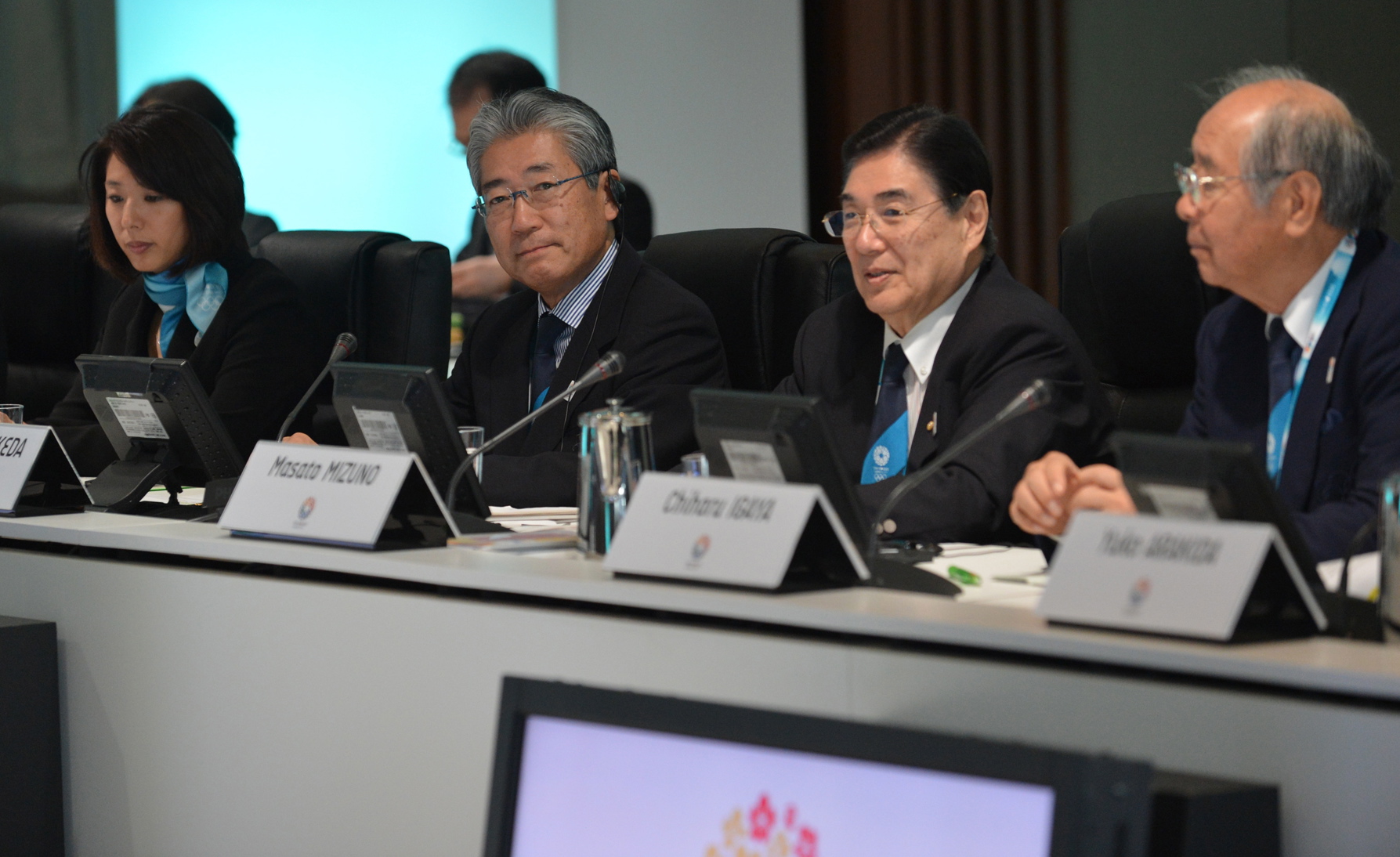
Thursday's wrap-up Tokyo 2020 news conference showcased bid officials and athletes, eight personalities in all. On stage, among others: Takeda; Masato Mizuno, the Tokyo 2020 chief executive and a JOC vice president; and Tokyo Gov. Naoki Inose.

There is a tendency here for sartorial conformity, the bid uniform a blue suit and white shirt. That monochromatic vision calls to mind the image the Pyeongchang bid team put forward in 2007 for 2014. Note: that bid did not win.

It was only when Pyeongchang injected more verve and dash in its clothes and its presentations -- and, not incidentally, switched almost entirely to speaking English, which the IOC moves mostly in now -- that it rolled to a landslide victory in 2011 for 2018.

Already some of the more sophisticated souls working on the Tokyo team have recognized the danger in the parallels to Pyeongchang's unsuccessful efforts -- because, too, the IOC would have to be convinced to come back to Asia in the summer of 2020 after being in Korea in the winter of 2018.

There were blue shirts on stage Thursday, not just white. And grey suits, not just blue. And Gov. Inose started the conference by saying, "I have really enjoyed this week," and he spoke in English.

To be plain, 2020 offers Tokyo a far better chance for victory than 2016.

There are only three cities in this 2020 race, not four as in 2016. And there's only one -- Istanbul -- that, like Rio, offers the IOC the expansionist strategy that has dominated recent bid contests.

Meanwhile, it's plain the issues around which the 2020 race will turn are, first, whether the IOC wants to keep heading toward new shores and, second, whether it wants another huge urban makeover construction project.

The strategy here -- and, in measure, in Madrid, too -- has to go like this:

Sochi, the 2014 Winter Games host, is already is known to cost more than $50 billion. Work is still not done.

Rio de Janeiro, the 2016 Summer Games site, is so bedeviled by delays that the IOC has been saying, albeit in IOC code, to hurry up with a multiplicity of projects. Time "is of the essence," the Brazilians were told when an IOC team was there just last month.

Istanbul's construction budget weighs in at $19.2 billion, and history has shown that figures provided in bid books tend to be understatements.

Madrid has yet to make its case to the evaluation commission; that four-day visit begins March 18.

Here, the venue plan calls for 28 of the 33 competition venues to be within five miles of the Olympic Village; the village would be built on reclaimed land in Tokyo Bay.

Though they have a $4.9 billion infrastructure budget, 40 percent of which will be directed for a make-over of the national stadium, they also have plenty in the bank, the money just sitting there, the commission heard.

Japan has a $5.9 trillion economy, the world's third-largest. Abe, moreover, has shown signs that he is willing to make market-opening changes that Japan has resisted for nearly 20 years.

If Tokyo were itself a country, the commission was told, its economy alone would almost make the top 10 in the world.

Even the Tokyo polling numbers are up: 70 percent of locals want the Games, an IOC survey disclosed. That's up from 47 percent last year.

Reflecting on the four days with the evaluation commission, the governor, still speaking in English, said, "I believe we have shown the best of Tokyo. All those assets that will underpin the smooth delivery of Tokyo 2020 -- for example, our exceptional transport infrastructure, our cutting-edge technology and the very high levels of safety and security in Tokyo."

That has the makings of a story: Tokyo as reliable, fun and interesting choice. Bring on the sushi. It just needs to be told, and votes asked for.

Unclear -- given history, personality and temperament -- is whether it can be done.

The governor, as he was wrapping up the news conference, suddenly found himself telling roughly 1,000 journalists about the work of the former Harvard professor and political scientist Samuel Huntington, who died in 2008, and Huntington's focus on the competing cultural identities in the world of perhaps seven or eight "civilizations." Japan, as the governor noted, is one.

"Because of the maturity of this civilization, we will have a situation where we can 'discover tomorrow,' " Inose said, now in Japanese, slipping in the bid's catchphrase.

"By 2020, we can show that to the world by hosting the Games."

In Tokyo, the risk is that the story -- the why -- keeps getting lost in translation. They have six months to try to figure it out.